Effects of Substrate Composition on Kombucha Quality: A Study of Liang Tea and Siam Orange (Citrus nobilis var. microcarpa) Blends
Applied Food Biotechnology,
Vol. 13 No 1 (2026),
7 décembre 2025
,
Page 1-24 (e29)
https://doi.org/10.22037/afb.v13i1.53105
Résumé
Background and Aim: The development of functional kombucha beverages from herbal and fruit substrates needs optimization of formulation to achieve a favorable balance between physicochemical and microbiological characteristics. This study aimed to assess the effects of different Liang tea-Siam orange (Citrus nobilis var. microcarpa) ratios on the physicochemical and microbiological characteristics of kombucha.
Material and Methods: Randomized block design was used with six Liang tea-Siam orange juice ratios of 100:0, 90:10, 80:20, 70:30, 60:40 and 50:50 (v/v). Kombucha was fermented for 7 d and then pH, total dissolved solids, total titratable acidity, total phenolic content, antioxidant activity, vitamin C, color characteristics (L*, a* and b*), symbiotic culture of bacteria and yeast pellicle thickness and lactic acid bacteria population were assessed. Data were analyzed using analysis of variance followed by Tukey’s honestly significant difference test at a 5% significance level.
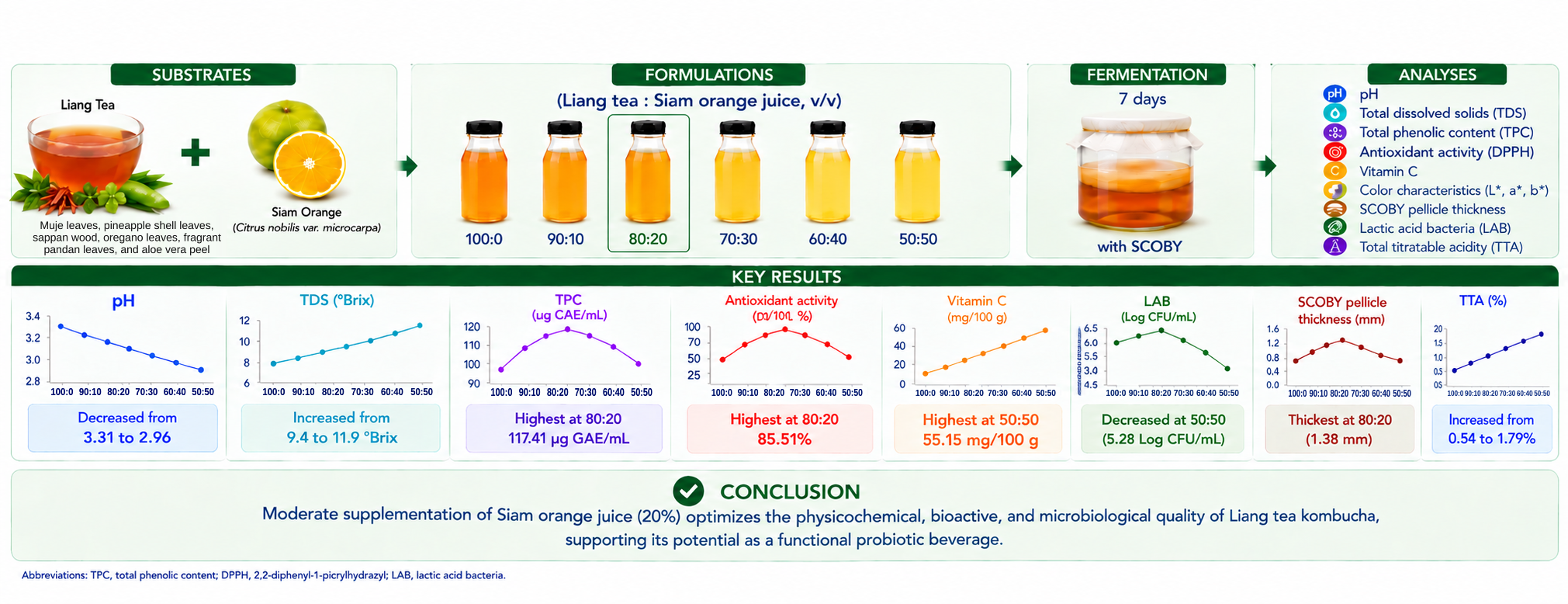
Results and Conclusion: As the Liang tea-Siam orange ratio shifted toward higher citrus proportions (e.g., decreasing Liang tea content), pH progressively decreased from 3.31 to 2.96, total titratable acidity increased from 0.54 to 1.79% and total dissolved solids increased from 9.4 to 11.9 °Brix, reflecting the combined effect of decreased Liang tea and increased citrus content on the fermentation substrate. Total phenolic content showed a non-linear response, increasing from 108.57 µg GAE/ml in the 100:0 formulation to a maximum of 117.41 µg GAE/ml at 80:20 before decreasing to 104.18 µg GAE/ml at 50:50. Antioxidant activity reached its highest value at 80:20 (85.51%), while vitamin C increased to the highest level at 50:50 (55.15 mg/100 g). The 80:20 formulation produced the thickest symbiotic culture of bacteria and yeast pellicle (1.38 mm) and preserved a relatively high lactic acid bacteria population (6.10 Log CFU/ml). In contrast, the 50:50 formulation demonstrated the lowest lactic acid bacteria population (5.28 Log CFU/ml) and lesser total phenolic content and antioxidant activity despite its highest vitamin C content. Although this did not produce the highest value for every parameter, the 80:20 Liang tea-Siam orange ratio showed a favorable overall profile among the treatments, combining favorable phenolic content, antioxidant activity, microbial viability and symbiotic culture of bacteria and yeast development.
- INTRODUCTION
Kombucha has emerged as a prominent functional beverage due to its rich composition of viable lactic acid bacteria (LAB) [1], organic acids and bioactive compounds that contribute to various health-promoting effects, including antioxidant, antimicrobial and gut-modulating activities [2]. Kombucha is a fermented beverage produced through a significant food biotechnology process that enhances food preservation, nutritional quality and sensory characteristics [3]. The beverage is produced by fermenting sweetened tea with a symbiotic culture of bacteria and yeast (SCOBY), resulting in a complex matrix of metabolites derived from the substrate and microbial metabolism [4]. In recent years, the global interest in natural and functional beverages has accelerated the diversification of kombucha substrates, particularly by incorporating herbal and fruit-based ingredients to enhance their nutritional and sensory qualities [1,5]. This creates novel opportunities to investigate traditional herbal formulations such as Liang tea in combination with Siam orange fruits to develop innovative functional drinks.
Kombucha fermentation using ingredients other than tea has widely been reported, including use of leaves rich in phenols such as noni fruit, Indian gooseberry, dried pineapple peels and cores [6–8]. Liang tea, a type of local Indonesian tea, is receiving attention as an alternative raw material for kombucha production. Liang tea is made from a mixture of sappan bark (Caesalpinia sappan L.), muje leaves (Dicliptera chinensis), oregano leaves (Origanum vulgare), pineapple leaves (Tradescantia spathacea), pandan leaves (Pandanus amaryllifolius) and aloe vera (Aloe vera chinensis) [9]. Liang tea has a distinctive flavor and high antioxidant content; thus, potentially producing kombucha with unique taste and health benefits.
Despite this increasing interest, empirical studies on kombucha formulated with complex herbal matrices such as Liang tea combined with Siam orange juices are still limited. Siam orange (Citrus nobilis var. microcarpa) juice is a recognized source of bioactive compounds, including ascorbic acid (vitamin C), citric acid, flavonoids (e.g., hesperidin and naringin) and carotenoids, which contribute to its antioxidant capacity [27,39,40]. However, effects of incorporating these citrus-derived bioactive compounds, particularly from Siam orange, on key quality parameters such as physicochemical characteristics and LAB numbers in kombucha fermentation are not comprehensively documented. This research builds on a previous study on the sensory and morphological characterization of LAB in kombucha made from a combination of Liang tea and Siam orange juice [10,11]. Building on a previous study, this research simultaneously assessed physicochemical responses, antioxidant activity, color, pellicle formation and LAB counts within a formulation gradient (six variations of the Liang tea and Siam orange juice ratio), rather than focusing on LAB morphological characteristics alone. This integrated approach, involving multiple parameters and substrates, represented the novelty of this research, compared to a previous study by the present authors.
From a theoretical perspective, the interaction mechanisms between herbal bioactive compounds in Liang tea (e.g., phenolics, flavonoids and tannins) and citrus-derived organic acids during kombucha fermentation are not fully understood. The substrate composition plays a critical role in investigating microbial metabolism and synthesis of secondary metabolites, including antioxidants and organic acids [12,13]. However, the synergistic or antagonistic interactions between plant-derived phytochemicals and acidic fruit matrices in shaping fermentation kinetics, SCOBY growth and metabolite transformation are still under investigation. This theoretical gap highlights the need of a mechanistic understanding of multi-substrate fermentation systems in kombucha production.
Although previous studies have demonstrated that fruit addition can modify the physicochemical, antioxidant and microbial characteristics of kombucha, most studies have assessed conventional tea or individual fruit-based substrates. For example, [14] reported that increasing the proportion of yuzu juice in green tea kombucha changed pH, LAB, polyphenols and sensory characteristics, with the 70:30 green tea-yuzu formulation showing favorable overall characteristics. [15] investigated the effects of multiple fermentation variables on antioxidant and invertase activities in kombucha and demonstrated that fermentation conditions and substrate-linked factors can substantially affect the functional characteristics of the beverage. However, their study focused on optimization of fermentation variables in conventional kombucha rather than interactions between a complex herbal substrate and citrus juice. In the present study, the emphasis was on substrate formulation, particularly the ratio between Liang tea and Siam orange juice and its simultaneous effects on physicochemical, antioxidant, color, pellicle and LAB characteristics.
However, the effects of combining Liang tea, a multi-herbal Indonesian beverage containing several botanicals, with Siam orange juice during kombucha fermentation have not systematically been assessed. In particular, there is limited empirical information on how the proportion of Siam orange juice simultaneously affects acidification, soluble solids, total phenolic content (TPC), antioxidant activity, vitamin C, beverage color, SCOBY pellicle development and LAB viability within single fermentation system. This represents an important research gap because the addition of citrus juice does not necessarily produce a linear improvement in all quality attributes; increasing fruit concentration may simultaneously increase bioactive compounds and acidity while imposing additional stress on the fermentation microbiota. Therefore, an integrated assessment is needed to identify a formulation that provides a favorable balance among physicochemical, functional and microbiological characteristics.
Compared with previous studies that focused on the sensory and morphological characteristics of LAB alone, the novelty of this study was in the systematic assessment of Liang tea and Siam orange juice ratios as a multi-substrate kombucha fermentation system and integration of parameters including pH, total soluble solids, total titratable acidity (TTA), TPC, antioxidant activity, color, SCOBY pellicle characteristics and LAB counts as formulation criteria. Rather than assessing citrus enrichment solely as a source of vitamin C or flavor, this study demonstrated that the proportion of Siam orange juice produced distinct and sometimes non-linear responses among quality attributes. The identification of the 80:20 Liang tea-Siam orange formulation as the condition providing the highest antioxidant activity and SCOBY thickness, while preserving a viable LAB population and acceptable acidity, provides a formulation-specific basis for further development of kombucha from indigenous Indonesian herbal and fruit resources.
Therefore, the specific objective of this study was to systematically assess the effects of the Liang tea and Siam orange juice ratio on the physicochemical (pH, total dissolved solids (TDS), TTA, TPC, antioxidant activity, vitamin C, color, SCOBY pellicle) and LAB characteristics of kombucha within an integrated experimental system and to identify a formulation that provides a favorable balance among these multiple quality attributes. This integrative, multi-response approach assessing several physicochemical and microbiological attributes simultaneously within one formulation gradient distinguishes this study from previous study that has typically assessed single substrates or isolated quality parameters in kombucha fermentation.
- MATERIALS AND METHODS
The experiment was carried out using randomized block design (RBD) with one treatment factor or the ratio of Liang tea infusion to Siam orange juice. Six formulation levels were assessed, including 100:0, 90:10, 80:20, 70:30, 60:40 and 50:50 (% v/v). The formulation of the Liang tea solution and Siam orange juice kombucha solution was present in Table 1. Four blocks were used, with each block representing one independently prepared batch of Liang tea stock solution and Siam orange juice stock prepared for that replication. Within each block, all six formulations were prepared from the corresponding independently prepared stocks. The six formulations were randomly assigned to the experimental units within each block. Thus, each block contained all six treatments, resulting in six treatments × four blocks = 24 independent experimental units. Each experimental unit consisted of a separate fermentation vessel containing the assigned formulation and was fermented independently for 7 d. The four blocks therefore represented independent preparation batches, while the six formulation ratios represented the treatment factor. The design was used to account for potential variation within independently prepared batches while allowing the effects of formulation to be assessed within all blocks.
2.2. Kombucha Starter Culture Rejuvenation
The kombucha starter culture was rejuvenated following the procedure described by [16] . The starter was purchased from e-commerce platforms in the form of a liquid derived from previously fermented black tea kombucha, with a SCOBY. A total of 2000 ml of water were brought to a boil and then black tea with 0.5 and 10% (w/v) sugar was added. The tea infusion was filtered and poured into a sterile glass container. Once the tea reached room temperature (RT), 10% (v/v) kombucha starter was added to the infusion. The container was covered with a clean cloth and secured with a rubber band and then fermented for 14 d. After the fermentation, the culture was harvested. Culture rejuvenation was carried out periodically.
- Siam Orange Juice Production
Siam orange (C. nobilis var. microcarpa), commercially known as "Jeruk Siam Pontianak," was purchased from local growers in Kecamatan Tebas, Kabupaten Sambas, West Kalimantan, Indonesia [17]. The production of Siam orange juice followed a modified procedure described by [18–20], with selection criteria, including soft texture, shiny peel and a color ratio of 70% green to 30% yellow. The Siam orange were washed under running water, cut in half and squeezed using citrus juicer. The extracted juice was filtered, pasteurized at 80 °C for approximately 10 min and then cooled to RT.
2.4. Liang Tea Brewing Preparation
The production of Liang tea kombucha with Siam orange juice began with the preparation of the Liang tea infusion based on the procedure described by [9]. A total of 500 ml of water were poured into a beaker and heated using hotplate until the temperature reached 100 °C. Liang tea powder, consisting of 1 g of muje leaves, 0.75 g of pineapple shell leaves, 0.2 g of sappanwood, 0.2 g of oregano leaves, 0.2 g of fragrant pandan leaves and 0.2 g of aloe vera peel, was transferred into a tea bag with a total weight of 2.55 g. The tea bag was then steeped in the hot water while preserving the temperature for 20 min. The resulting Liang tea infusion was filtered and poured into sterile glass bottles.
- Preparation of Liang Tea Kombucha with Siam Orange Juice
The preparation of Liang tea kombucha with Siam orange juice was based on a modified procedure described by [10,21,22]. The Liang tea infusion was supplemented with 16 g of granulated sugar in each glass bottle and stirred until completely dissolved. The solution was then cooled to approximately 30 °C; then, Siam orange juice was added to the solution based on the kombucha formulation in Table 1, with 16 g of kombucha starter culture. The fermentation vessels were covered with a clean cloth and secured with a rubber band. Fermentation was carried out at RT in absence of direct sunlight for 7 d. The resulting kombucha was then analyzed based on the research parameters. All analyses (pH, TDS, TTA, TPC, antioxidant activity, vitamin C, color, pellicle thickness and LAB enumeration) were carried out immediately after the 7-day fermentation and separation of the pellicle from the kombucha without intermediate storage to minimize compositional and microbial changes prior to assessment.
- Assessment of pH and Total Dissolved Solids of Kombucha
The analyses of pH and TDS were based on [23]. A total of 100 ml of kombucha were collected from each treatment and acidity of the tested samples was assessed using calibrated pH meter (AS218 Smart Sensor, Tiongkok, China; resolution ±0.01 pH U). The TDS of the samples were assessed using hand-held refractometer (Atago N-1E, Tokyo, Japan; resolution ±0.1 °Brix).
- Assessment of Total Titratable Acidity
The TTA was assessed using acid-base titration and NaOH as the titrant and phenolphthalein (PP) as the indicator, based on a method reported by [16]. Briefly, 10 ml of the sample were transferred into a 100-ml volumetric flask and diluted to the mark with distilled water (DW). The diluted sample was then filtered and a 10-ml aliquot of the filtrate was transferred into an Erlenmeyer flask. Then, 2–3 drops of 1% phenolphthalein indicator were added, followed by titration with 0.1 N NaOH until a persistent pink endpoint was achieved for approximately 30 s. The TTA was calculated using Eq. 1:
Eq. 1
where, VNaOH was the volume of NaOH solution, NNaOH was standardized concentration of the NaOH solution, Vsample was volume of the sample and MW was the molecular weight of acetic acid (60.05 g/mol).
- Assessment of Total Phenolic Content
The TPC was assessed using Folin-Ciocalteu colorimetric method according to [16], with modifications. Gallic acid was used as the calibration standard at concentrations of 50, 100, 150, 200 and 250 ppm. For each standard concentration, 1 ml of solution was mixed with 0.5 ml of Folin-Ciocalteu reagent and 4 ml of 7% (w/v) Na₂CO₃. The mixture was homogenized using vortex and set to stand for 8 min at RT. Absorbance was assessed at 760 nm using UV-vis spectrophotometer. For the kombucha samples, 1 ml of sample was treated using the same procedure. The TPC was calculated from the Gallic acid calibration curve and expressed as µg Gallic acid equivalents (GAE) per ml of sample.
- Antioxidant Activity Analysis
Antioxidant activity was assessed using DPPH (2,2-diphenyl-1-picrylhydrazyl) radical scavenging method, according to [8]with four independent biological replicates per treatment (n = 4). Briefly, 0.2 mg of DPPH was dissolved in 9.8 ml of ethanol p.a. to achieve a 0.052 mM DPPH working solution. One milliliter of kombucha sample was mixed with 3 ml of ethanol p.a. and 1 ml of 0.052 mM DPPH solution, vortexed and incubated at RT (28–30 °C) for 30 min in dark. A negative control, consisting of DPPH solution and ethanol without sample, was included to represent 100% radical activity. Absorbance was assessed at 517 nm using UV-vis spectrophotometer. Antioxidant activity was calculated using Eq. 2:
Eq. 2
A sample matrix blank was not included in this assay; this is acknowledged as a limitation, given the potential for background absorbance from the naturally colored kombucha samples. Antioxidant activity was expressed as percent DPPH inhibition rather than Trolox-equivalent units, as a Trolox standard curve was not generated in this study.
Vitamin C analysis was carried out using titration method according to [24,25]. A 5–10 g sample of kombucha was weighed and transferred into a 100-ml volumetric flask and then DW was added to the mark. The solution was filtered using filter paper or centrifugation to achieve a clear filtrate. Then, 5–25 ml of the filtrate were pipetted into a 100-ml Erlenmeyer flask. For dark-colored samples, DW was added to decrease color intensity. Then, 2 ml of 1% (w/v) starch solution were added to the solution as indicator. The sample was titrated with 0.01 N standard iodine solution until a light blue color appeared, indicating the endpoint. The vitamin C content was calculated based on the equivalence that 1 ml of 0.01 N iodine was equivalent to 0.88 mg of ascorbic acid. As this iodometric method is not fully specific to ascorbic acid and may be affected by other reducing compounds present in kombucha (e.g., polyphenols and reducing sugars), the resulting values should be interpreted as an estimate of titratable vitamin C-equivalent content rather than a fully specific quantification of ascorbic acid (Eq. 3).
Eq. 3
- Color Assessments
Color assessments (L*, a*, b*) were carried out using chromameter method based on a procedure by [26]. The sample was transferred into a Petri dish, then, a container containing the sample was transferred onto the chromameter sensor. The button on the device was pressed to carry out the assessment and the L*, a*, b* value data appeared on the screen. Briefly, values included L (lightness), a* (red), and b* (yellow). The L* represented the brightness level with a value of 0–100 (black and white). A* represented the type of color with a negative value for green (0–80) and a positive value for red (0–80). B* represents the type of color with a negative value for blue (0–70) and a positive value for yellow (0–70).
2.12. Pellicle Thickness Assessment
Pellicle thickness was assessed using digital Vernier caliper (±0.01 mm accuracy) based on the [27] procedure. The pellicle was carefully removed from the fermentation media and gently blotted with filter paper to eliminate excess liquid. The sample was then transferred onto a flat surface and thickness was assessed by positioning it between the caliper jaws without using excessive pressure. Assessments were carried out at three to five different (center and edges) to account for structural heterogeneity. The average value was calculated and expressed as mean ±SD (standard deviation). All assessments were carried out immediately after harvesting to avoid structural changes due to dehydration.
- Lactic Acid Bacteria Enumeration
The LAB were enumerated using the pour plate (deep inoculation) method on de Man, Rogosa and Sharpe (MRS) agar (Himedia, India), as described by [23]. Serial dilutions of each kombucha sample were prepared using sterile 0.85% (w/v) NaCl solution as diluent. An aliquot of 1 ml from an appropriate dilution was pipetted into a sterile Petri dish and approximately 15–20 ml of molten MRS agar (cooled to ~45 °C) were poured into the dishes and mixed thoroughly. The plates were incubated anaerobically at 35 °C for 48 h. Colonies were counted on plates containing an appropriate number of colonies (25–250 CFU) and results were expressed as log CFU/ml.
- Data Analysis
Data for each parameter were analyzed using analysis of variance (ANOVA) based on a randomized block design (RBD) (six treatments × four replications; treatment df = 5, block df = 3, error df = 15), at 5% significance levels (α = 0.05). Standard deviations reported in all tables were calculated from four independent biological replicates (separate fermentation batches) rather than repeated technical assessments of a single batch. When the ANOVA indicated a significant treatment effect, Tukey's honestly significant difference (HSD) test was carried out at the same significance level to compare treatment means. All calculations were carried out using Excel (Microsoft, USA).
- RESULTS AND DISCUSSION
- pH
The RBD ANOVA showed that the formulation of Liang tea kombucha with various ratios of Siam orange juice had a significant effect on the pH of kombucha [F(5,15) = 237.04, P < 0.0001], exceeding the critical value [F0.05(5,15) = 2.90]. Therefore, Tukey's HSD test was carried out at the 5% significance level. The pH results for each treatment and the HSD test can be seen in Table 2.
Table 2 demonstrated a clear decreasing in pH as the proportion of Siam orange juice increased in the Liang tea formulation. The progressive acidification increased at higher substitution levels, indicating a strong effect of citrus-derived organic acids predominantly citric acid (6.88–73.93 g/l), with minor contributions of ascorbic acid and malic acid on the system [28]. The decrease in pH was not entirely linear, as some intermediate formulations demonstrated statistically similar values, suggesting a buffering interaction within the kombucha matrix at moderate ratios, likely attributed to the weak acid-conjugate base equilibrium between the organic acids (e.g., citrate/citric acid and acetate/acetic acid) in the mixture, which temporarily stabilized proton concentration until the buffering capacity was exceeded at higher substitution levels [29]. In contrast, the highest incorporation level of citrus juice resulted in a significantly lower pH and significantly varied from all other treatments, highlighting a threshold effect where acid contribution dominated the fermentation environment. This pattern reflected an increasing acidity gradient driven by formulation changes, with statistically distinct groupings verifying that higher citrus proportions significantly intensified acidification. In this study, the Siam orange juice included a low pH value (3.53–3.6). The ideal pH value of the finished kombucha product is 2.5–4.2 [13,30]. All formulations still included an ideal average pH.
The relatively higher pH at 100:0 (Liang tea alone) is consistent with the mildly acidic to near-neutral profile typically reported for herbal tea infusions [11], prior to contribution from the further strongly acidic Siam orange juice; the progressive acidification observed with increasing citrus proportion therefore reflected diminishing buffering contribution of the liang tea matrix and increasing citric acid input from the juice. The decrease in kombucha pH is seemingly caused by increase in acid concentration during the fermentation process. Acids dissolved in the solution release protons (H⁺), increasing proton concentration as a result of microbial metabolic activity within the SCOBY [31]. Yeast metabolism was also suggested to contribute to acidification, as organic acids produced through sucrose decomposition by kombucha yeasts lowered the pH of their cell-free supernatants [2]. The longer the fermentation process, the more organic acids primarily acetic acid, with gluconic acid, glucuronic acid and lactic acid are formed [22,32] and the kombucha pH continues to decrease. The organic acids in citrus fruits decrease pH of fermented kombucha. This is consistent with research by [14], who detected that adding a higher ratio of yuzu juice to green tea kombucha decreased the pH of green tea kombucha. Results of this study were similar to those of previous research by [6], which showed that the higher the ratio of fruit juice added, the lesser the pH of the resulting kombucha.
The RBD ANOVA showed that the Liang tea-Siam orange juice formulation significantly affected the TDS of the kombucha [F(5,15) = 164.70, P < 0.0001], exceeding the critical value [F0.05(5,15) = 2.90]. Therefore, Tukey's HSD test was carried out to investigate differences within treatment means. Results of the analysis of the average TDS and HSD for each treatment can be seen in Table 2. It is noteworthy that °Brix assessed by refractometry reflected total soluble solids in the sample including sugars, organic acids and other dissolved compounds rather than sugar content or sweetness specifically. Therefore, the TDS values should not be interpreted as a direct measure of sugar concentration or perceived sweetness, which need chromatographic sugar quantification.
The TDS of kombucha formulated with Liang tea solution and Siam orange juice increased significantly as the proportion of juice increased from 0 to 50% (9.4 ±0.012 to 11.9 ±0.013 °Brix), while the 10% addition of the juice was statistically similar to the control, indicating that a larger juice fraction was needed before the increase in soluble solids became analytically distinct. This pattern was consistent with the physicochemical behavior of citrus-based beverages because citrus juice naturally contained appreciable soluble solids and sweeter citrus juices tend to showed higher TDS due to their greater natural sugar content [33]. A similar pattern was reported in Siam orange nectar, where increasing sucrose significantly increased TDS and greater soluble-solid values were directly associated with higher sugar input into the system [19].
The present increase in TDS was similar to that of kombucha studies, showing that substrate composition strongly assessed soluble-solids content as increasing palm sugar concentration significantly increased bitter leaf kombucha TDS because dissolved solids included residual sugars and fermentation-derived compounds such as organic acids, vitamins, pigments and proteins [34]. Evidence from pineapple-skin kombucha similarly revealed that sucrose concentration significantly affected TDS, whereas SCOBY concentration did not, reinforcing that soluble-solids variation depended more on substrate loading than inoculum level [35]. Mechanistically, this response was possible because kombucha fermentation depended on added carbohydrates as the principal carbon source, with sucrose supplying glucose and fructose for microbial metabolism, while sugar type affected downstream metabolite formation [36,37]. Although TDS commonly decreased during active fermentation since microorganisms used sugar and converted it into organic acids and other metabolites, as observed in black tea kombucha within 14 d, the higher starting soluble-solid contribution from C. nobilis juice appeared to outweigh that depletion effect in the final formulation [38]. This meant that increasing the proportion of C. nobilis juice likely improved the beverage soluble-solids profile, which might be associated with sugar and organic-acid concentration. Although sweetness perception was not assessed in this study, this suggested need to balance juice addition with fermentation control because sugar availability shaped sensory attributes and microbial metabolic outcomes [33,36,37].
- Total Titratable Acidity
The RBD ANOVA showed that the Liang tea-Siam orange juice formulation significantly affected the TTA of the kombucha [F(5,15) = 366.72, P < 0.0001], exceeding the critical value [F0.05(5,15) = 2.90]. Therefore, Tukey's HSD test was carried out to investigate differences within treatment means. Results of the analysis of the average TTA and HSD for each treatment can be seen in Table 3.
Table 3 shows that the titratable acidity increased significantly and progressively with increasing Siam orange juice proportion, from 0.54% ±0.05 in the 100:0 formulation to 1.79% ±0.02 in the 50:50 formulation, consistent with the corresponding decrease in pH from 3.31 to 2.96, described previously. This reflected the combined contribution of organic acids from the Siam orange juice component, which included small initial pH (3.53–3.60) with organic acids generated during fermentation.
The TTA represents the total quantity of acids able to neutralize the titrant, including both dissociated and undissociated species, whereas pH reflects only the activity of free protons. This difference explains why the two parameters responded with different magnitudes. Across the formulation gradient, TTA increased 3.3-fold (0.54 to 1.79%, equivalent to about 5.4 to 17.9 g/l acetic acid), while pH decreased by only 0.35 units, which corresponds to roughly a 2.2-fold increase in H⁺ activity. The treatment means of TTA and pH were strongly and negatively correlated (r = −0.98, calculated from the means in Tables 2 and 3). Organic acids in kombucha are weak acids that dissociate only partially, and their conjugate bases (citrate, acetate, gluconate) form buffering systems that dampen pH change [29,31]. This was evident between the 90:10 and 80:20 formulations. Their pH values did not differ significantly (3.21 vs. 3.18), yet TTA rose by 0.37 percentage points (0.86 to 1.23%). Total titratable acidity therefore revealed acid accumulation that pH alone partly masked.
Two sources likely contributed to the higher TTA. The first was the direct acid load from Siam orange juice, in which citric acid is the dominant acid, accompanied by malic and ascorbic acids [28,33]. The second was acid formed during the 7-d fermentation. Acetic acid bacteria oxidize ethanol produced by yeasts to acetic acid and convert glucose to gluconic acid, with glucuronic and lactic acids as additional products [22,32,36,39]. The control (100:0) already reached 0.54% from the tea-sugar substrate alone, so the 1.25 percentage-point increase at 50:50 reflects both sources combined. The juice replaced part of the Liang tea infusion and made up only about 42% of the final volume at 50:50, so its own acids may not account for the whole increase. The soluble solids it contributed (TDS 9.4 to 11.9 °Brix) probably also supplied glucose and fructose as extra substrate for acid production [36,37], and fruit-derived nutrients have been reported to support microbial metabolic activity in kombucha [40,41]. Because the TTA and organic acid profile of the unfermented juice were not determined, the contribution of each source cannot be quantified here.
Higher acidity from fruit addition has been reported in other kombucha systems. Increasing yuzu juice in green tea kombucha lowered pH [14], and high fruit inclusion increased acidity and could reduce microbial sugar use in Indian gooseberry kombucha [7]. Absolute values are difficult to compare across studies. TTA depends on tea type, sugar level, inoculum, temperature and fermentation time [29,36], and it is expressed in different units (g/l or % as acetic, citric or lactic acid equivalents). The final pH of all formulations (2.96–3.31) remained within the 2.5–4.2 range, which is considered acceptable for finished kombucha [13,30].
- Total Phenolic Content
The RBD ANOVA showed that the Liang tea-Siam orange juice formulation significantly affected the TPC of the kombucha [F(5,15) = 306.12, P < 0.0001], exceeding the critical value [F0.05(5,15) = 2.90]. Therefore, Tukey's HSD test was carried out to investigate differences within treatment means. Results of the analysis of the average TPC and HSD for each treatment can be seen in Table 3. The TPC showed non-linear response, increasing from 108.57 µg GAE/ml in the 100:0 formulation to a maximum of 117.41 µg GAE/ml at 80:20 before decreasing to 104.18 µg GAE/ml at 50:50, suggesting that the balance between Liang tea phenolic contribution and the increasing proportion of Siam orange juice, rather than citrus addition alone, shaped the net phenolic outcome, with decreasing Liang tea content at higher citrus ratios likely contributing to the decrease in TPC at 50:50. The non-linear response indicated that moderate citrus supplementation provided further favorable condition for preserving or increasing measurable phenolic compounds, compared to that higher citrus proportions did. The relatively high baseline TPC observed at 100:0 reflected the inherent phenolic richness of Liang tea, which was formulated from multiple botanicals with flavonoids and tannins, including sappan bark (C. sappan), known for its brazilin and tannin contents [9]. This might reflect the combined phenolic contribution from Liang tea and Siam orange, with fermentation-associated transformation of phenolic compounds by the SCOBY microbiota. However, specific compounds and pathways involved were not analyzed in this study [42]. Fermentation has also been reported to increase the TPC of herbal infusions by approximately 2.1–2.5-fold in kombucha, which was attributed to microbial enzymes hydrolyzing complex polyphenols into simpler phenolic compounds [13].
The TPC pattern closely corresponded with the antioxidant activity, as the two parameters reached their maximum at the 80:20 ratio. The 80:20 formulation showed the highest TPC (117.41 ±0.45 µg GAE/ml) and DPPH radical-scavenging activity (85.51% ±3.77). This similar response suggested that phenolic compounds contributed significantly to the antioxidant capacity of the kombucha [42,43]. A strong positive correlation between TPC and DPPH activity (r = 0.953, p < 0.05) was likewise reported in herbal kombucha [13]. However, antioxidant activity was not assessed with phenolic compounds alone because vitamin C increased progressively with increasing Siam orange proportion, reaching its highest value at 50:50 (55.15 mg/100 g). Despite its highest vitamin C content, the 50:50 formulation demonstrated lower antioxidant activity (70.62%) and TPC (104.18 µg GAE/ml) than that the 80:20 formulation did. This finding indicated that the antioxidant response resulted from the combined contribution of multiple antioxidant constituents rather than vitamin C concentration alone. Studies on fermented orange juice have similarly demonstrated that fermentation can modify bioactive compounds and antioxidant activity, indicating that antioxidant responses are affected by multiple components of the fermented matrix [44,45].
The TPC response was broadly consistent with the LAB population. The LAB were relatively high from 100:0 to 60:40, ranging from 5.85 to 6.16 Log CFU/ml, whereas the 50:50 formulation showed significant decrease to 5.28 ±0.48 Log CFU/ml. The simultaneous decrease in TPC and LAB at the 50:50 ratio occurred under the most acidic condition, as the pH decreased progressively from 3.31 in the control to 2.96 at 50:50 ratio. The greater acidity might impose additional physiological stress on LAB, while changes in the acidic environment might affect the stability or measurable availability of phenolic compounds. However, the effect of pH on phenolic stability is compound-dependent and various phenolic compounds show various responses to acidic conditions [46]. Nevertheless, this relationship should be interpreted cautiously because the present study did not directly assess phenolic biotransformation or establish a causal relationship between pH, microbial viability and TPC.
Collectively, these findings indicated that the effect of Siam orange supplementation on kombucha quality was not linear. Moderate supplementation, particularly at the 80:20 ratio, resulted in the highest TPC and antioxidant activity while preserving a relatively high LAB population and producing the greatest SCOBY pellicle thickness. Similar observations have been reported in fruit-based kombucha, where moderate fermentation conditions can enhance phenolic content and antioxidant activity, followed by decreases at later or less favorable conditions [47]. In contrast, the highest citrus proportion (50:50) increased vitamin C but was accompanied by lesser TPC, antioxidant activity, LAB viability and SCOBY development. It is noteworthy that the 80:20 formulation did not produce the highest value for every parameter; the LAB population was numerically highest at 90:10 (6.16 Log CFU/ml), slightly greater that the 80:20 value (6.10 Log CFU/ml). Rather than being universally optimal, the 80:20 formulation is best described as the most balanced formulation within the treatments assessed, combining favorable outcomes within the functional and fermentation-linked characteristics assessed in this study.
- Antioxidant Activity
The RBD ANOVA showed that the formulation of Liang tea kombucha with various ratios of Siam orange juice significantly affected the antioxidant activity of the kombucha [F(5,15) = 73.80, P < 0.0001], exceeding the critical value [F0.05(5,15) = 2.90]. Therefore, Tukey's HSD test was carried out at the 5% level. Results of the average antioxidant activity analysis for each treatment and HSD test are shown in Table 2. The antioxidant activity of kombucha formulated with Liang tea solution and Siam orange juice increased significantly from 48.78% ±3.50 in the control to 80.68% ±4.68 and peaked at 85.51% ±3.77 in the intermediate formulations, then decreased to 76.55% ±4.89, 73.35% ±2.27 and 70.62% ±3.16 at higher juice proportions, indicating a non-linear response; in which, moderate juice addition produced the strongest radical-scavenging effect. Particularly, the antioxidant activity of the 100:0 control (48.78% ±3.50) was lower than the antioxidant activity previously reported for unfermented Liang tea infusions prepared using similar steeping method (60.03% by [48] 61,16% by [9]). This suggested that the 7-d kombucha fermentation process might decrease or transforme a portion of Liang tea native phenolic and flavonoid antioxidant capacity, independent of citrus contribution and highlighting that Liang tea contribution to the final antioxidant activity was shaped by its initial bioactive content and stability under fermentation conditions. In contrast, fermentation increased the DPPH activity of green tea, black tea, lemon verbena and Shirazi thyme infusions in another study, although infusions with limited extraction efficiency in water-based brewing showed comparatively weaker activity [13], suggesting that the response depends on the substrate and its extraction conditions. It is noteworthy that DPPH radical-scavenging activity was included in an in vitro chemical assay reflecting antioxidant capacity under these specific assay conditions and should not directly be equated with physiological health benefits, which needs bioavailability, metabolism and in vivo or clinical evidence.
This finding aligned with evidence that citrus juices contained antioxidant constituents such as phenols, flavonoids and ascorbic acid, which directly contributed to DPPH radical scavenging activity [33,49,50]. The antioxidant activity of Liang tea kombucha formulated with Siam orange juice could be attributed to its phenolic compounds and vitamin C content, the two of which were quantified as indicators of antioxidant potential in this study. Phenolic compounds, primarily represented by Liang tea, are widely recognized as the major antioxidant contributors in tea-based beverages, while vitamin C (ascorbic acid) is a well-established antioxidant compound abundant in citrus fruits, including Siam orange (C. nobilis var. microcarpa). The TPC values in this study, which peaked at the 80:20 formulation (117.41 ± 0.45 µg GAE/ml), with the highest vitamin C content recorded at the 50:50 formulation (55.15 mg/100 g), indicated that the tea base and citrus juice contributed antioxidant-linked compounds to the kombucha matrix. As compound-specific profiling (e.g., high-performance liquid chromatography (HPLC)-based identification of individual phenolic or flavonoid species) was not carried out in this study, the identity of the specific phenolic compounds and their individual contributions to the antioxidant activity must be clarified in further studies. The initial increase was similar to that of kombucha studies, showing that fruit supplementation and fermentation commonly increase antioxidant capacity by increasing total phenolics and promoting microbial biotransformation of phytochemicals into more active compounds [5,36,37,47,51]. This might be explained by the antioxidant activity of kombucha affected by the composition of bioactive compounds supplied by the fruit substrate and microbial metabolism, while fermentation has been reported to increase phenolic diversity through degradation of complex compounds into smaller antioxidant molecules [37,51,52]. As individual phenolic and flavonoid compounds and microbial metabolic activity were not directly assessed in this study, this explanation should be regarded as a possible hypothesis rather than a demonstrated mechanism.
The decrease after the formulation with peak antioxidant activity suggested that increasing Siam orange juice did not produce a proportional antioxidant gain, which was still similar to that in literature because antioxidant outcomes varied with substrate type, matrix composition, concentration, fruit maturity and assay conditions [33,51,53]. This downward shift at higher proportions could reflect dilution of the most favorable tea-fermentation matrix, changes in phenolic balance or loss of compatibility between the added citrus compounds and the antioxidant system generated during fermentation because citrus antioxidant capacity is strongly shaped by flavonoid distribution and juice often shows lesser activity than that peel or tissue extracts do [50,54]. A partially similar non-monotonic effect appeared in citrus-enriched systems; in which, greater C. nobilis peel addition decreased antioxidant activity in an encapsulated beverage matrix, showing that more citrus-derived material did not always improve radical-scavenging performance [55]. By contrast, several fruit-kombucha studies reported continued increases in antioxidant activity with higher fruit levels or appropriate fermentation, including strawberry-based, pear-enriched, papaya leaf and fruit-flavored kombuchas. Therefore, the present pattern was not contradictory but rather indicated that the highest antioxidant response in Liang tea-Siam orange kombucha occurred at an intermediate formulation instead of the highest juice proportion [5,47,51]. This result revealed that formulation control was critical because moderate Siam orange addition appeared sufficient to maximize antioxidant functionality, while avoiding decreased efficiency at higher juice levels.
- Vitamin C Content
The RBD ANOVA showed that the formulation of Liang tea kombucha with various ratios of Siam orange juice significantly affected the vitamin C content of the kombucha [F(5,15) = 20.70, P < 0.0001], exceeding the critical value [F0.05(5,15) = 2.90]. Therefore, Tukey's HSD test was carried out at the 5% level. Vitamin C content in kombucha formulated with Liang tea solution and C. nobilis juice increased from 35.45 ±0.33 mg/100 g in 100% Liang tea treatment to 55.15 ±4.51 mg/100 g in the 50:50 formulation, while the intermediate formulations were statistically similar to each other, indicating that C. nobilis juice enrichment increased ascorbic acid concentration but produced a clearly distinct maximum only at the highest substitution level (Table 2). This pattern was possible because citrus fruits are recognized sources of vitamin C, although their ascorbic acid content varies by genotype and handling conditions [56]. The increase was similar to that of studies, showing that fruit fortification increased vitamin C in kombucha, as jujube supplementation increased vitamin C from 0.25 ±0.07 mg/100 ml in non-supplemented tea to 2.9 ±0.4 mg/100 ml before fermentation and up to 7.11 ±0.30 mg/100 ml after fermentation, while Citrus grandis kombucha similarly showed measurable vitamin C after enrichment [41,57]. The present result was consistent with kombucha theory because vitamin C is a recognized water-soluble vitamin in kombucha and can increase during fermentation through microbial metabolism, particularly pathways linked to glucose conversion and acetic acid bacteria (AAB) such as Gluconobacter [1,37,41,58].
In enriched systems, the higher vitamin C-equivalent values might be driven by direct contribution from C. nobilis juice; a contribution from fermentation-associated microbial activity, as suggested by reports that added substrates supplied nutrients that supported further microbial production of ascorbic acid [40,41] cannot be ruled out but was not directly evidenced in the present study and should be regarded as a possibility rather than an established mechanism. Given the non-specificity of the iodometric method used, the possible effect of other reducing compounds present in kombucha on the assessed values should be addressed when interpreting these results. Together, the non-stepwise pattern among the 10–40% treatments suggested that vitamin C retention did not depend on juice proportion alone because fermentation time, oxygen exposure, substrate type, microbial composition and temperature affected ascorbic acid formation and degradation in kombucha [58,59]. This interpretation was supported by studies showing that vitamin C could increase early and then decrease during storage or prolonged fermentation due to oxidation and substrate depletion; although some matrices still showed later increases depending on plant source and process conditions [41,58]. A further mechanistic consideration was that high fruit inclusion could alter fermentation dynamics. Fruits rich in organic acids, including ascorbic acid, increased acidity and at high proportions could decrease microbial sugar use as reported for Indian gooseberry fusion kombucha, which means that the final vitamin C value reflected vitamin input and the extent; to which, the fermentation matrix was favorable for SCOBY activity [7]. Because vitamin C contributed antioxidant functionality and citrus supplied bioactive flavonoids with antioxidant relevance, the higher value in the 50:50 formulation indicated a nutritionally stronger product, but it implied that optimization of juice levels needed balancing vitamin enrichment with fermentation stability and compositional changes in the beverage matrix [37,57,60].
- Color Characteristics
The RBD ANOVA revealed that the formulation of Liang tea kombucha with various ratios of Siam orange juice significantly affected all color characteristics of the kombucha as L* [F(5,15) = 2627.55, P < 0.0001], a* [F(5,15) = 106.63, P < 0.0001] and b* [F(5,15) = 293.72, P < 0.0001], each exceeding the critical value [F0.05(5,15) = 2.90]. Therefore, Tukey's HSD test was carried out at the 5% significance level. Results of the average color characteristics analysis for each treatment and the HSD test are shown in Table 4.
The color characteristics of kombucha (Table 4) formulated with Liang tea solution and Siam orange juice changed significantly as juice proportion increased, with L* increasing from 9.57±0.21 to 27.01±0.59, a* decreasing from 6.41±0.42 to 2.48±0.30 and b* increasing overall from 9.29±0.53 to 15.28±0.21, indicating a beverage that became lighter, less red, and further yellow as the citrus fraction increased [61–63]. This interpretation followed the CIELAB system, where L* represents lightness, a* represents the red-green axis and b* represents the yellow-blue axis, making the shift a direct indication of visual movement to a brighter yellow-orange appearance [18,61]. The increase in lightness was consistent with the general principle that citrus coloration is governed largely by chlorophyll loss and carotenoid accumulation during maturation and that citrus juice color is a major quality attribute reflecting underlying chemical composition [18,64]. However, chlorophyll and carotenoid content were not directly quantified in this study and this explanation should be regarded as a possible contributing factor rather than a verified cause. The stronger yellowness at higher C. nobilis levels matched citrus pigment chemistry, since orange and yellow citrus juices contain carotenoids such as violaxanthin, lutein, zeaxanthin, β-cryptoxanthin and β-carotene, which are principal contributors to yellow-orange color [65–67]. This result therefore agreed with pigment theory showing that natural fruit pigments, especially carotenoids, flavonoids and anthocyanidins, investigate the attractive color of fruits and beverages and are central to consumer-visible appearance [68–70].
The total color difference (ΔE*) was calculated relative to the control (100:0 formulation) using CIE76 formula of ΔE* = √[(ΔL*)² + (Δa*)² + (Δb*)²]. The ΔE* values increased progressively with increasing Siam orange juice proportion from 3.27 in the 90:10 formulation to 18.85 in the 50:50 formulation. While the minimum substitution level (90:10, ΔE* = 3.27) was less than this threshold and therefore further appropriately described as a significant but not distinctly perceptible color change, consistent with the classification criteria of [71]. The ΔE* values exceeding 3.5 are generally perceived by the human eye as a distinctly different color; therefore, all formulations containing ≥ 20% Siam orange juice (ΔE* ≥ 7.47) demonstrated a visually distinguishable color shift, compared to the control. This verified that the incorporation of Siam orange juice induced a perceptible alteration in the visual appearance of the kombucha, with the magnitude of this alteration becoming distinctly perceptible only at substitution levels of 20% Siam orange juice or higher. This also verified that the incorporation of Siam orange juice induced a significat perceptible alteration in the visual appearance of the kombucha, consistent with the shift to higher lightness (L*) and yellowness (b*) values, described previously.
The decrease in a* suggested that increasing Siam orange juice decreased the relative red-brown intensity contributed by the Liang tea matrix, which was consistent with kombucha evidence, showing that the substrate composition strongly shifted color coordinates and that fermentation or ingredient substitution could decrease redness while increasing lightness [62]. A similar substrate-driven response was reported in coffee-flavored kombucha; where, higher coffee concentration decreased luminosity and increased a* and b* as well as in orange-peel kombucha; where, orange peel addition darkened the beverage and altered all CIELAB values significantly. These verified that beverage color depended strongly on the nature and level of added plant material rather than fermentation alone [26,72]. The present pattern was therefore not contradictory to earlier kombucha studies; however, it differed in direction because C. nobilis juice supplied a lighter yellow matrix, whereas coffee and orange peel contributed darker brown or orange-brown pigments [26,64]. The non-monotonic fluctuation in a* and b* within intermediate formulations might reflect complex interactions within citrus carotenoids, tea-derived polyphenols, oxidation and fermentation-linked pigment transformation since fruit color development and stability are regulated not only by inherent pigment composition but also by light, temperature, pH, developmental stage and processing conditions. As pigment composition and oxidative changes were not directly assessed in this study, this was a suggestion rather than verified explanation [69,70,73,74]. This mattered technologically because color was the first sensory attribute affecting acceptance and beverages with further intense, uniform and visually appropriate yellow-orange tones attracted consumers, making the higher-L* and higher-b* formulations potentially further appealing if the flavor profile was still acceptable [69,75,76].
- Thickness of Kombucha Pellicle
The RBD ANOVA showed that the formulation of Liang tea kombucha with various ratios of Siam orange juice significantly affected pellicle thickness [F(5,15) = 30.53, P < 0.0001], exceeding the critical value [F0.05(5,15) = 2.90]. Therefore, Tukey's HSD test was carried out at the 5% significance level. Results of the average thickness of kombucha pellicle analysis for each treatment and the HSD test are shown in Table 3. Kombucha formulations were prepared from various ratios of Liang tea solution and Siam orange juice (100:0, 90:10, 80:20, 70:30, 60:40 and 50:50) and their effects on pellicle formation were assessed. The upper panel shows the visual appearance of the kombucha and pellicle layer, while the lower panel presents the assessed pellicle thickness (Figure 1).
Based on Table 3 and Figure 1, the kombucha pellicle thickness varied significantly within Liang tea and Siam orange juice formulations, with the 80:20 ratio producing the thickest pellicle (1.38 mm ±0.30), significantly higher than the other treatments. However, the 100:0 formulation yielded the thinnest pellicle among kombucha treatments (0.25 mm ±0.06). This result indicated that moderate citrus supplementation promoted pellicle formation. However, further increases in citrus proportion did not sustain that effect, as thickness decreased at 70:30 to 50:50. It is noteworthy that pellicle thickness is a macroscopic physical assessment and does not verify the extent of bacterial cellulose synthesis, its purity and crystallinity or the specific activity of Komagataeibacter spp., as this study did not include direct cellulose quantification (e.g., dry weight or compositional analysis) or microbial identification. The following discussion of underlying microbial and biochemical mechanisms is therefore present as a possible interpretation based on the literature, not as a finding directly demonstrated by the present data. Pellicle formation in kombucha is generally attributed in the literature to bacterial cellulose synthesis by AAB, particularly Komagataeibacter spp. [77–81]. Since microbial community composition was not assessed in this study, this is a possibility rather than demonstrated explanation. The greater pellicle thickness at 80:20 might reflect further favorable substrate balance for the yeast-AAB consortium [23,79,80].
This result was similar to results of studies reporting that pellicle growth responded strongly to fermentation conditions and microbial abundance rather than occurring uniformly within substrates. Kombucha biofilm developed progressively as cellulose and microbial biomass accumulated and thickness increased as the layered structure matured [79]. Studies that manipulated fermentation conditions showed that greater microbial growth was accompanied by greater pellicle biomass, supporting the interpretation that the 80:20 formulation better supported the cellulose-producing consortium [82]. Substrate composition was critical because kombucha fermentation increasingly used alternative raw materials and optimization of process variables was essential for maximizing SCOBY cellulose production and improving biofilm characteristics [77,78,83,84]. The decrease in pellicle thickness at higher citrus levels likely reflected acid and antimicrobial stress from the juice matrix. During kombucha fermentation, pH decreased as organic acids accumulated and excessive acidification could alter microbial ecology and inhibit growth of parts of the consortium [23,79]. The antimicrobial effect of kombucha has been linked to its low pH and organic acids, as neutralized kombucha lost its inhibitory activity against Clostridium sporogenes [2].
Citrus juice contained inhibitory compounds and studies in orange juice and lemon juice showed that acidic conditions and antimicrobial constituents such as citric and phenolic acids suppressed bacterial survival or decreased microbial populations [85–87]. This suggested mechanism might explain why adding citrus juice could stimulate cellulose formation by contributing fermentable components, while excessive addition likely created a harsher environment that limited AAB performance and decreased pellicle development. As microbial community composition, fermentable component levels and antimicrobial constituents were not directly assessed in this study, this explanation should be regarded as a hypothesis rather than a demonstrated mechanism. This interpretation is broadly consistent with evidence that closely linked AABs that differed in cellulose yield and stress tolerance, which has been reported to affect biofilm robustness and pellicle thickness under variable fermentation conditions [80,81].
The finding included practical implications for formulation design. As a macroscopic proxy, greater pellicle thickness is often associated in the literature with further extensive cellulose accumulation and could suggest further favorable conditions for the cellulose-producing consortium and greater potential cellulose yield for downstream use without direct verifications. Verifying this association needs direct cellulose quantification (e.g., dry weight or compositional analysis), which was beyond the scope of this study [88,89]. Additionally, known difficulty of achieving uniform SCOBY thickness suggested that the significant superiority of the 80:20 treatment was technologically relevant because formulation control could help stabilize pellicle development and improve process consistency [78,89].
- Lactic Acid Bacteria Count
The RBD ANOVA showed that the formulation of Liang tea kombucha with various ratios of Siam orange juice significantly affected the LAB count of kombucha [F(5,15) = 4.97, P = 0.007], exceeding the critical value [F0.05(5,15) = 2.90], although the effect was comparatively weaker than those for other parameters. Therefore, Tukey's HSD test was carried out at the 5% significance level. Results of the average LAB colony count of kombucha analysis for each treatment and the HSD test are shown in Table 3.
The LAB population of kombucha ranged from 5.28 to 6.16 Log CFU/ml, depending on the proportion of Liang tea-Siam orange juice (Table 3). The highest numerical LAB population was observed in the 90:10 Liang tea-Siam orange formulation (6.16 ±0.31 Log CFU/ml), followed by the 80:20 (6.10 ±0.14 Log CFU/ml) and 70:30 (5.99 ±0.12 Log CFU/ml) formulations. However, these three formulations were not significantly various from each other. The 100:0 and 60:40 formulations, with respectively LAB populations of 5.92 ±0.25 and 5.85 ±0.24 Log CFU/ml, showed intermediate responses and were statistically similar to the higher and the lower treatment groups. In contrast, the 50:50 formulation demonstrated the lowest LAB population (5.28 ±0.48 Log CFU/ml) and was significantly lower than the formulations assigned to the b group. These results were similar to those reported by [14], showing that the LAB counts for the green tea and yuzu juice formulations were 5.40 Log CFU/ml (100:0), 5.48 Log CFU/ml (70:30), 5.45 Log CFU/ml (50:50) and 5.13 Log CFU/ml (30:70). LAB populations of herbal kombucha in another study ranged from approximately 10⁴ to 10⁵ CFU/ml, and the differences among studies were attributed to sweetener amount, infusion type, initial inoculum and fermentation conditions [13].
Results indicated that a moderate ratio of Siam orange juice did not adversely affect LAB viability, whereas the shift to higher citrus and correspondingly lower Liang tea proportions might alter the substrate conditions relevant to LAB viability, through the increasing acidity from citrus and decreased availability of Liang tea-derived compounds. The relatively stable LAB population from the 90:10 to 60:40 formulations suggested that LAB were still viable over a relatively broad range of Liang tea-Siam orange ratios. The comparatively high LAB count at lower citrus proportions might reflect a fermentation substrate further favorable to LAB growth in the presence of Liang tea-derived compounds such as the flavonoid content of 217.28 mg QE/g and polyphenol content 97.58 mg GAE/g [9] . In contrast, the significant decrease at the 50:50 ratio might be associated with further acidic fermentation environment generated by the higher proportion of Siam orange juice. In the present study, the pH decreased progressively as the proportion of Siam orange juice increased, reaching the lowest value in the 50:50 formulation. The higher acidity might impose greater physiological stress on LAB and consequently decrease their viability. Acidic fruit-juice matrices could impose acid stress on LAB and affect their survival and metabolic activities, although the magnitude of this effect depended on the LAB strain and characteristics of the food matrix [1,45,90]. The survival of probiotic cultures in plant-based matrices depends on pH, food matrix composition, strain and storage conditions [1]. This threshold-like response suggested that the effect of citrus enrichment on LAB viability in kombucha might depend on the proportion of citrus incorporated into the fermentation matrix, rather than following a simple linear relationship [91].
- Limitations
Several limitations of this study should be acknowledged. First, no matrix blank was included in the DPPH assay and background absorbance from the naturally colored kombucha samples could not fully be excluded. Second, pellicle thickness was used as a macroscopic proxy for bacterial cellulose formation and SCOBY development, because dry weight or compositional analysis of the cellulose was not carried out and the microbial community was not characterized at the species level (e.g., molecular identification of kombucha yeasts using ITS/18S rRNA sequencing [2]); this interpretation is inferential rather than directly demonstrated. Third, °Brix (TDS) values reflect total soluble solids rather than sugar concentration specifically and sensory assessment of sweetness was not carried out. Fourth, the experimental design of a formulation gradient of Liang tea to Siam orange juice was not structured as a factorial design and therefore could not directly assess synergistic or antagonistic interactions between the two substrates; such interactions discussed should be regarded as hypotheses for further factorial studies rather than verified effects. Ultimately, all fermentations were carried out under a set of environmental conditions using one production batch of Liang tea and Siam orange juice per replicate and the findings should be validated within multiple production batches and, where relevant, pilot or industrial-scale conditions before broader generalization.
The formulation selection in this study was further supported by a complementary descriptive sensory assessment of similar six formulations, reported separately [11]. This study showed that overall consumer preference did not differ significantly within formulations (P > 0.05, Kruskal-Wallis), remaining within the 'slightly like to like' range (2.70–3.27) within all treatments, while color, taste and fizziness increased significantly with citrus proportion (P < 0.05). This indicated that the 80:20 formulation was not sensorially superior but was accepted comparably to the other formulations, supporting its identification as the formulation showing a favorable overall profile within the treatments.
- CONCLUSION
Proportion of Siam orange juice significantly affected the physicochemical characteristics of pH, TDS, TTA, TPC, Vitamin C content, antioxidant activity, color, pellicle thickness and LAB count of Liang tea kombucha. Increasing citrus juice proportion progressively decreased pH (from 3.31 to 2.96) and correspondingly increased TTA (from 0.54% ±0.05 to 1.79% ±0.02), while TDS and vitamin C content increased and color characteristics shifted to higher lightness and yellowness. In contrast, TPC and antioxidant activity demonstrated a non-linear response, the two reaching their maximum at the 80:20 Liang tea-Siam orange ratio (TPC = 117.41 ±0.45 µg GAE/ml; antioxidant activity = 85.51% ±3.77) before decreasing at higher citrus proportions. A similar formulation also produced the thickest SCOBY pellicle (1.38 mm ±0.30), whereas LAB populations were statistically similar to those formulations containing up to 40% citrus juice but decreased significantly at 50% citrus juice. It is noteworthy that the 80:20 formulation did not produce the highest value for every parameter: titratable acidity and vitamin C content increased monotonically and were highest at 50:50, while LAB population was numerically highest at 90:10. Rather than being universally optimal, the 80:20 formulation was best described as the formulation showing a favorable overall profile within the treatments, offering favorable outcomes within phenolic content, antioxidant activity, pellicle development and LAB viability under the highlighted conditions. Although titratable acidity data verified the overall extent of acidification within formulations and supported the pH-based interpretation of the fermentation process, this assessment reflected the combined concentration of all titratable organic acids and did not distinguish between the individual acid species such as acetic, citric, gluconic and lactic acids. Similarly, TPC assessed by the Folin-Ciocalteu assay reflected the combined reducing capacity of phenolic and other reducing compounds rather than the concentration of specific phenolic species.
Further studies incorporating organic-acid profiling and phenolic compound identification, for example via HPLC, are recommended to identify the specific acids and phenolic compounds responsible for the acidification and antioxidant patterns and to further clarify their relationships with the sensory and microbiological characteristics of the kombucha. Because the study assessed a fermentation time and selected quality parameters, further research should investigate fermentation kinetics, microbial community composition, organic acid and phenolic profiles, sensory acceptance and storage stability before broader product developments.
- DECLARATION STATEMENTS
- Acknowledgments
The researchers thank Faculty of Agriculture, Tanjungpura University, for supporting this research through funding from the DIPA Fund of Tanjungpura University in accordance with the Research Implementation Agreement Letter no. 2418/UN22.3/PT.01.03/2025; dated March 26, 2025.
- Conflicts of Interest
The authors report no conflict of interest.
- Author contributions
All the authors have significantly contributed to the conceptualization and design of the study; collection, analysis and interpretation of data; writing of the article or its critical revision for significant intellectual content and final approval of the version. writing review and editing, specifically R.D. and D.Y.; writing original draft, R.D.; visualization, validation, software, methodology, investigation, data curation, conceptualization, R.D.; supervision, D.Y.
- Funding
This research was funded by the Faculty of Agriculture, Universitas Tanjungpura (UNTAN), through the DIPA UNTAN research fund (Agreement Letter No. 2418/UN22.3/PT.01.03/2025, dated March 26, 2025). The article processing charge was paid by the authors personally and did not receive any external funding.
- Data Availability Statement
Data are available on requests.
The ethics approval of this study was coded as IR.SBMU.nnftri.Rec.1404.034.
- Using Artificial Intelligent Chatbots
During the preparation of this study, the authors used OpenAI's ChatGPT to review and refine the language and Consensus AI to search the literature. After using these tools/services, the authors reviewed and edited the content as needed and take full responsibility for the content of the publication.
- Ethical Consideration
This study used Kombucha starter culture containing yeasts, LAB and AAB to ferment Liang tea and Siam orange juice. As the study did not involve animal or human trials, ethical review documentation was not needed.
- Antioxidants
- Ascorbic acid
- Fermentation
- Lactic acid bacteria
- Pellicle
- Phenols
Comment citer
Références
[1]. Nair AS, Syama A, Senan S, Prabhu RR. The Era of Plant-Based Probiotics: An overview of potential benefits and future aspects. Appl Food Biotechnol. 2025; 12(1): 1-14. https://doi.org/10.22037/afb.v12i1.48298
[2]. Seyfollahi M, Khomeiri M, Kashaninejad M, Taheri S. Study of the antimicrobial activity of yeasts isolated from Kombucha in mitigating the spoilage of Clostridium sporogenes in Iranian acid-heat coagulated cheese. Appl Food Biotechnol. 2025 Dec 1; 13(1). https://doi.org/10.22037/afb.v13i1.51471
[3]. Rezaei-Tavirani M, Rezaei-Tavirani M. Suggestions for improving fermentation processes in the food industry. Appl Food Biotechnol. 2026 May 1; 13(2). https://doi.org/10.22037/afb.v13i2.52138
[4]. Ojo AO, de Smidt O. Microbial composition, bioactive compounds, potential benefits and risks associated with Kombucha: A concise review. Fermentation. 2023. https://doi.org/10.3390/fermentation9050472
[5]. Anantachoke N, Duangrat R, Sutthiphatkul T, Ochaikul D, Mangmool S. Kombucha beverages produced from fruits, vegetables, and plants: A review on their pharmacological activities and health benefits. Foods. 2023. https://doi.org/10.3390/foods12091818
[6]. Jennifer, Surya R. Antioxidant activity and consumer acceptance level of Kombucha tea with noni fruit extract Morinda citrifolia. In: IOP Conference Series: Earth and Environmental Science. 2024. https://doi.org/10.1088/1755-1315/1324/1/012122
[7]. Kitwetcharoen H, Phannarangsee Y, Klanrit P, Thanonkeo S, Tippayawat P, Klanrit P, et al. Functional Kombucha production from fusions of black tea and Indian gooseberry Phyllanthus emblica L.. Heliyon. 2024; 10. https://doi.org/10.1016/j.heliyon.2024.e40939
[8]. Kitwetcharoen H, Chamnipa N, Thanonkeo S, Klanrit P, Tippayawat P, Klanrit P, et al. Enhancing Kombucha functionality: Utilizing dried pineapple peels and cores as an alternative ingredient for improved antioxidant and antimicrobial properties. LWT. 2025; 216. https://doi.org/10.1016/j.lwt.2025.117358
[9]. Fannia E, Dewi YSK, Purwayantie S. Effect of temperature and brewing time on characteristics chemical and sensory of liang tea Pontianak. J Teknol Hasil Pertan. 2024; 17(1): 23. https://doi.org/10.20961/jthp.v17i1.65684
[10]. Ikhsan, Raharjo D, Sutiknyawati Kusuma Dewi Y. Characteristics of lactic acid bacteria (LAB) in Siam orange Kombucha. Camellia. 2026; 5(1). https://doi.org/10.30651/cam.v5i1.31061
[11]. Oktavianti NE, Sutiknyawati Y, Dewi K, Raharjo D. Sensory evaluation of liang tea Kombucha in various ratios of siam orange juice Citrus nobilis. Food Tech J Teknol Pangan. 2025; 8(2): 53-59. https://doi.org/10.26418/jft.v8i2.91925
[12]. Bortolomedi BM, Paglarini CS, Brod FCA. Bioactive compounds in Kombucha: A review of substrate effect and Fermentation conditions. Food Chem. 2022. https://doi.org/10.1016/j.foodchem.2022.132719
[13]. Shahrampour D, Naji-Tabasi S. Effect of different types of herbal infusions on functional properties of Kombucha fermented beverages: Antibacterial, antifungal and antioxidant characteristics. Appl Food Biotechnol. 2025; 13(1). https://doi.org/10.22037/afb.v13i1.51579
[14]. Woo HG, Lee CM, Jeong JH, Choi BK, Huh CK. Quality characteristics of Kombucha made with different mixing ratios of green tea extract and yuzu juice during fermentation. Korean J Food Preserv. 2021; 28(5): 646-653. https://doi.org/10.11002/kjfp.2021.28.5.646
[15]. Jafari R, Naghavi NS, Khosravi-Darani K, Doudi M, Shahanipour K. Kombucha microbial starter with enhanced production of antioxidant compounds and invertase. Biocatal Agric Biotechnol. 2020; 29: 101789. https://doi.org/10.1016/J.BCAB.2020.101789
[16]. Rosyada FFA, Agustina E, Faizah H. The effect of fermentation on the characteristics and antioxidant activity of wuluh starfruit leaf Kombucha tea Avverhoa bilimbi Linn. J Chem Res. 2023. https://doi.org/10.30598/ijcr.2023.10-agu
[17]. Dharmawan J, Barlow PJ, Curran P. Characterisation of volatile compounds in selected citrus fruits from Asia. Dev Food Sci. 2006; 43(C): 319-322. https://doi.org/10.1016/S0167-4501(0680076-2)
[18]. Aghajanzadeh S, Ziaiifar A, Verkerk R. Effect of thermal and non-thermal treatments on the color of citrus juice: A review. Food Rev Int. 2021; 39: 3555-3577. https://doi.org/10.1080/87559129.2021.2012799
[19]. Aini N, Dwiyanti H, Setyawati R, Handayani I, Septiana AT, Sustriawan B, et al. Siam orange Citrus nobilis L. nectar characteristics with variations in stabilizer and sucrose level. Food Res. 2022. https://doi.org/10.26656/fr.2017.6(3.386)
[20]. Achir N, Dhuique-Mayer C, Hadjal T, Madani K, Pain J, Dornier M. Pasteurization of citrus juices with ohmic heating to preserve the carotenoid profile. Innov Food Sci Emerg Technol. 2016; 33: 397-404. https://doi.org/10.1016/j.ifset.2015.11.002
[21]. Yuliana N, Nurainy F, Sari GW, Sumardi, Widiastuti EL. Total microbe, physicochemical property, and antioxidative activity during Fermentation of cocoa honey into Kombucha functional drink. Appl Food Res. 2023; 3(1). https://doi.org/10.1016/j.afres.2023.100297
[22]. Bishop P, Pitts ER, Budner D, Thompson-Witrick KA. Kombucha: Biochemical and microbiological impacts on the chemical and flavor profile. Food Chem Adv. 2022. https://doi.org/10.1016/j.focha.2022.100025
[23]. Sittisart P, Mahidsanan T, Yuvanatemiya V, Srinamngoen P. Technological quality and fungal community of Kombucha fermented with hemp leaves and milky mushroom flour Calocybe indica. PeerJ. 2024; 12. https://doi.org/10.7717/peerj.18116
[24]. Popescu S, Chiș T Ștefania, Chiricuţă MG, Vârlan AC, Pîrvulescu L, Velciov A. Vitamin C determination in Foods. Titrimetric methods - A review. J Agroaliment Processes Technol. 2025; 2024 (30)(4): 471-476. https://doi.org/10.59463/JAPT.2024.2.49
[25]. Sandrika A, Munir MA, Aprilia V, Emelda E. Determination of vitamin C ini spinach Amaranthus sp. using titration methode. J Pena Sains. 2023 Oct 31; 10(2): 73-79. https://doi.org/10.21107/jps.v10i2.19172
[26]. Saito MS, Santos W Dos, Mamede M. Coffee-Flavoured Kombucha: Development, physicochemical characterisation, and sensory analysis. Fermentation. 2024. https://doi.org/10.3390/fermentation10070334
[27]. Doğan N. Native bacterial cellulose films based on kombucha pellicle as a potential active food packaging. J Food Sci Technol. 2023; 60(11): 2893-2904. https://doi.org/10.1007/s13197-023-05808-x
[28]. Nour V, Trandafir I, Elena IONICA M. HPLC organic acid analysis in different citrus juices under reversed phase conditions. Hort Agrobot Cluj. 2010; 38(1): 44-48. https://doi.org/10.15835/nbha3814569
[29]. Salinas-Ruiz JP, Guevara García J, Rios Tovar D, Cruz Cabrera RP, Torrico DD. Effects of fermentation time and temperature on the physicochemical quality of Kombucha. Foods. 2026; 15(7). https://doi.org/10.3390/foods15071226
[30]. De Miranda J, Ruiz LF, Silva C, Uekane T, Silva K, Gonzalez A, et al. Kombucha: A review of substrates, regulations, composition, and biological properties. J Food Sci. 2022. https://doi.org/10.1111/1750-3841.16029
[31]. Villarreal-Soto S, Beaufort S, Bouajila J, Souchard J, Taillandier P. Understanding Kombucha tea fermentation: A review. J Food Sci. 2018; 83(3): 580-588. https://doi.org/10.1111/1750-3841.14068
[32]. Jayabalan R, Malbaša R V., Lončar ES, Vitas JS, Sathishkumar M. A review on Kombucha tea-microbiology, composition, fermentation, beneficial effects, toxicity, and tea fungus. Compr Rev Food Sci Food Saf. 2014. p. 538-550. https://doi.org/10.1111/1541-4337.12073
[33]. Karki N, Achhami H, Pachhai BB, Bhattarai S, Shahi DK, Bhatt LR, et al. Evaluating citrus juice: A comparative study of physicochemical, nutraceutical, antioxidant, and antimicrobial properties of citrus juices from Nepal. Heliyon. 2024; 10. https://doi.org/10.1016/j.heliyon.2024.e40773
[34]. Dwiloka B, Rizqiati H, Adiwiratna PL, Hapsari AEK, Dewi N. Physicochemical characteristics of bitter leaf Vernonia amygdalina Del. Kombucha with palm sugar addition. J Appl Food Technol. 2024. https://doi.org/10.17728/jaft.22187
[35]. Budiandari R, Prihatiningrum A, Azara R, Aini F. Influence of sucrose and scoby concentration on physical characteristics of Pineapple skin Kombucha. Academia Open. 2023. https://doi.org/10.21070/acopen.8.2023.6935
[36]. Nyhan L, Lynch K, Sahin A, Arendt E. Advances in Kombucha tea fermentation: A review. Appl Microbiol. 2022. https://doi.org/10.3390/applmicrobiol2010005
[37]. Antolak H, Piechota D, Kucharska A. Kombucha Tea-A double power of bioactive compounds from tea and symbiotic culture of bacteria and yeasts (SCOBY). Antioxidants. 2021; 10. https://doi.org/10.3390/antiox10101541
[38]. Wang B, Rutherfurd-Markwick K, Naren N, Zhang XX, Mutukumira A. Microbiological and physico-chemical characteristics of black tea Kombucha fermented with a New Zealand starter culture. Foods. 2023; 12. https://doi.org/10.3390/foods12122314
[39]. Neffe-Skocińska K, Sionek B, Ścibisz I, Kołożyn-Krajewska D. Acid contents and the effect of fermentation condition of Kombucha tea beverages on physicochemical, microbiological and sensory properties. CyTA J Food. 2017; 15(4): 601-607. https://doi.org/10.1080/19476337.2017.1321588
[40]. Júnior J, Mafaldo ÍM, De Lima Brito I, De Magalhães Cordeiro AMT. Kombucha: Formulation, chemical composition, and therapeutic potentialities. Curr Res Food Sci. 2022; 5: 360-365. https://doi.org/10.1016/j.crfs.2022.01.023
[41]. La Torre C, Plastina P, Cione E, Bekatorou A, Petsi T, Fazio A. Improved antioxidant properties and vitamin C and B12 content from enrichment of Kombucha with jujube Ziziphus jujuba Mill. powder. Fermentation. 2024. https://doi.org/10.3390/fermentation10060295
[42]. Zhou DD, Saimaiti A, Luo M, Huang SY, Xiong RG, Shang A, et al. Fermentation with tea residues enhances antioxidant activities and polyphenol contents in Kombucha beverages. Antioxidants. 2022; 11(1). https://doi.org/10.3390/antiox11010155
[43]. Razola-Díaz M del C, De Montijo-Prieto S, Guerra-Hernández EJ, Jiménez-Valera M, Ruiz-Bravo A, Gómez-Caravaca AM, et al. Fermentation of orange peels by lactic acid bacteria: Impact on phenolic composition and antioxidant activity. Foods. 2024; 13(8). https://doi.org/10.3390/foods13081212
[44]. Shi S, Wei Y, Lin X, Liang H, Zhang S, Chen Y, et al. Microbial metabolic transformation and antioxidant activity evaluation of polyphenols in Kombucha. Food Biosci. 2023; 51. https://doi.org/10.1016/j.fbio.2022.102287
[45]. Quan Q, Liu W, Guo J, Ye M, Zhang J. Effect of six lactic acid bacteria strains on physicochemical characteristics, antioxidant activities and sensory properties of fermented orange juices. Foods. 2022; 11(13). https://doi.org/10.3390/foods11131920
[46]. Friedman M, Jürgens HS. Effect of pH on the stability of plant phenolic compounds. J Agric Food Chem. 2000 Jun; 48(6): 2101-2110. https://doi.org/10.1021/jf990489j
[47]. Morales D, Gutiérrez-Pensado R, Bravo F, Muguerza B. Novel Kombucha beverages with antioxidant activity based on fruits as alternative substrates. LWT. 2023. https://doi.org/10.1016/j.lwt.2023.115482
[48]. Dewi YSK. Kandungan nutrisi , aktivitas antioksidan dan karakter sensori liang teh pada berbagai penambahan sari jeruk sambal pada liang teh. FoodTech J Teknol Pangan. 2023; 6(1): 28-34. https://doi.org/10.26418/jft.v6i1.66211
[49]. Aryawan KDD, Putra I, Sadyasmara CAB, Dewi I, Sekarhita PC. Sensory properties and antioxidant activity of siamese orange Citrus nobilis L. fruit leather. Sustain Environ Agricul Sci. 2024. https://doi.org/10.22225/seas.8.2.10714.96-102
[50]. Malik A, Najda A, Bains A, Nurzyńska-Wierdak R, Chawla P. Characterization of Citrus nobilis Peel Methanolic Extract for Antioxidant, Antimicrobial, and Anti-Inflammatory Activity. Molecules. 2021; 26. https://doi.org/10.3390/molecules26144310
[51]. Kuraj A, Kolniak-Ostek J. Dose-Dependent Effects of Pear Pyrus communis L. Juice on Kombucha polyphenols, antioxidant capacity, and enzyme inhibition. Molecules. 2026; 31. https://doi.org/10.3390/molecules31020371
[52]. Sahrifudin A, Aziz N, Yong W, Keong S, Sabidiz S, Peng S. Profiling of chemical composition, antioxidant properties and antibacterial activity of papaya-based Kombucha fermented with symbiotic cultures of bacteria and yeasts. Malays J Microbiol. 2025. https://doi.org/10.21161/mjm.240687
[53]. Crispino A, Silva L, Lima MF, Oliveira J. Development of flavored Kombuchas with Amazonian fruits: Bioactive compounds evaluation and antioxidant capacity. An Acad Bras Cienc. 2024; 96 suppl 1. https://doi.org/10.1590/0001-3765202420230356
[54]. García-Nicolás M, Ledesma-Escobar C, Priego-Capote F. Spatial distribution and antioxidant activity of extracts from citrus fruits. Antioxidants. 2023; 12. https://doi.org/10.3390/antiox12040781
[55]. Anggraini T, Yenrina R, Salisma M, Syukri D. Antioxidant activity and essential oil content in butterfly pea flower herbal tea Clitoria ternatea and siam orange peel extract Citrus nobilis Encapsulated. Asian J Appl Res Community Dev Empower. 2025. https://doi.org/10.29165/ajarcde.v9i2.551
[56]. Budiarto R, Mubarok S, Sholikin M, Sari DN, Khalisha A, Sari SL, et al. Vitamin C variation in citrus in response to genotypes, storage temperatures, and storage times: A systematic review and meta-analysis. Heliyon. 2024; 10. https://doi.org/10.1016/j.heliyon.2024.e29125
[57]. Ghose S, Duarah R, Nongrum Y, Singha S, Laloo ER. Sensory assessment, nutritional and antibacterial effect of Kombucha incorporated with Citrus grandis (L.) extract. Asian J Dairy Food Res. 2025. https://doi.org/10.18805/ajdfr.dr-2287
[58]. Abacı N, Denİz FŞ, Orhan I. Kombucha - An ancient fermented beverage with desired bioactivities: A narrowed review. Food Chem X. 2022; 14. https://doi.org/10.1016/j.fochx.2022.100302
[59]. Setyaji A, Fitriana AS, Samodra G. The Effect of temperature and fermentation duration on pH level and Vitamin C content of butterfly pea flower Clitoria ternatea L. Kombucha. Walisongo J Chem. 2024. https://doi.org/10.21580/wjc.v7i2.19519
[60]. Alam F, Mohammadin K, Shafique Z, Amjad ST, Asad M. Citrus flavonoids as potential therapeutic agents: A review. Phytother Res. 2021; 36: 1417-1441. https://doi.org/10.1002/ptr.7261
[61]. Vithana MDK, Singh Z, Hasan MU. Pre- and post-harvest elicitation with methyl jasmonate and salicylic acid followed by cold storage synergistically improves red colour development and health-promoting compounds in blood oranges. J Plant Growth Regul. 2024; 43: 1657-1671. https://doi.org/10.1007/s00344-023-11212-8
[62]. Gaban SVF, Nogueira SSQ, Marques FMM, Porro C, Filho EA, Silva L, et al. Optimization of Kombucha fermentation from green tea and Pineapple juice: chemical, physicochemical, and bioactive profiles for functional beverage development. ACS Omega. 2026; 11: 30197-30207. https://doi.org/10.1021/acsomega.6c03893
[63]. Kardas M, Kiciak A, Szynal K, Sitkiewicz B, Staśkiewicz-Bartecka W, Bielaszka A. Assessment of the color of orange juice in the context of dietitians’ food preferences. Front Nutr. 2024; 10. https://doi.org/10.3389/fnut.2023.1328795
[64]. Keawmanee N, Zhang L, Kato M. Regulation of chlorophyll and carotenoid metabolism in citrus fruit during maturation and regreening. Rev Agric Sci. 2023. https://doi.org/10.7831/ras.11.0_203
[65]. Chandra R, Prihastyanti M, Lukitasari D. Effects of pH, high pressure processing, and ultraviolet light on carotenoids, chlorophylls, and anthocyanins of fresh fruit and vegetable juices. eFood. 2021. https://doi.org/10.2991/efood.k.210630.001
[66]. Yue P, Jiang Z, Sun Q, Wei R, Yin Y, Xie Z, et al. Jasmonate activates a CsMPK6-CsMYC2 module that regulates the expression of β-citraurin biosynthetic genes and fruit coloration in orange Citrus sinensis. Plant Cell. 2022; 35: 1167-1185. https://doi.org/10.1093/plcell/koac363
[67]. Saini R, Ranjit A, Sharma K, Prasad P, Shang X, Gowda KGM, et al. Bioactive compounds of citrus fruits: A review of composition and health benefits of carotenoids, flavonoids, limonoids, and terpenes. Antioxidants. 2022; 11. https://doi.org/10.3390/antiox11020239
[68]. Lu WJ, Shi Y, Wang R, Su D, Tang M, Liu Y, et al. Antioxidant activity and healthy benefits of natural pigments in fruits: A review. Int J Mol Sci. 2021; 22. https://doi.org/10.3390/ijms22094945
[69]. Rodríguez-Mena A, Ochoa-Martínez L, González-Herrera S, Rutiaga-Quiñones O, González-Laredo R, Olmedilla‐Alonso B. Natural pigments of plant origin: Classification, extraction and application in foods. Food Chem. 2022; 398: 133908. https://doi.org/10.1016/j.foodchem.2022.133908
[70]. Espley R, Jaakola L. The role of environmental stress in fruit pigmentation. Plant Cell Environ. 2023. https://doi.org/10.1111/pce.14684
[71]. Mokrzycki WS, Tatol M. Colour difference ΔE: A survey. Mach Graph Vis. 2011; 20(4): 383-411. Available from: https://www.researchgate.net/publication/236023905_Colour_difference_Delta_E_-_A_survey
[72]. Pathanibul P, Boonjun P, Sae-Heng S. Development of Kombucha from black tea and dried orange peel tea. In: ICCMETS Conference Proceedings 2023. https://iccmets.com/proceedings/9.pdf
[73]. Kapoor L, Simkin A, Doss GP, Siva R. Fruit ripening: dynamics and integrated analysis of carotenoids and anthocyanins. BMC Plant Biol. 2022; 22. https://doi.org/10.1186/s12870-021-03411-w
[74]. Chen J, Liu F, Wu R, Chen J, Wang W, Ye X, et al. An up-to-date review: Differential biosynthesis mechanisms and enrichment methods for health-promoting anthocyanins of citrus fruits during processing and storage. Crit Rev Food Sci Nutr. 2022; 64: 3989-4015. https://doi.org/10.1080/10408398.2022.2137778
[75]. Kardas M, Rakuła M, Kołodziejczyk A, Staśkiewicz-Bartecka W. Consumer preferences, sensory evaluation, and color analysis of beetroot and tomato juices: Implications for product development and marketing in health-promoting beverages. Foods. 2024; 13. https://doi.org/10.3390/foods13244059
[76]. Rittisak S, Lonuch N, Buakeeree S, Yimtoe S. Development of jelly drink from cultivated banana pseudo stem juice Musa sapientum L. and pineapple juice supplemented with pineapple pulp. Food Res. 2023. https://doi.org/10.26656/fr.2017.7(2.721)
[77]. Ariff RM, Chai XY, Chang LS, Fazry S, Othman B, Babji A, et al. Recent trends in Kombucha: Conventional and alternative fermentation in development of novel beverage. Food Biosci. 2023. https://doi.org/10.1016/j.fbio.2023.102714
[78]. Laavanya D, Shirkole S, Balasubramanian P. Current challenges, applications and future perspectives of SCOBY cellulose of Kombucha fermentation. J Clean Prod. 2021; 295: 126454. https://doi.org/10.1016/j.jclepro.2021.126454
[79]. Tran T, Grandvalet C, Winckler P, Verdier F, Martin A, Alexandre H, et al. Shedding light on the formation and structure of Kombucha biofilm using two-photon fluorescence microscopy. Front Microbiol. 2021; 12. https://doi.org/10.3389/fmicb.2021.725379
[80]. Hartono A, Palupi KS, Putranto R, Santini A, Nurkolis F. Kombucha SCOBY as a fermentation-derived biofilm matrix: Species-resolved microbial communities and multidimensional in vitro bioactivities. Polymers (Basel). 2026; 18. https://doi.org/10.3390/polym18060764
[81]. Khiabani A, Sarabi-Jamab M, Shakeri MS, Pahlevanlo A, Emadzadeh B. Exploring the acetobacteraceae family isolated from Kombucha SCOBYs worldwide and comparing yield and characteristics of biocellulose under various fermentation conditions. Sci Rep. 2024; 14. https://doi.org/10.1038/s41598-024-77305-w
[82]. Atik A, Akarca G, Denizkara AJ. Impact of applying magnetic fields on the development of postbiotic metabolites and probiotic microorganisms in Kombucha tea. Food Sci Nutr. 2025; 13. https://doi.org/10.1002/fsn3.70700
[83]. Jayalakshmi T, Gayathry G, Kumutha K, Sabarinathan K, Amutha R, Veeramani P. Plausible avenues and applications of bioformulations from symbiotic culture of bacteria and yeast. J Pure Appl Microbiol. 2024. https://doi.org/10.22207/jpam.18.3.42
[84]. Boestami RMZ, Kamari A, Rohaeti E, Hastuti B. Production of Kombucha SCOBY cellulose by using tea and pumpkin peel waste as fermentation substrates: A comparison study. J Sci Math Lett. 2024. https://doi.org/10.37134/jsml.vol12.2.9.2024
[85]. Bainotti MB, Colás-Medà P, Viñas I, Alegre I. Effect of antimicrobial compounds on the survival and pathogenic potential of acid-adapted Salmonella enteritidis and Escherichia coli O157: H7 in Orange Juice. Antibiotics. 2025; 14. https://doi.org/10.3390/antibiotics14040335
[86]. Bainotti MB, Colás-Medà P, Viñas I, Alegre I. Listeria monocytogenes under acid and antimicrobial compounds stress: Survival and pathogenic potential in orange juice. Beverages. 2025. https://doi.org/10.3390/beverages11040096
[87]. Tsai CC, Lin LY, Lai T, Chou LC. To evaluate the effects of lactic acid bacteria fermented lemon juice from limon and Eureka varieties of Taiwan on anti-pathogenic bacteria and anti-allergy. J Food Nutr Res. 2021. https://doi.org/10.12691/jfnr-9-7-9
[88]. Chong AQ, Chin N, Talib R, Basha R. Application of scoby bacterial cellulose as hydrocolloids on physicochemical, textural and sensory characteristics of mango jam. J Sci Food Agric. 2024. https://doi.org/10.1002/jsfa.13827
[89]. Aditiawati P, Dungani R, Muharam S, Sulaeman A, Hartati S, Dewi M, et al. The nanocellulose fibers from symbiotic culture of bacteria and yeast (SCOBY) Kombucha: Preparation and characterization. In: Nanofibers - Synthesis, Properties And Applications. 2021. https://doi.org/10.5772/intechopen.96310
[90]. Plessas S. Advancements in the use of fermented fruit juices by lactic acid bacteria as functional foods: Prospects and challenges of Lactiplantibacillus (Lpb.) plantarum subsp. plantarum application. Fermentation. 2022. https://doi.org/10.3390/fermentation8010006
[91]. Rizzi F, Juan B, Espadaler-Mazo J, Capellas M, Huedo P. Lactiplantibacillus plantarum KABP051: Stability in fruit juices and production of bioactive compounds during their fermentation. Foods. 2024; 13(23). https://doi.org/10.3390/foods13233851
- Résumé ##plugins.themes.ojsPlusA.frontend.article.viewed##: 11 ##plugins.themes.ojsPlusA.frontend.article.times##
- Pdf (English) ##plugins.themes.ojsPlusA.frontend.article.downloaded##: 5 ##plugins.themes.ojsPlusA.frontend.article.times##