Applied Food Biotechnology
  • Registrarse
  • Entrar
  • Español (España)
    • English
    • فارسی
    • العربية
    • 简体中文
    • Français (France)
  • Home
  • Journal Info
    • Acerca de la revista
    • Equipo editorial
    • Indización y Resumen
    • Declaración de privacidad
    • Revisión de políticas y procedimientos
    • Política de Plagio
    • Política de archivo
    • Historia de la revista
  • Issues
    • Actual
    • Archivos
    • Accepted Manuscripts
    • In Press
  • Publication Ethics
  • Guideline For Authors
    • Submission
    • Journal Cover Letter
    • Copyright Form
    • Conflict of Interest
  • Contact Us
##plugins.themes.ojsPlusA.frontend.header.advSearch##
  1. Inicio
  2. Archivos
  3. Vol. 5 Núm. 2 (2018): Spring
  4. Original Article

Vol. 5 Núm. 2 (2018)

marzo 2018

Statistical Optimization of Medium Compositions for High Cell Mass and Exopolysaccharide Production by Lactobacillus plantarum ATCC 8014

  • Nor Zalina Othman
  • Abdul Rahman Jabir Mohd Din
  • Zahida Mohamad Azam
  • Mohamad Azuan Rosli
  • Mohamad Roji Sarmidi

Applied Food Biotechnology , Vol. 5 Núm. 2 (2018), 23 marzo 2018 , Página 87-96
https://doi.org/10.22037/afb.v5i2.19299 Publicado: 2018-03-23

  • ##plugins.themes.ojsPlusA.frontend.article.viewArticle##
  • Descargar
  • ##plugins.themes.ojsPlusA.frontend.article.cite##
  • Citas
  • ##plugins.themes.ojsPlusA.frontend.article.statastics##
  • ##plugins.themes.ojsPlusA.frontend.article.share##

Resumen


Background and Objective: Lactobacillus plantarum ATCC 8014 is known as a good producer of water soluble exopolysaccharide. Therefore, the aim of this study is to optimize the medium composition concurrently for high cell mass and exopolysaccharide production by Lactobacillus plantarum ATCC 8014. Since both are useful for food and pharmaceutical application and where most studies typically focus on one outcome only, the optimization process was carried out by using molasses as cheaper carbon source.

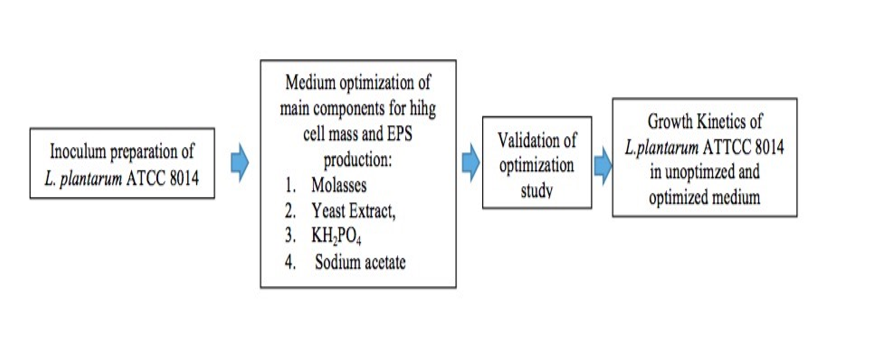
Material and Methods: The main medium component which is known significantly give high effect on the cell mass and EPS production was selected as variables and statistically optimized based on Box-Behnken design in shake flask levels. The optimal medium for cell mass and exopolysaccharide production was composed of (in g l -1): molasses, 40; yeast extract, 16.8; phosphate, 2.72; sodium acetate, 3.98. The model was found to be significant and subsequently validated through the growth kinetics studies in un-optimized and optimized medium in the shake flask cultivation.

Results and Conclusion: The maximum cell mass and exopolysaccharide in the new optimized medium was 4.40 g l-1 and 4.37 g l-1 respectively after 44 h of the cultivation. As a result, cell mass and exopolysaccharide production increased up to 4.5 and 16.5 times respectively, and the maximal exopolysaccharide yield of 1.19 per gram of cells was obtained when molasses was used as the carbon source. In conclusion, molasses has the potential to be a cheap carbon source for the cultivation of Lactobacillus plantarum ATCC 8014 concurrently for high cell mass and exopolysaccharide production.

Conflict of interest: The authors declare no conflict of interest.

Palabras clave:
  • ▪ Cell mass ▪ Exopolysaccharide ▪ Medium optimization ▪ Probiotic
  • PDF (English)

Cómo citar

Othman, N. Z., Mohd Din, A. R. J., Mohamad Azam, Z., Rosli, M. A., & Sarmidi, M. R. (2018). Statistical Optimization of Medium Compositions for High Cell Mass and Exopolysaccharide Production by Lactobacillus plantarum ATCC 8014. Applied Food Biotechnology , 5(2), 87–96. https://doi.org/10.22037/afb.v5i2.19299
  • ACM
  • ACS
  • APA
  • ABNT
  • Chicago
  • Harvard
  • IEEE
  • MLA
  • Turabian
  • Vancouver
  • Endnote/Zotero/Mendeley (RIS)
  • BibTeX

Citas

References

Ozyurt VH and Ötles S. Properties of Probiotics and Encapsulated Probiotics in Food

Acta Sci. Pol., Technol. Aliment.

  • Resumen ##plugins.themes.ojsPlusA.frontend.article.viewed##: 1292 ##plugins.themes.ojsPlusA.frontend.article.times##
  • PDF (English) ##plugins.themes.ojsPlusA.frontend.article.downloaded##: 727 ##plugins.themes.ojsPlusA.frontend.article.times##

##plugins.themes.ojsPlusA.frontend.article.downloadstatastics##

  • ##plugins.themes.ojsPlusA.frontend.article.linkedin##
  • ##plugins.themes.ojsPlusA.frontend.article.twitter##
  • ##plugins.themes.ojsPlusA.frontend.article.facebook##
  • ##plugins.themes.ojsPlusA.frontend.article.googleplus##
  • ##plugins.themes.ojsPlusA.frontend.article.telegram##

Desarrollado por

Open Journal Systems

Idioma

  • English
  • فارسی
  • العربية
  • 简体中文
  • Español (España)
  • Français (France)

Información

  • Para lectores/as
  • Para autores/as
  • Para bibliotecarios/as
  • ##plugins.themes.ojsPlusA.frontend.footer.home##
  • Archivos
  • Envíos
  • Sobre la revista
  • Equipo editorial
  • Contacto

AWT IMAGE

The journal of "Applied Food Biotechnology" is licensed under a  CC BY-NC 4.0. International License.

##plugins.themes.ojsPlusA.frontend.copyright##