From Scientific Criteria to Policy Action: An Evidence-Informed Governance Framework for Probiotic Dairy Products An Evidence-Informed Framework for Probiotic Dairy Products
Applied Food Biotechnology,
Vol. 13 No. 1 (2026),
7 December 2025
,
Page 1-10 (e35)
https://doi.org/10.22037/afb.v13i1.53889
Abstract
Background and Objective:The public-health value of probiotic dairy products depends on delivering characterized strains at efficacious levels through shelf life. Translating international scientific criteria into continuous regulatory oversight remains a challenge. This study aimed to develop an evidence-informed governance framework to strengthen quality assurance and regulation of probiotic dairy products in Iran.
Materials and Methods:This study synthesized international scientific literature and regulatory guidelines, incorporating insights from Iranian exploratory assessments and policy dialogues. Core scientific requirementsspecifically strain characterization, safety, health benefits, and viabilitywere operationalized into regulatory functions, institutional responsibilities, and performance indicators.
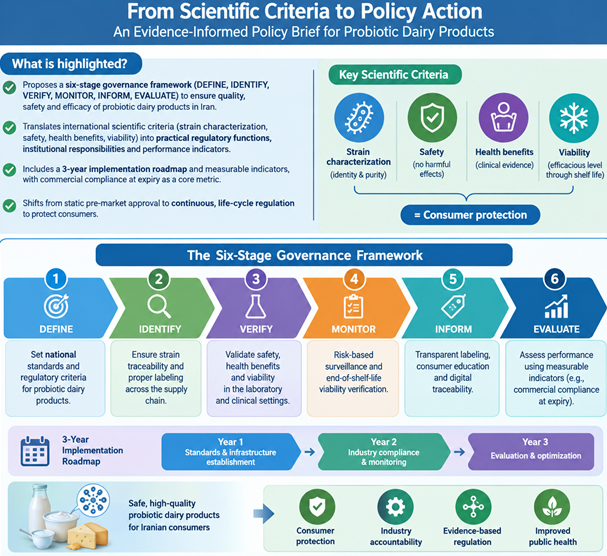
Results:The proposed six-stage governance cycleDEFINE, IDENTIFY, VERIFY, MONITOR, INFORM, and EVALUATEintegrates national standards, strain traceability, safety and efficacy validation, end-of-shelf-life viability verification, risk-based surveillance, transparent labeling, and digital traceability. It also includes a three-year implementation roadmap and measurable performance indicators, identifying commercial compliance at expiry as a core metric.
Conclusion:Effective probiotic governance requires a transition from static pre-market approval to continuous, life-cycle regulation. The proposed framework establishes a practical pathway linking scientific evidence, laboratory verification, industry accountability, and market surveillance to ensure consumer protection in Iran.
- Probiotic, Dairy products, Food governance, Food regulation, Quality assurance, Post-market surveillance, Traceability, Iran
How to Cite
References
1. Abdul Manan M. Progress in probiotic science: prospects of functional probiotic‐based foods and beverages. International journal of food science. 2025;2025(1):5567567.doi: 10.1155/ijfo/5567567.
2. Habiba MU, Rahman MM, Augustin MA, Varela C, Morris H, Bozkurt H. Traditional Fermented Dairy Products as Reservoirs of Bifidobacterium With Probiotic Potential: From Microbial Diversity to Functional Characterization. Comprehensive Reviews in Food Science and Food Safety. 2026;25(4):e70540.doi: 10.1111/1541-4337.70540.
3. Churin AA, Sokolyanskaya LO, Lukina AP, Karnachuk OV. Current concepts in probiotic safety and efficacy. Nutrients. 2026;18(4):696.doi:10.3390/nu18040696.
4. Swanson KS, Gibson GR, Hutkins R, Reimer RA, Reid G, Verbeke K, et al. The International Scientific Association for Probiotics and Prebiotics (ISAPP) consensus statement on the definition and scope of synbiotics. Nature reviews Gastroenterology & hepatology. 2020;17(11):687-701. doi:10.1038/s41575-020-0344-2.
5. Cordaillat-Simmons M, Rouanet A, Pot B. Live biotherapeutic products: the importance of a defined regulatory framework. Experimental & molecular medicine. 2020;52(9):1397-406. doi:10.1038/s12276-020-0437-6
6. Hill C, Guarner F, Reid G, Gibson GR, Merenstein DJ, Pot B, et al. The International Scientific Association for Probiotics and Prebiotics consensus statement on the scope and appropriate use of the term probiotic. Nat Rev Gastroenterol Hepatol. 2014;11(8):506-514. doi:10.1038/nrgastro.2014.66.
7. Hosseini S, Homayouni-Rad A, Kafil HS, Dorud N. Evaluating the antimicrobial effect of postbiotic extract from Lactobacillus casei on Escherichia coli in commercial sterilized milk. Journal of Food Safety and Hygiene. 2022;8(1):42-52. doi:10.18502/jfsh.v8i1.9960
8. Spacova I, Binda S, Ter Haar JA, Henoud S, Legrain-Raspaud S, Dekker J, et al. Comparing technology and regulatory landscape of probiotics as food, dietary supplements and live biotherapeutics. Frontiers in Microbiology. 2023;14:1272754. doi:10.3389/fmicb.2023.1272754.
9. Fusco V, Fanelli F, Chieffi D. Authenticity of probiotic foods and dietary supplements: a pivotal issue to address. Crit Rev Food Sci Nutr. 2022;62(25):6854-6871. doi:10.1080/10408398.2021.1907300.
10. Maddah G, Roustaee R, Mohammadi-Nasrabadi F, Tajabadi Ebrahimi M, Esfarjani F. Probiotic dairy products: an overview and health policy. Appl Food Biotechnol. 2026;13(1):e16(1-21). doi:10.22037/afb.v13i1.52656.
11. Carnevale A. Preparing ethics advisors to AI governance: strategies, regulations, global considerations. In: The AI Ethics Advisor: Methods and Practices for Training and Standardization of Experts. Cham: Springer; 2025. p. 163–249. doi: 10.1007/978-3-032-05526-2_5.
12. Sato K, Kodama K, Sengoku S. The Co-Evolution of markets and regulation in the Japanese functional food industry: balancing risk and benefit. Foods. 2025;14(9):1581. doi:10.3390/foods14091581.
13. Bogueva D, Danova S, Yerer MB, Emily CSM. Technological Innovation and Consumer Trust: Understanding Safety Perceptions in Next Generation Probiotic Development. Microorganisms. 2026;14(7):1479. doi:10.3390/microorganisms14071479.
14. Čuljak N, Repić I, Čanak I, Markov K, Aljinović-Vučić V, Konta I, et al. Label accuracy of commercial probiotics—CFU enumeration and microbial composition. Annals of microbiology. 2026;76(1):26.doi:10.1186/s13213-026-01854-w.
15. Li LY, Ramachandran R, Ross JS, Wallach JD. Premarket and postmarket real-world evidence studies supporting U.S. Food and Drug Administration regulatory decision-making, 2016-2024. Clinical trials (London, England). 2026;23(4):363-74. doi:10.1177/17407745251415190.
16. Siddique A, Gupta A, Sawyer JT, Huang TS, Morey A. Big data analytics in food industry: a state-of-the-art literature review. NPJ science of food. 2025;9(1):36. doi:10.1038/s41538-025-00394-y.
17. Sibanda T, Marole TA, Thomashoff UL, Thantsha MS, Buys EM. Bifidobacterium species viability in dairy-based probiotic foods: challenges and innovative approaches for accurate viability determination and monitoring of probiotic functionality. Front Microbiol. 2024;15:1327010. doi:10.3389/fmicb.2024.1327010.
18. Merenstein D, Guzzi J, Sanders ME. More Information Needed on Probiotic Supplement Product Labels. Journal of general internal medicine. 2019;34(12):2735-7. doi:10.1007/s11606-019-05077-5.
19. Fredua-Agyeman M, Larbi EA. Inaccurate labelling practices in probiotic products: A regulatory shortfall in Accra, Ghana. PloS one. 2025;20(5):e0322194. doi:10.1371/journal.pone.0322194.
20. Reddy CS, editor. Food security and food production: institutional challenges in governance domain. Newcastle upon Tyne: Cambridge Scholars Publishing; 2015. ISBN: 978-1-4438-7820-3.
- Abstract Viewed: 18 times
- pdf Downloaded: 7 times