The Genus Weissella: A Review of its Antimicrobial Potentials, Functional Characteristics and Uses in Food Biopreservation
Applied Food Biotechnology,
Vol. 13 No. 1 (2026),
7 December 2025
,
Page 1-19 (e24)
https://doi.org/10.22037/afb.v13i1.53088
Abstract
Background and Aim: Heterofermentative lactic acid bacteria belonging to the Genus Weissella possess unique metabolic capabilities with distinct value for natural food preservation. This review has synthesized current insights into the physiological characteristics, antibacterial pathways and antifungal mechanisms of Weissella species, with their practical uses within diverse food systems and safety problems restricting their commercial adoption.
Material and Methods: A comprehensive literature search was carried out using PubMed, Scopus, Web of Science and Google Scholar for peer-reviewed literature published up to June 2026. The review covered Weissella taxonomy, ecological distribution, functional characteristics, antimicrobial activities and mechanisms, food biopreservation and biosafety. Relevant literature was critically screened and synthesized based on strain characteristics, bioactive metabolites, mechanisms of action, food-matrix uses, preservation outcomes and safety considerations.
Results and Conclusion: The reviewed studies have indicated that Weissella shows strain-dependent antimicrobial activity mediated by multiple compounds, including organic acids, volatile organic compounds, bacteriocins and exopolysaccharides. These factors can inhibit foodborne and spoilage microorganisms through acidification, metabolic disruption and damage to fungal membranes and hyphae, with strains showing potentials for aflatoxin B1 adsorption. Antimicrobial effects have been reported against several bacterial and fungal pathogens, while food-model studies demonstrate decreases in microbial load and delayed visible spoilage in various food matrices. However, these effects cannot be generalized within Weissella because antimicrobial production, technological characteristics and safety characteristics differ within the strains. Therefore, further strain-specific safety assessment, standardized efficacy assessment, mechanistic studies and pilot and industrial-scale validation are needed before reliable use of Weissella-based biopreservation systems.
- INTRODUCTION
Filamentous fungi are some of the most persistent and economically significant sources of food contamination in the global food supply chain. Fungal colonization within staple supplies such as dairy, cereals, grains and fresh produce causes progressive degradation of organoleptic characteristics, nutritional value and market acceptability [1,2]. Therefore, fungal contamination poses a significant challenge to the food industry compromising safety and quality of food products [3]. In addition to physical deterioration, filamentous fungi synthesize mycotoxins that represent critical biological hazards in foods. While ingestion of contaminated supplies triggers acute toxicosis [4], chronic dietary exposure is linked to severe long-term health consequences, including developmental delays and nutritional impairment in early childhood [5]. Foodborne diseases are still a major global public health concern, with the World Health Organization (WHO) estimating that approximately 866 million people were ill and 1.52 million died from foodborne diseases worldwide in 2021 [6]. Furthermore, fungal contamination and mycotoxin occurrence pose substantial challenges throughout the global food supply chain. Eskola et al. estimated that mycotoxins were detectable in up to 60–80% of food-crop samples, indicating that contamination at detectable levels is substantially more widespread than estimates based on regulatory exceedances alone [7].
Fresh fruits and vegetables are particularly susceptible to fungal deterioration during postharvest handling, storage and distribution. Despite advances in agricultural production and postharvest management, fungal diseases are still major constraints to food security because they decrease product quality, shorten storage life and decrease market value [8]. Postharvest vulnerability is further heightened in tropical and subtropical climates, where increased ambient temperatures and relative humidity accelerate fungal proliferation. Highly perishable climacteric fruits such as mango, banana, strawberry, pineapple and papaya are susceptible to contamination by Botrytis cinerea, Penicillium expansum, Colletotrichum species and Rhizopus stolonifer during handling, transport and storage [9,10]. These pathogens typically enter host tissues via physical wounds or natural openings, rapidly colonizing plant tissues and driving severe postharvest decay and economic loss [11]. Species within Aspergillus and Penicillium represent critical postharvest threats because they merge aggressive spoilage capability with potent mycotoxin synthesis [2], positioning fungal contamination as food security and public health concern. Adequate consumption of fruits and vegetables is an important component of a healthy diet. For example, WHO links insufficient fruit and vegetable intake to nearly 19% of gastrointestinal cancer deaths, nearly 31% of ischaemic heart disease deaths and nearly 11% of stroke deaths [12]. Nevertheless, postharvest preservation is still challenging because physiological processes associated with maturation and postharvest deterioration continue after harvest [13]. Quality retention is further compromised by transpiration-driven water loss, tissue senescence and opportunistic bacterial (Pseudomonas spp.) or fungal infections (Fusarium spp., Alternaria alternata and C. gloeosporioides), which routinely damage high-value crops such as tomatoes and avocados [9,11].
To lessen postharvest deterioration, conventional food preservation depends on physical treatments, modified atmosphere packaging and chemical additives such as sorbates, benzoates, propionates, ethanol and ethylenediaminetetraacetic acid (EDTA). While these methods enhance microbial stability and extend shelf life, their long-term reliance faces increasing studies [14]. Nevertheless, exposure to chemical and biological preservatives can induce microbial stress responses and may contribute to the development of preservative-tolerant or antimicrobial-resistant microbial strains [15]. In contrast, physical preservation technologies may need substantial capital costs and potential degradation of organoleptic and nutritional quality [16]. These constraints have driven research to sustainable, natural preservation alternatives that balance broad-spectrum antimicrobial efficacy with consumer safety expectations [17].
Biopreservation uses beneficial microorganisms or their metabolites to suppress pathogens and spoilage organisms while preserving food quality. Compared with conventional chemical preservatives, this approach includes clean-label demand, although efficacy depends strongly on the food matrix, target organism and use conditions [18–20]. Lactic acid bacteria (LAB) are widely identified as promising biopreservative microorganisms due to their long-standing use in food fermentation and their ability to produce a range of antimicrobial and functional metabolites, including organic acids, bacteriocins, hydrogen peroxide and exopolysaccharides (EPS) [17,21]. Nevertheless, these characteristics are not necessarily shared by all Weissella strains, as their functional characteristics can vary significantly at the strain level.
Although Weissella has been discussed in relation to taxonomy, fermentation and probiotic potential, the evidence connecting strain-level taxonomy, metabolite-mediated antibacterial and antifungal mechanisms, practical food uses and regulatory safety is still fragmented. This review has addressed that gap by integrating recent taxonomic developments including the separation of Periweissella with mechanistic evidence and use outcomes within fresh produce, bakery products and cereal matrices. Its novelty depends on extending previous Weissella-focused reviews by providing a strain-conscious framework that links antimicrobial metabolites and mechanisms of action with matrix-specific efficacy, biosafety considerations and experimental evidence needed for further use and regulatory translation [22,23].
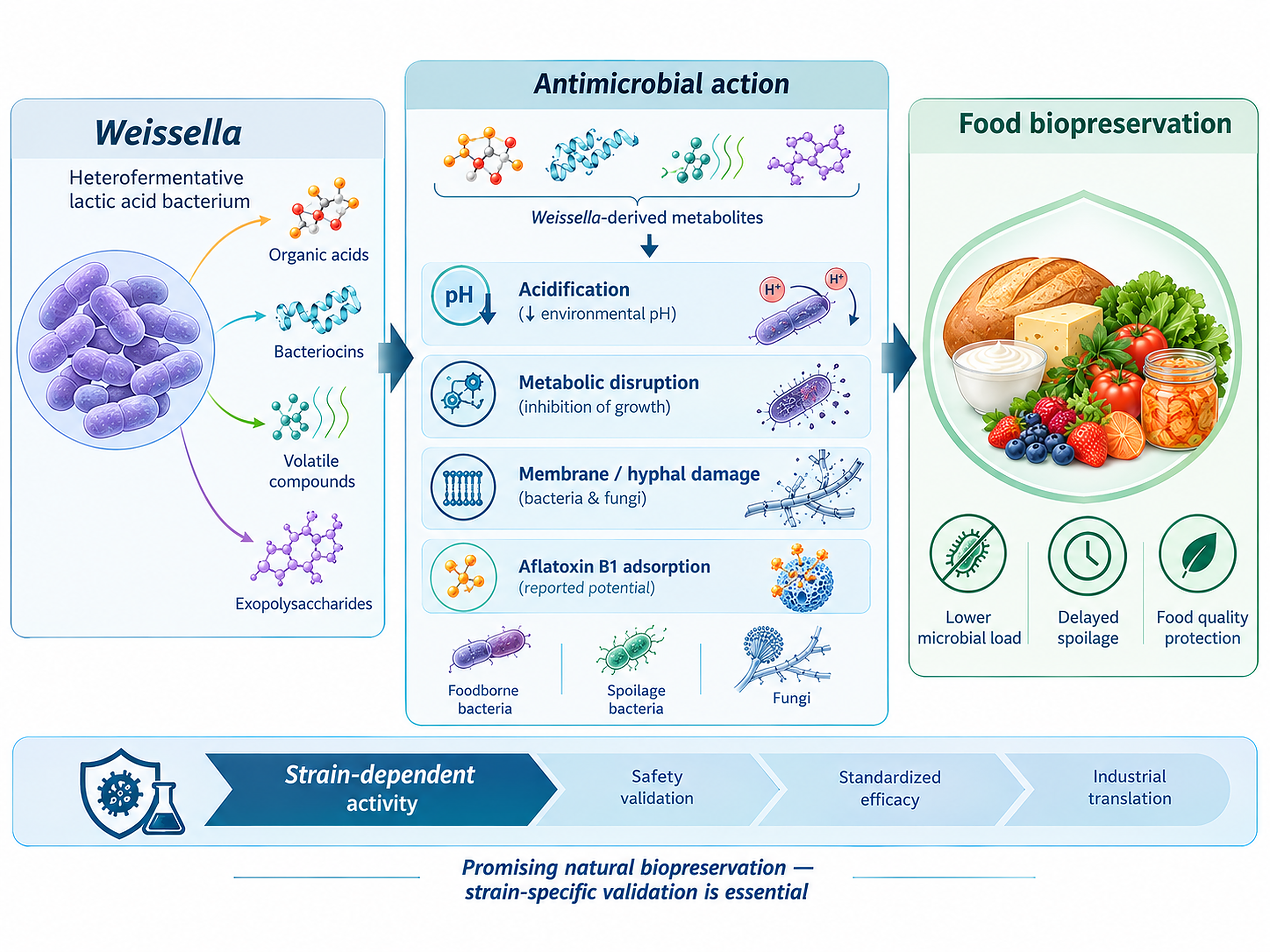
Accordingly, this review has assessed the taxonomy, ecological distribution, physiological and functional attributes, antimicrobial mechanisms, biopreservation performance and biosafety of Weissella, with particular emphasis on antifungal efficacy and the requirements for safe, scalable, clean-label food preservation. As shown in Figure 1, the food biopreservation potential of Weissella should be assessed through an integrated strain-level framework that addresses taxonomy, ecology, bioactive metabolites, antimicrobial activity, practical preservation outcomes and safety requirements.
- MATERIALS AND METHODS
2.1. Literature Search Strategy
To investigate the biotechnological landscape of Weissella, a comprehensive literature search was carried out using PubMed, Scopus, Web of Science and Google Scholar for relevant literature published up to June 2026. The retrieval strategy targeted peer-reviewed studies investigating Weissella taxonomy, ecological niches, functional characteristics, antimicrobial mechanisms, food preservation trials and biosafety assessments.
The retrieval strategy combined controlled vocabulary and keyword terms, including Weissella, Weissella cibaria, Weissella confusa, "bacteriocins", "weissellicins", "antimicrobial activity", "antifungal activity", "biopreservation", "lactic acid bacteria", "EPS", "postharvest diseases", "volatile organic compounds" and "mycotoxins". Terms were linked using Boolean logic (AND/OR) and reference lists of retrieved articles were manually screened to capture additional eligible studies.
2.2. Study Selection
Relevant peer-reviewed research articles, review articles and authoritative taxonomic resources were addressed. Non-peer-reviewed reports, conference abstracts, editorials and duplicate publications were excluded. Relevant studies addressed key facets of Weissella biology, including taxonomy, ecological distribution, physiological traits, antimicrobial modes of action, food preservation trials, probiotic attributes and biosafety assessments. Non-peer-reviewed reports, conference abstracts, editorials and duplicate datasets were excluded.
2.3. Data Collection and Synthesis
Data extraction focused on strain identification, ecological origins, synthesized bioactive metabolites, target microbial spectrums, mechanistic pathways, food matrix uses, shelf-life outcomes, technological functionality and safety parameters. Studies addressing antifungal activity against postharvest phytopathogens and food spoilage molds were prioritized with trials testing Weissella strains in practical biopreservation systems.
Current bacterial nomenclature and taxonomic reclassifications were verified using the “List of Prokaryotic Names with Standing in Nomenclature” (LPSN) to ensure consistency with the latest accepted classification of the genus. Information achieved from various studies were critically compared and synthesized to provide a comprehensive overview of the current state of knowledge, while identifying major advances, existing limitations and further research priorities [24].
- RESULTS AND DISCUSSION
3.1. Taxonomy and Diversity of the Genus Weissella
3.1.1. History and Current Taxonomy of Weissella and Periweissella
The Weissella Sp. was introduced by Collins et al. to classify Leuconostoc-like LAB isolated from naturally fermented Greek sausage. It initially contained seven species of W. confusa, W. halotolerans, W. kandleri, W. minor, W. paramesenteroides, W. viridescens and W. hellenica, with W. viridescens serving as the type species [25]. The genus was originally addressed non-motile, but this description was changed after the discovery of motile W. beninensis in fermented cassava [26].
The number of identified species increased as Weissella strains were isolated from fermented fish, kimchi, soil, cocoa, rice, grapes, dairy products, insects, animals and marine mammals. Important latest species included W. thailandensis [27], W. cibaria [28], W. soli [29], W. koreensis [30], W. fabaria [31], W. fabalis [32], W. diestrammenae [33], W. oryzae [34], W. uvarum [35], W. bombi [36], W. ceti [37], W. cryptocerci [38], W. muntiaci [39], W. sagaensis [40], W. coleopterorum [41] and W. fangxianensis [42]. However, W. jogaejeotgali was later addressed a heterotypic synonym of W. thailandensis, while W. kimchi was regarded as a synonym of W. cibaria [43,44]. Therefore, reported species numbers for Weissella may differ depending on the taxonomic database consulted, date of consultation and if synonyms are included. Based on the current LPSN classification consulted for this review, Weissella contains 21 names with the taxonomic status “correct name,” whereas 28 validly published names are listed when synonyms are included [24].
A major taxonomic revision was suggested in 2022. Phylogenetic analyses based on 498 core proteins and 16S ribosomal RNA gene sequences showed that five species formerly classified within Weissella formed a distinct evolutionary lineage. These species were transferred to the novel Genus Periweissella with P. beninensis, P. fabalis, P. fabaria, P. ghanensis and P. cryptocerci [45]. This separation was supported by genome-based phylogenomic analysis, which grouped Weissella species into six major clusters and identified the same five-species group [45]. The two genera belonged to the Family Lactobacillaceae within the Order Lactobacillales [46]. Their classification now depends on polyphasic evidence, including genome-wide phylogeny, average nucleotide identity, DNA-DNA hybridization, pheS gene analysis, biochemical characteristics and carbohydrate metabolism, because 16S ribosomal RNA comparisons alone cannot reliably distinguish all closely linked species (Table 1).
3.1.2. Ecological Distribution and Sources of Isolation
The broad ecological distribution of Weissella is one of its most distinctive biological characteristics and provides important insights into its significant physiological versatility. Whereas several LABs inhabit restricted ecological niches, Weissella species show broad environmental distribution. Strains have been isolated within nutrient-dense substrates, including fermented matrices, fresh produce, unpasteurized milk, meat, aquatic products, soil and wastewater [50]. This broad occurrence highlights versatile metabolic and stress-response pathways that support survival under fluctuating physicochemical conditions, enabling persistence within natural habitats and industrial food environments.
Isolating Weissella species from insect digestive tracts highlights their capacity to establish stable host associations within diverse animal taxa, including humans [33]. These host-associated strains likely act as functional commensals within gut ecosystems rather than transient colonizers. This host adaptation has prompted research into their probiotic attributes such as gut microbiota modulation, pathogen exclusion and mucosal health maintenance [51]. However, probiotic traits are still strictly strain-specific, with documented variations in epithelial adherence, metabolite yield and host immunomodulation.
In addition, these bacteria play a key role in the spontaneous fermentation of several traditional foods such as kimchi, doenjang and various fermented dairy and seafood products [30,52]. Their consistent occurrence within geographically diverse fermentations indicates evolutionary adaptation to food matrices, where rapid sugar metabolism and organic acid production offer a selective advantage. Accordingly, their presence reflects functional participation in fermentation ecology rather than transient environmental contamination.
The technological effect of Weissella extends beyond microbial succession during fermentation. By secreting short-chain fatty acids, EPSs and volatile aroma compounds, Weissella strains shape rheological, sensory and flavor profiles of the fermented foods [52]. Simultaneously, these metabolic end products suppress spoilage microorganisms and alter matrix pH, linking ecological adaptation directly to biopreservative functionality. Therefore, a strain's isolation niche may provide useful ecological context for subsequent technological screening and strain selection.
The niche diversity of Weissella offers a strategic guide for strain screening and bioprospecting. While fermented food isolates routinely demonstrate targeted processing traits such as rapid acidification, bacteriocin synthesis and antifungal potency, environmental and host-associated strains harbor novel, poorly characterized metabolic pathways. Source ecology thus provides predictive value rather than mere metadata, streamlining targeted strain discovery for specific food biotechnology uses. This ecological diversity provides an important context for the strain-level interpretation of Weissella characteristics, antimicrobial activities and food-biopreservation potentials presented in this review (Figure 2).
3.1.3. Identification Methods
Accurate identification of Weissella species is still one of the principal challenges in LAB taxonomy because of the substantial phenotypic and biochemical similarities shared with closely linked genera, particularly Leuconostoc and members of the former Lactobacillus complex. Conventional identification approaches based on colony morphology, carbohydrate fermentation profiles and routine biochemical assays frequently lack sufficient discriminatory power for reliable species-level classification, increasing the likelihood of taxonomic misidentification [23]. Therefore, reliance on phenotypic characteristics alone is no longer addressed adequate for studies needing precise taxonomic assignment or strain selection for food biotechnology.
Advances in molecular and proteomic methods have improved Weissella identification. Polymerase chain reaction (PCR)-based assays enabled identification of six Weissella strains and ten type strains [53]. An aptamer-based fluorescence polarization biosensor detected W. viridescens at 10²–106 colony-forming units (CFU) per millilitre, with 90.6–107.7% recovery in smoked hams [54]. Matrix-assisted laser desorption/ionization time-of-flight mass spectrometry (MALDI-TOF) with an expanded database identified 83.7% of Weissella isolates to the species level and 16.3% to genus level [55]. These methods provide complementary approaches for accurate Weissella identification. Although 16S ribosomal RNA gene sequencing is still a standard taxonomic marker, its discriminatory resolution for Weissella species is limited. High gene sequence conservation within closely linked taxa obscures species-level boundaries, particularly within recently diverged lineages [23]. Relying solely on 16S ribosomal RNA loci can hence undercount species diversity and introduce ambiguity into comparative genomic analyses.
To address these diagnostic constraints, pan-genome mining has informed the design of high-resolution molecular assays. For example, species-specific real-time PCR primers targeting pan-genomic locus tags now enable clear differentiation of 11 food-associated Weissella species that previously resisted conventional PCR resolu-tion [56]. These targeted assays enhance diagnostic specifi-city while streamlining real-time monitoring of key starter strains during industrial fermentations. Whole-genome sequencing (WGS) provides a high-resolution approach for Weissella characterization. In addition to taxonomic classification, WGS maps genome architecture, biosynthetic gene clusters for antimicrobials, metabolic pathways, probiotic locus tags and mobile resistome or virulome elements [45]. This genomic resolution shifts strain assessment from basic taxonomy to predictive modelling of technological efficiency and biosafety.
Comparative genomics resolves persistent taxonomic ambiguities in Weissella. High-throughput phylogenomic pipelines differentiate closely linked isolates beyond the resolution of single-locus markers while simultaneously profiling functional operons such as bacteriocin gene clusters, EPS synthases, carbohydrate active enzymes, stress response systems and antibiotic resistance genes. Comparative genomic analyses therefore provide a useful framework for addressing strain-specific functional and safety traits relevant to biopreservation and probiotic uses [57].
3.2. Physiological and Metabolic Characteristics
The physiological and metabolic traits of Weissella drive its use in food biotechnology and biopreservation. As LAB, Weissella species ferment carbohydrates into short-chain organic acids (SCOA) while contributing to matrix preservation, microbial community stability and host health [23]. In addition to basic acid production, these organisms produce diverse bioactive end-products that shape food quality, rheology and microbial interactions. Morphologically and physiologically, Weissella species are Gram-positive, catalase-negative non-spore-forming cocci or short rods depending on culture conditions [25]. While motility is rare within the genus, P. beninensis is a distinct exception due to peritrichous flagellation [26]. Such phenotypic variations demonstrate that functional traits diverge within species.
Central to Weissella physiology is an obligatory heterofermentative metabolism. Using 6-phosphogluconate/phosphoketolase pathway, Weissella species ferment hexoses into D/L-lactic acid, CO2, ethanol and acetate [23]. This coproduction of organic acids, volatile compounds and gas enhances fermentation dynamics by driving matrix acidification, suppressing spoilage agents and generating complex flavor and aroma profiles. The industrial use of Weissella thus depends on multifaceted biochemical activity rather than simple acid accumulation. The energy metabolism of Weissella highlights its adaptation to fermentative niches. Since chemoorganotrophs lacking heme synthesis pathways, these bacteria depend entirely on substrate-level phosphorylation, propagating under anaerobic or microaerophilic conditions [23]. This physiological dependence explains their frequent dominance during spontaneous food fermentation, where oxygen availability is limited and fermentable carbohydrates are abundant. Their metabolic strategy therefore provides a competitive ecological advantage over several aerobic microorganisms, while simultaneously promoting rapid acidification of the food matrix.
Temperature tolerance contributes significantly to the industrial relevance of this genus. Although all identified Weissella species are capable of growth at approximately 15 °C, several species tolerate temperatures between 42 and 45 °C [23], whereas optimal growth generally occurs between 20 and 30 °C [58]. Such physiological thermal tolerance enables Weissella strains to adapt within varied food matrices—from warm-incubated dairy fermentations to moderately conditioned meat processing. This thermal range broadens the industrial use of Weissella within diverse food processing environments rather than limiting it to a single production niche. In addition to core fermentative pathways, W. cibaria strains harbor key biochemical traits significantly dextran biosynthesis, esculin hydrolysis and arginine deamination [59]. Dextran synthesis is of important industrial interest; as a high-molecular-weight (HMW) glucan, it increases apparent viscosity, water-binding capacity and rheological stability in fermented dairy matrices. By improving mouthfeel and syneresis resistance without synthetic hydrocolloids, EPS production serves as a hydrocolloid-replacing functional trait for clean-label food design.
Weissella strains show a versatile carbohydrate fermentative profile, using cellobiose, fructose, galactose, maltose, raffinose, ribose, trehalose and xylose [23]. This metabolic range supports growth within diverse substrates, accounting for the prevalence of Weissella in fermented vegetables, dairy, cereals and meats. Such carbohydrate adaptability facilitates the design of matrix-tailored starter cultures for specialized industrial fermentations. Collectively, these physiological and metabolic characteristics demonstrate that the technological value of Weissella is set by the integration of multiple functional traits, rather than by a single metabolic capability. Efficient carbohydrate fermentation, heterofermentative metabolism, broad substrate utilization, environmental adaptability and EPS production have collectively contributed to the increasing interest in this genus as a multifunctional platform for food fermentation, natural preservation and probiotic development. Nevertheless, accumulating evidence indicates significant strain-dependent variability in these physiological characteristics, highlighting the importance of comprehensive phenotypic and genomic characterization before selecting candidate strains for commercial food biotechnology.
3.3. Functional Characteristics and Technological Uses
3.3.1. Exopolysaccharide Production
The EPS biosynthesis represents a major functional attribute expanding use of Weissella in food biotechnology. As natural biopolymers, EPS improve rheological characteristics, moisture retention and sensory quality in fermented matrices [60]. The EPS-yielding Weissella strains are thus increasingly assessed as functional starter cultures and cell factories for clean-label food formulations. Within the Leuconostocaceae family, Leuconostoc and Weissella are prime EPS producers, with Weissella showing high yields of dextran-type homopolysaccharides [61,62]. The W. cibaria, W. confusa and W. hellenica synthesize structurally varied EPS that differ in monosaccharide composition, glycosidic linkage patterns, molecular weight distribution and branching degree [63]. This structural diversity dictates polymer physicochemical traits, governing solubility, rheological behavior and hydrocolloid functionality in food systems.
The industrial use of EPS produced by selected Weissella strains extends into functional food formulation. These polymers serve as bioemulsifiers, thickeners, gelling agents and hydrocolloids, increasing apparent viscosity, water-holding capacity and matrix stability in fermented foods [64,65]. These rheological enhancements improve mouthfeel, texture and syneresis resistance while decreasing dependence on synthetic food additives. Therefore, EPS yield represents a key selection benchmark during industrial strain screening.
However, EPS functionality cannot be inferred from taxonomy alone due to pronounced strain-level divergence. Variations in polymer yield, monomeric composition, molecular weight and branching architecture cause significant differences in rheological behavior and hydrocolloid efficacy. Taxonomic classification is therefore inadequate for predicting technological performance, needing comprehensive strain-level phenotyping and genomic profiling to identify superior EPS-producing isolates [66]. As summarized in Figure 3, selected Weissella strains may inhibit fungi through the contributions of various metabolite classes, including organic acids, volatile compounds and bacteriocins, as well as EPS, although the relative contribution of each factor varies within strains and experimental conditions.
3.3.2. Nutritional Enhancement and Probiotic Potential
In addition to processing use, experimental studies indicate that the functional characteristics of Weissella are strongly strain-dependent and should not be generalized at the species level. For example, W. cibaria YB-1 produced a purified dextran with a molecular mass of 3.89 × 10⁶ Da and predominantly α(1→6) glycosidic linkages, with 4.3% α(1→3)-linked branches. The purified EPS showed a water solubility index of 95.23% ±4.45, water-holding capacity of 287.84% ±16.23 and emulsifying activity of 84.43% ±3.65 and further showed in vitro scavenging activity against superoxide anion and hydroxyl radicals [67]. Similarly, EPS production by W. cibaria GA44 reached an experimentally measured yield of 4.80 g l-1 under optimized cultivation conditions and the purified polymer demonstrated in vitro antioxidant activity against superoxide anion and hydroxyl radicals [68]. These findings demonstrate that EPS-associated functionality depends on the characteristics of individual strains and their polymers rather than on species identity alone.
Experimental evidence supports strain-specific bioactivity in addition to EPS production. Cell-free supernatant (CFS) from the oral probiotic strain W. cibaria CMU inhibited periodontal pathogens in a dose-dependent manner, with the antibacterial activity being predominantly associated with organic acids and hydrogen peroxide. Lactic acid, acetic acid and citric acid were the principal organic acids detected, reaching concentrations of 6.42, 2.78 and 0.88 mg ml-1, respectively. Proteomic analysis additionally identified 19 secreted proteins, including N-acetylmuramidase, providing experimental evidence for multiple antimicrobial components in this strain [69]. Thus, the functional potential of Weissella is better represented by experimentally characterized strain-metabolite relationships than genus-level claims.
Selected Weissella strains can produce biogenic amines, although this trait is strain-dependent. For example, W. halotolerans FAS29 and FAS30 showed tyrosine decarboxylase activity and produced tyramine, whereas W. confusa FS77 produced tyramine and histamine; putrescine production was detected in W. confusa FS52, FS53 and FJ2 [70]. Therefore, selection of strains for functional-food uses should combine technological screening with metabolite profiling and appropriate biosafety assessment to distinguish beneficial functional characteristics from potential safety risks [70].
3.4. Antimicrobial Potential and Mechanisms
3.4.1. Antibacterial Activity
The antibacterial activity reported for selected Weissella strains is primarily associated with the production of organic acids and other inhibitory metabolites. Lactic and acetic acids can decrease the environmental pH and, particularly in their undissociated forms, diffuse within bacterial membranes. Subsequent intracellular dissociation contributes to cytoplasmic acidification, disruption of proton gradients and impairment of essential metabolic processes; thereby, restricting the growth of susceptible bacteria [23,71]. However, these effects should be interpreted at the strain level because antibacterial activity varies based on the Weissella strain, target organism, culture conditions and composition of the cell-free preparation. For example, W. cibaria TM128 showed antibacterial activity against selected foodborne and spoilage bacteria, supporting its potential as an antagonist in food-associated environments [71]. Similarly, W. cibaria BYL4.2 and its CFS inhibited several bacterial species, including Escherichia coli, Staphylococcus aureus, P. aeruginosa and Listeria monocytogenes [72]. Other W. cibaria strains have demonstrated inhibitory activity against respiratory pathogens, including Streptococcus pyogenes, S. aureus and S. pneumoniae [73]. In foods, W. cibaria D30 showed antilisterial activity, when used in cottage cheese, indicating that antibacterial activity can be reserved within a food matrix [74].
Antibacterial effects have been documented for selected W. confusa strains. The W. confusa PL9001 decreased the adherence and growth of Helicobacter pylori [75], whereas W. confusa DD_A7 demonstrated antibacterial activity against an extended-spectrum β-lactamase-producing E. coli strain [76]. These findings reveal that antibacterial activity is not a uniform characteristic of the genus but rather a strain-dependent characteristic that should be established experimentally for each candidate strain.
Bacteriocins represent an additional class of antibacterial compounds in selected Weissella strains. Weissellicins and other bacteriocin-like peptides have been characterized in W. paramesenteroides and W. hellenica, with activity directed against susceptible bacterial organisms [77]. For example, weissellin A production has been investigated in W. paramesenteroides DX [78], while a bacteriocin produced by W. hellenica D1501 was characterized from a Chinese fermented meat product [79]. Therefore, bacteriocin-mediated effects should be described specifically as antibacterial unless direct antifungal activity has experimentally been demonstrated.
3.4.2. Antifungal Mechanisms
The antifungal activity of Weissella is associated with the production of multiple metabolites, although their relative contributions seem as strain and condition dependent. Experimental evidence has demonstrated that organic acids can contribute significantly to the antifungal activity of the selected Weissella strains. For example, metabolites from W. cibaria KM14 showed 94.3–99.4% inhibition against A. fumigatus, P. expansum and P. oxalicum and organic acids were identified as the most effective antifungal components, with lactic and acetic acids were within the predominant organic acids detected [80]. Scanning electron microscopy (SEM) revealed morphological changes in fungal hyphae after treatment with the CFS, although the precise molecular basis of these effects must fully be established [80]. Similarly, W. cibaria BYL4.2 and its CFS showed antifungal activity against P. chrysogenum. The supernatant presented pH-dependent activity, while metabolomic analysis indicated alterations in fungal metabolic pathways, including pathways linked to ATP-binding cassette transporters. These findings suggest possible metabolic mechanisms underlying fungal inhibition; however, they do not establish direct molecular targets [72].
Organic acids are therefore within the major antifungal metabolites reported for the selected Weissella strains [80,81]. Their antifungal effects are generally associated with extracellular acidification and, for undissociated organic acids, diffusion within the fungal plasma membrane followed by intracellular dissociation and proton accumulation. These processes have been suggested to disturb intracellular pH homeostasis and cellular metabolism; however, the relative contribution of each process may vary based on the strain, metabolite concentration, fungal species and environmental conditions [81]. The findings achieved with W. cibaria KM14 provide experimental support for the contribution of organic acids to antifungal activity; however, they do not establish that intracellular acidification is the unique or universal mechanism of fungal inhibition [80].
The effects observed with W. cibaria BYL4.2 further suggest that metabolic alterations may accompany Weissella-associated fungal inhibition. The CFS produced pH-dependent antifungal activity against P. chrysogenum, while metabolomic analysis revealed changes in fungal metabolic pathways, including pathways linked to ATP-binding cassette transporters [72]. These observations indicate that alterations in transport and cellular metabolism may contribute to fungal inhibition. However, direct inhibition of ATP-binding cassette transporters by a specific Weissella metabolite has not experimentally been demonstrated. Thus, these metabolic changes should be addressed potential mechanisms rather than verified molecular targets [72].
Volatile organic compounds (VOCs) have been experimentally implicated in the antifungal activity of selected Weissella strains. In W. paramesenteroides R2, gas chromatography-mass spectrometry (GC–MS) analysis identified 84 VOCs, with pyrazines accounting for approximately 51% of the detected VOC profile. Three major compounds—2,5-dimethylpyrazine, 2,4-di-tert-butylphenol and 2-furanmethanol—were individually assessed for antifungal activity. At 150 μl, 2,5-dimethylpyrazine produced maximum inhibition of approximately 83, 25 and 49% against B. cinerea, C. gloeosporioides and F. oxysporum, respectively. Use of R2-derived VOCs decreased disease incidence and severity in stored strawberries [82]. These findings provide experimental support for VOC-associated antifungal activity in this strain, whereas the precise cellular mechanisms underlying these effects are still incompletely characterized.
Bacteriocins and EPS have been investigated as biologically active metabolites of Weissella [77,83]. Bacteriocins produced by Weissella have been characterized primarily for their antibacterial activities, whereas evidence for their direct antifungal effects is still limited [77]. Similarly, galactan EPS produced by W. confusa KR780676 has demonstrated aflatoxin B1-binding activity, which is relevant to mycotoxin modification but represents toxin sequestration rather than direct inhibition of fungal growth [83]. Accordingly, bacteriocins and EPS should not currently be addressed established components of a direct antifungal mechanism.
Overall, the available evidence supports the contribution of specific metabolites, particularly organic acids and VOCs, to antifungal activity in selected Weissella strains. However, the available studies do not provide sufficient quantitative evidence to establish synergistic interactions within organic acids, VOCs, bacteriocins and EPSs. The observed effects should therefore be interpreted as strain and condition-dependent activities of individual or combined metabolites rather than evidence of a universally established multi-metabolite synergy. Further controlled combination studies using defined metabolite concentrations and appropriate interaction models are needed to investigate if these compounds act synergistically, additively or independently.
3.4.3. Physical and Cellular Effects on Fungi
The inhibitory effects of the selected Weissella strains and metabolites may be accompanied by observable morphological changes in susceptible fungi. In a study of W. cibaria KM14, exposure to its metabolites was associated with alterations in fungal morphology and cellular structure, including changes in hyphal appearance and structural integrity. These observations provide morphological evidence of cellular or structural disturbance associated with treatment and complement the reported quantitative inhibition of fungal growth. However, the morphological changes reported using SEM cannot establish specific antifungal mechanisms or identify metabolites responsible for the observed effects [80].
The relationship between the exposure to the cell-free preparation and the observed morphological changes therefore is insufficiently resolved. Although organic acids were identified as important contributors to the antifungal activity of W. cibaria KM14, the available morphological observations do not demonstrate that the ultrastructural changes were specifically caused by organic acids or other individual metabolites [80]. Establishing such a causal relationship needs component-specific experiments such as assessing purified or individually characterized metabolites at defined concentrations and comparing their effects with those of the complete cell-free preparation. Accordingly, the SEM findings should be interpreted as evidence of morphological or structural alterations rather than direct evidence of a particular molecular mechanism.
Overall, the available evidence indicates that the selected Weissella strains can show antibacterial or antifungal activity; however, mechanisms responsible for these effects are still strain and metabolite dependent. Quantitative inhibition data, metabolite analyses and morphological observations provide various levels of evidence and should not be treated similarly. In particular, morphological changes should be distinguished from mechanistic evidence and specific molecular mechanisms should be suggested only when supported by appropriate component-specific or mechanistic experiments. Furthermore, antibacterial activity, antifungal activity and toxin-binding activity represent distinct biological outcomes and should be described separately when interpreting the available evidence.
3.5. Biopreservation in Food Systems
3.5.1. Spectrum of Antifungal Activity
The biopreservative potential of Weissella depends on broad-spectrum activity against key postharvest pathogens and food spoilage molds [80,82,84]. Isolates inhibit fungal species responsible for raw commodity decay and processed food spoilage, offering a bio-based alternative to synthetic fungicides. The observed inhibition may involve one or more extracellular metabolites, including organic acids and VOCs, although their relative contributions vary within strains and experimental conditions. Multiple investigations verify Weissella activity against major phytopathogenic fungi, significantly B. cinerea, C. gloeosporioides, F. oxysporum and P. expansum [80,82,84].
Inhibition within distinct fungal genera demonstrates that Weissella metabolites target conserved physiological pathways in filamentous fungi rather than species-specific loci. This cross-genus efficacy highlights the use of Weissella for pre and postharvest biocontrol. For example, W. confusa and Limosilactobacillus fermentum strains isolated from traditional attieke fermentations show strong antagonism against Fusarium species, C. gloeosporioides, Botryodiplodia theobromae, A. carbonarius and A. niger [84]. These findings support use of traditional fermented foods as potential sources for bioprospecting antifungal LAB. Efficacy within diverse fruit and vegetable pathogens highlights Weissella as a bio-based intervention to limit postharvest loss and decrease chemical fungicide reliance. In addition to raw production, Weissella controls spoilage fungi in processed food matrices. In rice cake preservation, W. confusa inhibited Cladosporium species, Neurospora species and P. crustosum, significantly delaying fungal spoilage during storage [85]. Similarly, W. cibaria KM14 suppresses A. fumigatus, P. expansum and P. oxalicum common spoilage molds within diverse food supplies [80]. These findings indicate that metabolites produced by the selected Weissella strains can inhibit multiple spoilage fungi under the assessed conditions.
3.5.2. Practical Uses and Efficacy in Food Biopreservation
Translational studies verify that Weissella antifungal efficacy extends beyond in vitro assays into food preservation systems. Within diverse food matrices, Weissella inoculants decrease fungal spoilage, extend shelf life and preserve organoleptic quality, supporting their development as sustainable alternatives to chemical preservatives [82,84–86]. These uses illustrate that the effectiveness of Weissella is closely associated with strain-specific metabolic activity and characteristics of the target food matrix, emphasizing the importance of selecting appropriate strains for individual preservation strategies.
A representative experimental example of practical applicability is the use of W. paramesenteroides R2 isolated from mango for the biological control of postharvest grey mold caused by B. cinerea in strawberries [82]. This strain significantly decreased disease development while extending fruit shelf life, with the protective effect primarily attributed to the production of VOCs. Unlike conventional antimicrobial treatments that need direct contact with food surfaces, VOC-mediated inhibition provides an important technological advantage by enabling the remote suppression of fungal pathogens. Such contact-independent activity is particularly valuable for delicate fresh produce, where minimizing physical handling is essential to preserve product quality.
Similar preservation outcomes occur in tomato postharvest trials using W. confusa B35 live-cell coating or CFS preparations. The bacterial culture was prepared at approximately 107 CFU ml-1 before separation of cells and supernatant; the cells were used as a surface coating, whereas the CFS was used by immersion for 10 min, with untreated tomatoes serving as the negative control. The two treatments decreased visible spoilage, while CFS treatment showed the better preservation outcome, with treated tomatoes being visually intact over the 2-w experimental time at room temperature (RT). These findings indicate the potential contribution of secreted extracellular metabolites to tomato preservation; however, they should not be generalized as evidence of industrial-scale shelf-life extension without further validation under defined commercial processing and storage conditions [84]. This outcome demonstrates that secreted extracellular metabolites, rather than live cell colonization, drive antifungal efficacy. Use of cell-free preparations may offer potential formulation and processing advantages; however, their stability, standardization and regulatory requirements need dedicated assessments.
Weissella demonstrates biopreservative use in cereal matrices. In rice cake preservation trials, sourdough fermentation with W. confusa suppressed common spoilage molds and extended shelf life [85]. Under the conditions of the reported rice-cake study, W. confusa showed antifungal activity, similar to or greater than that observed with 0.3% calcium propionate. This finding indicates potential for further investigation of Weissella as a biological preservation approach in bakery products. Cereal and grain biopreservation represents an important use for Weissella due to its inhibition of mycotoxigenic Fusarium species [82,84]. Such antifungal activity may decrease the risk of subsequent mycotoxin accumulation by limiting fungal growth; however, inhibition of fungal growth should not be interpreted as direct mycotoxin degradation or detoxification. Where mycotoxin binding or sequestration has been demonstrated, this should be addressed a distinct mechanism from antifungal activity. The W. confusa isolates specifically inhibit spore germination in F. culmorum, verifying that antagonism operates at early stages of fungal development [87].
Nevertheless, comparative investigations have clearly demonstrated that antifungal efficacy is highly strain dependent. Although W. confusa ML2 showed antagonistic activity similar to that of BF2 against several Fusarium isolates, important differences were evident when individual fungal strains were assessed [86]. In peanut biocontrol experiments, BF2 successfully suppressed F. verticillioides NCIM 1099, F. graminearum MTCC 2089 and F. oxysporum MTCC 284, decreasing disease incidence from 100% in untreated controls to zero after bacterial treatment. In contrast, ML2 showed limited activity against F. verticillioides NCIM 1100, where disease incidence was 100%, although it effectively controlled F. graminearum MTCC 2089 and significantly decreased disease caused by F. oxysporum MTCC 284 to 10.52% [86]. These findings demonstrate that antifungal performance cannot be generalized within strains, even within the same species and strongly support the need for strain-level selection before commercial uses.
Additional evidence for this strain-dependent variability was achieved using surface-disinfected wheat grains artificially infected with Fusarium species [86]. Interestingly, the response observed in wheat differed from that observed in peanuts. Under these conditions, F. verticillioides NCIM 1100 was susceptible to W. confusa ML2 and BF2, whereas F. graminearum MTCC 2089 was further sensitive to BF2. In contrast, F. oxysporum MTCC 284 showed little or no response to CFS. These divergent outcomes demonstrate that antifungal efficacy depends on strain-specific metabolic traits and matrix-dependent physicochemical factors. Biopreservative performance must therefore be validated under specific food processing and storage conditions rather than generalized from simplified in vitro or single-matrix models.
Collectively, these findings establish Weissella as a versatile microbial platform for food biopreservation within fresh productions, bakery goods and cereal supplies. However, performance disparities within strains and food matrices necessitate rigorous use-specific screening and pilot validation under realistic processing parameters. Systematic strain selection optimizes Weissella-based biopreservation, advancing sustainable, clean-label food preservation strategies (Table 2).
3.5.3. Classification of Evidence by Experimental Level
The available evidence for Weissella-mediated biopreservation can be classified based on the experimental level; at which, antimicrobial efficacy has been demonstrated. At the in vitro level, studies have primarily assessed the inhibitory activity of Weissella strains or their metabolites against foodborne and phytopathogenic microorganisms under controlled laboratory conditions. These assays provide essential evidence of antimicrobial potential but do not fully reproduce the physicochemical complexity of food matrices. A second level comprises cell-free preparations, particularly CFS and metabolite-containing fractions. Studies using CFS from Weissella strains, including W. cibaria KM14 and BYL4.2, have demonstrated antifungal activity against several spoilage molds, supporting the contribution of extracellular metabolites to fungal inhibition.
The third level involves food-model studies; in which, Weissella strains or their metabolites are assessed directly in food matrices. Examples include the use of W. confusa in rice cakes and tomato preservation, demonstrating that antimicrobial activity observed under laboratory conditions can translate into measurable effects within food systems. The fourth level comprises storage and postharvest studies, which provide a higher degree of use relevance by addressing a performance under realistic storage conditions. Examples include W. paramesenteroides R2 for the control of B. cinerea on strawberries, W. confusa treatments in postharvest tomatoes and biocontrol studies involving peanuts and wheat grains. These studies demonstrate that efficacy is strongly affected by the strain characteristics and target food matrices.
Ultimately, pilot and industrial-scale validation represents the highest level of translational evidence. However, this level is still insufficiently represent in the current Weissella literature. Most available studies are still carried out under controlled laboratory or small-scale food-model conditions, while systematic validation under commercial processing, storage, supply-chain and economic constraints is still limited (Table 2). Therefore, further studies should progressively move from laboratory screening to pilot-scale and industrial validation to establish reproducibility, operational stability, safety and cost-effectiveness before commercial implementation (Figure 4).
3.6. Biosafety and Regulatory Considerations
3.6.1. Safety Discussion
The safety of Weissella strains intended for food biopreservation should be assessed at the strain level rather than inferred from species or genus identity alone. A comprehensive assessment should include phenotypic antimicrobial susceptibility testing (AST) and genomic screening for acquired antimicrobial-resistance determinants, particularly genes associated with clinically relevant antimicrobials and their potential association with mobile genetic elements (MGE). Additional safety parameters should include the assessment of biogenic amine production, hemolytic activity, cytotoxicity, virulence-associated traits and other potentially harmful metabolic activities. The WGS can further support safety assessment by enabling characterization of the resistome, virulome, plasmid-associated genes, MGEs and other genomic determinants potentially relevant to safety. However, the presence of a putative gene identified by in silico analysis should not be interpreted as evidence of pathogenicity; genomic findings should be complemented by appropriate phenotypic validation. This approach is particularly important for Weissella because antimicrobial susceptibility, metabolic characteristics and safety-linked traits can vary significantly within individual strains.
Fanelli et al. [88] assessed the probiotic and safety-linked characteristics of six type strains representing Weissella and Periweissella, including P. beninensis LMG 25373T (LMG 25373T), P. fabalis LMG 26217T, P. fabaria LMG 24289T, P. ghanensis DSM 19935T, W. diestrammenae DSM 27940T and W. uvarum B18NM42T (DSM 28060T). All strains were non-hemolytic, whereas differences in antibiotic susceptibility profiles were observed within the strains. These findings demonstrate that safety-linked characteristics should be interpreted at the strain level rather than generalized within the genus. Accordingly, candidate strains for food or probiotic uses need further assessment using appropriate phenotypic, genomic and use-specific safety assessments [88].
Regulatory status should be described using current authoritative sources and should not be generalized to the entire genus. According to the U.S. Food and Drug Administration (FDA), Generally Identified as Safe (GRAS) notice no. 1063 received a “no questions” letter for W. cibaria CMU in 2023. This is specifically used to the strain and the intended uses described in the GRAS notice and should not be generalized to other Weissella species or strains [89].
Similarly, qualified presumption of safety (QPS) status should be interpreted based on the current European Food Safety Authority (EFSA) framework. The EFSA investigates microorganisms within defined taxonomic units and addresses taxonomic identity, the available body of knowledge and relevant safety concerns, including acquired antimicrobial resistance in bacteria, when maintaining and updating the QPS framework [90]. The QPS status should not therefore be interpreted as a general safety designation for the entire genus or blanket authorization of a specific food use. Regulatory status should be assessed based on the applicable taxonomic unit, individual strain and intended use rather than generalized within Weissella.
Accordingly, further development of Weissella-based biopreservatives should adopt a standardized strain-level safety framework integrating AST, screening for transferable resistance genes and MGEs, biogenic amine assessment, hemolysis and cytotoxicity testing, characterization of virulence-associated traits and WGS. Such an integrated approach provides a stronger scientific basis for addressing strains with demonstrated antimicrobial or biopreservative activity and supporting later regulatory assessment.
3.6.2. Virulence Factors
WGS clarifies the distribution of putative virulence factors in Weissella. Comparative genomic mining reveals loci encoding hemolysins, collagen-binding domain proteins and cell-surface adhesins [50]. However, in silico gene annotation does not equate to active pathogenicity, as gene presence alone does not guarantee transcription, translation or functional phenotype expression. Specifically, W. cibaria JW15 showed low-homology matches to the endocarditis-associated antigen gene (efaA) and hemolysin A locus (CVF417) [91], while W. hellenica 0916-4-2 carries putative virulence-associated loci including hasC, cpsI, gnd, cpsF and clpE [92]. Although these genomic determinants trigger regulatory studies, their expression profiles, phenotypic contributions to virulence and potentials for horizontal gene transfer are still unverified. Furthermore, several sequence homologs annotated as putative virulence factors occur within food-grade LAB with long histories of safe fermentation uses. For example, hemolysin-like genes are common within traditional LAB genera without conferring clinical toxicity or phenotypic hemolysis. In silico homology alone should not therefore be treated as a definitive marker of pathogenic risk without phenotypic validation.
Paradoxically, several surface loci annotated as virulence factors mediate probiotic interactions in gut environments. Surface adhesins facilitate epithelial attachment, promoting mucosal colonization, ecological persistence and pathogen exclusion. For example, the fibronectin-binding protein gene (fbpA) in Weissella strains inhibits S. aureus biofilm formation, functioning as a protective factor rather than a virulence determinant [93,50]. These dual-function traits highlight the limitation of relying alone on genomic screening for safety assessments. Gene presence does not infer biological activity, as phenotypic expression depends on transcriptional regulation, environmental cues and functional context. Automated genome annotation must therefore be paired with phenotypic assays, including AST, phenotypic hemolysis screening and cell toxicity models to establish strain biosafety.
Despite advances in genome sequencing, genomic diversity and strain-level variation are still important considerations in assessing the safety and functional potential of Weissella. Comparative genomic studies, including analysis of W. hellenica 0916-4-2, have demonstrated significant genomic variation and presence of safety-linked genomic characteristics [92]. More recently, analysis of 347 high-quality Weissella genomes representing 16 species revealed extensive genomic diversity and species and strain-level variations in functional and safety-linked traits [94]. In combination with previous genome-based assessments of putative virulence and antimicrobial-resistance determinants [50], these findings support integrating comparative phylogenomics with functional genomics and phenotypic characterization to enable strain-specific safety assessment and support further regulatory assessment of the candidate strains for food uses.
- CONCLUSION AND FUTURE PERSPECTIVE
4.1. Conclusion
This review indicates that the selected Weissella strains possess antimicrobial (antibacterial and antifungal) activities associated with metabolites such as organic acids, bacteriocins, volatile organic compounds and EPSs. These effects may involve acidification, cellular or membrane disruption, metabolic disturbance and modification of the surrounding microbial environment, although the contribution of individual components and specific molecular mechanisms is still incompletely resolved. Separately, aflatoxin B1-binding activity reported for extracellular polysaccharides represents toxin sequestration rather than a mechanism of fungal-growth inhibition and should not be conflated with the antifungal effects described previously.
The reviewed evidence demonstrates substantial strain, target, matrix and condition-dependent variations in antimicrobial activity and technological performance. Experimental evidence ranges from laboratory assays and cell-free preparations to food-model and storage studies, whereas evidence under pilot-scale and industrially relevant conditions is still limited. Overall, the current evidence supports further investigation of selected Weissella strains for food biopreservation but does not support generalizing efficacy or technological performance within the genus.
4.2. Limitations of the Current Evidence
The reviewed literature has several limitations that restrict the translation of Weissella research into broader food uses. Evidence ranges from in vitro assays and cell-free preparations to selected food-model and storage studies, with outcomes varying based on strain, target organism and food matrix [80,82,86]. Methodological differences in treatment conditions, controls, food matrices and outcome measurements limit direct comparison within studies. In addition, some studies have not fully established the contribution of individual metabolites or clearly distinguished antifungal activity from other biological effects [80]. Although strain-specific safety and genomic assessments have been reported [88,94], broader validation under realistic food-processing conditions is still limited. Evidence from pilot-scale and industrial uses is less developed than that from laboratory and food-model studies. These gaps highlight the need of standardized methods, consistent reporting and progressive validation under realistic processing and storage conditions.
4.3. Future Perspective
Key research gaps include the lack of standardized comparative studies linking strain characteristics with antimicrobial efficacy, technological performance and safety. Integrating WGS with transcriptomics, proteomics, metabolomics and phenotypic characterization could help identify determinants associated with antimicrobial production and technological stability. Mechanistic studies should distinguish experimentally demonstrated effects from suggested mechanisms and investigate the individual and combined contributions of organic acids, bacteriocins, volatile compounds, EPSs and cell-associated factors.
Another important gap is the limited evidence distinguishing inhibition of fungal growth from mycotoxin degradation, detoxification or adsorption. Selected strains and their metabolites should therefore be assessed using standardized assays and progressively validated in realistic food matrices, storage conditions and pilot-scale systems. Such studies should assess sensory quality, nutritional characteristics, processing compatibility, stability and economic feasibility.
Ultimately, strain-specific safety and regulatory assessments are still essential, including antimicrobial susceptibility, transferable resistance determinants, MGEs, virulence-associated traits, hemolytic and cytotoxic activities and biogenic amine production. Coordinated experimental and reporting standards, with accessible strain-level datasets, improve reproducibility and facilitate comparison within various studies. Addressing these gaps helps investigate if laboratory findings can be translated into safe and reproducible Weissella-based food-biopreservation uses.
- Antimicrobial activity
- Biopreservation
- Food safety
- Lactic acid bacteria
- Weissella
How to Cite
References
[1]. Olagunju O, Mchunu N, Venter S, Guibert B, Durand N, Métayer I, et al. Fungal contamination of food commodities in Durban, South Africa. J Food Saf. 2018; 38(6): e12515. https://doi:10.1111/jfs.12515
[2]. Saleh I, Al-Thani R. Fungal food spoilage of supermarkets’ displayed fruits. Vet World. 2019; 12(11): 1877-1883. https://doi:10.14202/vetworld.2019.1877-1883
[3]. Pouris J, Kolyva F, Bratakou S, Vogiatzi CA, Chaniotis D, Beloukas A. The Role of Fungi in Food Production and Processing. Appl Sci. 2024; 14(12): 5046. https://doi:10.3390/app14125046
[4]. Milićević DR, Škrinjar M, Baltić T. Real and Perceived Risks for Mycotoxin Contamination in Foods and Feeds: Challenges for Food Safety Control. Toxins. 2010;2(4):572-592. https://doi:10.3390/toxins2040572
[5]. Tesfamariam K, De Boevre M, Kolsteren P, Belachew T, Mesfin A, De Saeger S, et al. Dietary mycotoxins exposure and child growth, immune system, morbidity, and mortality: A systematic literature review. Crit Rev Food Sci Nutr. 2020; 60(19): 3321-3341. https://doi:10.1080/10408398.2019.1685455
[6]. World Health Organization. WHO estimates of the global burden of foodborne diseases 2000-2021: 2026 edition. Geneva: World Health Organization; 2026.
[7]. Eskola M, Kos G, Elliott CT, Hajšlová J, Mayar S, Krska R. Worldwide contamination of food-crops with mycotoxins: Validity of the widely cited ‘FAO estimate’ of 25%. Crit Rev Food Sci Nutr. 2020; 60(16): 2773-2789. https://doi:10.1080/10408398.2019.1658570
[8]. Kumar D, Kalita P. Reducing Postharvest Losses during Storage of Grain Crops to Strengthen Food Security in Developing Countries. Foods. 2017; 6(1): 8. https://doi:10.3390/foods6010008
[9]. Hodges RJ, Buzby JC, Bennett B. Postharvest losses and waste in developed and less developed countries: opportunities to improve resource use. J Agric Sci. 2011;149(S1):37-45. https://doi:10.1017/S0021859610000936
[10]. Li X, Zeng S, Wisniewski M, Droby S, Yu L, An F, et al. Current and future trends in the biocontrol of postharvest diseases. Crit Rev Food Sci Nutr. 2024; 64(17): 5672-5684. https://doi:10.1080/10408398.2022.2156977
[11]. Wisniewski M, Droby S, Norelli J, Liu J, Schena L. Alternative management technologies for postharvest disease control: The journey from simplicity to complexity. Postharvest Biol Technol. 2016; 122: 3-10. https://doi:10.1016/j.postharvbio.2016.05.012
[12]. World Health Organization. The World Health Report 2002 - Reducing Risks, Promoting Healthy Life. Geneva: World Health Organization; 2002.
[13]. Karagiannis E. Postharvest physiology of climacteric and nonclimacteric fruits and vegetables. In: Oxygen, Nitrogen and Sulfur Species in Post-Harvest Physiology of Horticultural Crops (Internet). Elsevier; 2024 (cited 2026). p. 1-21. Available from: https://linkinghub.elsevier.com/retrieve/pii/B9780323917988000035 https://doi:10.1016/B978-0-323-91798-8.00003-5
[14]. Saikumar A, Singh A, Dobhal A, Arora S, Junaid PM, Badwaik LS, et al. A review on the impact of physical, chemical, and novel treatments on the quality and microbial safety of fruits and vegetables. Syst Microbiol Biomanufacturing. 2024; 4(2): 575-597. https://doi:10.1007/s43393-023-00217-9
[15]. Brul S, Coote P. Preservative agents in foods: mode of action and microbial resistance mechanisms. Int J Food Microbiol. 1999; 50(1–2): 1-17. https://doi: 10.1016/s0168-1605(99)00072-0
[16]. Picart-Palmade L, Cunault C, Chevalier-Lucia D, Belleville MP, Marchesseau S. Potentialities and limits of some non-thermal technologies to improve sustainability of food processing. Front Nutr. 2019; 5: 130. https://doi:10.3389/fnut.2018.00130.eCollection 2018
[17]. Nodem Sohanang FS, Coton M, Debaets S, Coton E, Ngoune Tatsadjieu L, Mohammadou BA. Bacterial diversity of traditional fermented milks from Cameroon and safety and antifungal activity assessment for selected lactic acid bacteria. LWT. 2021; 138: 110635. https://doi:10.1016/j.lwt.2020.110635
[18]. Droby S, Wisniewski M, Teixidó N, Spadaro D, Jijakli MH. The science, development, and commercialization of postharvest biocontrol products. Postharvest Biol Technol. 2016; 122: 22-29. https://doi:10.1016/j.postharvbio.2016.04.006
[19]. Boro M, Sannyasi S, Chettri D, Verma AK. Microorganisms in biological control strategies to manage microbial plant pathogens: a review. Arch Microbiol. 2022; 204(11): 666. https://doi:10.1007/s00203-022-03279-w
[20]. Hernandez-Montiel LG, Droby S, Preciado-Rangel P, Rivas-García T, González-Estrada RR, Gutiérrez-Martínez P, et al. A Sustainable Alternative for Postharvest Disease Management and Phytopathogens Biocontrol in Fruit: Antagonistic Yeasts. Plants. 2021; 10(12): 2641. https://doi:10.3390/plants10122641
[21]. La Bella E, Riolo M, Luz C, Baglieri A, Puglisi I, Meca G, et al. Fermentates of consortia of lactic acid bacteria and a cyanobacterium are effective against toxigenic fungi contaminating agricultural produces. Biol Control. 2024; 191: 105478. https://doi:10.1016/j.biocontrol.2024.105478
[22]. Fusco V, Chieffi D, Fanelli F, Montemurro M, Rizzello CG, Franz CM. The Weissella and Periweissella genera: up-to-date taxonomy, ecology, safety, biotechnological, and probiotic potential. Front Microbiol. 2023; 14: 1289937. https://doi.org/10.3389/fmicb.2023.1289937
[23]. Fusco V, Quero GM, Cho GS, Kabisch J, Meske D, Neve H, et al. The genus Weissella: taxonomy, ecology and biotechnological potential. Front Microbiol. 2015; 6. https://doi:10.3389/fmicb.2015.00155
[24]. Freese HM, Meier-Kolthoff JP, Sardà Carbasse J, Afolayan AO, Göker M. TYGS and LPSN in 2025: a Global Core Biodata Resource for genome-based classification and nomenclature of prokaryotes within DSMZ Digital Diversity. Nucleic Acids Res. 2026; 54(D1): D884-91. https://doi:10.1093/nar/gkaf1110
[25]. Collins MD, Samelis J, Metaxopoulos J, Wallbanks S. Taxonomic studies on some leuconostoc‐like organisms from fermented sausages: description of a new genus Weissella for the Leuconostoc paramesenteroides group of species. J Appl Bacteriol. 1993;75(6):595-603. https://doi:10.1111/j.1365-2672.1993.tb01600.x
[26]. Padonou SW, Schillinger U, Nielsen DS, Franz CMAP, Hansen M, Hounhouigan JD, et al. Weissella beninensis sp. nov., a motile lactic acid bacterium from submerged cassava fermentations, and emended description of the genus Weissella. Int J Syst Evol Microbiol. 2010;60(9):2193-2198. https://doi:10.1099/ijs.0.014332-0
[27]. Tanasupawat S, Shida O, Okada S, Komagata K. Lactobacillus acidipiscis sp. nov. and Weissella thailandensis sp. nov., isolated from fermented fish in Thailand. Int J Syst Evol Microbiol. 2000; 50(4): 1479-1485. https://doi:10.1099/00207713-50-4-1479
[28]. Björkroth J, Holzapfel W. Genera Leuconostoc, Oenococcus and Weissella. In: Dworkin M, Falkow S, Rosenberg E, Schleifer KH, Stackebrandt E, editors. The Prokaryotes (Internet). New York, NY: Springer US; 2006 (cited 2026). p. 267-319. Available from: http://link.springer.com/10.1007/0-387-30744-3_9 https://doi:10.1007/0-387-30744-3_9
[29]. Magnusson J, Jonsson H, Schnürer J, Roos S. Weissella soli sp. nov., a lactic acid bacterium isolated from soil. Int J Syst Evol Microbiol. 2002;52(3):831-834. https://doi:10.1099/00207713-52-3-831
[30]. Lee JS, Lee KC, Ahn JS, Mheen TI, Pyun YR, Park YH. Weissella koreensis sp. nov., isolated from kimchi. Int J Syst Evol Microbiol. 2002; 52(4): 1257-1261. https://doi:10.1099/00207713-52-4-1257
[31]. De Bruyne K, Camu N, De Vuyst L, Vandamme P. Weissella fabaria sp. nov., from a Ghanaian cocoa fermentation. Int J Syst Evol Microbiol. 2010; 60(9): 1999-2005. https://doi:10.1099/ijs.0.019323-0
[32]. Snauwaert I, Papalexandratou Z, De Vuyst L, Vandamme P. Characterization of strains of Weissella fabalis sp. nov. and Fructobacillus tropaeoli from spontaneous cocoa bean fermentations. Int J Syst Evol Microbiol. 2013; 63(Pt_5): 1709-1716. https://doi:10.1099/ijs.0.040311-0
[33]. Oh SJ, Shin NR, Hyun DW, Kim PS, Kim JY, Kim MS, et al. Weissella diestrammenae sp. nov., isolated from the gut of a camel cricket (Diestrammena coreana). Int J Syst Evol Microbiol. 2013; 63(Pt_8): 2951-2956. https://doi:10.1099/ijs.0.047548-0
[34]. Tohno M, Kitahara M, Inoue H, Uegaki R, Irisawa T, Ohkuma M, et al. Weissella oryzae sp. nov., isolated from fermented rice grains. Int J Syst Evol Microbiol. 2013; 63(Pt_4): 1417-1420. https://doi:10.1099/ijs.0.043612-0
[35]. Nisiotou A, Dourou D, Filippousi ME, Banilas G, Tassou C. Weissella uvarum sp. nov., isolated from wine grapes. Int J Syst Evol Microbiol. 2014; 64(Pt_11): 3885-3890. https://doi:10.1099/ijs.0.066209-0
[36]. Praet J, Meeus I, Cnockaert M, Houf K, Smagghe G, Vandamme P. Novel lactic acid bacteria isolated from the bumble bee gut: Convivina intestini gen. nov., sp. nov., Lactobacillus bombicola sp. nov., and Weissella bombi sp. nov. Antonie Van Leeuwenhoek. 2015; 107(5): 1337-1349. https://doi:10.1007/s10482-015-0429-z
[37]. Vela AI, Fernández A, Bernaldo De Quirós Y, Herráez P, Domínguez L, Fernández-Garayzábal JF. Weissella ceti sp. nov., isolated from beaked whales (Mesoplodon bidens). Int J Syst Evol Microbiol. 2011; 61(11): 2758-2762. https://doi:10.1099/ijs.0.028522-0
[38]. Heo J, Hamada M, Cho H, Weon HY, Kim JS, Hong SB, et al. Weissella cryptocerci sp. nov., isolated from gut of the insect Cryptocercus kyebangensis. Int J Syst Evol Microbiol. 2019; 69(9): 2801-2806. https://doi:10.1099/ijsem.0.003564
[39]. Lin ST, Wang LT, Wu YC, Guu JRJ, Tamura T, Mori K, et al. Weissella muntiaci sp. nov., isolated from faeces of Formosan barking deer (Muntiacus reevesi). Int J Syst Evol Microbiol. 2020; 70(3): 1578-1584. https://doi:10.1099/ijsem.0.003937
[40]. Li YQ, Tian WL, Gu CT. Weissella sagaensis sp. nov., isolated from traditional Chinese yogurt. Int J Syst Evol Microbiol. 2020;70(4):2485-2492. https://doi:10.1099/ijsem.0.004062
[41]. Hyun DW, Lee JY, Sung H, Kim PS, Jeong YS, Lee JY, et al. Brevilactibacter coleopterorum sp. nov., isolated from the intestine of the dark diving beetle Hydrophilus acuminatus, and Weissella coleopterorum sp. nov., isolated from the intestine of the diving beetle Cybister lewisianus. Int J Syst Evol Microbiol. 2021; 71(4). https://doi:10.1099/ijsem.0.004779
[42]. Xiang F, Dong Y, Cai W, Zhao H, Liu H, Shan C, et al. Comparative genomic analysis of the genus Weissella and taxonomic study of Weissella fangxianensis sp. nov., isolated from Chinese rice wine starter. Int J Syst Evol Microbiol. 2023; 73(4). https://doi:10.1099/ijsem.0.005870
[43]. Ennahar S, Cai Y. Genetic evidence that Weissella kimchii Choi et al. 2002 is a later heterotypic synonym of Weissella cibaria Björkroth et al. 2002. Int J Syst Evol Microbiol. 2004; 54(2): 463-465. https://doi:10.1099/ijs.0.02783-0
[44]. Kwak MJ, Choi SB, Kim BY, Chun J. Genome-based reclassification of Weissella jogaejeotgali as a later heterotypic synonym of Weissella thailandensis. Int J Syst Evol Microbiol. 2019; 69(12): 3672-3675. https://doi.org/10.1099/ijsem.0.003315
[45]. Bello S, Rudra B, Gupta RS. Phylogenomic and comparative genomic analyses of Leuconostocaceae species: identification of molecular signatures specific for the genera Leuconostoc, Fructobacillus and Oenococcus and proposal for a novel genus Periweissella gen. nov. Int J Syst Evol Microbiol. 2022; 72(3). https://doi:10.1099/ijsem.0.005284
[46]. Zheng J, Wittouck S, Salvetti E, Franz CMAP, Harris HMB, Mattarelli P, et al. A taxonomic note on the genus Lactobacillus: Description of 23 novel genera, emended description of the genus Lactobacillus Beijerinck 1901, and union of Lactobacillaceae and Leuconostocaceae. Int J Syst Evol Microbiol. 2020; 70(4): 2782-2858. https://doi:10.1099/ijsem.0.004107
[47]. Björkroth KJ, Schillinger U, Geisen R, Weiss N, Hoste B, Holzapfel WH, et al. Taxonomic study of Weissella confusa and description of Weissella cibaria sp. nov., detected in food and clinical samples. Int J Syst Evol Microbiol. 2002; 52(1): 141-148. https://doi:10.1099/00207713-52-1-141
[48]. Lee JK, Baek JH, Han DM, Lee SH, Kim SY, Jeon CO. Description and Genomic Characteristics of Weissella fermenti sp. nov., Isolated from Kimchi. J Microbiol Biotechnol. 2023; 33(11): 1448-1456. https://doi:10.4014/jmb.2306.06010
[49]. De Bruyne K, Camu N, Lefebvre K, De Vuyst L, Vandamme P. Weissella ghanensis sp. nov., isolated from a Ghanaian cocoa fermentation. Int J Syst Evol Microbiol. 2008; 58(12): 2721-2725. https://doi:10.1099/ijs.0.65853-0
[50]. Abriouel H, Lerma LL, Casado Muñoz MDC, Montoro BP, Kabisch J, Pichner R, et al. The controversial nature of the Weissella genus: Technological and functional aspects versus whole genome analysis-based pathogenic potential for their application in food and health. Front Microbiol. 2015; 6. https://doi:10.3389/fmicb.2015.01197
[51]. Lee KW, Park JY, Jeong HR, Heo HJ, Han NS, Kim JH. Probiotic properties of Weissella strains isolated from human faeces. Anaerobe. 2012; 18(1): 96-102. https://doi.org/10.1016/j.anaerobe.2011.12.015
[52]. Zannini E, Mauch A, Galle S, Gänzle M, Coffey A, Arendt EK, et al. Barley malt wort fermentation by exopolysaccharide-forming Weissella cibaria MG1 for the production of a novel beverage. J Appl Microbiol. 2013; 115(6): 1379-1387. https://doi:10.1111/jam.12329
[53]. Jang J, Kim B, Lee J, Kim J, Jeong G, Han H. Identification of Weissella species by the genus-specific amplified ribosomal DNA restriction analysis. FEMS Microbiol Lett. 2002; 212(1): 29-34. https://doi.org/10.1111/j.1574-6968.2002.tb11240.x
[54]. Ma P, Duan N, Ye H, Xia Y, Ding Z, Wang Z. Selection, truncation and fluorescence polarization based aptasensor for Weissella viridescens detection. Talanta. 2022; 246: 123499. https://doi:10.1016/j.talanta.2022.123499
[55]. Kim E, Cho Y, Lee Y, Han SK, Kim CG, Choo DW, et al. A proteomic approach for rapid identification of Weissella species isolated from Korean fermented foods on MALDI-TOF MS supplemented with an in-house database. Int J Food Microbiol. 2017; 243: 9-15. https://doi:10.1016/j.ijfoodmicro.2016.11.027
[56]. Kim E, Yang SM, Kim IS, Kim HY. Identification of novel molecular targets for Weissella species-specific real-time PCR based on pangenome analysis. Appl Microbiol Biotechnol. 2022; 106(11): 4157-4168. https://doi:10.1007/s00253-022-12003-z
[57]. Fanelli F, Montemurro M, Chieffi D, Cho GS, Franz CMAP, Dell’Aquila A, et al. Novel Insights Into the Phylogeny and Biotechnological Potential of Weissella Species. Front Microbiol. 2022; 13: 914036. https://doi:10.3389/fmicb.2022.914036
[58]. Björkroth J, Dicks LMT, Endo A. The genus Weissella. In Holzapfel WH, Wood BJB, editors, Lactic Acid Bacteria: Biodiversity and Taxonomy. Chichester, West Sussex, UK: John Wiley & Sons Ltd.; 2014. p. 417-428. https://doi: 10.1002/9781118655252
[59]. Ahmed RZ, Siddiqui K, Arman M, Ahmed N. Characterization of high molecular weight dextran produced by Weissella cibaria CMGDEX3. Carbohydr Polym. 2012; 90(1): 441-446. https://doi:10.1016/j.carbpol.2012.05.063
[60]. Lynch KM, Zannini E, Coffey A, Arendt EK. Lactic Acid Bacteria Exopolysaccharides in Foods and Beverages: Isolation, Properties, Characterization, and Health Benefits. Annu Rev Food Sci Technol. 2018; 9(1): 155-176. https://doi:10.1146/annurev-food-030117-012537
[61]. Kim MJ, Seo HN, Hwang TS, Lee SH, Park DH. Characterization of exopolysaccharide (EPS) produced by Weissella hellenica SKkimchi3 isolated from kimchi. J Microbiol. 2008; 46(5): 535-541. https://doi:10.1007/s12275-008-0134-y
[62]. Kavitake D, Devi PB, Singh SP, Shetty PH. Characterization of a novel galactan produced by Weissella confusa KR780676 from an acidic fermented food. Int J Biol Macromol. 2016;86:681-689. https://doi:10.1016/j.ijbiomac.2016.01.099
[63]. Zhou Y, Cui Y, Qu X. Exopolysaccharides of lactic acid bacteria: Structure, bioactivity and associations: A review. Carbohydr Polym. 2019; 207: 317-332. https://doi:10.1016/j.carbpol.2018.11.093
[64]. Han X, Yang Z, Jing X, Yu P, Zhang Y, Yi H, et al. Improvement of the Texture of Yogurt by Use of Exopolysaccharide Producing Lactic Acid Bacteria. BioMed Res Int. 2016; 2016: 1–6. https://doi:10.1155/2016/7945675
[65]. Bancalari E, Alinovi M, Bottari B, Caligiani A, Mucchetti G, Gatti M. Ability of a Wild Weissella Strain to Modify Viscosity of Fermented Milk. Front Microbiol. 2020; 10: 3086. https://doi:10.3389/fmicb.2019.03086
[66]. Kavitake D, Devi PB, Shetty PH. Overview of exopolysaccharides produced by Weissella genus – A review. Int J Biol Macromol. 2020; 164: 2964-2973. https://doi:10.1016/j.ijbiomac.2020.08.185
[67]. Ye G, Chen Y, Wang C, Yang R, Bin X. Purification and characterization of exopolysaccharide produced by Weissella cibaria YB-1 from pickle Chinese cabbage. Int J Biol Macromol. 2018; 120: 1315-1321. https://doi:10.1016/j.ijbiomac.2018.09.019
[68]. Adesulu-Dahunsi AT, Sanni AI, Jeyaram K. Production, characterization and In vitro antioxidant activities of exopolysaccharide from Weissella cibaria GA44. LWT. 2018; 87: 432-442. https://doi:10.1016/j.lwt.2017.09.013
[69]. Lim HS, Yeu JE, Hong SP, Kang MS. Characterization of Antibacterial Cell-Free Supernatant from Oral Care Probiotic Weissella cibaria, CMU. Molecules. 2018; 23(8): 1984. https://doi:10.3390/molecules23081984
[70]. Fhoula I, Boumaiza M, Tayh G, Rehaiem A, Klibi N, Ouzari I. Antimicrobial activity and safety features assessment of Weissella spp. from environmental sources. Food Sci Nutr. 2022; 10(9): 2896-2910. https://doi:10.1002/fsn3.2885
[71]. Trias R, Bañeras L. Lactic acid bacteria from fresh fruit and vegetables as biocontrol agents of phytopathogenic bacteria and fungi. Int Microbiol. 2008;(11):231-236. https://doi:10.2436/20.1501.01.66
[72]. Yao D, Wang X, Ma L, Wu M, Xu L, Yu Q, et al. Impact of Weissella cibaria BYL4.2 and its supernatants on Penicillium chrysogenum metabolism. Front Microbiol. 2022; 13: 983613. https://doi:10.3389/fmicb.2022.983613
[73]. Yeu JE, Lee HG, Park GY, Lee J, Kang MS. Antimicrobial and Antibiofilm Activities of Weissella cibaria against Pathogens of Upper Respiratory Tract Infections. Microorganisms. 2021; 9(6): 1181. https://doi:10.3390/microorganisms9061181
[74]. Kariyawasam KMGMM, Jeewanthi RKC, Lee NK, Paik HD. Characterization of cottage cheese using Weissella cibaria D30: Physicochemical, antioxidant, and antilisterial properties. J Dairy Sci. 2019; 102(5): 3887-3893. https://doi:10.3168/jds.2018-15360
[75]. Nam H, Ha M, Bae O, Lee Y. Effect of Weissella confusa Strain PL9001 on the Adherence and Growth of Helicobacter pylori. Appl Environ Microbiol. 2002; 68(9): 4642-4645. https://doi:10.1128/AEM.68.9.4642-4645.2002
[76]. Dey DK, Khan I, Kang SC. Anti-bacterial susceptibility profiling of Weissella confusa DD_A7 against the multidrug-resistant ESBL-positive E. coli. Microb Pathog. 2019; 128: 119-130. https://doi:10.1016/j.micpath.2018.12.048
[77]. Singh JK, Devi PB, Reddy GB, Jaiswal AK, Kavitake D, Shetty PH. Biosynthesis, classification, properties, and applications of Weissella bacteriocins. Front Microbiol. 2024; 15: 1406904. https://doi:10.3389/fmicb.2024.1406904
[78]. Papagianni M. Effects of dissolved oxygen and pH levels on weissellin A production by Weissella paramesenteroides DX in fermentation. Bioprocess Biosyst Eng. 2012; 35(6): 1035-1041. https://doi:10.1007/s00449-012-0689-1
[79]. Chen C, Chen X, Jiang M, Rui X, Li W, Dong M. A newly discovered bacteriocin from Weissella hellenica D1501 associated with Chinese Dong fermented meat (Nanx Wudl). Food Control. 2014; 42: 116-124. https://doi:10.1016/j.foodcont.2014.01.031
[80]. Liu P, Yang ZQ, Jin CZ, Li T, Jin FJ, Lee HG, et al. Antifungal activity of metabolites of Weissella cibaria KM14 isolated from traditional Korean food kimchi against three spoilage fungi. LWT. 2024; 205: 116545. https://doi:10.1016/j.lwt.2024.116545
[81]. Nasrollahzadeh A, Mokhtari S, Khomeiri M, Saris PEJ. Antifungal Preservation of Food by Lactic Acid Bacteria. Foods. 2022; 11(3): 395. https://doi:10.3390/foods11030395
[82]. Zhang X, An B. Biocontrol Potential of a Mango-Derived Weissella paramesenteroides and Its Application in Managing Strawberry Postharvest Disease. J Fungi. 2025; 11(7): 538. https://doi:10.3390/jof11070538
[83]. Kavitake D, Singh SP, Kandasamy S, Devi PB, Shetty PH. Report on aflatoxin-binding activity of galactan exopolysaccharide produced by Weissella confusa KR780676. 3 Biotech. 2020; 10(4): 181. https://doi:10.1007/s13205-020-02173-w
[84]. Oroh Guillaume Seri, Celah Kakou, Grokoré Yvonne Koffi, Tiemélé Laurent-Simon Amoikon, Kohi Alfred Kouame, Wahauwouele Hermann Coulibaly, et al. Identification and antifungal potential of lactic acid bacteria strains isolated from Attiéké (Cassava semolina) ferment for tomato bio-preservation. GSC Biol Pharm Sci. 2025; 31(3): 117-127. https://doi:10.30574/gscbps.2025.31.3.0190
[85]. Baek E, Kim H, Choi H, Yoon S, Kim J. Antifungal activity of Leuconostoc citreum and Weissella confusa in rice cakes. J Microbiol. 2012;50(5):842-848. https://doi:10.1007/s12275-012-2153-y
[86]. Krishnan SV, Anaswara PA, Nampoothiri KM, Kovács S, Adácsi C, Miklós I, et al. Unveiling the Perspective on Weissella confusa as a Promising Biocontrol Agent Against Fusaria. Microorganisms. 2025; 13(3): 666. https://doi:10.3390/microorganisms13030666
[87]. Lowe DP, Ulmer HM, Graser K, Arendt EK. The Influence of Starter Cultures on Barley Contaminated with Fusarium culmorum TMW 4.0754. J Am Soc Brew Chem. 2006;64(3):158-165. https://doi:10.1094/ASBCJ-64-0158
[88]. Fanelli F, Montemurro M, Verni M, Garbetta A, Bavaro AR, Chieffi D, et al. Probiotic Potential and Safety Assessment of Type Strains of Weissella and Periweissella Species. Hom EFY, editor. Microbiol Spectr. 2023; 11(2): e03047-22. https://doi:10.1128/spectrum.03047-22
[89]. U.S. Food and Drug Administration. GRAS Notice No. 1063: Weissella cibaria CMU. 2023.
[90]. EFSA Panel on Biological Hazards (BIOHAZ), Allende A, Alvarez‐Ordóñez A, Bortolaia V, Bover‐Cid S, De Cesare A, et al. Update of the list of QPS‐recommended biological agents intentionally added to food or feeds as notified to EFSA. EFSA J. 2026; 24(1). https://doi:10.2903/j.efsa.2026.9823
[91]. Jang YJ, Gwon HM, Jeong WS, Yeo SH, Kim SY. Safety Evaluation of Weissella cibaria JW15 by Phenotypic and Genotypic Property Analysis. Microorganisms. 2021; 9(12): 2450. https://doi:10.3390/microorganisms9122450
[92]. Panthee S, Paudel A, Blom J, Hamamoto H, Sekimizu K. Complete Genome Sequence of Weissella hellenica 0916-4-2 and Its Comparative Genomic Analysis. Front Microbiol. 2019; 10: 1619. https://doi:10.3389/fmicb.2019.01619
[93]. Wang L, Si W, Xue H, Zhao X. A fibronectin-binding protein (FbpA) of Weissella cibaria inhibits colonization and infection of Staphylococcus aureus in mammary glands. Cell Microbiol. 2017; 19(8): e12731. https://doi:10.1111/cmi.12731
[94]. Chaichana N, Singkhamanan K, Wonglapsuwan M, Pomwised R, Surachat K. Genome-guided characterization of Weissella species highlights strain-specific functional traits relevant to food fermentation and probiotics. Gil R, editor. Microbiol Spectr. 2026; 14(8): e00331-26. https://doi:10.1128/spectrum.00331-26
- Abstract Viewed: 89 times
- Pdf Downloaded: 21 times