Isolation, Authentication, and Public Deposition of Bacillus sp. from Natto as a Valuable Strain in Biotechnology
Applied Food Biotechnology ,
Vol. 13 Núm. 1 (2026),
7 diciembre 2025
,
Página 1-11 (e31)
https://doi.org/10.22037/afb.v13i1.53605
Resumen
Background and Objective: Natto isolated Bacillus, due to its high capacity for producing bioactive compounds, is a valuable microbial strain in biological sciences and technologies. However, identified and registered isolates of this strain are available only in a limited number of national type culture collections and only in certain countries. This study aimed to isolate, identify, and publicly deposit a strain of this bacterium, thereby providing researchers, technologists, and biotech industries with access to this valuable strain.
Materials and Methods: Natto was prepared by using natto starter and employed as a source of bacterial cells. The bacterium was isolated based on colony morphology, Gram staining, and spore staining, followed by diagnostic biochemical tests. Subsequently, molecular identification was accomplished via 16S rRNA gene sequencing. The isolate's capacity for MK-7 production was assessed via an indirect assay and reported in K1-equivalents. The obtained bacterial isolate was re-evaluated through biochemical and molecular tests at the Persian Type Culture Collection (PTCC), Tehran, Iran. Accession number PQ459382 was assigned by the NCBI database to the 16S rRNA gene sequence obtained from the bacterial isolate.
Results and Conclusion: This isolate was registered and publicly deposited at the PTCC under the identification number PTCC 1987. The isolate demonstrated substantial potential for bioactive compounds production, confirming its functional value for future biotechnological research and products. The novelty of this work lies in providing a publicly accessible, Bacillus sp. from natto to remove a key barrier for research and industrial application.
- INTRODUCTION
Natto is a fermented food and one of Japan's traditional and ancient dishes. It is primarily produced by fermenting soybean seeds, but natto production through the fermentation of other legumes such as black beans, adzuki beans, and black-eyed peas is also common [1]. Natto has a distinct flavor and a pungent smell. Its taste is categorized as an acquired taste, meaning that if a person tries it for the first time, they may not find it pleasant, and it takes time for one's palate to become accustomed to this new flavor. The appearance and texture of this food also differ significantly from conventional foods. Natto looks like soybeans held together by a sticky and viscous consistency, similar to pizza cheese. When chewing natto soybeans, the breakdown and disintegration of the bean's tissue due to fermentation are distinctly noticeable [2].
In Japanese culture, natto is typically eaten for breakfast, served with rice. Natto has a strong nutritional profile, including several vitamins, especially vitamin K2 [3]. Natto serves as a rich source of this vitamin, with menaquinone-7 (MK-7) being the predominant form found in the fermented product [4, 5]. Findings from cohort studies indicate that pretreatment natto intake may be asso-ciated with improved survival among patients with stomach and colorectal cancer [6].
Natto is produced as a result of metabolic activity and fermentation by the B. subtilis natto strains [7]. This bacterium has a high capacity for producing MK-7; therefore, MK-7 production processes using this bacterium have been extensively studied. Many efforts have also been made to increase this strain's MK-7 production capacity by optimizing growth conditions, subsequently employing the strain for industrial MK-7 production [8-10]. Currently, pharmaceutical companies and dietary supplement manufacturers use this strain to produce MK-7. Beyond its well-documented ability to synthesize MK-7, B. subtilis natto exhibits additional pharmaceutical and biomedical properties of considerable importance. Notably, this bacterium is also recognized as a potent producer of the fibrinolytic enzyme nattokinase. This enzyme has significant pharmaceutical and therapeutic applications. Nattokinase can eliminate thrombosis and blood clots without interfering with the blood coagulation process [11, 12]. It has been shown that nattokinase is effective in fibrin digestion, treating amyloid diseases as well as preventing and treating cardiovascular diseases [13-15].
Despite the importance of B. subtilis natto as a valuable strain in the pharmaceutical industries, biotechnology, and nutritional sciences, access to this strain is not easy in many countries. This bacterium is available in Leibniz Institute DSMZ (German Collection of Microorganisms and Cell Cultures) and Japan Collection of Microorganisms (JCM) (Table 1). The strains which are available from Leibniz Institute DSMZ were designated as a human pathogen. Just the strain in the JCM is food grade and was isolated from natto (fermented soybeans). Therefore, it is necessary to identify and deposit an isolate of Bacillus which was obtained from natto as a valuable strain to facilitate its availability for the advancement of biological research and technologies.
The current work was therefore designed to recover and authenticate a naturally occurring Bacillus isolate from natto, with subsequent public deposition of the strain to a public culture repository.
- MATERIAL AND METHODS
2.1. Materials
Soy beans were purchased from local shops (Shiraz, Iran, February 2023). All microbiological media were purchased from Quelab (Montreal, Quebec, Canada). Gram staining kit was provided by LabTron (Tehran, Iran). A reference strain IBRC-M 11153 was purchased from Iranian Biological Resource Center (IBRC) and employed in parallel throughout all experiments.
2.2. Study Setting and Timeline
This experimental work was performed from February 2023 to April 2026 in Biotechnology Research Center, Mohammad Rasoolullah (PBUH) Research Tower, Shiraz University of Medical Sciences, Shiraz, Iran.
2.3. Preparation of Natto
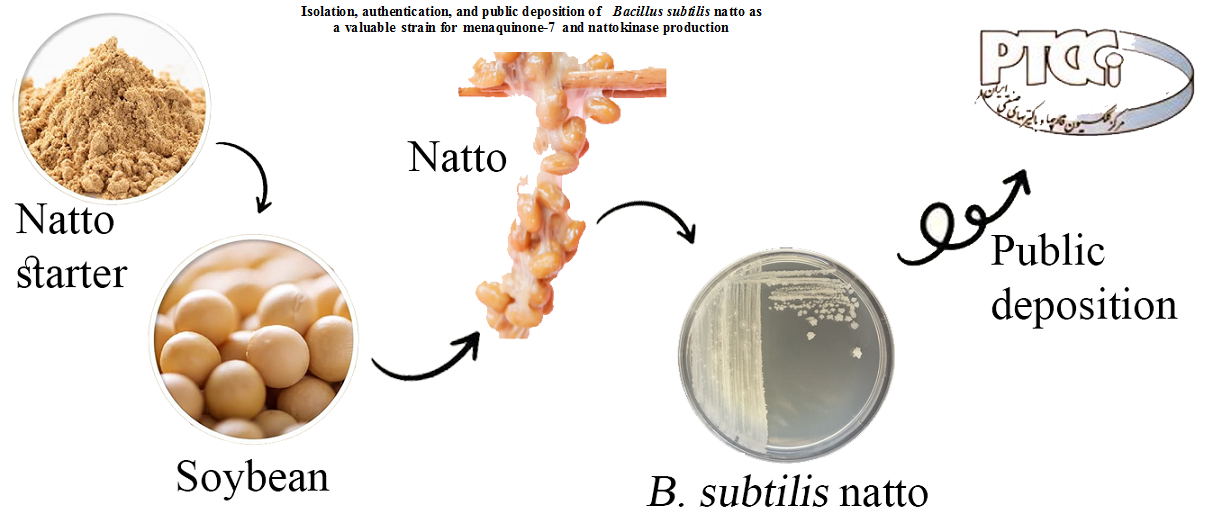
Unprocessed soybean seeds were used to prepare natto. For this purpose, 20 grams of dry soybean seeds were soaked in water for 24 hours. A 500 mL Erlenmeyer flask containing the soaked seeds was sterilized in an autoclave under conditions of 121°C and 15 psi for 15 minutes. On the other hand, 0.02 g natto starter was dissolved in 1.5 mL sterilized deionized water. Once the flask had cooled to ambient temperature, natto starter was spread over the soybean seeds. The opening of the flask was covered with several layers of sterile gauze, and the flask was incubated at 35°C for 48 hours. After this period, the soybean seeds were fermented, and natto with an appropriate sticky consistency was obtained.
2.4. Isolation
Natto (1 g) was combined with 9 mL of sterile normal saline, and low-speed centrifugation was used to remove solid particles (100 g, 1 min). The supernatant was used as the bacterial suspension. To reduce the concentration of bacterial cells, the obtained suspension was serially diluted six times, each time at a ratio of 1:9 with sterile normal saline. To destroy vegetative cells and any possible contaminants, the resulting dilutions were subjected to heating in a water bath at 80°C for 15 minutes. In the next step, 100 microliters of each dilution were evenly spread onto an 8 cm Petri dish containing nutrient agar supple-mented with 5% pasteurized milk. Following 24 hours of incubation at 35°C, the grown culture was used for single-colony isolation by streaking in a quadrant streak pattern, followed by re-incubation at 35°C. After 24 hours, single colonies that resembled Bacillus in colony morphology were isolated.
The bacterial isolate was identified through a three-stage approach. Initially, physiological and biochemical assays were performed at the Biotechnology Research Center, Shiraz University of Medical Sciences, Shiraz, Iran. Subsequently, molecular analyses were carried out at the Iranian Biological Resource Center (IBRC, Tehran, Iran). Since none of these approaches alone could resolve the isolate to the species level, the combined physiological, biochemical, and molecular data were used to achieve species-level identification. Accordingly, in the third stage, all physiological, biochemical, and molecular tests were repeated at the Persian Type Culture Collection (PTCC), where species-level identification was successfully achieved. A detailed account of each identification stage was provided in the following. To ensure accuracy and transparency, the results from each center were reported exactly as originally stated by that center.
2.5. Differential Staining
The isolated single colonies were subjected to differential staining. After Gram staining and confirming that the selected colonies were Gram-positive, spore staining was performed using malachite green. The pre-sence of spores inside the bacillus-shaped cells, the posi-tion of the spore within the cell, and the relative size of the spore to the bacterial cell diameter was noted.
2.6. Biochemical Examinations
Biochemical and phenotypic profiling of the isolate was conducted in accordance with the standard identification schemes provided in Bergey's Manual of Systematic Bacteriology [16]. In this regard, citrate utilization, starch hydrolysis, gelatin hydrolysis, hydrogen sulfide produc-tion, salt tolerance (at concentrations of 5%, 7%, and 9%), catalase activity, Voges-Proskauer (VP), glucose fermenta-tion, mannitol fermentation, and nitrate reduction tests were conducted.
2.7. Molecular Evaluations
To achieve molecular identification, 16S rRNA gene sequencing was performed. For this purpose, DNA extraction was carried out using a modified Marmur method with a commercial kit available for DNA extraction (DNP KIT, Sinaclon, Tehran, Iran). PCR was performed using universal primers 27F (AGAGTTT-GATCMTGGCTCAG) and 1492R (GGTTACCTTGTTA-CGACTT) to amplify a fragment of the 16S rRNA gene sequence, the resultant PCR product underwent electro-phoresis using a 1% agarose gel. Finally, the DNA fragment with a size of about 1500 nucleotides was extracted and sent to the Iranian Biological Resource Center (IBRC, Tehran, Iran) for sequencing. Sequencing was performed using DNA analyzers sequencing (Bioneer, 3730XL, Korea) according to the Sanger method. Raw for-ward and reverse reads were processed and edited using Chromas Pro software (Technelysium, Australia). Low-quality bases at both the 5′ and 3′ ends, as well as ambiguous or erroneous bases, were trimmed manually. The quality-filtered reads were then aligned and assembled into a single consensus contig based on their overlapping regions. The assembled 16S rRNA gene contig was subse-quently queried against the EzBioCloud database (https://www.ezbiocloud.net/) to determine the closest type-strain matches and to assign the isolate to the appropriate taxonomic group. Resulted sequence was also deposited in the National Center for Biotechnology Information (NCBI, US) database.
2.8. MK-7 Assay
A colorimetric method was used to evaluate the capacity of the isolate to produce MK-7 [17]. First, a 0.5 McFarland standard was obtained using a cultured plate. A 50 mL Erlenmeyer flask holding 18 mL of Mueller-Hinton broth was then inoculated with 2 mL of the standardized bacterial suspension. The culture was incubated at 37°C with agitation at 150 rpm. Following a 4-day incubation period, the broth was centrifuged at 10,000g for 10 minutes, and the resulting supernatant was collected and employed as the MK-7 test sample. Uninoculated Mueller-Hinton broth was used as blank (negative control) and a solution of vita-min K that was prepared from vitamin K ampoules (Phyto-menadione, vitamin K1, 10 mg/ml, Kanavit) was used as control (positive control). To perform the MK-7 assay, MTT (400 µM) and NaBH₄ (300 mM) solutions were first prepared using a 7 mM sodium hydroxide solution. The concentration of MK-7 was measured in a 96-well plate. For this purpose, 50 µL of the test sample, 100 µL of MTT solution (400 µM), and 50 µL of NaBH4 solution (300 mM) were mixed in the wells. The plate was subsequently agitated by swirling for a duration of 30 seconds and then incubated at ambient temperature. The plate was then allo-wed to stand for 2 minutes, after which the absorbance was measured at 540 nm with a microplate reader (Biotech, USA). A calibration curve, established using vitamin K ampoules (Phytomenadione, vitamin K1, 10 mg/mL, Kanavit), was employed to convert the recorded absor-bance values (a.u.) into concentration units (µM). Although vitamin K1 was used as the calibration standard for practical and stability reasons, the colorimetric assay is not specific for MK-7 and thus provides an indirect estimate of MK-7 production, which is reported in K1-equivalents.
2.9. Protease Activity Assay
A casein plate method was used to evaluate the capacity of the isolated to produce protease enzyme [18]. For this purpose, a 0.5 McFarland standard suspension was first prepared. To prepare the casein plates, 2% agar and 5% ultra-high-temperature (UHT) processed milk were used. The milk was added to the agar solution after autoclaving and before it completely cooled. After preparing the casein plates, a 6 mm diameter well was made in the center of each plate. In the next step, 30 µL of the 0.5 McFarland standard was poured into the well. After incubation for 24 h at 37°C, halo formation was assessed by visual inspection of the agar plates, and the width of the cleared hydrolysis areas was subsequently quantified.
2.10. Statistical Analysis
All evaluations in regard to MK-7 assay and protease activity assay were performed in triplicate using three separate cultures. Data were evaluated vis IBM SPSS Statistics (version 23, International Business Machine (IBM) Corp., Armonk, New York, US) and reported as mean ± standard deviation.
2.11. Isolate Registration and Deposition
The isolate was sent to the Persian Type Culture Collection (PTCC) at the Iranian Research Organization for Science and Technology (IROST, Tehran, Iran) for public registration and deposition. In this regard an active culture of the bacterial isolate on nutrient agar medium was sent to the PTCC on June 17, 2025, along with a micro-organism registration application form. At this center, the submitted isolate was re-examined using biochemical and molecular tests, and officially registered after identity confirmation.
- RESULTS AND DISCUSSION
3.1. Preparation of Natto
Fermentation of soybean seeds by the isolated bacterium led to the formation of a viscous, elastic matrix on the soybean seeds (Figure 1a). As a result of this process, the texture of the soybean seeds also became completely soft and spongy. This viscous coating was used as a rich source of bacterial cells.
3.2. Isolation
Following dilution and culturing of the bacterial suspension from fermented soybeans onto nutrient agar plates supplemented with milk, colonies appeared. Among these, colonies resembling morphology of Bacillus were selected. These colonies measured 2–3 mm in diameter, had a dull white to cream color, and exhibited wavy, filamentous margins (Figure 1b). Similar colony morpho-logy for Bacillus isolates has been previously reported [19].
3.3. Differential Staining
Gram staining and observation of bacterial cells using a compound microscope confirmed the presence of Gram-positive, rod-shaped bacterial cells, which appeared purple and were arranged in chains of varying length (Figure 2a). Spore staining revealed an elongated oval endospore in the bacterial cells (Figure 2b).
3.4. Biochemical Examinations
The physiological characteristics of the obtained bacter-ial isolate were examined using biochemical tests, and the results are tabulated in Table 2. Obtained results were fully consistent with the expected characteristics of Bacillus group.
3.5. Molecular Evaluations
Electrophoresis of the PCR product showed that the amplified sequence was approximately 1500 bp in size (Figure 3). Sanger sequencing of this amplified fragment yielded a sequence of 1367 nucleotides. The results of 16S rRNA gene sequencing showed that the studied isolate, with 1367 nucleotides, has a phylogenetic affinity of 99.9% with B. subtilis strain NCIB 3610 (accession number ABQL01000001), and 99.8% with Bacillus tequilensis KCTC13622 (accession No AYTO01000043), Bacillus cabrialesis TE3 (accession number MK462260), Bacillus inaquosorum KCTC 13429 (accession number AMXN0-1000021), and Bacillus stercoris JCM 30051 (accession number MN536904). So, the strain was approved as Bacillus sp. by the phylogenic evaluations.
A region of the sequencing that overlapped between both forward and reverse reads, a sequence of 837 nucleotides, was deposited in the NCBI database under accession number PQ459382, available at the following URL:https://www.ncbi.nlm.nih.gov/nuccore/PQ459382.1.
3.6. MK-7 Assay
In previous studies, the amount of MK-7 produced by B. subtilis was measured using high-performance liquid chromate-graphy (HPLC). However, a colorimetric method has also been developed for determining the con-centration of this compound [17]. The principle of this method involves the reduction of MTT, resulting in the for-mation of purple formazan and measuring the absorbance at 540 nm. To convert the absorbance values into MK-7 concentration, a standard curve was plotted by vitamin K1. Using this method, the MK-7-producing ability of the isolate was indirectly determined, and the results were rep-orted as equivalents of vitamin K1. The MK-7 production capacity of the obtained isolate was calculated equal to 3.806 ± 0.413 µM of vitamin K1.
3.7. Protease Activity Assay
Ability of the isolated bacteria to produce the enzyme protease was evaluated using the casein plate method. For this purpose, after inoculating the isolate on casein plates and incubating for 24 hours, bacterial growth resulted in the formation of clear zones in the agar medium. These clear zones are due to the secretion of the enzyme protease and the subsequent hydrolysis of casein present in the milk. As shown in Figure 4, the isolate was able to grow on the casein plate and develop a casein hydrolysis zone. The clear zone produced by this isolate measured as 12.5 ± 0.7 mm. It should be noted that the diameter of the well in the agar was 6 mm. Although casein plate method is usually employed for the nattokinase activity assay [18], but results could not be considered as sole nattokinase activity. However, correct interpretation is to consider nonspecific protease activities.
3.8. Isolate Registration and Deposition
Isolated bacterium was sent to PTCC for approval evaluations and registration. In this regard, the isolate was re-examined through identification evaluations. Confirm-ation letter was received from PTCC on April 23, 2026 and the isolate has been registered under accession number PTCC 1987. The confirmation letter declared that based on the molecular analysis (16S rRNA analysis), it was determined that the isolate belongs to the Bacillus group. Given the high similarity of the aforementioned gene between members of this group, further molecular analyses are needed to accurately determine the bacterial species. The submitted isolate will be stored in the Center's General Collection and distributed to researchers and technologists of the country upon request in accordance with legal regulations. Information related to this isolate would be published on the Center's website as follows. "Dr. Ebrahiminezhad A.; Biotechnology Research Center; Shiraz University of Medical Sciences. Isolated by Dr. Karami A. et al. from Japanese Natto fermented food; prepared by Kawashimaya Natto starter. Produces Nattokinase. 16S rRNA analysis shows this isolate is a member of Bacillus genus."
As discussion, an isolate of Bacillus sp. from natto was successfully obtained, characterized, and publicly deposi-ted, addressing a notable gap in the accessibility of this industrially and biomedically valuable microorganism. The isolation process, initiated from traditionally prepared natto, yielded bacterial colonies exhibiting characteristic morphological features of Bacillus, including dull white to cream color, wavy filamentous margins, and the production of clear halos on milk-enriched agar, indicating casein hydrolysis. These phenotypic observations were strongly supported by microscopic examinations, which revealed Gram-positive, rod-shaped cells capable of forming subter-minal endospores which is a hallmark of the Bacillus genus.
The identity of the isolate was confirmed through biochemical profiling and 16S rRNA gene sequencing. The biochemical test results (e.g., positive for catalase, VP, starch hydrolysis, gelatin hydrolysis, and citrate utilization; negative for H₂S production) aligned perfectly with the taxonomic characteristics of Bacillus as determined in Bergey’s Manual of Systematic Bacteriology. Further-more, molecular analysis demonstrated 99.9% sequence similarity to the 16S rRNA gene of B. subtilis, providing genetic evidence for the identification. The deposition of the 16S rRNA gene sequence in the NCBI database (ace-ssion number PQ459382) and the isolate itself in the Persian Type Culture Collection (PTCC 1987) ensures long-term accessibility and traceability for the Iranian research community.
A critical contribution of this work is the quantitative confirmation that the isolate retains key functional attributes, namely the production of bioactive compounds. Using a validated colorimetric method, the isolate produced 3.806 ± 0.413 µM of MK-7. Additionally, the casein plate assay revealed significant protease activity, as evidenced by a 12.5 ± 0.7 mm clear zone of hydrolysis. These findings confirm that the deposited isolate is functionally competent for more research in regard to phar-maceutical biotechnology. Compared to some previously reported strains that require growth optimization for enhanced yields, the isolated bacteria demonstrate baseline production capacities that can serve as a foundation for future strain improvement studies [20, 21].
Bacillus isolates of fermented food origin such as natto can be suite for deployment in industrial processes and biotechnological ventures. However, it should be considered that particularly in the case of the current isolate no genomic, safety, in vivo, clinical, or production-scale validation was performed. On the other hand, due to restrictions on access to Bacillus natto strains held in culture collections, it was not possible to compare the isolate obtained in this study with strains from collections in other countries. Clearly, if access to such strains were possible, conducting phenotypic, molecular, or functional feature comparative studies could provide valuable data. Overall, this work eliminates a significant logistical barrier, restricted access to authenticated strains, and provides a well-characterized, publicly available resource to accel-erate research in microbial biotechnology, food science, and drug development.
- CONCLUSION
In conclusion, an isolate belonging to the Bacillus group was successfully obtained from natto starter and charac-terized through morphological, biochemical, and mole-cular methods. Based on the combined results of morpho-logical, biochemical, and phylogenetic analyses, together with the confirmatory evaluations conducted by the PTCC, the isolate was assigned to the Bacillus group. It should be noted, however, that the PTCC confirmation letter stated that, although 16S rRNA analysis placed the isolate within the Bacillus group, the high similarity of this gene among members of the group means that further molecular ana-lyses are required for accurate species-level determination. Accordingly, the identification reported here should be regarded as group-level assignment rather than an unequ-ivocal species-level confirmation. The isolate was publicly deposited at the PTCC (accession number PTCC 1987), with its 16S rRNA gene sequence archived in NCBI (PQ459382). The isolate demonstrated substantial MK-7 production and significant protease activity, supporting its functional value for future biotechnological research and products. By making this isolate publicly available, this study removes a key obstacle to research progress (limited access to authenticated starter cultures) and provides a foundational resource for future investigations into MK-7 and protease production, process optimization, and thera-peutic development. It should also be considered that no genomic, safety, in vivo, clinical, or production-scale validation was performed in the current experiment; so, such evaluations, together with comparison with deposited strains, represent attractive topics for future studies.
- DECLARATION STATEMENTS
5.1. Acknowledgments
The authors are great full to the Islamic Azad University (Ja.C.) for the contributions and collaborations.
5.2. Funding
Funding for the experiments conducted in this study was supplied by Shiraz University of Medical Sciences, Shiraz, Iran (Reference No. 23438).
5.3. Conflict of Interest
The authors affirm that they had no financial or personal relationships that could be construed as a conflict of interest in relation to the design, execution, or reporting of this work.
5.4. Author Contributions
A.K: Investigation, methodology, laboratory experiment-tation, and data curation, M.K. and A.V.: Supervision and methodological guidance, F.K: Conceptualization, A.E: Ideation, formal analysis, visualization, supervision, valid-ation, grant owner, writing-original draft, and writing-review and editing.
5.5. Ethical Considerations
This experiment was approved by the Iran National Committee for Ethics in Biomedical Research (Reference No. IR.SUMS.REC.1400.538; approval date 2021-10-10).
5.6. Data Availability `
The data that support the findings of this study are available from the corresponding author upon reasonable request. The 16S rRNA gene sequence generated and analyzed during the current study has been deposited in the National Center for Biotechnology Information (NCBI) database under accession number PQ459382 (https://www.ncbi.-nlm.nih.gov/nuccore/PQ459382.1). The bacterial isolate has been publicly deposited at the Persian Type Culture Collection (PTCC) under the identification number PTCC 1987 and is available to researchers and technologists upon request in accordance with the Center's legal regulations.
5.7. Use of Generative AI
Generative AI was used to translate some parts of the article into English language and also to improve the spelling, grammar and flow of the article. Finally, the text was fully checked, revised, and verified by the authors.
- Bacillus
- Fermented food
- Fermented soybeans
- Natto
Cómo citar
Citas
1. Arbab Sakandar H, Chen Y, Peng C, Chen X, Imran M, Zhang H. Impact of fermentation on antinutritional factors and protein degradation of legume seeds: A review. Food Rev Int. 2023; 39(3): 1227-1249.
2. Zhang Q, Wu J, Cheung YM, Lin Y, Deng X, Li M, et al. Deciphering the flavor chemistry of traditional and novel nattos: A multidisciplinary approach integrating amino acid profiling, volatile compound analysis, and molecular docking. Food and Humanity. 2026; 6: 101213. https://doi.org/10.1016/j.foohum.2026.101213
3. Wang C, Chen J, Tian W, Han Y, Xu X, Ren T, et al. Natto: A medicinal and edible food with health function. Chin Herb Med. 2023; 15(3): 349-359.
4. Afzaal M, Saeed F, Islam F, Ateeq H, Asghar A, Shah YA, et al. Nutritional health perspective of natto: A Critical Review. Biochem Res Int. 2022; 2022(1): 5863887.
5. Wen Z, Zhen M, Wang J, Agudamu A, Zhang Y. Habitual natto intake elevates serum MK-7 levels, enhances osteocalcin carboxylation, and supports bone density: A meta-analysis of Japanese evidence. Front Nutr. 2025; 12(2025): 1713726. https://doi.org/10.3389/fnut.2025.1713726
6. Minami Y, Kanemura S, Oikawa T, Suzuki S, Hasegawa Y, Nishino Y, et al. Associations of Japanese food intake with survival of stomach and colorectal cancer: A prospective patient cohort study. Cancer Sci. 2020; 111(7): 2558-2569. https://doi.org/10.1111/cas.14459
7. Zhang L, Wu J-l, Xu P, Guo S, Zhou T, Li N. Soy protein degradation drives diversity of amino-containing compounds via Bacillus subtilis natto fermentation. Food Chem. 2022; 388: 133034. https://doi.org/10.1016/j.foodchem.2022.133034
8. Wang H, Liu H, Wang L, Zhao G, Tang H, Sun X, et al. Improvement of MK-7 production by Bacillus subtilis natto in a novel residue-free medium by increasing the redox potential. Appl Microbiol Biotechnol. 2019; 103(18): 7519-7535. https://doi.org/10.1007/s00253-019-10044-5
9. Liao C, Ayansola H, Ma Y, Ito K, Guo Y, Zhang B. Advances in enhanced MK-7 production from Bacillus subtilis. Frontiers Bioeng Biotechnol. 2021; 9(2021): 695526. https://doi.org/10.3389/fbioe.2021.695526
10. M M, C SD. A bioprocess optimization study to enhance the production of MK-7 using Bacillus subtilis MM26. Microb Cell Fact. 2025; 24(1): 109. https://doi.org/10.1186/s12934-025-02735-8
11. Weng Y, Yao J, Sparks S, Wang KYJIjoms. Nattokinase: an oral antithrombotic agent for the prevention of cardiovascular disease. 2017; 18(3): 523.
12. Kurosawa Y, Nirengi S, Homma T, Esaki K, Ohta M, Clark JF, et al. A single-dose of oral nattokinase potentiates thrombolysis and anti-coagulation profiles. Sci Rep. 2015; 5(1): 11601. https://doi.org/10.1038/srep11601
13. Chen H, McGowan EM, Ren N, Lal S, Nassif N, Shad-Kaneez F, et al. Nattokinase: A promising alternative in prevention and treatment of cardiovascular diseases. 2018; 13: 1177271918785130.
14. Wu H, Zhang Q, Suo H, Xu F, Huang W, Wang DO. Nattokinase as a functional food ingredient: therapeutic applications and mechanisms in age-related diseases. Food Sci Hum Wellness. 2024; 13(5): 2401-2409. https://doi.org/10.26599/FSHW.2022.9250198
15. Kou Y, Feng R, Chen J, Duan L, Wang S, Hu Y, et al. Development of a nattokinase–polysialic acid complex for advanced tumor treatment. 2020; 145: 105241.
16. Kim SB, Goodfellow M. Saccharopolyspora. In: Trujillo ME, Dedysh S, DeVos P, Hedlund B, Kämpfer P, Rainey FA, Whitman WB, editors. Bergey's Manual of Systematics of Archaea and Bacteria. John Wiley & Sons; 2015. p. 1-30. https://doi.org/10.1002/9781118960608.gbm00186
17. Fukuda M, Qianjun L, Kishikawa N, Ohyama K, Kuroda N. Development of ultrafast colorimetric microplate assay method for ubiquinone utilizing the redox cycle of the quinone. Microchem J. 2019; 150: 104104. https://doi.org/10.1016/j.microc.2019.104104
18. Chandrasekaran Devi S, Vaithilingam M, Shanker R, Kumar S, Thiyur S, Babu V, et al. Exploring the In Vitro Thrombolytic Activity of Nattokinase From a New Strain Pseudomonas aeruginosa CMSS. Jundishapur J Microbiol. 2015; 8. https://doi.org/10.5812/jjm.23567
19. Pandav PV, Ahire RS, Patil SR, Pawar SB. Process development for high density cultivation yield for Bacillus subtilis. Int J Adv Multidiscip Res. 2021; 2(7): 335-339. https://journals.ijramt.com/index.php/ijramt/article/view/1171
20. Mahdinia E, Demirci A, Berenjian A. Enhanced vitamin K (MK-7) production by Bacillus subtilis natto in biofilm reactors by optimization of glucose-based medium. Curr Pharm Biotechnol. 2018; 19(11): 917-924.
21. Karami A, Kargar M, Kafilzadeh F, Vaez A, Ebrahiminezhad A. Investigating the ability of wild and preserved strains of Bacillus subtilis natto to produce menaquinone 7 (vitamin K) and nattokinase. J Microbial World. 2024; 17(58): 6-19.
- Resumen ##plugins.themes.ojsPlusA.frontend.article.viewed##: 100 ##plugins.themes.ojsPlusA.frontend.article.times##
- Pdf (English) ##plugins.themes.ojsPlusA.frontend.article.downloaded##: 22 ##plugins.themes.ojsPlusA.frontend.article.times##