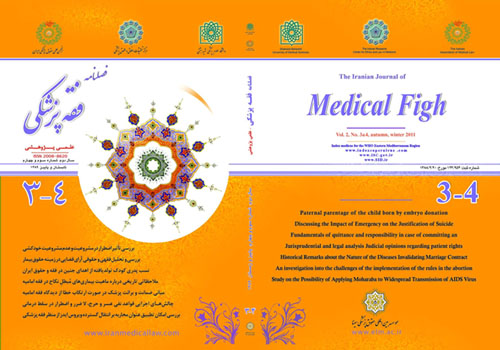
Fundamentals of quittance and responsibility in case of committing an error in Shiite Jurisprudence
Medical Figh,
Vol. 2 No. 4-3 (1389),
3 October 2010
,
Page 86-127
https://doi.org/10.22037/mfj.v2i4-3.3574
Abstract
Saving patients' lives is an important duty for physicians. Regardless of the level of a physician’s skills, there is always a possibility of damage or loss in patients’ life. In jurisprudence, there is a dispute as to whether a physician is responsible if he commits medical mistakes in the course of treatment. Some scholars believe that a physician is always responsible for damages related to his professional mistakes whether he has obtained permission or not. They base their arguments on the generality of the related narrations of ajir (hired) and juridical rules such as Itlaf (destruction), Tasbib (causing damages), La darar (denegation of harmfulness) and Qorur (deception).
On the other hand, some others believe that physicians are never responsible for such damages. They base their arguments on the Ihsan (beneficence) rule and Bara’ah (quittance) principle. They argue that physicians have not undertaken achieving the improvement result and they are merely responsible for treatment of the patients.
According to Bara’ah principle, physicians could be released from such responsibility. In other words, they are always responsible unless they obtain quittance from their patients. This argument is based on the general rules of al-osr wal-haraj (denegation of hardships) in the society along with Sokuni’s narration. In addition, the necessity of commitment to conditions is another reason for this argument. Exploring the grounds of responsibility (al-ziman) and the grounds for their release from al-ziman the latter argument proves to be more acceptable. Therefore physicians should obtain permission from the patients or their guardians before taking medical actions and also the veterinary should obtain quittance from the owner of animal. Theses evidences are stronger and they are not responsible after obtaining quittance.
Keywords
Physician, responsibility, quittance, permission, rule, isqat, talaf, ihsan, ibra’
How to Cite
- Abstract Viewed: 412 times
- PDF Downloaded: 219 times