Characterization of Probiotic Fermented Milk Prepared by Different Inoculation Size of Mesophilic and Thermophilic Lactic Acid Bacteria
食品生物技术的应用,
卷 3 编号 4 (2016),
1 七月 2016
,
第 276-282 页
https://doi.org/10.22037/afb.v3i4.13522
摘要
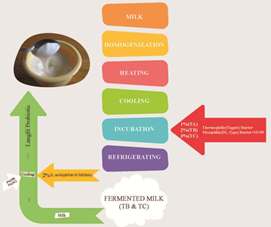
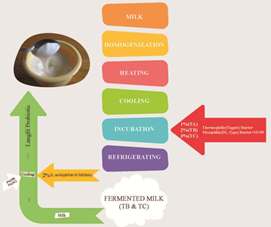
Background and Objectives: Importance of development of novel probiotic fermented milk and challenge made for its acceptability is well known. In this research, the impact of different inoculation sizes of yogurt and DL-type starter culture (mesophilic and thermophilic LAB) on titratable acidity, viscosity, sensorial and microbial properties of fermented milk was investigated; and finally, probiotic Langfil was produced.
Materials and Methods: Fermented milk produced by 1, 2 and 3% v v-1 inocula consisting thermophilic: mesophilic starter cultures 10:90 (Lactococcus lactis subsp. lactis, Lactococcus lactis subsp. cremoris, Lactococcus lactis subsp. lactis, Lactococcus lactis subsp. lactis biovar. diacetylactis and Leuconostoc mesenteroides subsp. cremoris. Streptococcus thermophilus and Lactobacillus delbrueckii subsp. Bulgaricus) were analyzed for determination of titratable acidity, viscosity, viability of mesophilic starter cultures and sensory properties on days 5, 10, and 15 of storage at 4°C. Then, the most suitable treatments were selected for the producing probiotic Langfil, containing probiotic starter culture (2% v v-1 inoculums with equal ratio of Lactobacillus acidophilus and Bifidobacterium bifidum. Lactococcus lactis and L. cremoris were counted on M17 agar, while Leuconostoc and Lactobacillus were counted aerobically on tomato juice agar and MRS bile agar, respectively. Bifidobacterium was cultured anaerobically on MRS bile agar. Sensory evaluation was carried out by ten trained panelists, based on a nine-point hedonic scale during the cold storage.
Results and Conclusion: According to results, the best organoleptic properties were achieved in the product prepared with 2% the mesophilic and thermophilic starter cultures and 2% probiotic. This product had a high viscosity. An Iranian probiotic Langfil with desired properties was produced using the best treatment prepared.
Conflict of interests: The authors declare no conflict of interest.
- Fermented milk
- Langfil
- Mesophilic starter culture
- probiotic
- Yoghurt culture
##submission.howToCite##
参考
Tamime AY, Marshall VME. Microbiology and technology of fermented milks, In: Law, B. A (eds) Microbiology and biochemistry of cheese and fermented milk. 1997; 2nd edition, Blackie Academic & Professional, London, 57-152. doi: 10.1007/978-1-4613-1121-8.
Jumah RY, Abu-Jdayil B, Shaker RR. Effect of type and level of starter culture on the rheological properties of set yogurt during gelation process. Int J Food Propert 2001; 4(3): 531-544. doi: 10.1081/JFP-100108654.
Hassan AN, Frank JF. Starter cultures and their use, In: Marth EH, Steele JL (eds), Applied Dairy Microbiology, 2001 2nd edition. Marcel Dekker, Inc, New York, 151-206.
Ruas-Madiedo P, Alting AC, Zoon P. Effect of exopolysaccharides and proteolytic activity of Lactococcus lactis subsp. cremoris strains on the viscosity and structure of fermented milks. Int Dairy J. 2005; 15: 155-164. doi: 10.1016/j.idairyj.2004.05.009.
Laws AP, Marshall VM. The relevance of exopolysaccharides to the rheological properties in milk fermented with ropy strains of lactic acid bacteria. Int Dairy J 2001; 11: 709-721. doi: 10.1016/S0958-6946(01)00115-7.
Duboc P, Mollet B. Applications of exopolysaccharides in the dairy industry, Int Dairy J. 2001; 11: 759–768. doi: 10.1016/S0958-6946(01-)00119-4.
Lin TY, Chang-Chien MF. Exopolysaccharides production as affected by lactic acid bacteria and fermentation time. Food Chem. 2007; 100:1419-1423. doi: 10.1016/j.foodchem.2005.11.033.
Ruas-Madiedo P, Tuinier R, Kanning M, Zoon P. Role of exopolysaccharide produced by Lactococcus lactis subsp. cremoris on the viscosity of fermented milks. Int Dairy J. 2002; 12: 689-695. doi:10.1016/ S0958-6946(01)00161-3.
Tamime AY, Skriver A, Nilsson LE. Starter cultures, In: Tamime AY (ed) Fermented Milks. 2006; Blackwell Science Ltd, Oxford, UK, doi: 11-52. 10.1111/j.1471-0307.2007.00321.x.
Fondén R, Leporanta K, Svensson U. Nordic/Scandinavian Fermented Milk Products, In: Tamime AY (ed.) Fermented Milks. 2006; Blackwell Science Ltd, Oxford, UK, 156-173. doi: 11-52. 10.1111/j.1471-0307.2007.00321.x.
Mistry VV. Fermented Milks and Cream, In: Marth EH, Steele JL (ed) Applied Dairy Microbiology. 2001; Marcel Dekker, Inc. US, 301-325.
Tamime AY, Saarela M, Korslund-Søndergaard A, Mistry VV, Shah NP. Production and Maintenance of Viability of Probiotic Microrganisms in Dairy Products, In: Tamime AY (ed.) Probiotic Dairy Products. 2005; Blackwell Publishing Ltd, Oxford, 39-72. doi: 10.1111/j.1471-0307.2007.00273.x.
Chandan RC. History and Consumption Trends, In: Chandan RC (Ed.) Manufacturing yogurt and fermented milks. 2006. Blackwell Publishing Ltd, Oxford, UK. doi: 10.1002/9780470277812.
Ray B, Bhunia AK. Fundamental Food Microbiology. 2007; 4th edition, CRC, Boca Raton, FL, 188-190.
Toba T, Kotani T, Adachi S. Capsular polysaccharide of a slime-forming Lactococcus lactis ssp. cremoris LAPT 3001 isolated from Swedish fermented milk 'langfil'. Int J Food Microbiol. 1991; 12(2-3):167-171. doi: 10.1016/0168-1605(91)90066-X.
Kurmann JA, Rasic JL, Kroger M. Encyclopedia of fermented fresh milk products: an international inventory of Fermented Milk, Cream, Buttermilk, Whey, and Related Products, 1992; Van Nostrand Reinhold, New York, 202-255.
Mistry VV. Fermented liquid milk products. In: Hui YH (ed.) Handbook of food and beverage fermentation technology 2004; Marcel Dekker Inc, New York, 833-847. doi: 10.1201/9780203913550.
Mistry VV. Fermented liquid milk production: Hui YH (ed.) Handbook of food science, technology and engineering 2006; Taylor & Francis Group, New York, (66)1-8.
Oberman H, Libudzisz Z. Fermented milks, In: Wood BJB. (Ed.) Microbiology of Fermented Foods, 2nd, Blackie Academic and Professional, London, 308-349 (1998). doi: 10.1007/978-1-4613-0309-1.
Cinbas A, Yazici F. Effect of the addition of blueberries on selected physicochemical and sensory properties of yoghurts, blueberry addition to yoghurts, Food Technol Biotechnol. 2008; 46(4):434-441.
Atlas RM. The Handbook of Microbiologycal Media for the Examination of Food. 2008; CRC Press, Boca Raton, 211-286. doi: 10.1111/j.1471-0307.2008.0-0358.x.
Robinson RK, Itsaranuwat P. Properties of yoghurt and their appraisal. In: Tamime AY (ed.) Fermented Milks 2006; Blackwell Science Ltd, Oxford, UK, 76-94. doi: 10.1002/9780470995501.ch1.
Varga L, Molnar-Asvanyi N, Szigeti J. Manufacturing technology for a Spirulina-enriched mesophilic fermented milk. International Scientific Conference on Sustainable Development & Ecological Footprint 2012; Sopron, Hungary, 1-6.
Kahala M, Ma¨Ki M, Lehtovaara A, Tapanainen JM, Katiska R, Juuruskorpi M, Juhola J, Joutsjoki V.
Characterization of starter lactic acid bacteria from the Finnish fermented milk product viili. J Appl Microbiol. 2008; 105(6): 1929-1938. doi: 10.1111-/j.1365-2672.2008.03952.x.
Donkor ON, Nilmini SLI, Stolic P, Vasiljevic T, Shah NP. Survival and activity of selected probiotic organisms in set-type yoghurt during cold storage. Int Dairy J. 2007; 17: 657–665. doi: 10.1016/j.idair-yj.2006.08.006.
- 摘要 ##plugins.themes.ojsPlusA.frontend.article.viewed##: 1772 ##plugins.themes.ojsPlusA.frontend.article.times##
- PDF (English) ##plugins.themes.ojsPlusA.frontend.article.downloaded##: 1756 ##plugins.themes.ojsPlusA.frontend.article.times##