Performance Evaluation of a Jug r 2-Targeted Real-Time PCR Assay in Processed and Commercial Food Matrices: Implications for Allergen Risk Management
Applied Food Biotechnology,
Vol. 13 No 1 (2026),
7 décembre 2025
,
Page 1-13 (e21)
https://doi.org/10.22037/afb.v13i1.52730
Résumé
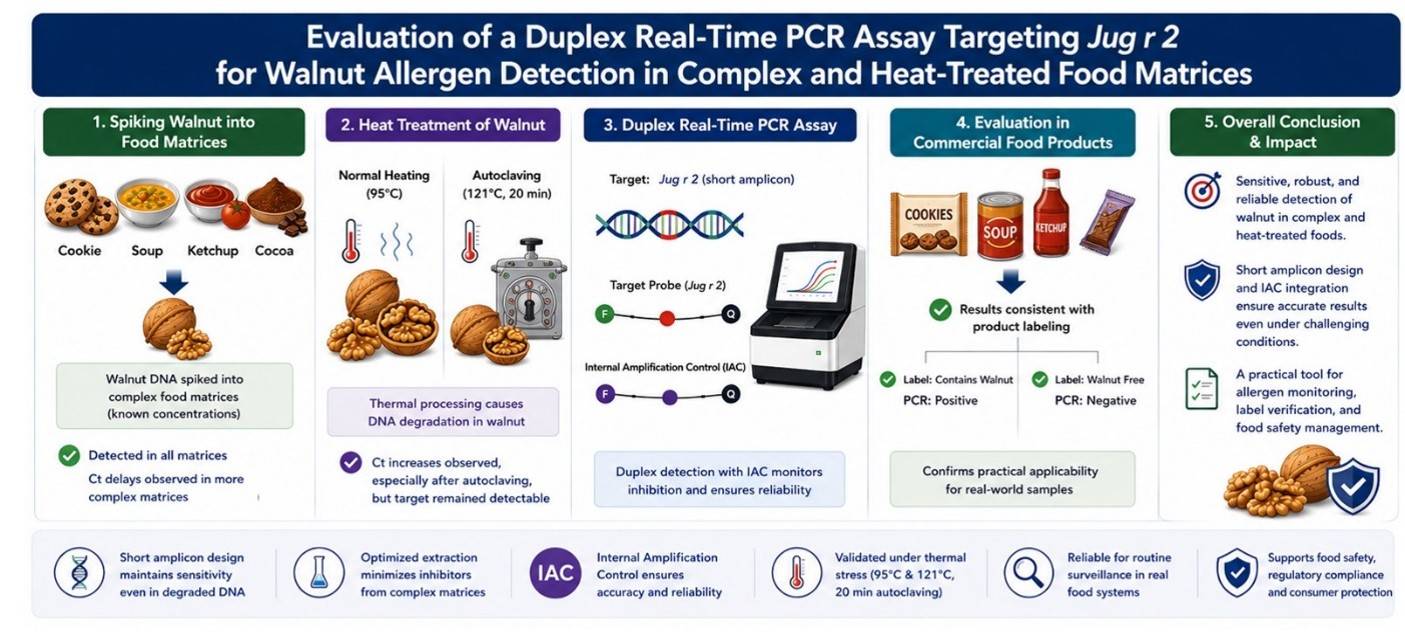
The reliable detection of walnut allergen contamination in processed foods is challenging due to matrix complexity and DNA degradation caused by thermal processing. In this study, the operational performance of a TaqMan-based duplex real-time PCR assay targeting an ultra-short region of Jug r 2 was evaluated for its applicability in complex food matrices and heat-treated samples. The assay incorporated an internal amplification control to monitor DNA extraction efficiency and PCR inhibition. The assay successfully detected walnut DNA across all spiked formulations (cookies, soup, ketchup, and cocoa). The observed matrix-dependent Ct shifts remained within acceptable limits, reflecting moderate inhibitory effects, with the highest delay observed in the soup matrix (+4.52 cycles). Thermal processing, especially autoclaving, (121°C, 20 min), induced significant DNA fragmentation, resulting in an average Ct shift of +4.78 cycles; however, the Jug r 2 target remained consistently detectable across all replicates due to the robust 88-bp short amplicon architecture. The successful detection of walnut DNA in commercial food products further validated the practical applicability of this assay for routine allergen surveillance in real food samples. Overall, this optimized duplex platform demonstrated high robustness, matrix tolerance, and commercial feasibility for the detection of walnut-derived material in processed foods, offering a practical tool for allergen monitoring, label verification, and food safety management.
- Juglans regia
- Walnut allergen
- Real-Time PCR
- Processed foods
- Food safety
Comment citer
Références
1. Tedner SG, Asarnoj A, Thulin H, Westman M, Konradsen JR, Nilsson C. Food allergy and hypersensitivity reactions in children and adults—A review. Journal of Internal Medicine. 2022;291(3):283-302.
2. Sampath V, Abrams EM, Adlou B, Akdis C, Akdis M, Brough HA, et al. Food allergy across the globe. Journal of Allergy and Clinical Immunology. 2021;148(6):1347-64.
3. Pasioti M, Xepapadaki P, Mathioudakis AG, Lakoumentas J, Efstathiou E, Papadopoulos NG. Current options in the management of tree nut allergy: A systematic review and narrative synthesis. Pediatric Allergy and Immunology. 2024;35(5):e14132.
4. Muraro A, de Silva D, Halken S, Worm M, Khaleva E, Arasi S, et al. Managing food allergy: GA2LEN guideline 2022. World Allergy Organization Journal. 2022;15(9).
5. Odisho N, Carr TF, Cassell H. Food Allergy: Labelling and exposure risks. Journal of food allergy. 2020;2(1):115-8.
6. El Hosry L, Elias V, Chamoun V, Halawi M, Cayot P, Nehme A, et al. Maillard Reaction: Mechanism, Influencing Parameters, Advantages, Disadvantages, and Food Industrial Applications: A Review. Foods (Basel, Switzerland) [Internet]. 2025; 14(11):[1881 p.].
7. Zhang Y, Lei S, Zou W, Wang L, Yan J, Zhang X, et al. Research progress on detection methods for food allergens. Journal of Food Composition and Analysis. 2025;137:106906.
8. Lozano-Ojalvo D, Benedé S. Molecular Approaches for Food Protein Allergenicity Assessment and the Diagnosis and Treatment of Food Allergies. Foods (Basel, Switzerland). 2023;12(6).
9. Hoffmann-Sommergruber K, Pfeifer S, Bublin M. Applications of Molecular Diagnostic Testing in Food Allergy. Current Allergy and Asthma Reports. 2015;15(9):56.
10. Linacero R, Cuadrado C. New Research in Food Allergen Detection. Foods (Basel, Switzerland) [Internet]. 2022; 11(10):[1520 p.].
11. Brežná B, Hudecová L, Kuchta T. A novel real-time polymerase chain reaction (PCR) method for the detection of walnuts in food. European Food Research and Technology. 2006;223(3):373-7.
12. Schrader C, Schielke A, Ellerbroek L, Johne R. PCR inhibitors – occurrence, properties and removal. Journal of Applied Microbiology. 2012;113(5):1014-26.
13. Janská V, Piknova L, Kuchta T. Semi-quantitative estimation of the walnut content in fillings of bakery products using real-time polymerase chain reaction with internal standard material. European Food Research and Technology. 2012;235.
14. Hird H, Chisholm J, Sanchez A, Hernández M, Goodier R, Schneede K, et al. Effect of heat and pressure processing on DNA fragmentation and implications for the detection of meat using a real-time polymerase chain reaction. Food additives and contaminants. 2006;23:645-50.
15. Holzhauser T. Protein or No Protein? Opportunities for DNA-Based Detection of Allergenic Foods. Journal of agricultural and food chemistry. 2018;66(38):9889-94.
16. López-Andreo M, Aldeguer M, Guillén I, Gabaldón JA, Puyet A. Detection and quantification of meat species by qPCR in heat-processed food containing highly fragmented DNA. Food Chemistry. 2012;134(1):518-23.
- Résumé ##plugins.themes.ojsPlusA.frontend.article.viewed##: 39 ##plugins.themes.ojsPlusA.frontend.article.times##
- pdf (English) ##plugins.themes.ojsPlusA.frontend.article.downloaded##: 4 ##plugins.themes.ojsPlusA.frontend.article.times##