Advancements in Applied Food Biotechnology: Integrated Approaches in Biopreservatives, and Probiotic Delivery Systems, Two Years of Journal Experience
بیوتکنولوژی غذایی کاربردی,
دوره 13 شماره 1 (2026),
7 دسامبر 2025
,
صفحه 1-20 (e32)
https://doi.org/10.22037/afb.v13i1.53679
چکیده
Background and Aim: Faced with rising antimicrobial resistance, environmental concerns, and growing consumer demand for clean-label food products, applied food biotechnology plays a pivotal role in establishing sustainable, resilient, and health-oriented food networks. This manuscript synthesizes recent advancements across three interconnected domains: natural antimicrobials, industrial fermentation, and probiotic delivery systems.
Material and Methods: Critical analysis of the manuscript publiched in last years from Applied Food Biotechnology was performed.
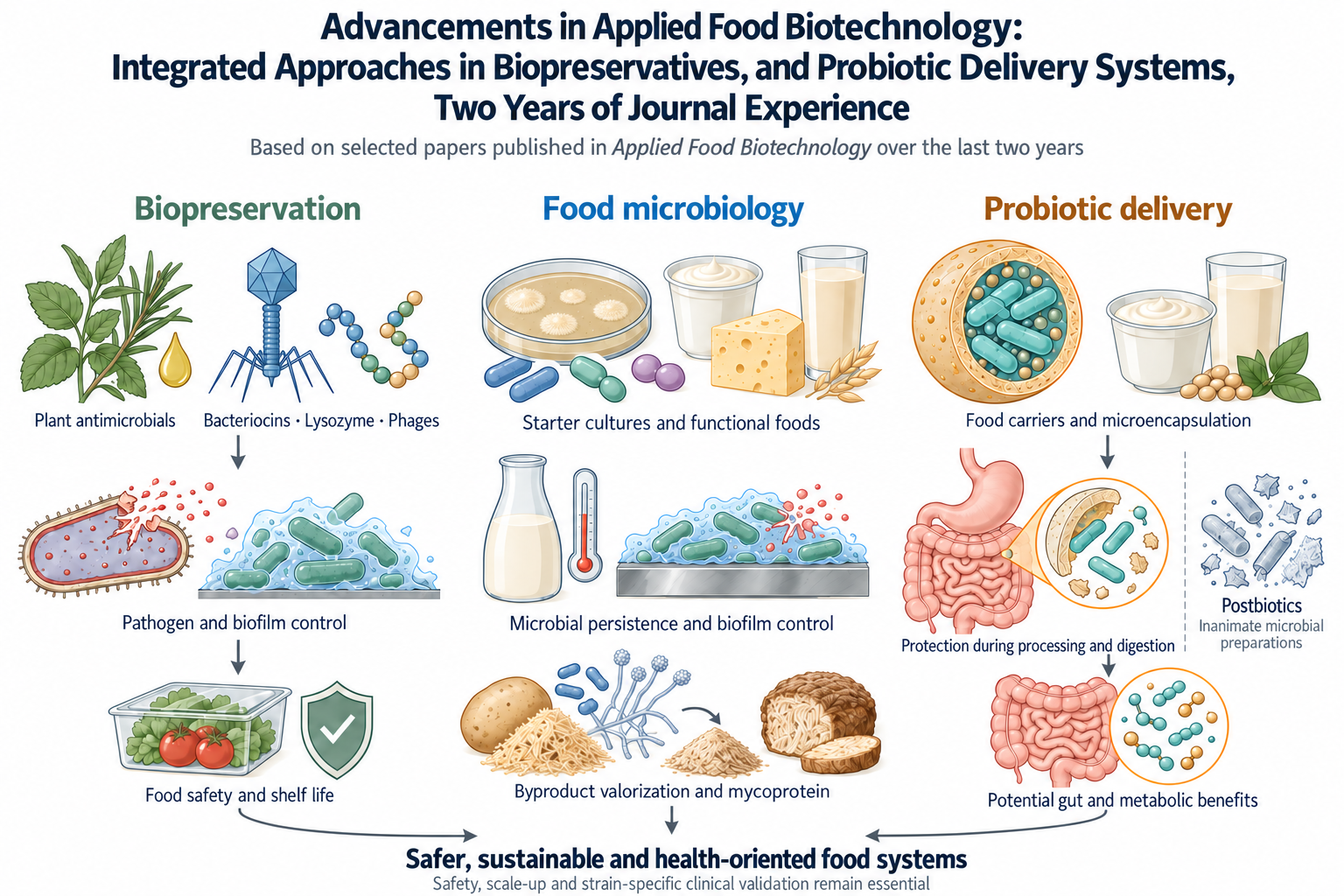
Results and Conclusion: In biopreservation, natural antimicrobials, including plant essential oils, polyphenols, lytic bacteriophages, and microbial bacteriocins, offer non-toxic alternatives to synthetic chemical additives. These bioactive compounds disrupt cell membranes and suppress quorum sensing, effectively controlling persistent pathogens such as Staphylococcus aureus, Escherichia coli O157:H7, and Listeria monocytogenes without promoting cross-resistance. Furthermore, innovations in functional food microbiology have accelerated the development of plant-based probiotics, postbiotics, and advanced encapsulation matrices. These delivery systems safeguard microbial viability during thermal processing and gastrointestinal transit, facilitating targeted delivery to support gut homeostasis, immune modulation, and metabolic regulation. Together, these multidisciplinary strategies bridge fundamental microbiology with industrial applications to build safer, sustainable food systems.
- INTRODUCTION
Knowledge is rarely built in isolation; it thrives at the intersection of diverse disciplines. In multidisciplinary fields like applied food biotechnology, progress depends on bridging microbiology, biochemistry, food engineering, and green technology. Applied Food Biotechnology is a journal that welcomes a wide variety of topics acting as a vibrant ecosystem of ideas. By bringing together research on natural biopreservatives, precision fermentation, strain engineering, and bio-nanotechnology, it reflects a core truth: variety is the foundation of modern understanding. Embracing a spectrum of perspectives breaks rigid scientific silos, encouraging cross-pollination where a discovery in one domain sparks innovation in another. Ultimately, celebrating thematic breadth equips us to navigate complex global food challenges with agility, creativity, and lasting resilience.
The modern landscape of food science, human health, and agricultural sustainability faces unprecedented challenges. The global rise of antimicrobial resistance (AMR), driven by the overuse of conventional antibiotics, poses a major threat to public health and clinical medicine. Concurrently, changing climate patterns, expanding international supply chains, and evolving consumer demands are forcing the food industry to transition away from synthetic chemical additives, artificial preservatives, and environmentally detrimental manufacturing work-flows. In response to these pressing global issues, the integration of natural antimicrobials, food microbiology, and functional probiotic delivery systems has emerged as a crucial paradigm for the next generation of safe, resilient, and health-oriented food systems.
At the center of this paradigm shift is the exploitation of natural antimicrobial compounds derived from plants, animals, and beneficial microorganisms. Bioactive molecules, such as plant essential oils, polyphenols, microbial bacteriocins, and lytic bacteriophages, offer potent, non-toxic alternatives to traditional chemical pesticides and synthetic food preservatives. Unlike single-target synthetic drugs, natural antimicrobials frequently operate via complex, multi-target mechanisms, such as bacterial cell membrane disruption, cell wall lysis, or the suppression of quorum sensing gene expression, which drastically lowers the likelihood of target pathogens developing cross-resistance. Integrating these natural biopreservatives into food matrices effectively inhibits persistent foodborne pathogens (including Staph. aureus, Escherichia coli O157:H7, Listeria monocytogenes, and Clostridium species) while extending product shelf-life and ensuring consumer safety.
Finally, the convergence of food microbiology and probiotic research continues to expand the therapeutic landscape of functional nutrition. Beyond traditional fermented dairy products, innovative plant-based matrices, postbiotic supernatants, and advanced microencapsulation technologies (e.g., electrospun nanofibers, bio-nanocomposites, and chitosan complexes) are critical for preserving microbial viability against thermal processing and gastrointestinal stress. These delivery vehicles enable targeted intestinal release, supporting host gut homeostasis, immune modulation, and metabolic regulation, such as dyslipidemia and blood glucose control [1].
Collectively, recent advancements in applied food biotechnology bridge fundamental biological research with practical industrial applications. By uniting bio-preservation, metabolic strain engineering, bioprocess optimization, and targeted functional delivery, scientific innovation continues to build sustainable, safe, and health-promoting global food networks for the future.
- ANTIMICROBIALS
Studying natural antimicrobial compounds derived from plants, fungi, bacteria, and marine organisms is critical in addressing some of modern medicine's greatest challenges. On other side, as conventional antibiotics face declining efficacy due to the global rise of antimicrobial resistance (AMR), drug-resistant superbugs threaten public health. Natural products provide a vast, untapped chemical landscape containing unique bio-active molecules that can serve as templates for next-generation pharmaceuticals.
Beyond human medicine, research into natural antimicrobials plays a vital role in agriculture and food security. Applications of natural antimicrobials is essential in production of food products where help to reduce traditional chemical preservatives and to respond to the demands for more natural and healthier food commodities. Plant-based essential oils, polyphenols, and microbial bacteriocins offer non-toxic alternatives to synthetic chemical pesticides and artificial food preservatives. Integrating these bio-preservatives helps inhibit foodborne pathogens, extend shelf life, and reduce consumer exposure to synthetic chemicals. Furthermore, natural antimicrobials often exhibit complex mechanisms of action, such as targeting bacterial cell membranes or disrupting quorum sensing, making it harder for microbes to develop resistance compared to single-target synthetic drugs. Investigating these compounds unlocks sustainable solutions across medicine, agriculture, and industry [2-4]. Thus, is not surprising that in last one year, several papers published in Applied Food Biotechnology were available on exploring different aspects of natural antimicrobials as effective tools in controls of pathogens and spoilages in food and clinical areas.
Staph. aureus is one of the most cited pathogens related to clinical and food safety aspects that poses persistent food safety challenges due to its widespread prevalence and heat-resistant enterotoxins [5]. Finding appropriate antimicrobials to control Staph. aureus is challenge. Wang et al. [5] suggested applications of purified egg-white lysozyme and reported on strong catalytic activity log-phase Staph. aureus. Authors [5] reported on that expressed mode of action can be considered as primarily bacteriolytic, hydrolyzing peptidoglycan bonds in the bacterial cell wall, which results in membrane collapse and intracellular leakage. In addition, thermal modification under optimized conditions (90 oC for 15 min at pH 6.2) can significantly enhance this antibacterial performance, boosting overall inhibition against S. aureus by 35.1 % to achieve 82.5 % total efficacy compared to the native enzyme. Moreover, authors explored possibilities for synergistic interactions with phenolic compounds, combining ferulic acid with lysozyme provides superior inhibition. And reported in possible mechanisms on activations of effective enzymatic cascade.
Talking about food borne pathogens, one of the serious problems is contamination with E. coli O157:H7, extremely low infectious dose (fewer than 10 to 100 CFU), and capacity of this painvolvedto be involve in severe human illness such as hemorrhagic colitis and hemolytic-uremic syndrome [6]. In perspective on rise of antimicrobial resistance and the limitations of traditional chemical or physical decontamination methods, application of lytic bacteriophages can be a solution for control of E. coli O157:H7, as phages can offer a highly specific, natural alternative for biocontrol in food, including meat systems. In work of Molaei Gharamaleki et al. [6], authors evaluated single-phage treatments and demonstrate strong, dose-dependent bactericidal action. Even with high initial contamination level of 107 CFU/mL of E. coli O157:H7 on beef, application of single-phage treatment (phage tf1) at a multiplicity of infection (MOI) of 0.1 eliminates 65 % of bacteria within 20 minutes at room temperature, while increasing the dose to an MOI of 100 achieves a 99 % reduction. Moreover, if exposure period was increased to over 60-minute, single-phage application yields a 93.5 % reduction at MOI 10, a 99 % reduction at MOI 100, and complete (100 %) bacterial elimination at MOI 1000. All these results served as proof for efficacity of phage treatment. Moreover, authors suggested that phage cocktails (comprising phages tf1, tf2, and sc) can be even more effective, bringing cell counts below clinical transmission thresholds. In addition, authors explored not only efficacity of phage mode of actin versus E. coli O157:H7, but pointed on role of factors as temperatures, confirming that while lower temperatures slow lysis kinetics, refrigeration inherently limits initial bacterial binding.
Molaei Gharamaleki et al. [6] suggested a novel and creative packaging intervention, spraying phage suspensions directly onto commercial low-density polyethylene plastic wrap provides effective surface delivery and proved beneficial consequences in reduction of E. coli O157:H7. Long-term stability assessments confirm that phage tf1 retains consistent plaque-forming ability and structural integrity during 7 months of refrigerated storage at 4 oC.
Clostridium sprorogenes is other food born pathogen with relevance to human and other animals health. In study of Seyfollahi et al. [7] the antimicrobial activity of cell-free supernatants (CFS) obtained from yeast strains isolated from Kombucha were explored regarding antimicrobial properties. Seyfollahi et al. [7] focused on antimicrobials produced by strains belonging to the species Candida parapsilosis. CFS of two Cand. parapsilosis strains demonstrated potent anti-clostridial effects, reaching inhibition rates of up to 99 % and 75.17 % versus C. sprorogenes, respectively.
Kombucha is a natural fermented beverage and has won scientific attention in last decades based on several beneficial properties that may bring to consumers. In study of Shahrampour and Naji-Tabasi [8] clearly stated that the fermentation of herbal infusions with Kombucha starter cultures significantly affected microbiological, chemical, functional, and antimicrobial profiles, transforming standard plant teas into bioactive functional beverages. Changes in microbial populations were evaluated in different kombucha formulations (green tea (GTK), black tea (BTK), lemon verbena (LVK), and Shirazi thyme (STK)), where acetic acid bacteria (AAB) dominated the microbial microflora, and reached log CFU/mL between 6.59 ± 0.47 and 7.35 ± 0.35. In addition, presence of lactic acid bacteria (LAB) was between 104 and 105 CFU.mL-1, while yeasts recorded around 5.29 ± 0.36 and 5.43 ± 0.35 log CFU.mL-1. All this resulted in shift in acidity. From other side, the biochemical transformation during fermentation more than doubled the total phenolic content (TPC) compared to unfermented controls. Shahrampour and Naji-Tabasi [8] suggested that fermentation also contribute to robust antimicrobial capabilities as consequence of combinations of pH, phenlic compounds, antimicrobials produced by microbial cultures and provide evidence taking in consideration antimicrobial effects recorded only in fermented products against Aspergillus niger or Aspergillus flavus, and Gram-negative bacteria such as E. coli or Salmonella enteritidis. Regarding antibacterial performance, Staph. aureus proved highly susceptible
Salmonella is a very robust food borne pathogen with relevance to human health. As Gram negative microorganisms, Salmonella spp. are not sensitive to effect of bacteriocins (including nisin) from Gram positive, including that produced by LAB. However, combination between nisin and other natural antimicrobials can be a strategy for inhibition of Salmonella spp. and this was explored by Adam et al. [9], where combination between nisin and allicin was shown to be effective versus Salmonella Typhimurium ATCC 13311 at minimum inhibitory concentrations (MIC) of 0.031 mg.mL-1 and 0.016 mg.mL-1, respectively. Moreover, their combination demonstrated strong synergistic activity with a fractional inhibitory concentration index (FICI) of at reduced concentrations of 0.008 mg.mL-1 nisin and 0.004 mg.mL-1 allicin. In addition, time-kill inactivation kinetics was shown. Authors [9] suggested that outer membrane permeability is disrupted by allicin and further can facilitate nisin's penetration to cause cytoplasmic enzyme leakage and target the inner cell membrane. As challenged study, Adam et al. [9] confirmed efficacity of combined application of nisin and allicin in fresh chicken meat model, after inoculation with 105 CFU.mL-1S. Typhimurium and provided evidence for pathogen significant reduction compared to controls.
Bacteriocins can play essential role in biopreservation of food products, however, there production needs to be optimized, and recombinant technologies and heterologous expression can be one of the possible large scale applications. Rukying et al. [10] reported on the functional characterization of a heat-stable recombinant LCI 5.05 kDa bacteriocin. Authors successfully expressed in E. coli BL21(DE3) pLysS and purified the bacteriocin, yielding 0.18 mg.mL-1 of active protein. Moreover, expressed recombinant bacteriocins demonstrated broad-spectrum antibacterial activity, with minimum inhibitory concentrations (MICs) of 50 μg.mL-1 versus against Gram-positive bacteria (Micrococcus luteus, Staph. aureus, and Bacillus subtilis) and 100 μg.mL-1 against test Gram-negative pathogens (S. Typhimurium, E. coli, and Vibrio parahaemolyticus). Bacteriocinogenic activity was enhanced when combined with 0.03 % acetic acid. Stability testing revealed that recombinant LCI retains thermal resistance up to 100 oC for 15 min, maintains activity across a broad pH range of 3.0 to 11.0, and preserves efficacy in the presence of 0.5 to 2.0 % bile salts.
A plant extracts has been always parts of the antimicrobials explored by human preservation practices. Sahraei et al. [11] reported on extraction of essential oils from Rosa damascena applying an ultrasound-assisted steam distillation, followed by its subsequent formulation into a nano-emulsion and observed high bioactive retention alongside strong antimicrobial performance. Specifically, performed chemical analysis via GC-MS showed a rich volatile profile dominated by a long-chain alkane mixture of hexacosane, tridecane, and eicosane (27.81 %), followed by heneicosane (20.74 %), citronellol (10.02 %), tetradecane (8.70 %), geraniol (1.52 %), and -pinene (1.39 %). It is interesting to point out that primary technological advancement in this study was achieved through a single-step, continuous recirculating system combining high-shear homogenization and ultrasonic sonication, which produced nano-emulsion with distinct physical characteristics. Authors implemented FTIR spectroscopy and morphological analysis via SEM, revealing that while the droplets remained discrete in liquid suspension, they coalesced into a continuous, smooth film upon drying. Moreover, in antimicrobial evaluations, the nanoemulsion demonstrated an effective MIC of 15,000 ppm (1.5 %) against both Gram-negative (E. coli) and Gram-positive (Staph. aureus) bacteria. At a Minimum Bactericidal Concentration (MBC) of 30,000 ppm, complete bacterial eradication was achieved for E. coli, while substantial growth inhibition was observed for Staph. aureus. Overall, these findings highlight the continuous system's efficiency in producing a stable, nanoscale essential oil delivery mechanism with strong antibacterial efficacy suitable for natural food preservation applications.
The antimicrobial activity of LAB from fish origin were further explored by Prima et al. [12]. The study demonstrated that five homofermentative rod-shaped LAB isolates, designated as IR2.2, IR2.4, IR4.1, IR4.3, and IR4.5, presented a strong potential probiotic potential. Authors [12], reported that microbial cultures studied retained high viability even after been exposed to simulated gastric acid at pH 2.5 and presence of bile salt. However, among all 5 candidates, isolate IR4.3 displayed the most significant antimicrobial efficacy, most probably associated with production of bacteriocin with robust activity against E. coli ATCC0157 and Staph. aureus ATCC25923, compared to that of commercial antibiotics such as penicillin, kanamycin, and ampicillin. The identification based on 16S rRNA gene sequencing identified isolate IR4.3 as Limosilactobacillus (Lactobacillus) fermentum.
Afshari et al. [13] explored antimicrobial properties of CFS from two probiotic cultures from Lactiplantibacillus plantarum and Lacticaseibacillus casei against common foodborne pathogens and their application in preserving pasteurized cheese. Afshari et al. [13] provided evidence that in in-vitro agar-well diffusion assays, both CFS containing antimicrobials inhibited different strains of Listeria monocytogenes, Staph. aureus, and E. coli in a concentration-dependent manner. Overall, the Lpb. plantarum antimicrobials demonstrated significantly stronger antimicrobial activity than those from Lbs. casei, particularly against Gram-positive bacteria. Based on performed Gas chromatography-mass spectrometry (GC-MS), were identified presence of several organic acids, fatty acid esters, and phenolic compounds, suggesting being contributing to the observed antimicrobial effects.
Furthermore, Afshari et al. [13] applied to cheese inoculated with L. monocytogenes (1 × 10⁵ CFU.g-1) during 10 days of refrigerated storage at 4 °C, the crude CFS obtained from Lpb. plantarum CFS and reported that treatment significantly reduced pathogen growth, total microbial counts, and mold/yeast counts compared to control samples (p < 0.05). The maximum reduction in L. monocytogenes relative to the control reached 0.80 log CFU.g-1on day two.
- 3. FOOD MICROBIOLOGY
Food microbiology is a vital subdiscipline of biological sciences that explores the dynamic interactions between microorganisms and food systems. It bridges fundamental biology, biochemistry, and human health by investigating how bacteria, fungi, and viruses influence food safety, preservation, and quality. Beyond mitigating foodborne pathogens and spoilage, the field harnesses beneficial microbes for fermentation, probiotics, and bio-based ingredients like exopolysaccharides. As global populations rise and food supply chains expand, food microbiology plays an essential role in biotechnology and food security, transforming biological principles into practical solutions that safeguard human health and advance sustainable food production and is essential in development of new fermented food products [14-15].
Earlier this year, Khosravi-Darani et al. [16] already pointed in their editorial paper on importance of biotechnological research and close relations with food microbiology, where new products and safety are always in crossing points, highlighting key biotechnological innovations with focus on creation of sustainable, resilient, and health-oriented food systems to address global challenges such as population growth, climate change, and resource constraints. In this regards, novel microbial strains are being engineered to enhance flavor profiles, organoleptic qualities, and nutrient bioavailability in fermented products. Applied microbiology and advances in probiotic research continues to expand into plant-based matrices, postbiotic coatings, and advanced delivery systems, that can better protect probiotic viability under thermal and gastrointestinal stress. In enzyme engineering, studies report the optimization and design of thermostable phytases, alkaline -amylases, and computational milk-clotting peptides to boost nutritional quality and industrial processing efficiency [16].
Khrundin [17] evaluated the physicochemical, rheological, and sensory changes in rice-based beverages produced by combining enzymatic pre-hydrolysis ( -amylase) with lactic acid fermentation using Lactobacillus delbrueckii subsp. bulgaricus. In cited study [17] author tested two solid-to-liquid ratios (hydromodules 1:2 and 1:3 w/v) across two fermentation periods (8 and 24 h). It was reported that enzymatic hydrolysis successfully converted starch into fermentable sugars, eliminating raw cereal off-flavors and forming a stable, homogeneous dispersion. Subsequent bacterial fermentation led to rapid acidification, dropping the pH to 3.1–3.7 and increasing titratable acidity up to 34.2–90.3 °T. In next, the 1:2 hydromodule outperformed the 1:3 ratio, demonstrating higher dry matter availability, stronger network formation, and superior water-holding capacity (up to 98.5 %) with minimal syneresis (0.5–1.0 %). Textural profile analysis revealed that fermentation enhanced structural integrity, increasing internal cohesiveness by 5–6 % and improving gumminess compared to unfermented controls. While 24 h fermentation provided strong structural recovery, it resulted in excessive acidification, leading to a sharp, unpleasant taste and lower consumer acceptance. Furthermore, sensory panels rated the 8-hour fermentation at a 1:2 ratio (sample 1:2_8h) as the most optimal, receiving the highest overall acceptability score (29 points). This sample combined balanced acidity, a rich and coating mouthfeel, high viscosity (1026 cP), and an appealing flavor profile. Conversely, 1:3 formulations were perceived as overly watery and lacking body due to lower solid contents. Correlation analysis and principal component analysis confirmed that both the hydromodule ratio and fermentation time heavily influence product quality, with higher viscosity, cohesiveness, and moderate acidification driving consumer preference. Overall, combining enzymatic hydrolysis with an 8 h Lab. bulgaricus fermentation at a 1:2 rice-to-water ratio offers a promising method for developing high-quality, plant-based functional beverages [17].
When new dairy products are developed, scientists try to combine beneficial and organoleptic characteristics in perfect match, creating products that fits to consumer preferences. Bigelow et al. [18]. In their study, Bigelow et al. [18] evaluated the effects of incorporating licorice extract (0 to 0.6 %) and caffeine (60 to 100 mg per 100 mL) into a probiotic fermented beverage made from whey and apple juice. The results supported hypothesis that higher concentrations of licorice extract and caffeine exerted are acting in synergistic effect on the viability of the probiotic strain Lpb. (Lactobacillus) plantarum, resulting in increasing bacterial counts from 6.27 to 7.79 Log CFU.mL-1. Moreover, this supplementation enhanced as well total phenolic content from 125.87 to 164.16 mg GAE.g-1 and antioxidant activity (evidenced by a drop in IC50 values from 145.46 to 112.26 µg.mg-1), alongside an increase in viscosity from 142.62 to 168.36 mPa.s-1. Furthermore, was recorded decrease in pH from 4.26 to 4.17 and sample even product lightness (L* from 53.74 to 46.1) due to darker pigment accumulation. However, while both additives modified color parameters, only licorice extract induced a statistically significant increase in redness (a*). Moreover, from a sensory perspective, the formulation containing 0.3 % licorice extract and 80 mg caffeine achieved the highest overall acceptability, striking an optimal balance in flavor and appearance without off-notes. Overall, combining licorice extract and caffeine successfully enhances the functional, physicochemical, and sensory quality of probiotic fermented beverages during storage [18].
Work of Bagherikia et al. [19] investigated some aspects in nutritional and functional valorization of potato pulp, an agro-industrial byproduct, through solid-state fermentation (SSF) using Lms. (Lactobacillus) fermentum combined with the fungi Aspergillus oryzae or Rhizopus oryzae in simultaneous and two-step strategies. Authors [19] reported that when applied into the simultaneous fermentation probiotic viability of Lms. fermentum was improved, and furthermore, co-culture with A. oryzae reaching the highest crude protein content (15.91 % on a dry matter basis). In contrast, treatments involving R. oryzae resulted in a reduction in crude protein content. In addition, Bagherikia et al. [19] explored possibility for implementation of the two-step process (with fungal pretreatment followed by bacterial fermentation) and demonstrated that these approaches can be considered as the most effective for improving pulp functionality and digestibility. The two-step sequence using R. oryzae followed by Lms. fermentum yielded the best results in total phenolic content (1011 mg gallic acid equivalents per gram of dry matter) and antioxidant capacity (97.01 % DPPH radical scavenging and 934.9 µmol Trolox in the ABTS assay). Additionally, the two-step approaches in both explored research combinations (R. oryzae and Lms. fermentum or A. oryzae and Lms. fermentum) provided the highest values for organic matter digestibility and metabolizable energy. Furthermore, authors applied scanning electron microscopy analysis and confirmed that the two-step fermentations caused the most severe microstructural dismantling of the potato pulp's rigid matrix and starch granules, facilitating nutrient release. In conclusion, Bagherikia et al. [19] suggested that simultaneous inoculation optimizes protein and probiotic viability, whereas the two-step process with R. oryzae maximizes functional value, making fermented potato pulp a promising supplement for animal nutrition.
Dairy products are one of the most studied by food microbiologists and as well may be most popular among consumers, including applied as vectors for delivery of beneficial, including probiotics cultures to the consumers. With objective to select new starter cultures for cheese industry, Zebboudj et al. [20] explored the effects of commercial mixed starters and a natural whey starter on the physicochemical, microbiological, and sensory properties of a semi-traditional Algerian Edam-type cheese produced under controlled hygienic conditions. Authors have given focus on three distinct formulations in their research: Formulation 1 used a combination of commercial mesophilic, thermophilic, and red smear cultures; Formulation 2 utilized natural whey from a previous batch; and Formulation 3 combined mesophilic and red smear cultures without thermophilic bacteria. As was expected, the choice of appropriate combination of starter cultures significantly affected cheese yield, brining duration, and physicochemical attributes. Zebboudj et al. [20] reported that omitting thermophilic bacteria in Formulation 3 resulted in the highest yield (14.56 %) and lowest moisture content (33.82%) but required the longest brining time (7 h 30 min). However, Formulation 1 had the lowest yield (11.24 %) and shortest brining time (5 h 37 min), alongside the highest fat (20.00 %) and ash contents (2.40 %). While, Formulation 2 recorded the lowest pH (4.80) and highest titratable acidity (20.70 °D) due to enhanced lactic acid production, resulting in the highest moisture content (38.10 %). It was relevant observations by Zebboudj et al. [20] that based on performed microbiological evaluations confirmed, the absence of pathogenic species, including E. coli, Staph. aureus, and Salmonella, across all cheese samples, was stated, verifying the effectiveness of proper pasteurization, good manufacturing practices, and the natural antimicrobial action of LAB. Moreover, sensory evaluations demonstrated that Formulation 1 yielded the highest overall organoleptic quality, presenting a smooth texture, light-yellow appearance, pleasant cheesy aroma, and a balanced flavor profile. Formulation 2 displayed characteristics typical of traditional fermented dairy products, such as higher perceived acidity and a softer texture, offering an authentic traditional profile. Formulation 3 exhibited a drier appearance and lower flavor intensity. Overall, the findings show that combining traditional whey reuse with commercial cultures can optimize cheese quality and yield while preserving local traditional identity and safety standards [20].
In work evaluating the essential role of starter cultures in yoghurt preparation, Tayeb et al. [21] evaluates the population kinetics and physicochemical profiles during the 8-hour fermentation of Algerian goat milk using Strep. thermophilus and Lb. bulgaricus starter cultures, the only legitime combination of starter cultures required by regulations if the fermented milk will be called yoghurt. Initial bacterial populations for Strep. thermophilus and Lb. bulgaricus start at 0.62 × 10⁷ CFU.mL-1 and 0.30 × 10⁷ CFU.mL-1, respectively. Strep. thermophilus grows rapidly in the early stages (reaching 386.50 × 10⁷ CFU.mL-1 by 4 h), initiating milk acidification and establishing favorable conditions for Lb. bulgaricus. Conversely, Lb. bulgaricus expands steadily throughout the entire process, achieving a final count of 65.54 × 10⁷ CFU.mL-1 at 8 h. Tayeb et al. [21] stated that over the 8-h period, significant physicochemical transformations occur, including drops of milk pH from 6.62 ± 0.07 to a final value of 4.12 ± 0.20. Regarding titratable acidity, values rises from 15.88 ± 0.64 D to 84.75 ± 2.19 D. Moreover, viscosity increases substantially from initial unmeasurable baseline levels to 6425.00 ± 638.64 mPa s, while syneresis reaches levels of 12.75 ± 0.88 %. Applied statistical analyses using linear mixed-effects models demonstrate strong correlations between specific bacterial species and these structural changes. Lab. bulgaricus serves as the dominant driver of acidification, displaying roughly twice the acidifying capacity on pH reduction compared to Strep. thermophilus and a three-fold greater effect on titratable acidity. Furthermore, Lab. bulgaricus exerts a major influence on texture, showing a primary role in viscosity enhancement, largely attributed to exopolysaccharide production and proteolysis, while also correlating positively with syneresis. In conclusion, Strep. thermophilus initiates early acidification, while Lab. bulgaricus governs the ultimate acidification, texture, and structural parameters of fermented goat milk, fact known from the centuries, but now clearly explored and mapped for the goat milk yoghurt preparation and pointed on essential adjustment of the ratio between these two strains enables effective optimization of industrial production processes [21].
Role of naturally produced aroma compounds have always been critical point in selection of starter cultures. The study of Safari et al. [22] explored the biosynthetic capacity of Lactobacillus helveticus and Enterococcus faecium strains isolated from traditional Iranian yogurts to produce key aromatic compounds, with specific focus on acetaldehyde and diacetyl, both as single cultures and in co-culture combinations. According to data reported by Safari et al. [22], the biochemical profiles showed that Lab. helveticus evaluated in the study were the principal producers of acetaldehyde, yielding concentrations up to 25.59 mg.kg-1. However, Ent. faecium explored in the study produced higher levels of diacetyl, reaching up to 13.20 mg.kg-1, which imparted a desirable buttery flavor and aroma to the yogurt. When cultured together, the presence of Ent. faecium slightly increased the overall output of both flavor compounds and significantly enhanced sensory evaluation scores for taste, color, and texture. Moreover, in addition to flavor development, studied Ent. faecium demonstrated robust salt tolerance and the ability to lower milk pH to approximately 4.0 after 14 h. Safari et al. [22] highlighted the technological potential of Ent. faecium as adjunct starter cultures merit more attention as some strains from the species can help to improve the aroma and structural characteristics of fermented dairy products.
Continuous on dairy environment, but exploring milk clotting and improvement on cheese production, Saleem et al. [23] describes an in silico pipeline for designing short, synthetic milk-clotting peptides as sustainable, thermolabile, and vegan/halal-friendly alternatives to traditional calf chymosin and microbial enzymes in cheese production. Authors [23] used as starter point, the catalytic motifs derived from the Rhizomucor miehei protease, Pepstatin A complex (PDB ID: 2RMP), and generated a library of approximately 160,000 21-amino-acid peptide variants. Appling a machine learning models (XGBoost trained on PDBbind+ and a Convolutional Neural Network trained on SKEMPI 2.0) further screened the initial variants and subsequent single-site mutants, successfully identifying candidates with high binding affinity for -casein. Furthermore, in silico filters eliminated toxic candidates and selected non-target cross-reactivity with αS1- , αS2- , and β-casein subunits to ensure targeted cleavage. Based on performed in silico screening, the computational pipeline identified two lead candidates, Pep1 and Pep2, which demonstrated exceptional performance over the reference enzyme R. miehei protease (RMP). Characterized with higher binding affinity and specificity, where Pep1 and Pep2 exhibited significantly higher predicted -casein binding affinities ( for Pep1 and for Pep2 at 40°C) compared to RMP ( at 45 °C). Both peptides showed vastly improved specificity scores (-10.85) versus RMP (0.85); Thermolability, where Pep1 and Pep2 displayed lower melting indices (-4.05 and -3.09, respectively) than RMP (0.17). Molecular dynamics simulations confirmed optimal structural stability, hydrogen bonding, and compact geometry at 40°C, with progressive destabilization occurring above 50°C and thermal melting temperatures ( ) below 55 °C. This reduced heat tolerance allows the enzymes to be easily inactivated by post-clotting, preventing residual proteolysis that typically causes bitterness and texture defects during cheese aging. However, an experimental laboratory approach will need to be conducted to confirm in silico results suggested by Saleem et al. [23].
Milk fermentation serve as generation of different beneficial bioactive peptides, explored for centuries from traditional medicine. However, from the prism of 21 century knowledge mechanisms of these benefits can be revealed. In this regards, Yusuf et al. [24] investigated the antidiabetic potential of functional bioactive peptides generated by fermenting A2 cow’s milk by Lbs. rhamnosus RAL43. In results reported by Yusuf et al. [2] was shown that Lbs. rhamnosus RAL43 displayed high proteolytic activity, releasing significant quantities of peptides into the whey fraction during a 24-h fermentation period. In vitro assays demonstrated that the resulting whey fraction effectively inhibited key digestive enzymes involved in carbohydrate breakdown and postprandial blood glucose spikes. Specifically, it exhibited 66.35 %I inhibition against α-glucosidase, 68.87 %against α-amylase, and 10.69 %against dipeptidyl peptidase-4 (DPP4). Size-fractionation via ultrafiltration indicated that the primary enzyme-inhibiting activity resided within the >10 kDafraction. Moreover, proteomic screening using high-resolution liquid chromatography-mass spectrometry identified multiple bioactive peptide fragments derived mainly from β-casein. Part of recorded proteins included five potential DPP4-inhibiting peptides (notably VLVLDTDYK) alongside 14 other peptides possessing diverse health benefits, such as ACE-inhibitory, anti-oxidant, antimicrobial, and hypocholesterolemic prop-erties. Furthermore, the molecular docking simula-tions confirmed that the previously mentioned VLVLDTDYK peptide successfully binds to the DPP4 protein. The docking poses showed that while the peptide forms stable hydrogen bonds, hydrophobic interactions, and salt bridges with DPP4 residues, it binds outside the main active site, which explains the moderate in vitro DPP4 inhibition observed. Moreover, Yusuf et al. [24] clearly suggested that fermenting A2 milk with Lbs. rhamnosus RAL43 can yield functional bioactive peptides capable of suppressing carbohydrate-digesting enzymes, supporting its potential application as a starter culture to develop functional foods for blood glucose regulation and Type 2 diabetes management.
Amino-acid composition plays an important role in nutritional and health promoting properties of fermented dairy products, where starter cultures have an essential role. Nodtochii et al. [25] studied shabat, a fermented camel milk products, collected across four regions of Western Kazakhstan (Atyrau, Aktobe, Mangystau, and West Kazakhstan) and reported on specificity of amino acid composition. Tested shabat samples were prepared according to national quality standards of Kazakhstan, displaying a fat content ranging from 5.47 % to 6.69 % (exceeding minimum standard requirements by 1.5 to 2 times) and protein levels between 2.14 % and 3.21 %. In performed biochemical analysis was recorded that essential amino acids comprised 43 % to 46 % of the total amino acid content across all samples, consistent with global benchmarks. However, despite a high proportion of overall essential amino acids, regional variations in specific limiting amino acids constrained the protein's overall biological value. It is reported that histidine served as the first limiting amino acid in samples from Atyrau and West Kazakhstan (with amino acid scores of 56 % and 53 %, respectively). Conversely, leucine was the primary limiting amino acid in samples from Aktobe and Mangystau (scores of 76.4 % and 71.8 %). Additionally, elevated concen-trations of phenylalanine, tyrosine, and tryptophan, how-ever, which exceeded FAO/WHO reference values by two- to three-fold, further created a nutrient imbalance. The more important take home message stated by Nodtochii et al. [25] was underscore how local environmental condi-tions, camel diets, and regional husbandry practices infl-uence the nutritional completeness of shubat dairy product.
Milk is highly nutritive food product, however, as well serving as excellent nutritional source for different pathogenic and spoilage microorganisms. Rozhkova et al. [26] evaluates the limitations of standard pasteurization procedures (72 oC ± 2) and the potential of biocontrol agents to eliminate Pseudomonas aeruginosa, a psychrotrophic, opportunistic pathogen responsible for milk spoilage. Standard short-time pasteurization regimes applied in industrial conditions (20 to 60 sec), including used in cheese production proved insufficient to completely eliminate both the reference strain (P. aeruginosa ATCC 25668) and a farm-isolated wild-type strain (P. aeruginosa 47). Although a 20-second exposure reduced cell counts, surviving viable cells resumed growth during subsequent refrigerated storage at 6 oC ± 2. Moreover, by day 7 of storage, bacterial populations rebounded significantly, reaching cell counts up to 3.5 × 10⁶ CFU.mL-1 and causing visible spoilage, including surface film formation and color changes, by day 14. When authors [26] performed microscopic examination revealed heat-induced adaptive mechanisms known to be typical for Pseudomonas spp., such as cell elongation and filamentous chain structures, driven by heat-shock response proteins and disaggregates like ClpG were observed. Thermal exposure trials applied by Rozhkova et al. [26], demonstrated that extending pasteurization to 15 minutes at 72 oC ± 2 uccessfully achieved complete bacterial inactivation, with no growth detected after 14 days of refrigerated storage, whereas 5- and 10-min exposures still allowed post-treatment recovery. Moreover, In parallel, co-cultivation experiments identified beneficial LAB as potential biocontrol agents to complement heat treatment. Strains of Lbs. helveticus (Bbn4 and NK1) exhibited strong antagonistic activity, inhibiting P. aeruginosa growth by up to 70–84 % after 48 h. This antimicrobial effect is largely attributed to organic acid production, iron-chelating properties, and peptidoglycan-degrading enzymes. Ultimately, the study of Rozhkova et al. [26] advocates for an integrated safety strategy in dairy processing that combines optimized, longer thermal processing regimes with protective LAB cultures to effectively prevent P. aeruginosa persistence and spoilage.
Dhan, an Algerian traditional fermented butter, was explored regarding variety of LAB community involve in his fermentation [27]. Authors provided a comprehensive characterization of the LAB community in 9 authentic Dhan produced from raw cow’s milk in Northwestern Algeria (Tiaret and Tissemsilt regions of Algeria), where LAB loads average of 4.92 ± 0.47 log CFU.g-1 when cultured on MRS agar and 4.52 ± 0.77 log CFU.g-1 when M17 agar was applied as growth media. Microbiological quality assessments showed moderate, acceptable microbial populations, with total aerobic mesophilic microbiota averaging 2.04 ± 0.27 × 10⁴ CFU.g-1, alongside acceptable limits for total coliforms, fecal coliforms, yeasts, and molds, a hygienic important markers. Across 18 isolated bacterial strains, phenotypic and biochemical profiling using (unfortunately) only the API50CHL system classified the isolates into three primary genera: Lactobacillus (73 %), Lactococcus (16 %), and Leuconostoc (11 %). Species-level identification revealed six distinct strains including Lpb. plantarum (predominante species 39 %, in 7 products Lbs. casei (predominante species 17 %, in 3 products), Lactobacillus acidophilus (predominate species 17% in 3 products), Lactococcus cremoris (predominant species 11 % in products), Leuconostoc lactis (predominate species 11 % in products) and Leuconostoc mesenteroides subsp. dextranicum (predominant species 6 % in 1 products . Overall, Tayeb et al. [27] provided evidence demonstrating a rich microbial diversity in Dhan, highlighting the potential of these native LAB strains as candidates for technological applications, starter cultures, and food biopreservation.
Alternative food sources are essential areas of food microbiology. An example of this is survey conducted by Taghizadeh et al. [28]. In this bibliometric study authors analyzes 435 publications from the Web of Science Core Collection spanning 1964 to 2025 to map the scientific landscape of mycoprotein research. Scientific output grew dramatically over this period, accelerating sharply between 2020 and 2025, a period that accounts for 62.8 % of all analyzed publications. Annual output grew nearly fourfold from 19 papers in 2020 to 74 in 2025, reflecting heightened global interest driven by climate concerns, food security, and alternative protein technologies. The research field has undergone a clear thematic shift from early industrial fermentation and fungal cultivation technologies to a multidisciplinary focus encompassing food science, nutrition, health, and environmental sustainability, opening (re-opening) new avenues in supply with proteins. Despite rapid growth, critical gaps persist, including a lack of long-term human health studies, limited context-specific environmental impact assessments, and notable underrepresentation from regions such as Africa and South America. Moving forward, priority areas focus on strain engineering, synthetic biology, techno-economic scaling, regulatory harmonization, sensory optimization, and expanding international collaborations to build resilient alternative protein systems [28].
Food safety is other critical aspects, where role of chemical contamination, including pesticides, herbicides, fungicides, etc. can be crucial in validation of food products. Taghilou et al. [29] evaluated presence of pesticide residues in the environment, and they can accumulate and magnify through the food chain, entering organisms through air, water, soil, and direct contact. Taghilou et al. [29] pointed on major categories like organochlorines, organophosphates, carbamates, and pyrethroids act as endocrine-disrupting chemicals (EDCs). It was already shown that these pollutants alter gene expression, block or activate receptors, disrupt hormone synthesis, and interfere with transport proteins. Exposure to EDCs triggers severe health issues, including reproductive failure, thyroid dysfunction, metabolic diseases (such as diabetes and obesity), and various cancers. Normally conventional food processing techniques, including washing, peeling, boiling, and cooking, often achieve only partial surface removal and fail against systemic pesticides embedded in food matrices. Advanced processing technologies like ultrasonication, ozonation, and cold plasma face limitations include high setup costs, nutrient loss, and may alternate sensory traits. Additionally, standalone bioremediation using native microbes or plants operates slowly and struggles against highly persistent or toxic pesticides. Thus, Taghilou et al. [29] suggested that nano-bioremediation can provide a solution by integrating nanotechnology with biological systems like bacteria, fungi, algae, and plants. This hybrid approach typically follows a two-phase mechanism: high-surface-area nanomaterials first adsorb, catalyze, or breakdown persistent pesticides into simpler intermediate structures. Microbial consortia or immobilized enzymes then readily biodegrade these intermediates into non-toxic end products like carbon dioxide and water. Moreover, Taghilou et al. [29] suggested that specific applications can include biogenic zinc oxide nanoparticles achieving over 80% degradation of chlorpyrifos, immobilized hydrolases in magnetic zeolitic imidazolate frameworks for multi-pesticide removal, and bio-nanohybrid systems achieving complete lindane elimination. Beyond degradation efficiency, nano-bioremediation offers lower energy consumption, site-specific targeting, and targeted toxicity reduction. However, successful real-world application requires further research into nanoparticle safety, soil pH impacts, metabolite toxicity, long-term ecosystem effects, and scalability.
The review article by Al Ghamdi et al. [30] examines the mechanics, risks, and biocontrol strategies associated with bacterial biofilm formation in the food industry, particularly within meat processing environments. Proc-esses of biofilms develop occur through a four-step process, attachment, colonization, maturation, and dispersion, where bacterial cells adhere to biotic or abiotic contact surfaces like stainless steel, plastic, and rubber. Within these structures, microorganisms secrete extra-cellular polymeric substances that form a protective barrier and are involved in formation of the biofilm. This matrix significantly enhances microbial resistance, allowing embedded pathogens to tolerate stress, evade host immune responses, and exhibit a 10- to 1000-fold increase in antimicrobial drug resistance compared to their planktonic counterparts. Authors of the review paper [30] pointed out that some of the most problematic foodborne pathogens (including Gram-negative species such as E. coli, Salmonella spp., and P. aeruginosa, as well as Gram-positive bacteria like L. monocytogenes and Staph. aureus) are also capable of forming resilient biofilms. Moreover, when biofilm was formed, these facilitate cell-to-cell communication via quorum sensing and even promote horizontal gene transfer, which drives the rapid dissemination of multidrug resistance across multispecies populations.
How can the biofilms be treated? Conventional chemical sanitizers (e.g., chlorine compounds, hydrogen peroxide, ozone) and physical treatments (such as steam heat or non-thermal plasma) often fail to eliminate mature biofilms due to poor matrix penetration, ingredient damage, chemical residues, and emerging bacterial tolerance. To overcome these limitations, green biological strategies are increasingly emphasized. Enzymes like proteases, cellulases, and -amylases degrade the EPS architecture to dislodge embedded cells. Bacteriophages and phage-derived enzymes (such as endolysins and depolymerases) target specific pathogens, causing cell lysis and matrix breakdown. Additionally, LAB-derived bacteriocins and plant extracts rich in essential oils, flavonoids, and phenolics effectively disrupt cell adherence and inhibit biofilm maturation [30].
This study of Huynh et al. [31] optimized and evaluated a multi-component functional coffee blend enriched with Bacillus subtilis-fermented lotus leaves (Nelumbo nucifera), breadfruit leaves (Artocarpus altilis), lotus seeds, notoginseng flowers (Panax notoginseng), caterpillar fungi (Cordyceps militaris), and hydrolyzed collagen. Authors suggested application of solid-state fermentation of lotus leaves (107 CFU.g-1, 35 oC, 65-70 % relative humidity for 72 h) and reported achievement of 2.5-fold increase in polyphenol content and doubled lipase enzyme activity. Moreover, a second-order mixture design with response surface methodology (RSM) established an optimal formulation (approx. 20 % fermented lotus leaf extract, 9.9 % breadfruit leaf powder, 7 % lotus seed extract, 3.7 % notoginseng flower extract, 0.37 % caterpillar fungus extract, 1.7 % collagen, and ~57–58% coffee), yielding strong antioxidant capacity, effective enzyme retention, and high sensory scores. Scaling up production to a 100 kg pilot batch demonstrated product stability over 6 months (< 5 % degradation of bioactive compounds) and reduced manufacturing costs from around US$ 13 to US$ 6 per kg.
Furthermore, it was shown that this fermented drink can have beneficial properties [32]. In a 6-month randomized, double-blind, placebo-controlled trial with 127 overweight adults, daily consumption of the nutritional coffee led to statistically significant reductions in body weight (–1.40 kg), BMI (–0.50 kg.m-2), waist circum-ference (–1.00 cm), body fat (–1.40 %), and visceral fat (–8.30 cm2 compared to control groups receiving counseling alone. Significant improvements in cardiovascular risk markers were also observed, including drops in low-density lipoprotein cholesterol (LDL-C by –12.20 mg.dL-1) and total cholesterol (–17.30 mg.dL-1), with no serious adverse events reported. Furthermore, a consumer accep-tance survey of 800 participants indicated a 65 % repurchase intention, with logistic regression identifying aroma and taste as the primary drivers of consumer preference. Overall, the study demonstrates the feasibility, safety, metabolic efficacy, and market potential of this novel functional coffee for weight management and lipid profile regulation [32].
Heyndrickxia coagulans is a species, explored as beneficial culture and even some strains commercialized as probiotics. Alizadeh et al. [32] investigates the production, survival, and application of the spore-forming probiotic strain H. coagulans MTCC 5856 (formerly Bacillus coagulans) for use in functional food products. Evaluating cultivation strategies Alizadeh et al. [32], suggested a significant trade-off between vegetative growth and spore formation. While pulse-feeding glucose during fed-batch fermentation enhanced vegetative cell populations, the continued presence of glucose completely inhibited sporulation. However, in contrast, when culturing was via batch fermentation naturally triggered nutrient limitation, successfully reached 7.11 log CFU.mL-1 of heat-resistant spores. Furthermore, to safeguard spore integrity during lyophilization (freeze-drying), six cryoprotectants were evaluated by Alizadeh et al. [32]. From them, skim milk proved most effective, increasing post-drying spore viability from 63.04 % (without protectant) to 88.23 %, closely followed by sorbitol at 84.57 %. The protective effect of skim milk can be attributed to its calcium content and proteins, which stabilize cell walls and form a protective matrix that mitigates osmotic stress. Alizadeh et al. [32] also showed that the spores demonstrated high tolerance under simulated gastrointestinal stress, maintaining over 90 % survival in acidic conditions (pH 2.5 and 4.0) and exceeding 85 % survival after 24 h in simulated gastric juice (pH 2.3). Furthermore, when exposed to 0.3 % and 0.5 % bile salts over 8 h, the spores exhibited low inhibition coefficients (0.16 and 0.28, respectively), indicating excellent bile tolerance and potential for gut germination. In following, Alizadeh et al. [32] explored how incorporation into two commercial food matrices demonstrated strong long-term shelf stability at ambient temperature. After 6 months of storage, H. coagulans spores retained 85.06% viability in gelatin-based pastilles and 97.98 % viability in reconstituted coffee mix. Overall, these findings highlight H. coagulans MTCC 5856 as a highly robust, scalable candidate for shelf-stable and thermally processed functional probiotic foods [36].
- PROBIOTICS
Probiotics and postbiotics have emerged as pivotal focal points in modern microbiology, revolutionizing our understanding of host-microbe interactions and health regulation. Probiotics, live microorganisms that confer health benefits when administered in adequate amounts, have long been studied for their ability to fortify gut microbiota, enhance mucosal immunity, and suppress pathogens. However, the scientific landscape has expanded toward postbiotics, which comprise inanimate micro-organisms and their functional cell components or metabo-lites (such as short-chain fatty acids, exopolysaccharides, and teichoic acids) [33-34].
Unlike live strains, postbiotics offer distinct advan-tages in stability, targeted delivery, and safety, making them particularly valuable for immunocompromised indiv-iduals or functional food applications. Together, research into probiotics and postbiotics bridges basic microbial physiology with clinical therapeutics and industrial biotechnology. Unraveling their mechanisms not only deepens our knowledge of the human microbiome but also fuels innovative strategies for disease prevention, gut health maintenance, and novel biotherapeutics [35-37].
Probiotics can be delivered to the consumers by different vectors. This can be pharmaceutical preparations but can be different fermented (and not fermented) food products, there dairy products are one of the most traditional ones. Maddah et al. [38] have provided a review paper in Applied Food Biotechnology summarizing evidence regarding benefits of probiotic dairy products and highlighting industry challenges, consumer patterns, and regulatory priorities. It is well known fact, explored by applied microbiology, that probiotic delivered by dairy products can support gastrointestinal health, play essential role in immune modulation, and metabolic regulation, with potential adjunctive benefits for conditions like inflame-matory bowel disease, infectious diarrhea, and even controlling Helicobacter pyluri infections. The dairy matrices clearly shown that can act as optimal carriers, help in buffering probiotics during gastrointestinal transit to enhance cell survival. However, it is a well-known fact that clinical efficacy remains highly strain-specific, dose-dependent, and condition-specific, thus these are some of the criteria that further probiotics needs to be evaluated. Products generally require to be at least 106-8 CFU.mL-1 or CFU.g-1 at the time of consumption to confer claimed health benefits. And evidence needs to be provided that health benefits are clinical facts. Furthermore, a major gap exists between regulatory standards and commercial quality control. Somehow regulations, science and industry are still not well matching. Key compliance issues include strain misidentification, labeling inaccuracies, and rapid loss of microbial viability during processing and shelf life. For instance, an assessment of 18 commercial probiotic dairy products in Iran revealed that only 5.5 % met the minimum required viable bacterial count at shelf life, was reported by Maddah et al. [38]. Moreover, technical hurdles, such as maintaining oxygen-sensitive microbes (strict anaerobes), require advanced solutions like micro-encapsulation, prebiotic addition, and industrial auto-mation/digitalization. Other important points, reviewed by Maddah et al. [38] is related to consumer acceptance, that is heavily influenced by sociodemographic, product price, and knowledge levels. It is interesting to mentioned that according to Maddah et al. [38], women are primary decision-makers, demonstrating higher health awareness, while higher-income households dominate current con-sumption due to premium pricing. But maybe widespread consumer confusion persists due to unverified online information and non-standardized labeling. Maddah et al. [38] suggested that a structured stakeholder policy dialogue can emphasize key strategies to overcome these barriers, including establishing region-specific standardized reg-ulations (taking in consideration regional cultural specificity), enforcing mandatory label disclosures (genus, species, strain, and viable count at expiration), expanding public education, and providing industry incentives like grants or tax subsidies. Developing indigenous probiotic strains from traditional fermented dairy can enhance supply chain resilience, lower production costs, and facilitate sustainable growth.
Probiotics are very often associated with dairy products, as this was maybe most historical approaches explored by food industry, however, plant based delivery of probiotics is winning more and more attention from industry and consumers. In a review contribution, Nair et al. [39] highlights the shift toward plant-based probiotics (PBPs) driven by expanding vegan preferences, lactose intolerance, dairy allergies, and environmental sustain-ability demands. Yes, food industry was explored for decades with fermented dairy sources like yogurt and kefir. However, in last few years, focus was given to non-dairy substrates, including cereals, legumes, fruits, vegetables, tree nuts, and plant milks, as well as traditional fermented foods such as kimchi, sauerkraut, tempeh, miso, natto, kombucha, and pickles. These plant matrices naturally offer dietary fiber, antioxidants, and phytochemicals that synergistically support bacterial viability and host gut health. Furthermore, Nair et al. [39] pointed that plant-based food matrices and be as well source of prebiotics and provide a synbiotics environment, combining probiotic strains (e.g., Lpb. plantarum, Lbs. casei, and B. coagulans) with plant-derived prebiotic fibers like inulin from chicory root or acacia gum. This synergy/synbiotics may enhance bacterial survival during gastrointestinal transit and imp-roves therapeutic outcomes, including gut barrier integrity, short-chain fatty acid production, immune modulation, reduced cholesterol levels, and lowered inflammation. Product innovations are moving beyond beverages into functional foods such as probiotic-infused quinoa snacks, chocolates, millet biscuits, and fortifying ready-to-eat fruits. Moreover, despite these benefits, several major tech-nological and market challenges persist. Maintaining probiotic cell viability (higher then 106-7 CFU.mL+ or g) throughout shelf life and digestive transit requires strategies like encapsulation, cold-chain integrity, and pH optimization. Additionally, manufacturers face high production costs, variable plant matrices, and off-flavors, alongside consumer skepticism regarding sensory attributes and efficacy. The authors conclude that future growth relies on strain-specific clinical validation, personalized nutrition formulations, advanced delivery technologies, clear regulatory labeling, and targeted public health education to fully realize the health and environmental potential of PBPs [39].
Immune system enhancement can be consequence of probiotics mode of action. However, Dehghani et al. [40] reviewed role of selenium-enriched microalgae (such as Chlorella vulgaris and Spirulina) as a bioactive strategy to improve immune function. In his review Dehghani et al. [40] pointed on important key observations including fact that microalgae bioaccumulate inorganic selenium and convert it into organic forms, mainly selenomethionine and selenocysteine. All this offer significantly higher bioavailability and lower toxicity compared to inorganic selenite or selenate supplements. Moreover, selenium functions primarily through key selenoproteins, including glutathione peroxidases (GPXs) and the thioredoxin (Trx) system. These enzymes reduce negative consequences of reactive oxygen species (ROS) and hydroperoxides, mitigating cellular oxidative stress and maintaining redox homeostasis without damaging host tissues. Furthermore, selenium influences both innate and adaptive immune responses. It enhances the activity and cytotoxicity of natural killer cells, stimulates macrophage phagocytosis while promoting an anti-inflammatory M2 phenotype, and supports dendritic cell function. Additionally, it promotes T-cell proliferation (favoring Th1 responses) and boosts humoral immunity by increasing antibody synthesis (IgG, IgM, IgA). As well, cultivating selenium-enriched microalgae provides a sustainable, eco-friendly method to produce nutraceuticals, fortified foods (like breads, noodles, and soups), beverages, and animal feeds. This approach helps address global dietary selenium defic-iencies without requiring extensive arable land. While adequate selenium intake boosts antiviral, antibacterial, and anti-inflammatory activity, excessive selenium acts as a pro-oxidant, leading to acute or chronic toxicity. Precise dosage optimization and strict quality controls during cultivation and harvesting remain necessary to prevent heavy metal contamination or microcystins [40].
The study of Mohamadzadeh et al. [41] evaluated the enhancement of Lms. (Lactobacillus) reuteri ATCC 23272 viability and stability using an O-carboxymethyl chitosan (OCMC)-coated alginate-based bio-nanocomposite incur-porating inulin, pectin, and magnesium oxide nanoparticles (MgONPs). Using a simplex lattice mixture design, the optimal formulation was determined to be 68 % w/v OCMC coating, 29.4 % w/v inulin, and 2.6 % w/v pectin at constant concentrations of sodium alginate and MgONPs. In report of Mohamadzadeh et al. [41], the optimized microencapsulation matrix yielded a microencapsulation efficiency of 96.43% and exceptional cell survival after microwave oven drying (99.36 %). Under simulated gastrointestinal conditions, the microencapsulated Lms. reuteri ATCC 23272 maintained a survival rate of 88.95 %, significantly outperforming uncoated alginate beads which exhibited a survival rate of only 71.49 %. Furthermore, the OCMC-coated bio-nanocomposite also provided superior protection during thermal stress and long-term storage. Upon exposure to heat treatment at 80 °C for 5 minutes, viable cell of Lms reuteri ATCC 23272 counts decreased by only 1.46 log CFU.g-1 in the OCMC-coated bionanocomposite microcapsules, compared to a severe reduction of 5.91 log CFU.g-1 observed in standard alginate beads. Following 42 days of storage, the OCMC-coated formulation enhanced probiotic stability over alginate beads by 2.93 log CFU.g-1at 4 °C and by 3.25 log CFU.g-1 at 25 °C [41].
Clinical evidence for the probiotics cultures are one of the essential research confirmations. Thus, Afshar et al. [42] investigated seven potential probiotic lactobacilli strains isolated from traditional Iranian tarkhineh (Lbs. casei, Lms. fermentum, Lentilactobacillus kefiri, Compani-lactobacillus alimentarius, Lab. acidophilus, Lms. reuteri, and Levilactobacillus brevis). When tested in in vitro conditions, the strains exhibited up to 67.41 % cholesterol assimilation and 51.15 % triglyceride-lowering capacities. They displayed robust survival under simulated gastric and intestinal fluids, tolerance to phenol and lysozyme, safe antibiotic susceptibility profiles (non-hemolytic, DNase-negative), variable adhesion to Caco-2 cells, and effective antibacterial activity against common human pathogens. Furthermore, in performed a 35-day in vivo trial using high-fat diet (HFD) male Wistar rats, daily administration of the probiotic mixture (2 × 10⁹ CFU.mL-1 rat-1 significantly ameliorated dyslipidemia. Compared to HFD controls, the probiotic treatment reduced serum total cholesterol by 16.6 % and LDL-cholesterol by 56.7 %, while increasing the HDL-c/LDL-c ratio 13.2-fold (from 0.132 to 1.75). The probiotic mixture achieved triglyceride reduction that surpassed the efficacy of lovastatin. Overall, Afshar et al. [42] demonstrate that traditional fermented dairy products serve as a promising source of robust probiotic lactobacilli capable of managing dyslipidemia and metabolic disorders.
Pharmaceutical products exploring combinations of different active substances and beneficial microorganisms. This was topic of research explored by Kinanti et al. [43], where a chitosan–sodium tripolyphosphate (STPP) micro-encapsulation system designed for the co-encapsulation of Rosa damascena Mill. extract along with two probiotic strains (Lbs. casei and B. longum).
Kinanti et al. [43] reported on performed Dynamic Light Scattering (DLS) analysis showed an average particle size of 3107 ± 273.2 nm. While Scanning Electron Microscopy (SEM) confirmed smooth, well-dispersed, spherical microcapsules without aggregation, measuring roughly 2.8 to 3.4 μm in diameter. Based on SEM-EDX predominant peaks of carbon and oxygen detected from the biopolymer matrix and botanical/probiotic core, along with sodium, chlorine, and potassium, confirming effective STPP crosslinking. Furthermore, Gas Chromatography-Mass Spectrometry (GC-MS) measured a residual ethanol concentration of 2.53 % ± 0.21 (v/v) trapped within the matrix. Important attention was given to probiotic viability and during 28 days of cold storage at 4 oC, the microen-capsulated rose extract and probiotics maintained a stable viable bacterial count of 5.16 ± 0.38 log CFU mL-1 and subsequent incubation and Gram-staining verified that the encapsulated probiotic cells remained viable and capable of proliferation.
Kinanti et al. [43] evaluated bio-accessibility and digestion characteristics, where under simulated GIT con-ditions, raw rose extract suffered significant anthocyanin degradation, dropping from 42.2 μg.mL-1 to 7.1 μg.mL-1 (16.82 % bio-accessibility). Moreover, complex of rose extract and probiotic cultures improved anthocyanin recovery, achieving 25.80 % bio-accessibility post-sim-ulation. This statistically significant 9.0 % absolute increase demonstrates that the chitosan-STPP matrix effec-tively shields anthocyanins against harsh gastric conditions and facilitates controlled intestinal release. All this poin-ting that the co-microencapsulation strategy offers a viable approach for preserving probiotics and improving the targeted delivery of bioactive anthocyanins in functional foods and nutraceuticals [43].
- CONCLUSIONS
The comprehensive research collected in this volume underscores the transformative role of applied food microbiology, and natural biopreservatives in shaping safer, more resilient, and health-oriented food systems. Collectively, the studies reviewed several noteworthy trends in contemporary food microbiology research, specifically integrating biopreservatives, fermentation engineering, and probiotic delivery systems. First, there is a growing emphasis that natural antimicrobials, including plant essential oils, polyphenols, lytic bacteriophages, and microbial bacteriocins, are considered as powerful, non-toxic alternatives to synthetic preservatives and conven-tional antibiotics. By disrupting cell membranes, degrading target cell walls, and inhibiting quorum-sensing mechanisms, these bio-based interventions effectively mitigate critical pathogens like Staph. aureus, E. coli O157: H7, and L. monocytogenes without inducing cross-resistance. Ultimately, these combined innovations validate that integrating bio-preservation, metabolic strain design, and targeted delivery platforms bridges the gap between fundamental microbiological insights and comm-ercial industrial scale-up. Continued multidisciplinary collaboration, standardized international regulations, and targeted clinical validation will remain essential to fully commercialize these technologies, ensuring the delivery of sustainable, safe, and therapeutically active functional foods to global populations.
- Applied food biotechnology
- Natural antimicrobials
- Biopreservation
- Precision fermentation
- Microbial cell factories
- Probiotics and postbiotics
- Microencapsulation
- Bioactive peptides
- Food safety
- Circular bioeconomy
ارجاع به مقاله
مراجع
[1]. Aspri M, Papademas P, Tsaltas D. Review on Non-Dairy Probiotics and Their Use in Non-Dairy Based Products. Fermentation. 2020; 6(1): 30. https://doi.org/10.3390/fermentation6010030
[2]. Pinto L, Tapia-Rodríguez MR, Baruzzi F, Ayala-Zavala JF. Plant Antimicrobials for Food Quality and Safety: Recent Views and Future Challenges. Foods 2023; 12(12): 2315. https://doi.org/10.3390/foods12122315
[3]. Pandey AK, Kumar P, Singh P, Tripathi NN, Bajpai VK. Essential Oils: Sources of Antimicrobials and Food Preservatives. Frontiers in Microbiology, 2017; 7, 2161. https://doi.org/10.3389/fmicb.2016.02161
[4]. Quinto EJ, Caro I, Villalobos-Delgado LH, Mateo J, De-Mateo-Silleras B, Redondo-Del-Río MP. Food Safety through Natural Antimicrobials. Antibiotics, 2019; 8(4): 208. https://doi.org/10.3390/antibiotics8040208
[5]. Wang Y, Xu X, Wu H, Jia W, Luo J, Qiu W, Huang J, Shu Z. Purification and Antimicrobial Use of Egg-white Lysozyme against Staphylococcus aureus. Appl Food Biotechnol. 2026; 13 (1): e1 (1-12). http://dx.doi.org/10.22037/afb.v13i1.50307
[6]. Molaei Gharamaleki H, Rahmani R, Sheikhzadeh Hesari F, Zarrini G. Bacteriophage-based Biocontrol of Escher-ichia coli O157:H7 in Beef: Investigating Sprayed Wraps for Enhanced Food Safety. Appl Food Biotechnol. 2026; 13 (1): e3 (1-10). http://doi.org/10.22037/afb.v13i1.50662
[7]. Seyfollahi M, Khomeiri M, Kashaninejad M, Taheri S. Study of Antimicrobial Activity of Yeasts Isolated from Kombucha in Mitigating the Spoilage of Clostridium sporogenes in Iranian Acid-heat Coagulated Cheese. Appl Food Biotechnol. 2026; nh13 (1): e6 (1-11). http://doi.org/10.22037/afb.v13i1.51471
[8]. Shahrampour D, Naji-Tabasi S. Effect of Different Types of Herbal Infusions on Functional Properties of Kombucha Fermented Beverages: Antibacterial, Antifun-gal and Antioxidant Characteristics Appl Food Biotechnol. 2026; 13 (1): e7 (1-13). http://doi.org/10.22037/afb.v13i1.51579
[9]. Adam AS, Jiddah NU, Ajingi YS, Ngoenphoemsup N, Ruengvisesh S, Phuengjayaem S, Euanosetr J, Jongruja N. Synergistic Inhibitory Effects of Nisin and Allicin against Salmonella Typhimurium in Fresh Chicken Meats. Appl Food Biotechnol. 2026; 13 (1): e10 (1-12). http://doi.org/10.22037/afb.v13i1.51583
[10]. Rukying N, Ajingi YS, Sombuttra N, Duangkeaw P, Jiddah NU, Ruengvisesh S, Euanorasetr J, Rattanarojpong T, Pason P, Angsuthanasombat C, Jongruja N. Functional Characterization of a Novel Heat-stable Recombinant LCI Bacteriocin. Appl Food Biotechnol. 2025; 12 (1): e12 (1-11). http://dx.doi.org/10.22037/afb.v12i1.47824
[11]. Sahraei F, Ahari H, Mizani M, Mohammadi Nafchi A, Anvar A. A Novel Integrated Steam distillation Method for Producing Rosa damascene Nanoemulsions to Improve Antibacterial Activity. Appl Food Biotechnol. 2025; 12 (1): e27 (1-13). http://dx.doi.org/10.22037/afb.v12i1.50491
[12]. 12. Prima HS, Rusfidra R, Yansen F, Maulana F, Gusti MA. Characterization, Molecular Identification and Antimicrobial Activity of Lkinactic Acid Bacteria with Potentials as Halal Probiotics Isolated from Rinuak Fish (Psilopsis sp.) in Lake Maninjau, West Sumatra, Indonesia. Appl Food Biotechnol. 2025; 12 (1): e16 (1-16). http://dx.doi.org/10.22037/afb.v12i1.48364
[13]. Afshari A, Abdi-Moghadam Z. Cutting-Edge Cheese Crafting: Exploring the Benefits of Postbiotics Coating in Pasteurized Cheese Production. Appl Food Biotechnol. 2025; 12 (1): e25 (1-12). http://dx.doi.org/10.22037/afb.v12i1.50103
[14]. Isaac-Bamgboye FJ, Mgbechidinma CL, Onyeaka H, Isaac-Bamgboye IT, Chukwugozie DC. Exploring the Potential of Postbiotics for Food Safety and Human Health Improvement. J Nutr Metabol. 2024; 2024: 1868161. https://doi.org/10.1155/2024/1868161
[15]. Liu S, Zhao L, Li M, Zhu Y, Liang D, Ma Y, Sun L, Zhao G, Tu Q. Probiotic Bacillus as fermentation agents: Status, potential insights, and future perspectives. Food Chemistry: X, 2024; 22: 101465. https://doi.org/10.1016/j.fochx.2024.101465
[16]. Khosravi-Darani K, Rezaei-Savadkouhi N, Zerafati-Shoae N. Innovative Solutions in Food Biotechnology: Advancing Sustainable, Resilient, and Health-Oriented Food Systems. Appl Food Biotechnol. 2025; 12 (1): e34. http://doi.org/10.22037/afb.v12i1.52439
[17]. Khrundin DV. Physicochemical, Rheological and Sensorial Changes of Lactobacillus bulgaricus fermented rice-base product: Influence of Processing Parameters. Appl Food Biotechnol. 2025; 12 (1): e23 (1-13). http://dx.doi.org/10.22037/afb.v12i1.49480
[18]. Bigelow AA, Sedaghati M, Emtyazjoo M. Characterization of a Probiotic Whey–apple Juice Fermented Beverage Enriched with Licorice Extract and Caffeine. Appl Food Biotechnol. 2026; 13 (1): e4 (1-11). http://doi.org/10.22037/afb.v13i1.51080
[19]. Bagherikia H, Hamidi-Esfahani Z, Karimi Torshizi MA. Nutritional and Functional Biovalorization of Potato Pulp Through Simultaneous and Two-Stage Fermen-tations. Appl Food Biotechnol. 2026; 13 (1): e11 (1-13). http://doi.org/10.22037/afb.v13i1.51825
[20]. Zebboudj N, Chentouf HF, Yezli W, Boudra A. Effects of Commercial and Natural Starter Cultures on Physi-cochemical, Microbiological and Sensory Characteristics of Algerian Edam-type Cheese. Appl Food Biotechnol. 2026; 13 (1): e12 (1-8). http://doi.org/10.22037/afb.v13i1.51819
[21]. Tayeb S, Morsli A, Saadia L, Mohamed C, Khaled H, Ben Salah-Abbes J. Bacterial Population Kinetics and Physicochemical Profiles in Fermented Goat Milks: Roles of Streptococcus thermophiles ATCC19258 and Lacto-bacillus bulgaricus ATCC11842. Appl Food Biotechnol. 2025; 12 (1): e7 (1-12). http://dx.doi.org/10.22037/afb.v12i1.47532
[22]. Safari A, Tajabadi Ebrahimi M, Azari N. Study on the acetaldehyde and diacetyl producing Abilities of Enterococcus and Lactobacillus Strains Isolated from Yogurts. Appl Food Biotechnol. 2025; 12 (1): e8 (1-9). http://dx.doi.org/10.22037/afb.v12i1.47492
[23]. Saleem SS, Akinola OM, Abdul Rahman MB, Chor Leow AT, Muhd Noor ND, Salleh AB, Oslan SN. Innovative Computational Design of Sustainable Milk-Clotting Peptides for Enhanced Cheese Production. Appl Food Biotechnol. 2025; 12 (1): e19 (1-30). http://dx.doi.org/10.22037/afb.v12i1.48544
[24]. Yusuf D, Handayani R, Sulistiani, Dewi FR, Anggadhania L, Abidiy SI,Nur Kasman A.A.M. Antidiabetic Bioactive Peptides from A2 Milk Fermented by Lacticaseibacillus rhamnosus: Enzyme Inhibition and Docking Insights. Appl Food Biotechnol. 2025; 12 (1): e21 (1-15). http://dx.doi.org/10.22037/afb.v12i1.48611
[25]. Nadtochii L, Orazov A, Ryskaliyeva B, Myktybayeva R. Assessment of the Amino Acid Composition of Shubat from Western Kazakhstan. Appl Food Biotechnol. 2025; 12 (1): e28 (1-9). http://dx.doi.org/10.22037/afb.v12i1.50507
[26]. Rozhkova I, Kishilova S, Pryanichnikova N, Leonova V, Illarionova E, Petrov A. Microbial persistence in pasteurized milk: biocontrol and heat treatment optimization. Appl Food Biotechnol. 2025; 12 (1): e15 (1-10). http://dx.doi.org/10.22037/afb.v12i1.48596
[27]. Tayeb S, Saadia L, Mohamed C, Khaled H. Investigating lactic acid bacterial community of Dhan: Insights into the microbiology of western Algerian traditional fermented butter. Appl Food Biotechnol. 2025; 12 (1): e17 (1-9). http://dx.doi.org/10.22037/afb.v12i1.48504
[28]. Taghizadeh M, Hashempour-baltork F, Rastegar H. Mapping scientific landscape of mycoproteins as sustainable protein sources: a bibliometric study of trends, hot issues and innovation pathways (1964–2025). Appl Food Biotechnol. 2026; 13 (1): e15 (1-17). http://doi.org/10.22037/afb.v13i1.52244
[29]. Taghilou S, Mousavi SN, Koushki M, Chiti H, Peyda M, Amiri-Dashatan N, Farahani M. Emerging Roles of Nanobioremediation in Decreasing Endocrine Disrupting Pesticides within the Food Chain. Appl Food Biotechnol. 2025; 12 (1): e33. http://doi.org/10.22037/afb.v12i1.51169
[30]. Al Ghamdi H, Zabermawi N, Aly MM. Biofilm Formation of Foodborne Pathogens and Strategies of Its Prevention and Biocontrol: A Review. Appl Food Biotechnol. 2025; 12 (1): e4 (1-8). http://dx.doi.org/10.22037/afb.v12i1.46861
[31]. Huynh PPT, Nguyen HC, Dinh HS, Le TL, Quan QD, Le QT, Nguyen BT, Pham H, Nguyen TC, Bui MN, Tran HD. Optimization and Clinical Assessment of Nutritional Coffee Incorporating Fermented Lotus Leaves and Selected Herbal Bioactive Compounds. Appl Food Biotechnol. 2025; 12 (1): e9 (1-19). http://dx.doi.org/10.22037/afb.v12i1.47852
[32]. Alizadeh N, Babaeipour V, Tabandeh F. Enhancing the survival rate and population growth of Heyndrickxia coagulans spores for use in functional foods. Appl Food Biotechnol. 2025; 12 (1): e24 (1-13). http://dx.doi.org/10.22037/afb.v12i1.49837
[33]. Ikram A, Safdar SZ, Arshad MT, Rasheed A, Gnedeka KT. An overview of postbiotics: unveiling their distinct role in gut health. Food Agricult Immunol. 2024; 35(1). https://doi.org/10.1080/09540105.2024.2434463
[34]. Marco ML, Sanders ME, Gänzle M, Arrieta MC, Cotter PD, De Vuyst L, Hill C, Holzapfel W, Lebeer S, Merenstein D, Reid G, Wolfe BE, Hutkins R. The International Scientific Association for Probiotics and Prebiotics (ISAPP) consensus statement on fermented foods. Nature Rev Gastroenterol Hepatol 2021; 18(3): 196–208. https://doi.org/10.1038/s41575-020-00390-5
[35]. Chikindas ML, Xu D, Popov IV, Carneiro KO, Elova NA, Bekmurodova GA, Amirsaidova DA, Pepoyan A, Miralimova SM, Mitrokhin OV, Sichel LS, Tagg J, Todorov SD. Beyond Probiotics: Postbiotics for Healthy Aquaculture. Advance Science 2026; 70(1): e70326. https://doi.org/10.1002/mnfr.70326
[36]. Chikindas ML, Roopchand DE, Tiwari SK, Sichel LS, Karwe MV, Nitin N, Fagundes VL, Popov IV, Tagg JR, Lu X, Todorov SD. An integrated engineering approach to creating health-modulating postbiotics. Mol Nutr Food Res. 2025; 70(1): e70326. https://doi.org/10.1002/mnfr.70326
[37]. Zółkiewicz J, Marzec A, Ruszczyński M, Feleszko W. Postbiotics—A Step Beyond Pre- and Probiotics. Nutrients, 2020; 12(8): 2189. https://doi.org/10.3390/nu12082189
[38]. Maddah G, Mohammadi-Nasrabadi F, Tajabadi Ebrahimi M, Roustaee R, Esfarjani F. Probiotic dairy products: An overview and health policy Appl Food Biotechnol. 2026; 13 (1): e16 (1-21). http://doi.org/10.22037/afb.v13i1.52656
[39]. Nair SA, Syama A, Senan S, R Prabhu R. The Era of Plant-Based Probiotics – An Overview of Potential Benefits and Future Aspects. Appl Food Biotechnol. 2025; 12 (1): e18 (1-14). http://dx.doi.org/10.22037/afb.v12i1.48298
[40]. Dehghani A, Farhoudi F, Bigdeli Y, Ghiasi A, Ajami M. Selenium-Enriched Microalgae: A Novel Bioactive Strategy for Immune System Enhancement. Appl Food Biotechnol. 2025; 12 (1): e22 (1-22). http://dx.doi.org/10.22037/afb.v12i1.48938
[41]. Mohamadzadeh M, Vasheghani-Farahani E, Fazeli A, Shojaosadati SA. O-carboxymethyl Chitosan-coated Bionanocomposite to Enhance Probiotic Viability under Gastrointestinal Digestion, Storage and Heat Treatment Conditions. Appl Food Biotechnol. 2025; 12 (1): e10 (1-13). http://dx.doi.org/10.22037/afb.v12i1.47575
[42]. Afshar P, Amini K, Mohajerani H, Saki S. Antihyperlipidemic and Probiotic Characteristics of Novel Lactobacillus Strains Isolated from Traditional Iranian Dairy. Appl Food Biotechnol. 2025; 12 (1): e31 (1-13). http://dx.doi.org/10.22037/afb.v12i1.50629
[43]. Kinanti RG, Asiyah R, Ramadhani DN, Ratna AP, Lestari SR, Hengpratom T, Saati EA. Characterization of the Chitosan Microencapsulation of Rosa damascene Mill. Extract and (Lacticaseibacillus casei and Bifidobacterium longum) Probiotics. Appl Food Biotechnol. 2025; 12 (1): e32 (1-14). http://dx.doi.org/10.22037/afb.v12i1.46674
- چکیده مشاهده شده: 38 بار
- Pdf (English) دانلود شده: 14 بار