Improvement of Growth and Sporulation of Probiotic Bacillus coagulans Ganeden BC30 by a Two-stage Cultivation Strategy and Different Medium Compositions
Applied Food Biotechnology,
Vol. 14 No. 1 (2027),
17 Aban 2026
,
Page 1-14 (e2)
https://doi.org/10.22037/afb.v14i1.53789
Abstract
Background and objective: Bacillus coagulans is a spore-forming probiotic with significant industrial potential; however, its sporulation is known to be challenging under standard culture conditions, limiting commercial applications. This study aimed to improve sporulation of Bacillus coagulans Ganeden BC30 by a two-stage cultivation strategy. In addition, different culture medium compositions, calcium chloride supplementation, and extended incubation time were examined for improvement.
Materials and Methods: We cultured Bacillus coagulans Ganeden BC30 in MRS broth and nutrient broth. The growth curve was monitored via optical density measurements. Sporulation was evaluated using a two-stage cultivation strategy, calcium chloride supplementation, and extended incubation time. Spores were quantified by heat-shock treatment.
Results and Conclusion: Results showed that the two-stage cultivation strategy (transfer from MRS broth to nutrient broth) induced earlier sporulation, with spores detected after 24 h of cultivation; however, the number of counted spores were lower. This highlights the potential of two-stage cultivation as a promising strategy for reducing the time for sporulation. Additionally, MRS broth supported significantly higher vegetative cell growth compared to nutrient broth (p <0.05). However, sporulation was delayed in MRS broth, with no detectable spores until at least 38 h of incubation. Supplementation with 0.8 g.L-1 CaCl₂ significantly increased spore yield at 160 h compared to MRS broth alone (p <0.05). Notably, spores produced in MRS broth did not survive at 80°C, whereas those formed on nutrient agar with 10 g.L-1 D-glucose retained resistance. These findings demonstrate that while MRS broth with CaCl₂ maximizes spore yield, the two-stage strategy accelerates sporulation onset. In this study, we provided practical strategies to improve spore formation protocols that may have potential use on an industrial scale.
- INTRODUCTION
Probiotics are defined as live microorganisms that can have beneficial effects on the host body if adequate doses are used [1]. Increasing awareness of the health benefits of probiotics has driven the growth of the global probiotic market and its widespread adoption, which was estimated at approximately 77 billion USD in 2022 and is expected to increase by 14 % by 2030 [2]. According to Grand View Research, the Asia-Pacific region held the largest share of the global probiotics market (39.1%) in 2025. However, annual growth rates of 11.9% and 12.0% are projected for North America and Europe, respectively, through 2033 [3]. Probiotics have beneficial effects such as inhibition of pathogen colonization, modulation of intestinal microbiota dysbiosis, and prevention and treatment of various diseases, including neurological, cardiovascular, chronic, skin, and dental disorders [4-7]. Among probiotic bacteria, Bacillus spp. are one of the most important groups. Both vegetative cells and spores of Bacillus spp. can be utilized as probiotics [6]. Probiotic Bacillus spp. exhibit greater stability during storage, packaging, transportation, food processing, and consumption in comparison with non-spore-forming probiotics [8, 9]. Sporulation depends on cell density, intercellular communication, and quorum sensing. Sporulation leads to asymmetric division of cells that eventually results in the formation of mature spores [10, 11]. In addition, their capacity to produce a wide variety of compounds highlights the importance of probiotic Bacillus spp. in the food industry [12]. Despite these advantages, challenges remain in classifying them as probiotics. Some strains of Bacillus spp. are reported as pathogens for hosts. In this regard, recognizing a particular strain of Bacillus as probiotic requires safety assessments [13].
As a specific example, one of the most common probiotic Bacillus spp. is Bacillus coagulans. Bacillus coagulans is a Gram-positive, non-pathogenic bacterium capable of producing lactic acid [14]. This bacterium was first isolated from canned milk in 1915 [15]. The absence of genes with the potential to be pathogenic is another excellent characteristic of Bacillus coagulans that enhances its suitability as a probiotic. Moreover, it cannot transfer antibiotic resistance genes easily [16, 17].
Despite the fact that Bacillus coagulans has great potential to be an important probiotic strain, its sporulation was reported to be more difficult than other Bacillus species [18]. In addition, low yield and instability of spores have been considered challenges in the industrial production of spores of Bacillus coagulans [19]. Furthermore, the spore production and optimization process should support both cell growth and spore formation equally [20]. A two-stage cultivation strategy is a new method to increase production yield. It consists of two stages: the first focuses on biomass production, and the second focusses on the product formation [21]. Spore production with one-stage cultivation (producing spores in the same step as biomass production) resulted in a lower spore yield. For example, spores of B. atrophaeus produced with a two-stage cultivation strategy showed a 10-fold increase [22]. Additionally, different strategies have been employed to enhance sporulation in Bacillus spp. including modulation of culture medium composition and investigation of different cultivation conditions [20]. For example, optimization of the nutrient medium for Bacillus subtilis led to a two‑fold increase in spore production compared to previously documented yields [23]. Also, under calcium‑deficient conditions, sporulation was prolonged, indicating the significant role of calcium in the sporulation process of Bacillus spp. [24]. One of the main challenges in optimizing sporulation is the strong strain dependence so making the standardization of a fixed protocol is highly complex [25]. In addition, one of the significant challenges in the optimization of Bacillus sporulation for industrial purposes is population heterogeneity. Spores may exhibit heterogeneous behaviors. This variability can negatively impact the performance and reliability of spore-based products [26].
Bacillus coagulans Ganeden BC30 is a safe, GRAS strain that is used as a probiotic in many food products [27]. In various studies, this strain has demonstrated high survivability and has been shown to help in the digestion of proteins and sugars [2]. It has also been reported to provide health benefits in both human and animal studies [28, 29]. Bacillus coagulans Ganeden BC30 survived the baking process in food products, and it remained viable and retained its probiotic properties in pasta to which it had been added as a probiotic agent [2, 30]. Therefore, improving its growth and sporulation is crucial for industrial applications.
This study evaluated the growth and sporulation of Bacillus coagulans Ganeden BC30 by investigating several strategies to enhance spore formation, including a two-stage cultivation strategy, calcium and glucose supplementation, and prolonged sporulation induction. The aim was to identify practical and cost-effective protocols. Although sporulation has been studied in various Bacillus species, the specific culture conditions that improve sporulation in Bacillus coagulans Ganeden BC30 remain poorly understood.
- MATERIALS AND METHODS
Bacillus coagulans Ganeden BC30 was purchased from the culture collection of the University of Isfahan (CCUI).
2.2. Culture Media
The following culture media were used throughout the study:
- Peptone water (PW) (Ibresco, Iran) was sterilized at 121°C for 15 min at a final pH of 7.2.
- Nutrient broth (NB) (Ibresco, Iran) and nutrient agar (NA) (Ibresco, Iran) were sterilized at 121°C for 15 min at a final pH of 7.4.
- Nutrient agar supplemented with 5 g.L-1 D-glucose (NA-5G) and 10 g.L-1 D-glucose (NA-10G) were sterilized at 110°C for 10 min.
- De Man, Rogosa and Sharpe (MRS) broth (Ibresco, Iran) was sterilized at 121°C for 15 min at a final pH of 6.8.
- MRS broth supplemented with calcium chloride (CaCl₂) at a final concentration of 0.8 g.L-1 (MRS-CaCl₂) (Ibresco, Iran).
2.3. Culture Conditions
Bacillus coagulans Ganeden BC30 was cultured on solid medium using the streak plate method. After 48 h of aerobic incubation at 37 °C, colonies were transferred to liquid culture medium (nutrient broth and MRS broth). The liquid cultures were incubated at 37 °C with continuous shaking at 130 rpm for 48 h under aerobic conditions.
2.4. Sporulation Improvement
2.4.1. Effect of calcium chloride and extended incubation
To investigate the effect of calcium chloride and incubation time on sporulation, Bacillus coagulans Ganed-en BC30 was grown in MRS broth supplemented with 0.8 g.L-1 CaCl₂ (MRS-CaCl₂) [31]. The incubation period was extended to 160 h under standard liquid culture conditions (MRS broth and MRS-CaCl2 broth, at 37 °C with continuous shaking at 130 rpm with 160 mL of culture media in 500-mL Erlenmeyer flasks). At different time points (after 19, 38, and 160 h of incubation), samples were collected to enumerate vegetative cells and spores. MRS agar was used for colony recovery in this step and post-heat treatment colonies were enumerated as spores.
2.4.2. Two-Stage cultivation strategy
A two-stage cultivation strategy was used to investigate the effect of culture medium on sporulation and increase spore number. First, Bacillus coagulans Ganeden BC30 was cultured on MRS agar, and incubated aerobically for 48 h at 37 °C. Then, colonies from plates were inoculated into 500-mL Erlenmeyer flasks containing 160 mL MRS broth or MRS-CaCl₂ broth. The flasks were then incubated aerobically at 37 °C for 19 h with continuous shaking (130 rpm). When cells reached the end of the logarithmic phase (after 19 h), 10 mL of each culture (7×10⁸ CFU.mL-1 in MRS broth and 1×10⁹ CFU.mL-1 in MRS-CaCl2 broth) was centrifuged under aseptic conditions at 4000 rpm for 5 min at 4 °C. The resulting cell pellet was resuspended in 160 mL nutrient broth and incubated for an additional 24 h aerobically at 37 °C with continuous shaking (130 rpm). Both pre- and post-heat treatment colonies were enumerated. For comparative purposes, a single-stage cultivation in MRS broth, with similar total incubation time, was utilized as a control. MRS agar was used for colony recovery in this step and post-heat treatment colonies were enumerated as heat-resistant CFUs.
2.5. Vegetative Cells and Spore Count of Commercial Powder
A bacterial smear was first prepared on a glass slide. The slide was then passed through a flame. Malachite green was used as the primary spore stain and then heated for 5 min. After rinsing with water, safranin was added [32]. Finally, the samples were observed under a light microscope (Olympus) to observe the presence or absence of spores and estimate the spore-to-vegetative cell ratio. To determine the initial culturable cell and spore counts in the commercial Bacillus coagulans Ganeden BC30 powder, we used a serial dilution method. Briefly, 0.5 g of the commercial powder was suspended in 49.5 mL of Peptone Water (1:100 dilution), followed by further serial dilutions in Peptone Water. To enumerate spores, the microbial suspension was subjected to heat shock at 80°C for 10 min to inactivate vegetative cells [33, 34]. Subsequently, 100 µl of each sample was spread onto NA, NA‑5G, and NA‑10G agar plates. The plates were incubated aerobically for 48 h at 37 °C. Colony-forming units (CFU) were counted, and the results were expressed as CFU per gram (CFU.g-1) of the commercial powder. Colonies recovered after heat treatment on nutrient agar and nutrient agar supplemented with 5 and 10 g.L-1 D-glucose and were enumerated as heat-resistant colony-forming units (CFUs).
2.6. Growth Curve
To establish the growth curve of this strain, pre-cultures were prepared in nutrient broth and MRS broth using Erlenmeyer flasks. After 24 h of incubation, the pre‑culture was inoculated into fresh main culture medium (nutrient broth and MRS broth) to achieve a final optical density at 600 nm (OD₆₀₀) between 0.1 and 0.15. Bacterial growth was monitored by measuring the OD₆₀₀ every 2 h using a spectrophotometer (Eppendorf) [35]. At the end of the logarithmic (log) phase, vegetative cells were enumerated by serial dilution and plating on NA and MRS agar, and incubating aerobically at 37 °C for 48 h.
2.7. Spore Formation Assessment
To ensure the accurate counting of spores, heat treatment was applied to eliminate vegetative cells. Samples containing both vegetative cells and spores were subjected to heat shock at either 70 °C or 80 °C for 10 min before counting on solid culture media.
2.8. Statistical Analysis
Experiments used a factorial randomized complete block design with at least three independent replicates per treatment. Data were analyzed using three-way ANOVA, with culture medium, heat treatment, and incubation time as fixed main factors as well as their two-way and three-way interactions. One-way ANOVA followed by Duncan’s test was used to compare individual means, whereas comparisons between heat-treated (+ heat) and non-heat-treated (− heat) samples within each treatment were performed using a t-test. Comparisons were considered significant at p < 0.05. SPSS software (version 26) was used for statistical analysis of the data, and the graphs were generated using GraphPad Prism 10 software. Results were expressed as mean ± standard error (SE).
- RESULTS AND DISCUSSION
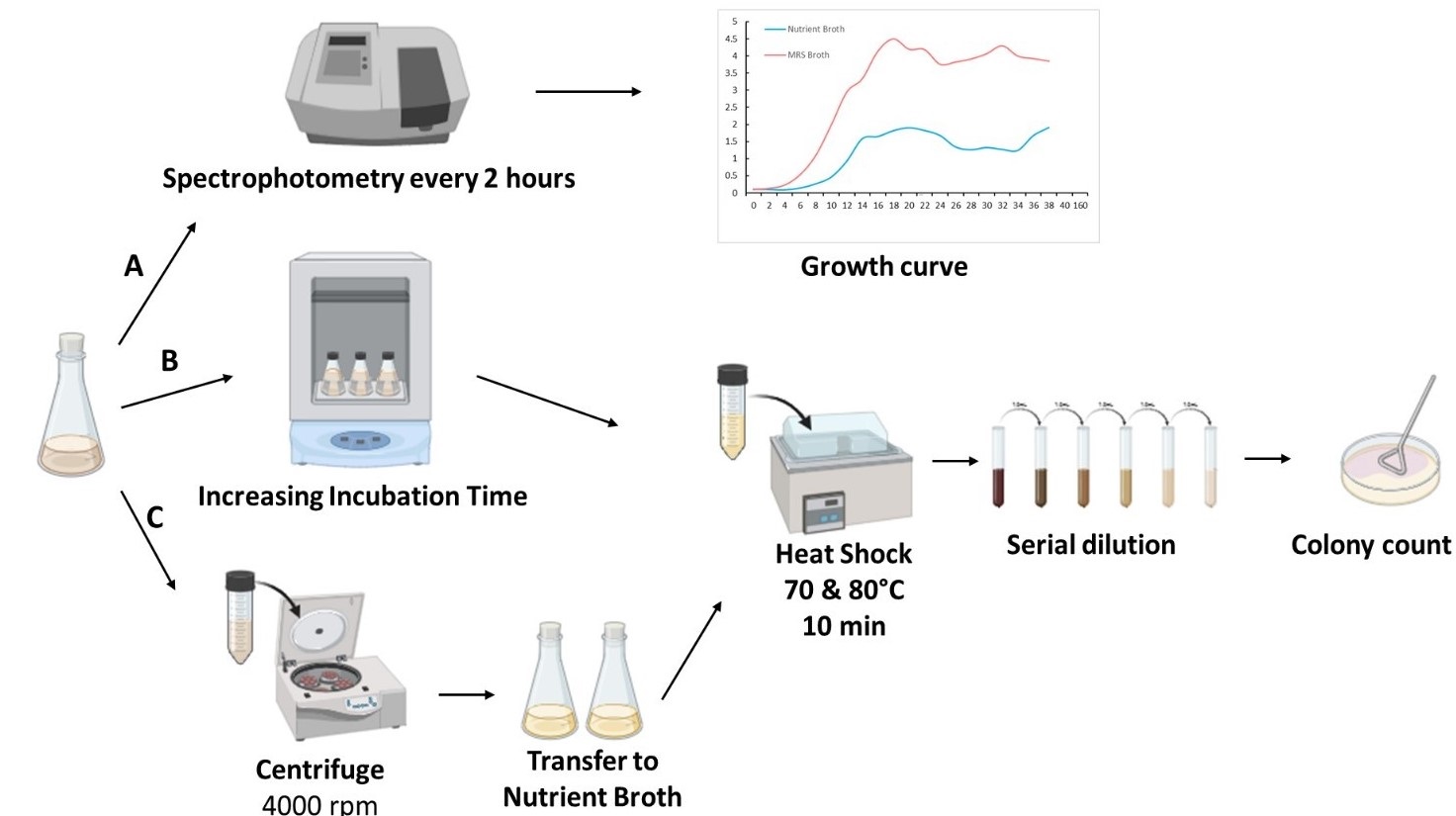
A graphical abstract summarizing the main findings of this study is presented in Fig. 1.
3.1. Morphological Characterization of Bacillus coagulans Ganeden BC30
The commercial powder appeared fine, off‑white hom-ogeneous material (Fig.2A). After cultivation on MRS agar, distinct colony morphology was observed (Fig.2B). Examination under a stereomicroscope revealed the surf-ace topography and shape of the colonies (Fig.2C). Finally, spore staining confirmed the presence of endospores, which appeared as green terminal structures (Fig.2D).
3.2. Effect of D-glucose on growth and sporulation of Bacillus coagulans Ganeden BC30
The total culturable counts (vegetative cells plus spores) and heat-resistant CFUs of the commercial probiotic powder were determined before and after heat treatment (80 °C for 10 min), respectively (Fig.3). Our findings indicate that the enrichment of nutrient agar with D-glucose resulted in higher counts of both culturable vegetative cells and heat-resistant CFUs relative to nutrient agar (p <0.05). This observation agrees with previous find-ings that a different strain of Bacillus coagulans exhibited a superior growth rate in the presence of glucose and achieved maximum growth after 8 h of cultivation [36]. Moreover, it was reported that a certain strain of Bacillus coagulans was able to tolerate high concentrations of glucose [37]. This may underscore the suitability of glucose as a carbon source for these species. Although in the present study, different D‑glucose concentrations (5 and 10 g.L-1) did not result in statistically significant differences in total culturable cell counts (pre‑heat treatment), a notable difference was observed in heat-resistant CFUs counts. Specifically, colonies enumeration after heat treatment revealed significantly higher counts on plates containing 10 g.L-1 D‑glucose compared to both NA and NA‑5G (p < 0.05). Following heat treatment, heat-resistant CFU counts on both NA and NA‑10G increased significantly compared to the corresponding counts before heat treatment (p <0.05). In contrast, NA‑5G plates exhibited a significant decrease in colony counts after heat treatment relative to pre‑heat samples (p <0.05). This unexpected result suggests that while 5 g.L-1 D‑glucose may favor vegetative cell growth, it concurrently inhibits the sporulation process. It is possible that the reduced heat-resistant CFU counts at 5 g.L-1 glucose is due to partial catabolite repression effect, although further experiments are required to confirm this hypothesis. In addition, adding D-glucose to nutrient agar increased colony recovery significantly (p <0.05). Based on our results, colony recovery was higher with 5 and 10 g.L-1 of D-glucose supplementation. D-glucose was added to the nutrient agar so it did not affect the heat resistance of the colonies.
3.3. Growth Curve of Bacillus coagu-lans Ganeden BC30
The growth curves of Bacillus coagulans Ganeden BC30 were generated and analyzed in both nutrient broth and MRS broth. Based on the growth curves, maximum cell density was achieved after 18-20 h of incubation (Fig. 4). Enumeration of cells at the end of the logarithmic phase (Table 1) revealed that the growth rate was significantly higher in MRS broth (p <0.05), with an approximately 20.07-fold increase compared to nutrient broth. This finding was further supported by the graphical represent-tation of the growth curves. These results underscore the enhanced suitability of MRS broth for cultivating Bacillus coagulans Ganeden BC30. This is possibly due to its richer nutrient composition and optimized formulation. Mean-while, nutrient broth was reported to be the least effective culture medium for the growth of Bacillus coagulans Ganeden BC30. In contrast, MRS broth illustrated significantly higher bacterial growth [38].
3.4. Sporulation improvement
3.4.1. Effect of extended incubation time
Our study showed a delay in the initiation of sporulation for Bacillus coagulans Ganeden BC30 in MRS broth, with cells not entering the sporulation process until as late as 38 h of incubation. Similar to our findings, a study investigating various Bacillus spp. indicated that B.coagulans expresses fewer sporulation proteins. Although this does not definitely prove that sporulation is more difficult, it could serve as a contributing factor [39]. Furthermore, the reduced sporulation observed in the nutrient-rich media might be due to the medium’s composition. While a richer medium promotes higher growth rates, it can sometimes lead to insufficient sporulation [20].
To improve the sporulation of Bacillus coagulans Ganeden BC30, the cultivation time was extended to 160 h (Fig. 5). Spore counts were performed after heat treatment at 70°C for 10 min. At 160 h of incubation, the number of spores reached 7.8×10⁵ CFU.mL-1, whereas no spores were detected at earlier hours. This proves that heat shock at 70°C for 10 min can eliminate vegetative cells completely; as no colonies were detected at either of the two previous time points. Pre-heat treatment colony counts showed significant dynamic changes, increasing initially and subsequently decreasing, with the lowest values recorded at 160 h. Despite this decline in vegetative cell counts, spore counts consistently increased over the incubation period. The time × heat interaction was significant (p <0.0001), however, the time × culture medium interaction was not (Table 2). This shows that in both media compositions, increasing time has led to a significant increase in the number of colonies.
3.4.2. Effect of calcium chloride supplementation
To further enhance sporulation, MRS broth was supplemented with 0.8 g.L-1 calcium chloride (CaCl₂) (Fig. 6). Similar to our previous findings, spores were not detected at 19 h and 38 h of incubation. However, the addition of CaCl₂ significantly increased spore production, reaching 9.24×10⁶ CFU.mL-1 after 160 h of incubation, representing a substantial improvement compared with MRS broth alone (Fig. 5, Table 2). Similar results were obtained, with higher sporulation rates in another Bacillus coagulans strain with the addition of calcium [19, 31]. However, a contradictory observation was reported that for a different strain of Bacillus coagulans, the addition of calcium led to a decrease in spore count by comparison with a cation-free medium [40]. The observation that calcium chloride increased spore yield without accelerating the sporulation process suggests that calcium primarily acts during the later stages of spore maturation rather than during the initiation of sporulation. The growth pattern of vegetative cells (pre-heat treatment) in MRS broth with and without CaCl₂ was similar, with maximum cell densities achieved at 38 h. However, at the same point, pre-heat treatment CFUs increased in MRS broth with calcium chloride. A significant medium × heat interaction (p < 0.0001) indicated that the effect of CaCl₂ on spore counts differed between heated and non-heated samples. The three-factor interaction was not significant (p> 0.05), suggesting a consistent pattern of colony number variation over time, regardless of heat treatment or medium (Table 2). MRS agar without calcium chloride was used for colony recovery after heat shock and calcium chloride did not affect colony recovery.
3.4.3.Two‑Stage cultivation strategy
To investigate the effect of two-stage cultivation stategy on sporulation induction, cells initially grown in MRS broth (with or without CaCl₂) were transferred to nutrient broth and incubated for an additional 24 h (Fig. 7). According to our results, remarkably, a significant increase in pre-heat treatment colony counts was observed in nutrient broth when cells originated from MRS broth without CaCl₂, compared to those from MRS broth with CaCl₂. Spores were detected after 24 h of cultivation in nutrient broth and they reached about 3×10³ CFU.mL-1 in both conditions. While these spore yields were lower than those obtained after 160 h of incubation in MRS and MRS‑CaCl₂, sporulation occurred notably earlier (24 h vs. 160 h). One possible explanation is that the reduction of the culture medium's nutrients imposes greater physiological stress on the bacterium and induces sporulation effectively. This strategy of altering culture conditions to promote sporulation has been successfully applied to other Bacillus species using various media. However, previous reports often lack detailed descriptions of the medium modifications, generally referring to the use of two-stage cultivation methods. For instance, a two-stage cultivation has been demonstrated to increase sporulation in Bacillus atrophaeus. While single-stage cultivation is more economical in terms of cost, materials, and time, the authors of that study emphasized the effective induction of sporulation in the two-stage strategy. Thus, for high spore yield, a two-stage strategy is advisable despite the longer process [41]. Similarly, a two-stage strategy was employed to improve the sporulation rate of Bacillus subtilis. Their method consisted of a basic culture medium (TSB) as the first stage and, when cells were harvested by centrifugation, transferring them to a bioreactor containing an optimized SBM medium. This approach successfully achieved both a high vegetative cell growth rate and a substantial spore yield [42]. Although this method led to earlier induction of sporulation, identifying the specific reason, whether the transfer of cells or nutrient limitation in the medium, was beyond the scope of this study. Our primary purpose was to enhance sporulation rather than to investigate its underlying mechanism and requires further studies. Overall, although spore counts were higher in commercial powder, the achieved levels through our methods were also substantial.
3.5. Spores' heat resistance
Modification of even a single parameter related to the culture conditions or medium composition for Bacillus species can lead to considerable alterations in the thermal resistance of the produced spores [26]. In this study, post-heat treatment colonies were cultivated in MRS broth, MRS broth supplemented with calcium chloride, and a two‑stage cultivation strategy. Spores were enumerated after exposure to heat-shock treatments at 70 °C and 80 °C. According to our results, no spores were detected after the 80 °C heat shock in MRS broth, MRS broth with calcium, or the two-stage strategy of cultivation, even after 160 h of incubation.
In contrast to our earlier findings, where heat-resistant CFUs on nutrient agar remained resistant to an 80 °C heat shock, spores formed in MRS broth in the present study did not retain resistance at 80 °C.
Interestingly, even in the two-stage cultivation strategy, in which sporulation occurred in nutrient broth, the spores still failed to survive the 80 °C heat shock. A previous study reported a decrease in viable spore counts of Bacillus coagulans and Bacillus subtilis following heat shock at 80°C [43]. Similarly, as results showed in another study, heat treatment might not activate spores under certain conditions and it reduced their viability when the temperature was excessive [44]. To investigate the presence or absence of spores, spore staining was performed at different time of incubation (Fig. 8); after confirmation of the presence of spores at 160 h, a heat shock at 70°C was applied.
However, modification of the culture composition increased the number of spores. Supporting our results, a change in one factor in the culture medium does not necessarily mean a corresponding change in the number of spores formed. This means, for example, at pH 10, fewer spores were formed, but these spores had higher heat resistance [24].
3.6.Future research recommendation
Future studies should investigate the molecular mechanisms underlying these observations, particularly the expression of key sporulation genes (e.g., spo0A, spoIIE) under different carbon concentrations and medium compositions. Additionally, it would be valuable to examine spore tolerance to other harsh conditions relevant to industrial and probiotic applications, such as UV radiation, extreme pH, oxidative stress, high pressure, and simulated gastrointestinal fluids. Future research should investigate various parameters such as incubation temperature, aeration rate, dissolved oxygen levels, initial pH of the medium, osmotic stress, limitation of key nutrients such as carbon, nitrogen, or phosphorus sources, supplementation with various minerals, and the use of different carbon sources to optimize and induce sporulation. Despite the potential of these approaches, sporulation in this bacterium is far from straightforward and requires much more extensive investigation.
Fig. 8. Spore staining for the investigation of the presence or absence of spores in MRS broth. A) After 3 days of incubation. B) After 7 days (160 h) of incubation.
- CONCLUSION
In conclusion, this study comprehensively evaluated the effects of culture medium composition, glucose concentration, calcium chloride supplementation, extended incubation time, and a two-stage cultivation strategy on the growth and sporulation of Bacillus coagulans Ganeden BC30. Our findings demonstrate that sporulation in this strain is highly dependent on culture conditions and requires specific optimization strategies. MRS broth, despite supporting superior vegetative cell growth, significantly delays sporulation onset, with no detectable spores. Supplementation with calcium chloride enhances spore yield compared to MRS broth alone. The two-stage cultivation strategy successfully induces earlier sporulation, although this approach yields lower number of spores compared to extended incubation in MRS broth and MRS-CaCl2 broth. Furthermore, our results reveal that high spore yield does not necessarily guarantee high heat resistance. This dissociation between spore quantity and quality highlights the importance of selecting appropriate culture conditions based on the intended application. D-glucose appeared to improve the recovery of colonies and higher numbers of heat-resistant CFUs (presumptive spores) were observed in glucose-containing media under our conditions. In contrast, MRS supported better cell growth and may therefore be more suitable when biomass production is the priority. Calcium supplementation was associated with increased cell growth and spore counts, which we speculate may be related to the role of calcium in dipicolinic acid (DPA) in spores. The two-stage cultivation strategy may therefore be useful in situations where the timing of sporulation is important, as it led to earlier formation of heat-resistant CFUs.
- Bacillus coagulans
- spore
- probiotics
- two-stage cultivation strategy
- heat resistance
How to Cite
References
[1]. Hill C, Guarner F, Reid G, Gibson GR, Merenstein DJ, Pot B, Morelli L, Canani RB, Flint HJ, Salminen S, Calder PC, Sanders ME. The International Scientific Association for Probiotics and Prebiotics consensus statement on the scope and appropriate use of the term probiotic. Nat Rev Gastroenterol Hepatol. 2014; 11(8): 506-514. http://doi.org/10.1038/nrgastro.2014.66
[2]. Payne J, Bellmer D, Jadeja R, Muriana P. The potential of Bacillus species as probiotics in the food industry: A review. Foods. 2024; 13(15): 2444. http://doi.org/10.3390/foods13152444
[3]. Grand View Research. Probiotics market size, share & trends analysis report. 2026. https://www.grandviewresearch.com/industry-analysis/probiotics-market
[4]. Filidou E, Kandilogiannakis L, Shrewsbury A, Kolios G, Kotzampassi K. Probiotics: Shaping the gut immunological responses. World J Gastroenterol. 2024; 30(15): 2096-2108. https://doi.org/10.3748/wjg.v30.i15.2096
[5]. Wieërs G, Belkhir L, Enaud R, Leclercq S, Philippart de Foy J-M, Dequenne I, Timary PD, Cani PD. How probiotics affect the microbiota. Front Cell Infect Microbiol. 2020; 9: 454. http://doi.org/10.3389/fcimb.2019.00454
[6]. Ramirez-Olea H, Reyes-Ballesteros B, Chavez-Santoscoy RA. Potential application of the probiotic Bacillus licheniformis as an adjuvant in the treatment of diseases in humans and animals: A systematic review. Front Microbiol. 2022; 13: 993451. http://doi.org/10.3389/fmicb.2022.993451
[7]. Ansari F, Pourjafar H, Tabrizi A, Homayouni A. The effects of probiotics and prebiotics on mental disorders: a review on depression, anxiety, Alzheimer, and autism spectrum disorders. Curr Pharm Biotechnol. 2020; 21(7): 555-565. http://doi.org/10.2174/1389201021666200107113812
[8]. Yin L, Chen M, Zeng T, Liu X, Zhu F, Huang R. Improving probiotic spore yield using rice straw hydrolysate. Lett Appl Microbiol. 2021; 72(2): 149-156. http://doi.org/10.1111/lam.13387
[9]. Łubkowska B, Jeżewska-Frąckowiak J, Sroczyński M, Dzitkowska-Zabielska M, Bojarczuk A, Skowron PM, Cięszczyk P. Analysis of industrial Bacillus species as potential probiotics for dietary supplements. Microorganisms. 2023; 11(2): 488. http://doi.org/10.3390/microorganisms11020488
[10]. Biermann R, Beutel S. Endospore production of Bacillus spp. for industrial use. Eng Life Sci. 2023; 23(11): e2300013. http://doi.org/10.1002/elsc.202300013
[11]. Koopman N, Remijas L, Seppen J, Setlow P, Brul S. Mechanisms and applications of bacterial sporulation and germination in the intestine. Int J Mol Sci. 2022; 23(6): 3405. http://doi.org/10.3390/ijms23063405
[12]. Elshaghabee FM, Rokana N, Gulhane RD, Sharma C, Panwar H. Bacillus as potential probiotics: status, concerns, and future perspectives. Front Microbiol. 2017; 8: 1490. http://doi.org/10.3389/fmicb.2017.01490
[13]. Liu S, Zhao L, Li M, Zhu Y, Liang D, Ma Y, Sun L, Zhao G, Tu Q. Probiotic Bacillus as fermentation agents: Status, potential insights, and future perspectives. Food Chem. : X. 2024; 22: 101465. http://doi.org/10.1016/j.fochx.2024.101465
[14]. Altun GK, Erginkaya Z. Identification and characterization of Bacillus coagulans strains for probiotic activity and safety. Lwt. 2021; 151: 112233. http://doi.org/10.1016/j.lwt.2021.112233
[15]. De Clerck E, Rodriguez-Diaz M, Forsyth G, Lebbe L, Logan NA, DeVos P. Polyphasic characterization of Bacillus coagulans strains, illustrating heterogeneity within this species, and emended description of the species. Syst Appl Microbiol. 2004; 27(1): 50-60. http://doi.org/10.1078/0723-2020-00250
[16]. Liang J, Li C, Chen Z, Guo F, Dou J, Wang T, Xu ZS.. Progress of research and application of Heyndrickxia coagulans (Bacillus coagulans) as probiotic bacteria. Front Cell Infect Microbiol. 2024; 14: 1415790. http://doi.org/10.3389/fcimb.2024.1415790
[17]. Cao J, Yu Z, Liu W, Zhao J, Zhang H, Zhai Q, Chen W. Probiotic characteristics of Bacillus coagulans and associated implications for human health and diseases. J Funct Foods. 2020; 64: 103643. http://doi.org/10.1016/j.jff.2019.103643
[18]. Mirmajidi SH, Irajie C, Savardashtaki A, Nezafat N, Morowvat MH, Ghasemi Y. Optimization of spore production in Bacillus coagulans using response surface methodology approach. Appl Biochem Biotechnol. 2024; 196(11): 7557-7569. http://doi.org/10.1007/s12010-024-04934-2
[19]. Jin Y, Chen F, Cao J. Integrated RSM and genomic analysis for optimized sporulation in Heyndrickxia coagulans. Fermentation. 2026; 12(3): 158. http://doi.org/10.3390/fermentation12030158
[20]. Biermann R, Rösner L, Beyer LM, Niemeyer L, Beutel S. Bioprocess development for endospore production by Bacillus coagulans using an optimized chemically defined medium. Eng Life Sci. 2023; 23(10): e2300210. http://doi.org/10.1002/elsc.202300210
[21]. Rong Y, Jensen SI, Woodley JM, Nielsen AT. Modulating metabolism through synthetic biology: Opportunities for two‐stage fermentation. Biotechnol Bioeng. 2024; 121(10): 3001-3008. http://doi.org/10.1002/bit.28791
[22]. Stier P, Kulozik U. Comparison of one‐step with two‐step production of Bacillus atrophaeus spores for use as bioindicators. MicrobiologyOpen. 2022; 11(6): e1332. http://doi.org/10.1002/mbo3.1332
[23]. Chen ZM, Li Q, Liu HM, Yu N, Xie TJ, Yang MY, Shen P, Chen XD. Greater enhancement of Bacillus subtilis spore yields in submerged cultures by optimization of medium composition through statistical experimental designs. Appl Microbiol Biotechnol. 2010; 85(5): 1353-1360. http://doi.org/10.1007/s00253-009-2162-x
[24]. Minh NT, Durand A, Loison P, Perrier-Cornet JM, Gervais P. Effect of sporulation conditions on the resistance of Bacillus subtilis spores to heat and high pressure. Appl Microbiol Biotechnol. 2011; 90(4): 1409-1417. http://doi.org/10.1007/s00253-011-3183-9
[25]. Tian Z, Hou L, Hu M, Gao Y, Li D, Fan B, Wang F, Li S. Optimization of sporulation conditions for Bacillus subtilis BSNK-5. Processes. 2022; 10(6): 1133. http://doi.org/10.3390/pr10061133
[26]. Bressuire-Isoard C, Broussolle V, Carlin F. Sporulation environment influences spore properties in Bacillus: evidence and insights on underlying molecular and physiological mechanisms. FEMS Microbiol Rev. 2018; 42(5): 614-626. http://doi.org/10.1093/femsre/fuy021
[27]. Konuray G, Erginkaya Z. Potential Use of Bacillus coagulans in the Food Industry. Foods. 2018; 7(6): 92. http://doi.org/10.3390/foods7060092
[28]. Nyangale EP, Farmer S, Cash HA, Keller D, Chernoff D, Gibson GR. Bacillus coagulans GBI-30, 6086 Modulates Faecalibacterium prausnitzii in Older Men and Women. J Nutr. 2015; 145(7): 1446-1452. http://doi.org/10.3945/jn.114.199802
[29]. Wilson SM, Kang Y, Wren JF, Menton JF, Vinay E, Millette M, Kelly MR, Xie Z, Miller MJ, Swanson KS. Effects of Bacillus coagulans (GBI-30, 6086) supplementation on apparent total tract nutrient digestibility and the fecal characteristics and metabolites, immunity, and microbiota of healthy adult dogs. J Anim Sci. 2025; 103. http://doi.org/10.1093/jas/skaf251
[30]. Fares C, Menga V, Martina A, Pellegrini N, Scazzina F, Torriani S. Nutritional profile and cooking quality of a new functional pasta naturally enriched in phenolic acids, added with β-glucan and Bacillus coagulans GBI-30, 6086. J Cereal Sci. 2015; 65: 260-266. http://doi.org/10.1016/j.jcs.2015.07.017
[31]. Cao XB, Nguyen BC, La TMH, Do TY, Nguyen VT, Dinh TMH, Nguyen TT. Effects of yeast extract and Ca 2+, Fe 3+ ions on the growth and sporulation of Bacillus coagulans. 2024. In: Vietnam National Biotechnology Conference.
[32]. Shen C, Zhang Y. Staining technology and bright-field microscope use. Food Microbiology Laboratory for the Food Science Student: A Practical Approach: Springer; 2023. p. 9-17. http://doi.org/10.1007/978-3-031-26197-8
[33]. Li Y, Wu X, Li M, Li X, Wang J, Li K. Fermentation process optimization of a bacteriostatic Bacillus coagulans based on response surface methodology. AMB Express. 2025; 15(1): 145. http://doi.org/10.1186/s13568-025-01912-7
[34]. Bevilacqua A, Petruzzi L, Sinigaglia M, Speranza B, Campaniello D, Ciuffreda E, Corbo MR. Effect of physical and chemical treatments on viability, sub-lethal injury, and release of cellular components from Bacillus clausii and Bacillus coagulans Spores and Cells. Foods. 2020; 9(12). http://doi.org/10.3390/foods9121814
[35]. Madigan MT, Martinko JM, Dunlap PV, Clark DP. Brock biology of microorganisms 12th edn. Int Microbiol. 2008;11(1).
[36]. Dooley D, Ryu S, Giannone RJ, Edwards J, Dien BS, Slininger PJ, Trinh CT. Expanded genome and proteome reallocation in a novel, robust Bacillus coagulans strain capable of utilizing pentose and hexose sugars. Msystems. 2024; 9(11): e00952-24. http://doi.org/10.1128/msystems.00952-24
[37]. Zhou X, Ye L, Wu JC. Efficient production of L-lactic acid by newly isolated thermophilic Bacillus coagulans WCP10-4 with high glucose tolerance. Appl Microbiol Biotechnol. 2013; 97(10): 4309-4314. http://doi.org/10.1007/s00253-013-4710-7
[38]. Poormontaseri M, Ostovan R, Berizi E, Hosseinzadeh S. Growth rates of Bacillus species probiotics using various enrichment media. Int J Nutr Sci. 2017;2(1):39-42.
[39]. Khatri I, Sharma S, Ramya T, Subramanian S. Complete genomes of Bacillus coagulans S-lac and Bacillus subtilis TO-A JPC, two phylogenetically distinct probiotics. PLoS One. 2016; 11(6): e0156745. http://doi.org/10.1371/journal.pone.0156745
[40]. Sinnelä MT, Park YK, Lee JH, Jeong KC, Kim Y-W, Hwang H-J, Mah J-H. Effects of calcium and manganese on sporulation of Bacillus species involved in food poisoning and spoilage. Foods. 2019; 8(4): 119. http://doi.org/10.3390/foods8040119
[41]. Stier PJ. Factors influencing the production of bacterial spores as biological indicators with standardized resistance to inactivation with hydrogen peroxide: Technische Universität München; 2023.
[42]. Posada-Uribe LF, Romero-Tabarez M, Villegas-Escobar V. Effect of medium components and culture conditions in Bacillus subtilis EA-CB0575 spore production. Bioprocess Biosyst Eng. 2015; 38(10): 1879-1888. http://doi.org/10.1007/s00449-015-1428-1
[43]. Jafari M, Alebouyeh M, Mortazavian AM, Ghanati K, Amiri Z, Zali MR. Influence of heat shock temperatures and fast freezing on viability of probiotic sporeformers and the issue of spore plate count versus true numbers. Nutr Food Health Dis. 2016; 3(1): 35-42.
[44]. Turnbull PC, Frawley DA, Bull RL. Heat activation/shock temperatures for Bacillus anthracis spores and the issue of spore plate counts versus true numbers of spores. J Microbiol Methods. 2007; 68(2) 353-357. http://doi.org/10.1016/j.mimet.2006.09.014
- Abstract Viewed: 0 times
- Pdf Downloaded: 0 times