In silico discovery of the potential role of Rosmarinus officinalis oil as a natural antibacterial agent for treating infections caused by extended-spectrum beta-lactamase-producing bacteria via molecular docking Weissella: Antimicrobial and Food Biopreservation Potentials
Applied Food Biotechnology,
Vol. 13 No. 1 (2026),
7 December 2025
,
Page 1-11(e26)
https://doi.org/10.22037/afb.v13i1.53256
Abstract
- INTRODUCTION
Rosemary is cultivated in almost all regions of the Mediterranean Basin. It is widely used for its therapeutic characteristics [1] because it contains bioactive compounds with several activities, including antibacterial [2], antioxidant, antiparasitic, antifungal and anticarcinogenic activities [3]. Nowadays, antibiotic resistance is a serious public health concern worldwide [4]. According to several researchers, rosemary essential oil (EO) is a potential alternative antimicrobial agent to combat various harmful microorganisms, including Escherichia coli, Staphylococcus aureus, Pseudomonas aeruginosa, Aeromonas hydrophila, Bacillus cereus, Clostridium perfringens and Salmonella Choleraesuis [5]. The pharmacological effects of EO extracted from this plant are majorly due to its high phenolic component content [6].
Based on the development of antimicrobial resistance in bacterial infections, this investigation assessed the antibacterial efficacy of compounds in Rosmarinus officinalis oil. Thus, it is essential to investigate structurally distinct antibacterial agents with a fewer adverse effects that can eradicate drug-resistant mutations [7]. However, drug investigation is a challenging process, but virtual screening and molecular docking (VS) are the methods in computer-aided drug design (CADD) that have significantly decreased the expenses and lead times connected to medicine development by forecasting the most favorable conformation, position and direction of a small molecule (potential medication) for simplifying further lead optimization. This is the preferred technique [8], when the three-dimensional (3D) structure of the protein target is accessible.
Studies have shown that Gram-negative bacteria are generally more resistant than Gram-positive bacteria [9]. Therefore, the current study focused on a bacterium that best represents antibiotic resistance in Gram-negative bacteria, namely, bacteria that produce extended-spectrum beta-lactamases (ESBLs). The main goal of molecular docking is to design interactions between a target macromolecule (protein) and a small molecule (ligand) [10]. Understanding the precise location and mode of ligand binding facilitates the logical design of modifications to maximize the interactions between proteins and ligands [10].
- MATERIALS AND METHODS
2.1. Strains of Bacteria
Totally, ten Enterobacteriaceae strains were isolated from patients with various infections in various laboratories, Batna, Algeria. Only ESBL-positive bacterial isolates were selected for the characterization of antimicrobial activity. Three strains belonging to the Genus Enterobacter were selected; their molecular identification was carried out at the National Research Center for Antibiotic Resistance, Clermont-Ferrand, France. Thus, the identified species was E. hormaechei hoffmannii.
2.2. Bacterial Culture
MacConkey agar (BioMerieux, France) was used to cultivate strains at 37 °C ±1 for 24 h. The authors screened ESBL production using double-disc synergy test (DDST) with third-generation cephalosporins (cefotaxime, ceftazidime, aztreonam and cefepime) and clavulanic acid [11]. Isolates were identified using biochemical examinations and the identifications were verified using mass spectrometry (MS) with VITEK MS (Bio-Merieux, France).
2.3. The Extraction Process
The plant, R. Officinalis, was collected, stored out of the sun, dried in a temperature-controlled area and then processed into a powder. The extraction process involved steam distillation, as heat caused the plant cells to burst, releasing molecules that creating an azeotropic odor. The distillation process involved immersing the plant raw material (rosemary) in 100 ml of purified water and transferring it over a heat source. The mixture was then heated to boiling. The Gas chromatography-mass spectrometry (GC-MS) method was not carried out. The nine ligands were selected only based on the literature.
2.4. Assessment of Antimicrobial Activity
The antibacterial characteristics of the extract from the extracted oil were assessed against various ESBL-producing bacterial strains of pathogenic enterobacteria using filter paper disk diffusion method (6-mm diameter) [11]. Antibacterial activity was assessed by the presence of an inhibition zone around the disk.
2.5. Molecular Docking
To estimate the affinity between the β-lactamase and the nine components of rosemary EO, molecular docking calculations were carried out using AutoDock Vina [14]. The 3D structure of the β-lactamase target (PDB ID: 5FA7) was achieved from the RCSB protein databank. Ligand structures were modeled and geometry optimized at the optimized and modeled DFT/B3LYP/6-31G(d,p) levels using Gaussian 09 package [15]. Prior to docking, water molecules, except those preserved in the active site and co-crystallized, ligands were removed from the receptors and hydrogen atoms were added. The receptor was treated as rigid, whereas the ligands were considered flexible. Receptor and ligand structures were converted to PDBQT format using AutoDock Tools 1.5.6, the authors treated the ligands as flexible included. the authors removed water molecules (except those in the active site) and all cocrystallized ligands but preserved the hydrogens. The authors removed water molecules (except those in the active site) and all cocrystallized ligands but preserved the hydrogens. The docking search space was defined by a grid box centered at x = -25 y¸= -5 and z = 21 Å, with dimensions of 19 × 19 × 17 Å. The exhaustiveness parameter was set to 50 and a random seed of 2013 was used. Nine docking poses were generated for each ligand and ranked based on the predicted binding affinity calculated using AutoDockTools. The topranked pose was then used for interaction analysis and visualization using Discovery Studio Visualizer [16]. For validation, a re-docking procedure was carried out using co-crystallized ligand 5VR ([[(3R,6S)-6-(acetamidocarbamoyl)-1-methanoyl-piperidin-3-yl]amino] hydrogen sulfate; C₉H₁₆N₄O₇S), extracted from the β-lactamase crystal structure (PDB ID: 5FA7). The ligand was re-docked into a similar binding site using described docking parameters and the resulting top-ranked pose was superimposed on its original crystallographic conformation. The calculated all-atom RMSD between the re-docked and crystallographic poses was 2.29 Å (2.2899 Å), indicating a reasonable reproduction of the crystallographic binding orientation. Avibactam, a known β-lactamase inhibitor, was additionally included as a reference compound for comparaison of the predicted docking scores.
- RESULTS AND DISCUSSION
3.1. The Importance of Protein Choice
Based on the literature, extended-spectrum beta-lactamases (ESBLs) are produced by most Enterobacteriaceae and causing community-acquired and nosocomial illnesses, rendering strains resistant to beta-lactam antibiotics and leading to serious therapeutic failures [17]. The blaCTX-M-type enzymes have become an increasingly serious public health issue. They are spread worldwide and have become the most common ESBLs in human and animal Enterobacteriaceae [18]. Within various blaCTX-M types distributed internationally, blaCTX-M-15 has been reported in humans, animals and the environment. Several studies have identified ESBL-producing genes, in particular, the blaCTX-M-15 variant (CTX-M-1 group), in Algeria, Africa, the USA, Europe, Asia, Canada, France and the UK [19].
3.2. The Importance of Choosing a Ligand
This study aimed to demonstrate an innovative strategy from natural sources such as medicinal plants to eliminate resistant bacterial strains, especially those that produce ESBL enzymes, as a potential substitute for modern medication in treating bacteria that have developed antibiotic resistance [20]. Therefore, it is essential to comprehend how bioactive chemicals are distributed in rosemary EO (ROEO), which is responsible for its antimicrobial effects [21]. The choice of the rosemary plant was based on recent studies, indicating that it includes excellent broad-spectrum antibacterial activity [22].
Rosemary oil contains phenols, alcohols, aldehydes and ketones, which show activity [23]. Within these substances, phenols are the most active substances against bacteria because of the acidic characteristics of their hydroxyl groups [24]. Because alcohols are soluble in aqueous media, they effectively disrupt bacterial cell walls, making them particularly effective against bacterial strains [25]. The antibacterial process of ROEO is majorly due to cytoplasmic membrane disruption, mixed-force kinetics, proton and electron movements, active cellular transport and coagulation of intracellular contents, as well as cell death [26].
3.3. Molecular Docking
The antibacterial activities of EO extracted from R. officinalis and used against ESBL-producing and multidrug-resistant bacteria were assessed. The filter-paper diffusion technique showed that R. officinalis EO demonstrated anti-E. hormaechei Hoffmannii activity, creating a zone of inhibition around the disc impregnated with the extract, ranging from 2 to 4 in diameter. Each strain was assessed three times to provide significant verification of the presence of activity. Based on the absence of GC-MS analysis in the current study, the nine ligands were selected based on their persistence and antibacterial effects in rosemary oil, referring to published scientific literature.
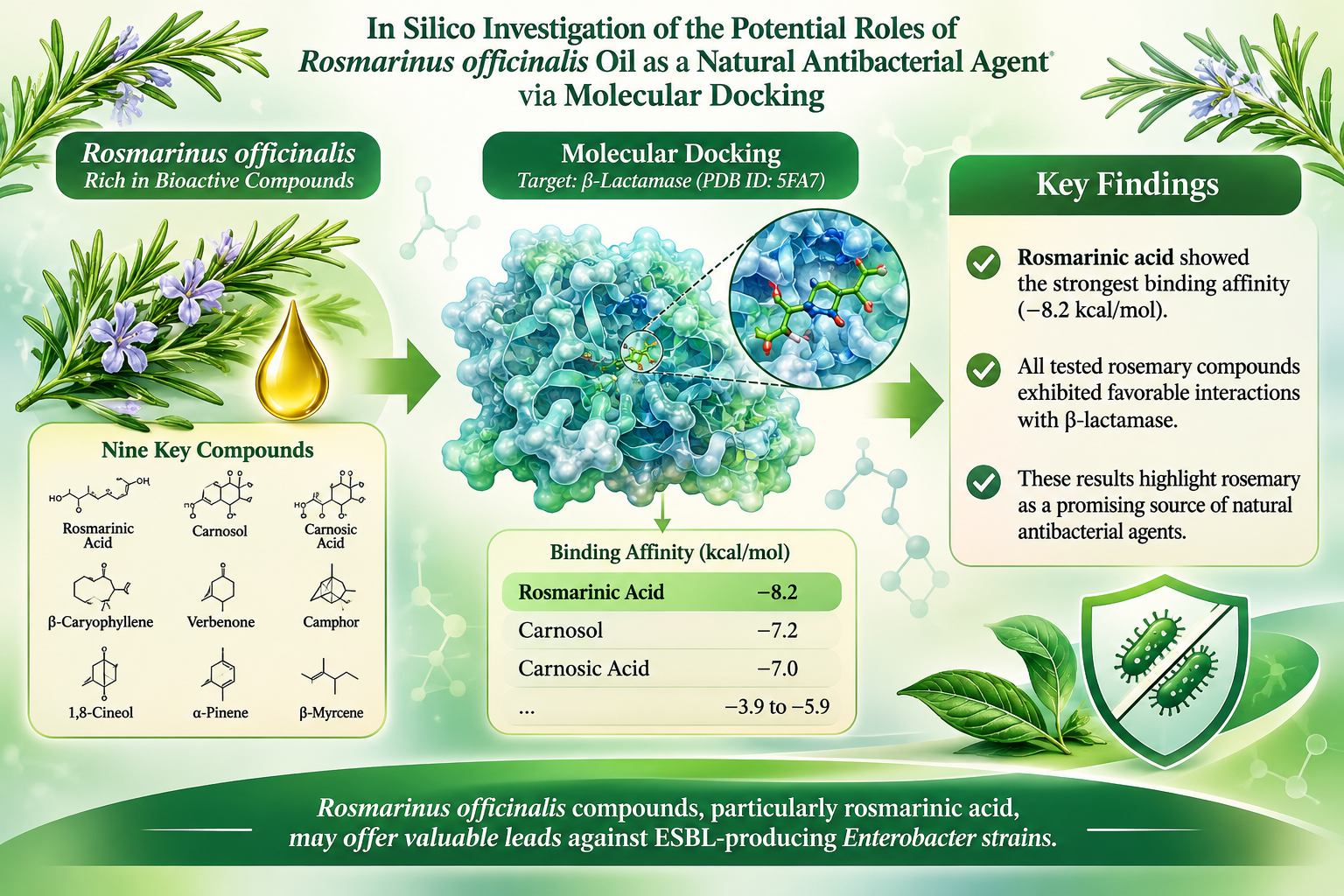
The current molecular docking analysis (Table 1) demonstrated that rosmarinic acid included further favorable predicted docking score/binding affinity under the computational conditions and the highest affinity within the EO components studied for β-lactamase (-8.2 kcal.mol-1). This affinity was ensured by seven hydrogen bonds with active-site residues (Figure 1a). This results were similar to those of several studies, showing that the antibacterial characteristics of rosemary were primarily attributed to rosmarinic acid [27].
Table 1: Binding energy (ΔG) and non-bonded interactions between the nine components of rosemary essential oil and β-lactamase
The current findings also showed that the compounds with the strongest affinity against β-lactamase were carnosol and carnosic acid following rosmarinic acid, with ΔG values of -7.2 and -7.0 kcal.mol-1, respectively. These two components could form relatively stable complexes with the target (Table 1). In general, intramolecular nonbonded interactions between the nine components and the enzyme were either hydrogen bonding, hydrophobic interactions, or the two ones (Figures 1a–1i).
Carnosol and carnosic acid are phenolic compounds in rosemary EO that may include antimicrobial and antioxidant effects [28]. Moreover, the current findings were similar to those of further research [29], demonstrating that rosmarinic acid, carnosol and carnosic acid are the phenolic compounds responsible for the biological activities of R. officinalis and Eucalyptus plants [30], particularly antibacterial activity. Based on the reports, these phenolic acids (rosmarinic acid, carnosic acid and carnosol) include good interactions with bacterial cell wall proteins that are widespread in Gram-positive and Gram-negative bacteria, including penicillin-binding proteins (PBP) and outer membrane protein A (OMPA), which explains the antibacterial characteristics of the selected phenolic acids [31]
It is noteworthy that, in addition to previously highlighted compounds (rosmarinic acid, carnosic acid and carnosol), other compounds included affinity with ESBL enzymes with an almost similar difference in binding energy (ΔG), including β-caryophyllene -5.9 kcal.mol-1, verbenone -5.4 kcal.mol-1 and camphor -5.0 kcal.mol-1. These findings were similar to those of previous research, indicating that caryophyllene [10], verbenone and camphor are antibacterial agents [32], especially against enterobacteria. In addition, the skin readily absorbs camphor, resulting in a cooling sensation similar to menthol [33]. Other components such as 1,8-cineol and α-pinene interacted with the current target with ΔG values of -4.9 and -4.6 kcal.mol-1, respectively. As reported by [34], presence of 1,8-cineol and α-pinene in the EO of rosemary makes it effective against a wide variety of fungal and bacterial infections, especially because α-pinene is the major chemotype in R. officinalis. In addition, several studies have shown that volatile substances (e.g., 1,8-cineol and α-pinene) increases the antibacterial activity of rosmary oil [35].
The current data demonstrated that β-myrcene included the least effective interaction with ESBL (ΔG = -3.9 kcal.mol-1). However, this did not preclude its antibacterial activity, as reported in other studies [36]. The molecular docking results in the current study showed high affinity between microbial proteins (ESBL) and ligands in rosemary EO, particularly rosmarinic acid, carnosol and carnosic acid, which are well known for their bioactivities [37]. Based on the results of the predictions assessed by molecular docking and the current findings, R. officinalis can be recommended in the pharmaceutical sector as a natural antibacterial agent to treat infections caused by clinical or foodborne ESBL-producing isolates [38]. The molecule developed for industrial scale-up must contain the concentrations of each component in rosemary EO, with high levels of rosmarinic acid, carnosol and carnosic acid to ensure sufficient effectiveness against ESBL-producing bacteria.
Based on the results of scientific research worldwide, rosemary EO shows an interactive effect against several strains, including the most common agents that cause hospital-acquired (HA) and community-acquired (CA) diseases, by overcoming and decreasing the impermeability of the membrane. Examples include methicillin-resistant S. aureus (MRSA), E. coli, P. aeruginosa [39], S. epidermidis, Streptococcus sp., Enterococcus faecalis, B. subtilis, A. hydrophila, B. cereus, C. perfringens and Salmonella Choleraesuis [40].
Additionally, earlier published reports [41] have shown that rosemary includes the potential to inhibit several bacteria and may make bacteria further susceptible to common medicines by becoming further active on Gram-positive mutants, compared to Gram-negative mutants. This accurs possibly as a result of the presence of an outer membrane in Gram-negative [42] strains, which restricts hydrophobic chemicals ability to diffuse via its lipopolysaccharide (LPS) cover, as well as inducing its permeability and cell death [43]. The lipophilic ends of Gram-positive bacteria cell membrane contain acids, which facilitate the infiltration of the EO hydrophobic substances [44]. As described by [44] and [45], efflux systems such as the resistance-nodulation-cell division (RND) family are primary sources of resistance and multidrug resistance in Gram-negative bacteria.
- CONCLUSION
The emergence of bacterial resistance to antibiotics leads to therapeutic failure and sometimes death in patients with bacterial infections. These findings have created an urgent need of a natural broad-spectrum antibacterial substance such as rosemary EO, which includes strong medicinal, antibacterial and antioxidant characteristics, as an innovative strategy for eliminating resistant bacterial strains. Therefore, researchers are searching for plant-based substitutes with antibacterial characteristics but with no undesirable side effects of synthetic drugs. Rosemary species include a promising future in healthcare and their therapeutic potentials should be further addressed in food science and human and animal medicines. These findings suggest a promising role for rosemary-derived compounds in addition to conventional antibiotics. Based on the limited number of isolates and the lack of GC-MS characterisation as well as the absence of direct enzyme inhibition assays and quantitative measurements of MIC/MBC, further in vivo investigations are needed to fully clarify their potentials in antibacterial therapy.
- DECLARATION
5.1. Conflict of Interest
The authors declare no conflict of interest.
5.2. Funding
No funding was received for this study.
5.3. Author Contributions With
RA designed the study; RA and ML carried out the experiments; RA and B analyzed the data; RA and HR wrote the manuscript draft; and RA, ML and HR revised the manuscript. All the authors approved the final version of the manuscript.
5.4. Ethical Considerations
All ethical principles were addressed in carrying out and writing this manuscript.
5.5. Data Availability
In accordance with the principles of transparency and open research, the authors declare that all data and materials used in this study are available upon request.
5.6. Using Artificial Intelligence Chatbot
No AI chatbot was used in this study.
- Antibacterial effects, ESBL-producing bacteria, molecular docking, rosmarinic acid, Rosmarinus officinalis
How to Cite
References
1. Shimira F, Zahid G, Nyirahabimana F. An overview and renewed emphasis on ethnopharmacology of rosemary (Salvia rosmarinus). Curr Perspect Med Arom Plants. 2022;5(Suppl 1):74-85.
doi: 10.38093/cupmap.1098392
2. Drew BT, Gallegos GJG, Xiang CL, Kriebel R, Drummond CP, Walker JB, Sytsma KJ. Salvia united: The greatest good for the greatest number. Taxon. 2017;66:133-145. doi: 10.12705/661.7
3. Schoch CL, Ciufo S, Domrachev M, Hotton CL, Kannan S, Khovanskaya R, Leipe D, McVeigh R, O'Neill K, Robbertse B, Sharma S, Soussov V, Sullivan JP, Sun L, Turner S, Karsch-Mizrachi I. NCBI Taxonomy: a comprehensive update on curation, resources and tools. Database. 2020;2020:baaa062. doi: 10.1093/database/baaa062
4. Szentmihályi F, Tulok MH, Hegedüs A, Renner C, Varga IS. Antioxidant effect of various rosemary (Rosmarinus officinalis L.) clones. Acta Biol Szeged. 2003;47(Suppl 1-4):111-113.
5. Chalchat JC, Garry RP, Michel A, Benjilali B, Chabard JL. Essential oil of rosemary (Rosmarinus officinalis): the chemical composition of oil of various origins (Morocco, Spain, France). J Essent Oil Res. 1993;5(6):613-618. doi: 10.1080/10412905.1993.9698293
6. Mulas M, Brigaglia N, Cani MR. Clone selection from spontaneous germplasm to Rosmarinus officinalis L. crop. Acta Hortic. 1998;457:287-294. doi: 10.17660/ActaHortic.1998.457.36
7. González-Trujano ME, Peña EI, Martínez AL, Moreno J, Guevara-Fefer P, Déciga-Campos M, López-Muñoz FJ. Evaluation of the antinociceptive effect of Rosmarinus officinalis L. using three different experimental models in rodents. J Ethnopharmacol. 2007;111(3):476-482. doi: 10.1016/j.jep.2006.12.011
8. Milyuhina AK, Zabodalova LA, Kyzdarbek U, Romazyaeva IR, Klyuchko NY. In vitro antibacterial and antioxidant activity of Rosmarinus officinalis. E3S Web Conf. 2021;285:05012. doi: 10.1051/e3sconf/202128505012
9. Bozin B, Mimica-Dukić N, Samojlik I, Jovin E. Antimicrobial and antioxidant properties of rosemary and sage (Rosmarinus officinalis L. and Salvia officinalis L., Lamiaceae) essential oils. J Agric Food Chem. 2007;55(19):7879-7885. doi: 10.1021/jf0715323
10. Hamidpour R, Elias G, Hamidpour S. Rosmarinus officinalis (rosemary): a novel therapeutic agent for antioxidant, antimicrobial, anticancer, antidiabetic, and and antidepressant. Herb Med. 2017;3(2):1-8. doi: 10.21767/2472-0151.100028
11. Valdés A, García-Cañas V, Rocamora-Reverte L, Gómez-Martínez A, Ferragut JA, Cifuentes A. Effect of rosemary polyphenols on human colon cancer cells: transcriptomic profiling and functional enrichment analysis. Genes Nutr. 2013;8:43-60. doi: 10.1007/s12263-012-0311-9
12. Chama Z, Benchiha NN, Benabbou A, Kanoun K, Derkaoui I, Arbi H, Klouche-Addou L. Evaluation of the antibacterial activity of essential oils of Rosmarinus officinalis L. and Rosmarinus eriocalyx from the region of Sidi Bel Abbès (Algeria). Int J Med Fragr Med Arom Plants. 2022;8(2):12-24. doi: 10.53552/ijmfmap.8.2.2022.12-24
13. Solórzano-Santos F, Miranda-Novales MG. Essential oils from aromatic herbs as antimicrobial agents. Curr Opin Biotechnol. 2012;23(2):136-141. doi: 10.1016/j.copbio.2011.08.005
14. Bennadja S, Tlili Ait Kaki Y, Djahoudi A, Hadef Y, Chefrour A. Antibiotic activity of the essential oil of laurel (Laurus nobilis L.) on eight bacterial strains. J Life Sci. 2013;7(8):814-819.
15. Sirocchi V, Caprioli G, Cecchini C, Coman MM, Cresci A, Maggi F, Papa F, Ricciutelli M, Vittori S, Sagratini G. Biogenic amines as freshness index of meat wrapped in a new active packaging system formulated with essential oils of Rosmarinus officinalis. Int J Food Sci Nutr. 2013;64(8):921-928. doi: 10.3109/09637486.2013.809706
16. Nieto G, Ros G, Castillo J. Antioxidant and antimicrobial properties of rosemary (Rosmarinus officinalis L.). Medicines. 2018;5(3):98. doi: 10.3390/medicines5030098
17. Habtemariam S. The therapeutic potential of rosemary (Rosmarinus officinalis) diterpenes for Alzheimer's disease. Evid Based Complement Alternat Med. 2016;2016:2680409. doi: 10.1155/2016/2680409
18. Kola A, Hecel A, Lamponi S, Valensin D. Novel perspective on Alzheimer's disease treatment: rosmarinic acid molecular interplay with copper(II) and amyloid β. Life. 2020;10(7):118. doi: 10.3390/life10070118
19. Jawad AM, Allawi AK, Ewadh HM. Essential oils of rosemary as an antimicrobial agent against three types of bacteria. Med J Babylon. 2018;15(1):53-56.
20. Gachkar L, Yadegari D, Rezaei MB, Taghizadeh M, Astaneh SA, Rasooli I. Chemical and biological characteristics of Cuminum cyminum and Rosmarinus officinalis essential oils. Food Chem. 2007;102(3):898-904. doi: 10.1016/j.foodchem.2006.06.035
21. Napoli EM, Siracusa L, Saija A, Speciale A, Trombetta D, Tuttolomondo T, La Bella S, Licata M, Virga G, Leone R, Wild R. Sicilian rosemary: phytochemical and morphological screening and antioxidant activity evaluation of extracts and essential oils. Chem Biodivers. 2015;12:1075-1094. doi: 10.1002/cbdv.201400274
22. Suaib L, Gaurav R, Dwivedi MS, Mahendra R, Darokar MS, Alok Kaira P, Sunian P, Khanuja S. Potential of rosemary oil to be used in drug-resistant infections. Altern Ther Health Med. 2017;23(5):54-59.
23. Joseph-McCarthy D, Baber JC, Feyfant E, Thompson DC, Humblet C. Lead optimization via high-throughput molecular docking. Curr Opin Drug Discov Devel. 2007;10(3):264-274.
24. DiMasi JA, Grabowski HG, Hansen RW. Innovation in the pharmaceutical industry: new estimates of R&D costs. J Health Econ. 2016;47:20-33. doi: 10.1016/j.jhealeco.2016.01.012
25. Inouye S, Takizawa T, Yamaguchi H. Antimicrobial activity of the essential oils and their major constituents against respiratory tract pathogens by gaseous contact. J Antimicrob Chemother. 2001;47(5):565-573. doi: 10.1093/jac/47.5.565
26. Lopez P, Sanchez C, Batlle R, Nerin C. Solid- and vapor-phase antimicrobial activities of six essential oils: susceptibility of selected foodborne bacterial and fungal strains. J Agric Food Chem. 2005;53(17):6939-6946. doi: 10.1021/jf050965g
27. Bozin B, Mimica-Dukić N, Simin N, Anackov G. Characterization of the volatile composition of essential oil of some Lamiaceae species and the antimicrobial and antioxidant activities of the entire oils. J Agric Food Chem. 2006;54(5):1822-1828. doi: 10.1021/jf051922t
28. Saleh A, Al Kamaly O, Ashwaq Alanazi S, Noman O. Phytochemical analysis and antimicrobial activity of Rosmarinus officinalis L. growing in Saudi Arabia: experimental and computational approaches. Processes. 2022;10(11):2422. doi: 10.3390/pr10112422
29. Stanzione F, Giangreco I, Cole JC. Use of molecular docking computational tools in drug discovery. Prog Med Chem. 2021;60:27-68. doi: 10.1016/bs.pmch.2021.01.004
30. Clinical and Laboratory Standards Institute (CLSI). Performance standards for antimicrobial susceptibility testing; 25th informational supplement. M100-S25. Wayne, PA: CLSI; 2015.
31. Lazreg HA, Gaaliche B, Fekih A, Mars M, Aouni M, Chaumon JP, Said K. In vitro cytotoxic and antiviral activities of Ficus carica latex extracts. Nat Prod Res. 2011;25(3):310-319. doi: 10.1080/14786419.2010.528758
32. Trott O, Olson AJ. AutoDock Vina: improving the speed and accuracy of docking with a new scoring function, efficient optimization and multithreading. J Comput Chem. 2010;31(2):455-461. doi: 10.1002/jcc.21334
33. Frisch MJ, Trucks GW, Schlegel HB, Scuseria GE, Robb MA, Cheeseman JR, et al. Gaussian 16, Revision C.01. Wallingford, CT: Gaussian, Inc; 2016.
34. Dassault Systèmes BIOVIA. Discovery Studio Modeling Environment, Release 2017. San Diego, CA: Dassault Systèmes; 2017.
35. Padmini N, Ajilda AAK, Sivakumar N, Selvakumar G. Extended-spectrum β-lactamase–producing Escherichia coli and Klebsiella pneumoniae: critical tools for antibiotic resistance pattern. J Basic Microbiol. 2017;57(5):460-470. doi: 10.1002/jobm.201700008
36. Woodford N, Turton JF, Livermore DM. Multiresistant Gram-negative bacteria: the role of high-risk clones in the dissemination of antibiotic resistance. FEMS Microbiol Rev. 2011;35(5):736-755. doi: 10.1111/j.1574-6976.2011.00268.x
37. Bonnet R. Growing group of extended-spectrum β-lactamases: the CTX-M enzymes. Antimicrob Agents Chemother. 2004;48(1):1-14. doi: 10.1128/aac.48.1.1-14.2004
38. Cantón R, Coque TM. The CTX-M β-lactamase pandemic. Curr Opin Microbiol. 2006;9(5):466-475. doi: 10.1016/j.mib.2006.08.011
39. Cantón R, González-Alba JM, Galán JC. CTX-M enzymes: origin and diffusion. Front Microbiol. 2012;3:110. doi: 10.3389/fmicb.2012.00110
40. Peirano G, Pitout JDD. Molecular epidemiology of Escherichia coli producing CTX-M β-lactamases: the worldwide emergence of clone ST131 O25:H4. Int J Antimicrob Agents. 2010;35(4):316-321. doi: 10.1016/j.ijantimicag.2009.11.0003
41. Abderrahim A, Djahmi N, Loucif L, Nedjai S, Chelaghma W, Gameci-Kirane D, Dekhil M, Lavigne JP, Pantel A. Dissemination of OXA-48– and NDM-1–producing Enterobacterales isolates in an Algerian hospital. Antibiotics. 2022;11(6):750. doi: 10.3390/antibiotics11060750
42. Merah-Fergani O, Sebaihia M, Berrazeg M, Amraoui R, Diene S, Rolain JM. Occurrence and diversity of extended-spectrum β-lactamases in clinical isolates of Enterobacteriaceae in a tertiary care hospital in Algeria. J Infect Dis Antimicrob Agents. 2022;39(1):1-14.
43. Rahmani A, Meradi L, Piris R. Molecular characterization of the whole genome in clinical multidrug-resistant strains of Klebsiella pneumoniae. J Infect Dev Ctries. 2023;17(1):59-65. doi: 10.3855/jidc.17168
44. Storberg V. ESBL-producing Enterobacteriaceae in Africa: a non-systematic literature review of research published 2008–2012. Infect Ecol Epidemiol. 2014;4:20342. doi: 10.3402/iee.v4.20342
45. Bevan ER, Jones AM, Hawkey PM. Global epidemiology of CTX-M β-lactamases: temporal and geographical shifts in genotype. J Antimicrob Chemother. 2017;72(8):2145-2155. doi: 10.1093/jac/dkx146
46. Ruppé E, Hem S, Lath S, Gautier V, Ariey F, Sarthou JL, Monchy D, Arlet G. CTX-M β-lactamases in E. coli from community-acquired urinary tract infections, Cambodia. Emerg Infect Dis. 2009;15(5):741-748. doi: 10.3201/eid1505.071299
47. Carović-Stanko K, Petek M, Grdiša M, Pintar J, Bedeković D, Ćustić MH, et al. Medicinal plants of the family Lamiaceae as functional foods—A review. Czech J Food Sci. 2016;34(5):377-390. doi: 10.17221/504/2015-CJFS
48. Ajit Singh Y, Gautham K, Marappan G, Kumaragurubaran K, Yashpal Singh M, Kuldeep D. Exploring alternatives to antibiotics as health-promoting agents in poultry: a review. J Exp Biol Agric Sci. 2016;4(3S):368-383. doi: 10.18006/2016.4(3S).368.383
49. Moreno S, Scheyer T, Romano CS, Vojnov AA. Antioxidant and antimicrobial activities of rosemary extracts linked to their polyphenol composition. Free Radical Res. 2006;40(2):223-231. doi: 10.1080/10715760500473834
50. Kačániová M, Terentjeva M, Kántor A, Tokár M, Puchalski C, Ivanišová E. Antimicrobial effect of sage (Salvia officinalis L.) and rosemary (Rosmarinus officinalis L.) essential oils on microbiota of chicken breast. Proc Latv Acad Sci Sect B Nat Exact Appl Sci. 2017;71(1):461-467. doi: 10.1515/prolas-2017-0081
51. Lee SY, Gwon SY, Kim SJ, Moon BK. Inhibitory effect of commercial green tea and rosemary leaf powders on the growth of foodborne pathogens in laboratory media and Oriental-style rice cakes. J Food Prot. 2009;72(5):1107-1111. doi: 10.4315/0362-028x-72.5.1107
52. German T, Mekonnen M, Mengesha M, Philiphos M. Rosemary production and utilization. 2016. Available from: https://www.researchgate.net/publication/313030290
53. Abkhoo J, Jahani S. Antibacterial effects of aqueous and ethanolic extracts of medicinal plants against pathogenic strains. Int J Infect. 2017;4:e42624. doi: 10.5812/iji.42624
54. Kumuda M, Dhanapal K, Sravani K, Madhavi K, Sofi FR, Praveen Kumar G. Studies on the antioxidant and antimicrobial properties of rosemary (Rosmarinus officinalis) and oregano (Origanum vulgare) extracts. Int J Curr Microbiol Appl Sci. 2017;6(12):3253-3261. doi: 10.20546/ijcmas.2017.612.378
55. de Macedo LM, Dos Santos EM, Militão L, Tundisi LL, Ataide JA, Souto EB, et al. Rosemary (Rosmarinus officinalis L. syn. Salvia rosmarinus Spenn.) and its topical applications: a review. Plants. 2020;9(5):651. doi: 10.3390/plants9050651
56. Aouf A, Bouaouina S, Abdelgawad M, Abourehab ASM, Amr F. In silico study for Algerian essential oils as antimicrobial agents against multidrug-resistant bacteria isolated from pus samples. Antibiotics. 2022;11(10):1317. doi: 10.3390/antibiotics11101317
57. Rota MC, Herrera A, Martínez RM, Sotomayor JA, Jordán MJ. Antimicrobial activity and chemical composition of Thymus vulgaris, Thymus zygis and Thymus hyemalis essential oils. Food Control. 2008;19(7):681-687. doi: 10.1016/j.foodcont.2007.07.007
58. Hassan S, Švajdlenka E, Rengasamy K, Melichárková R, Pandian SE. Le profil métabolique des huiles essentielles et l'évaluation de l'activité anti-uréase par spectrométrie de masse de Salvia officinalis L. S Afr J Bot. 2018;113:26.
59. Mechchate O, Es-Safi H, Bouhrim I, Jawhari M, Ouassou F, Kharchoufa H, Alzain L, Alzamel M, Al Kamaly NM, Bouyahya O, et al. Phytochemical screening, antioxidant and antibacterial activities of pollen extracts from Micromeria fruticosa, Achillea fragrantissima, and Phoenix dactylifera. Plants. 2021;10(4):676. doi: 10.3390/plants10040676
60. Dorman H, Deans S. Antimicrobial agents from plants: antibacterial activity of plant volatile oils. J Appl Microbiol. 2000;88(2):308-316. doi: 10.1046/j.1365-2672.2000.00969.x
61. Oussalah M, Caillet S, Saucier L, Lacroix M. Antimicrobial effects of selected plant essential oils on the growth of a Pseudomonas putida strain isolated from meat. Meat Sci. 2006;73(2):236-244. doi: 10.1016/j.meatsci.2005.11.019
62. Seow YX, Yeo CR, Chung HL, Yuk HG. Plant essential oils as active antimicrobial agents. Crit Rev Food Sci Nutr. 2014;54(5):625-644. doi: 10.1080/10408398.2011.599504
63. Tsai P, Tsai T, Ho S. In vitro inhibitory effects of rosemary extracts on growth and glucosyltransferase activity of Streptococcus sobrinus. Food Chem. 2007;105(1):311-316. doi: 10.1016/j.foodchem.2006.11.051
64. Ekambaram SP, Perumal SS, Balakrishnan A, Marappan N, Gajendran SS, Viswanathan V. Antibacterial synergy between rosmarinic acid and antibiotics against methicillin-resistant Staphylococcus aureus. J Intercult Ethnopharmacol. 2016;5(4):358-363. doi: 10.5455/jice.20160906035020
65. Bešta-Gajević R, Karalija E, Jerković-Mujkić A, Karadža D, Smajlović-Skenderagić L, Dahija S. Antimicrobial and antioxidant activity of the extracts from Origanum vulgare L. growing wild in Bosnia and Herzegovina. Genet Appl. 2018;2(2):62-66. doi: 10.31383/ga.vol2iss2pp62-66
66. Bernardes WA, Lucarini R, Tozatti MG, Souza MGM, Andrade Silva ML, Da Silva Filho AA, et al. Antimicrobial activity of Rosmarinus officinalis against oral pathogens: relevance of carnosic acid and carnosol. Chem Biodivers. 2010;7(7):1835-1840. doi: 10.1002/cbdv.200900301
67. Azizkhani M, Tooryan F. Antioxidant and antimicrobial activities of rosemary extract, mint extract and a mixture of tocopherols in beef sausage during storage at 4°C. J Food Saf. 2014;35(1):128-136. doi: 10.1111/jfs.12166
68. Silva AMOE, Machado ID, Santin JR, de Melo ILP, Pedrosa GV, Genovese MI, Farsky SHP, Mancini-Filho J. Aqueous extract of Rosmarinus officinalis L. inhibits neutrophil influx and cytokine secretion. Phytother Res. 2014;29(1):125-133. doi: 10.1002/ptr.5238
69. Vemu B, Tocmo R, Nauman MC, Flowers SA, Veenstra JP, Johnson JJ. Pharmacokinetic characterization of carnosol from rosemary (Salvia rosmarinus) in male C57BL/6 mice and inhibition profile in human cytochrome P450 enzymes. Toxicol Appl Pharmacol. 2021;431:115729. doi: 10.1016/j.taap.2021.115729
70. Al Harba YAH, Al Fadal SAM, Noor UM. Study of antioxidant, biological activity and docking study for phenolic acids in Rosmarinus officinalis L. crude extract. Plant Arch. 2021;21(1):137-146. doi: 10.51470/PLANTARCHIVES.21.1.137-146
71. Parisa B, Pınar ŞEN, Fikrettin Ş. Antimicrobial properties of free and encapsulated essential oil into chitosan of rosemary. Res Sq. 2023. doi: 10.21203/rs.3.rs-2646496/v1
72. Nieto G. Biological activities of three essential oils of the Lamiaceae family. Medicines. 2017;4(3):63. doi: 10.3390/medicines4030063
73. Ugur A, Sarac N, Duru ME. Antimicrobial activity and chemical composition of Senecio sandrasicus on antibiotic-resistant staphylococci. Nat Prod Commun. 2009;4(4):579-584. doi: 10.1177/1934578X0900400428
74. Schmidt E, Bail S, Friedl SM, Jirovetz L, Buchbauer G, Wanner J, Denkova Z, Slavchev A, Stoyanova A, Geissler M. Antimicrobial activities of single aroma compounds. Nat Prod Commun. 2010;5(9):1365-1368. doi: 10.1177/1934578X1000500906
75. Selestino MN, Vittorazzi C, Guimaraes A, Martins J, Fronza M, Endringer D, Scherer R. Effects of β-caryophyllene and Murraya paniculata essential oil in murine hepatoma cells and in the bacteria and fungi 24-h time–kill curve studies. Pharm Biol. 2017;55(1):190-197. doi: 10.1080/13880209.2016.1254251
76. Gill AO, Delaquis P, Russo P, Holley RA. Evaluation of antilisterial action of cilantro oil on vacuum-packed ham. Int J Food Microbiol. 2002;73(1):83-92. doi: 10.1016/S0168-1605(01)00712-7
77. El-Ageeli WH, Al-Mansori BBM, Alsagheer SHM, Ben-Khayal FA. Identification and classification of Libyan Rosmarinus officinalis essential oil components by GC-MS and prediction of its antioxidant activity. Al-Mukhtar J Sci. 2020;35(3):184-192. doi: 10.54172/mjsc.v35i3.255
78. Costa J, Sousa S, Gamvao A, Mata J, Leitao J, Carvalho M. Key parameters on the antibacterial activity of silver–camphor complexes. Antibiotics. 2021;10(2):135. doi: 10.3390/antibiotics10020135
79. Ramirez P, Santoyo S, Garcia-Risco MR, Señorans FJ, Ibanez E, Reglero G. Use of specially designed columns for antioxidants and antimicrobials enrichment by preparative supercritical fluid chromatography (Prep-SFC). J Chromatogr A. 2007;1143(1-2):234-242. doi: 10.1016/j.chroma.2006.12.096
80. Bendeddouche MS, Benhassaini H, Hazem Z, Romane A. Essential oil analysis and antibacterial activity of Rosmarinus tournefortii from Algeria. Nat Prod Commun. 2011;6(10):1511-1514. doi: 10.1177/1934578X1100601026
81. Nieto G, Ros G, Castillo J. Antioxidant and antimicrobial properties of rosemary (Rosmarinus officinalis L.): a review. Medicines. 2018;5(3):98. doi: 10.3390/medicines5030098
82. Borges RS, Ortiz BLS, Pereira ACM, Keita H, Carvalho JCT. Rosmarinus officinalis essential oil: a review of its phytochemistry, anti-inflammatory activity, and mechanisms of action involved. J Ethnopharmacol. 2019;229:29-45. doi: 10.1016/j.jep.2018.09.038
83. Porter NG, Wilkins AL. Chemical, physical and antimicrobial properties of essential oils of Leptospermum scoparium and Kunzea ericoides. Phytochemistry. 1999;50(3):407-415. doi: 10.1016/S0031-9422(98)00548-2
84. Soković M, van Griensven LJLD. Antimicrobial activity of essential oils and their components against the three major pathogens of the cultivated button mushroom, Agaricus bisporus. Eur J Plant Pathol. 2006;116:211-224. doi: 10.1007/s10658-006-9063-7
85. Angourani HR, Heydari M, Yousefi AR, Pashaei B, Mastinu A. Nanoparticles based on plant protein containing Rosmarinus officinalis essential oil: fabrication, characterization, and evaluation. Appl Sci. 2022;12(19):9968. doi: 10.3390/app12199968
86. O'Bryan CA, Crandall PG, Chalova VI, Ricke SC. Orange essential oil antimicrobial activities against Salmonella spp. J Food Sci. 2008;73(6):M264-M267. doi: 10.1111/j.1750-3841.2008.00790.x
87. Wagner A, Bernardes WA, Lucarini R, Tozatti MG, Bocalon Flauzinoa LG, Souza MGM, Turatti ICC, Andrade Silva ML, Martins CHG, da Silva Filho AA, Cunha RW. Antibacterial activity of the essential oil from Rosmarinus officinalis and its major components against oral pathogens. Z Naturforsch C. 2010;65(9-10):588-593.
88. Kuhlmann A, Röhl C. Phenolic antioxidant compounds produced by in vitro cultures of rosemary (Rosmarinus officinalis) and their anti-inflammatory effect on lipopolysaccharide-activated microglia. Pharm Biol. 2006;44(6):401-410. doi: 10.1080/13880200600794063
89. Borrás-Linares I, Stojanović Z, Quirantes-Pine R, et al. Rosmarinus officinalis leaves as a natural source of bioactive compounds. Int J Mol Sci. 2014;15(11):20585-20606. doi: 10.3390/ijms151120585
90. Boutabia L, Telailia S, Bouguetof I, Faouzi Guenadil F, Chefrour A. Composition chimique et activité antibactérienne des huiles essentielles de Rosmarinus officinalis L. de la région de Hammamet (Tébessa, Algérie). Bull Soc R Sci Liège. 2016;85:174-189.
91. Saricaoglu FT, Sadettin T. Antimicrobial activity and antioxidant capacity of thyme, rosemary and clove essential oils and their mixtures. J Innov Sci Eng. 2018;2(1):25-33.
92. Aseer M, Sabu KR, Woldemariam M, Aklilu A, Biresaw G, Yohanes T, Seid M, Merdekios B. Antibacterial activity of Rosmarinus officinalis against multidrug-resistant clinical isolates and meat-borne pathogens. Evid Based Complement Alternat Med. 2021;2021:6677420. doi: 10.1155/2021/6677420
93. Oluwatuyi M, Kaatz GW, Gibbons S. Antibacterial and resistance-modifying activity of Rosmarinus officinalis. Phytochemistry. 2004;65(24):3249-3254. doi: 10.1016/j.phytochem.2004.10.009
94. Jarrar N, Abu-Hijleh A, Adwan K. Antibacterial activity of Rosmarinus officinalis L. alone and in combination with cefuroxime against methicillin-resistant Staphylococcus aureus. Asian Pac J Trop Med. 2010;3(2):121-123. doi: 10.1016/S1995-7645(10)60049-1
95. Goncalves GA, Correa RC, Barros L, Dias MI, Calhelha RC, Correa VG, Ferreira IC. Effects of in vitro gastrointestinal digestion and colonic fermentation on a rosemary (Rosmarinus officinalis L.) extract rich in rosmarinic acid. Food Chem. 2019;271:393-400. doi: 10.1016/j.foodchem.2018.07.132
96. Alvarez MV, Ortega-Ramirez LA, Silva-Espinoza BA, Gonzalez-Aguilar GA, Ayala-Zavala JF. Antimicrobial, antioxidant, and sensorial impacts of oregano and rosemary essential oils over broccoli florets. J Food Process Preserv. 2019;43(3):e13889. doi: 10.1111/jfpp.13889
97. Al Zuhairi JJMJ, Kashi FJ, Rahimi-Moghaddam A, Yazdani M. Antioxidant, cytotoxic and antibacterial activity of Rosmarinus officinalis L. essential oil against bacteria isolated from urinary tract infection. Eur J Integr Med. 2020;38:101192. doi: 10.1016/j.eujim.2020.101192
98. Chama Z, Benchiha N, Benabbou A, Kanoun K, Derkaoui I, Arbi H, Klouche-Addou L. Evaluation of the antibacterial activity of essential oils of Rosmarinus officinalis L. and Rosmarinus eriocalyx from the region of Sidi Bel Abbès (Algeria). Int J Med Fragr Med Arom Plants. 2022;8(2):12-24. doi: 10.53552/ijmfmap.8.2.2022.12-24
99. Jafari-Sales A, Pashazadeh M. Study of chemical composition and antimicrobial properties of rosemary (Rosmarinus officinalis) essential oil on Staphylococcus aureus and Escherichia coli in vitro. Int J Life Sci Biotechnol. 2020;3(1):62-69. doi: 10.38001/ijlsb.693371
100. Issabeagloo E, Kermanizadeh P, Taghizadieh M, Forughi R. Antimicrobial effects of rosemary (Rosmarinus officinalis L.) essential oils against Staphylococcus spp. Afr J Microbiol Res. 2012;6(23):5039-5042. doi: 10.5897/AJMR12.741
101. Sirocchi V, Caprioli G, Cecchini C, Coman MM, Cresci A, Maggi F, Papa F, Ricciutelli M, Vittori S, Sagratini G. Biogenic amines as freshness index of meat wrapped in a new active packaging system formulated with essential oils of Rosmarinus officinalis. Int J Food Sci Nutr. 2013;64(8):921-928. doi: 10.3109/09637486.2013.809706
102. Narang R, Jadhav A. Review on herbal potentials as antibiotics. Int J Multidiscip Res. 2023;5(3).
103. Pintore G, Usai M, Bradesi P, Juliano C, Boatto G, Tomi F, Chessa M, Cerri R, Casanova J. Chemical composition and antimicrobial activity of Rosmarinus officinalis L. oils from Sardinia and Corsica. Flavour Fragr J. 2002;17(1):15-19. doi: 10.1002/ffj.1022
104. Marinas I, Grumezescu A, Saviuc C, Chifiriuc M, Mihaiescu D, Lazar V. Rosmarinus officinalis essential oil as antibiotic potentiator against Staphylococcus aureus. Biointerface Res Appl Chem. 2012;2(1):271-276.
105. Nostro A, Germano MP, D'Angelo V, Marino A, Cannatelli MA. Extraction methods and bioautography for evaluation of medicinal plant antimicrobial activity. Lett Appl Microbiol. 2000;30(5):379-384. doi: 10.1046/j.1472-765x.2000.00731.x
106. Ratledge C, Wilkinson SG. Microbial lipids. London: Academic Press; 1988.
107. Inouye S, Takizawa T, Yamaguchi H. Antimicrobial activity of the essential oils and their major constituents against respiratory tract pathogens by gaseous contact. J Antimicrob Chemother. 2001;47(5):565-573. doi: 10.1093/jac/47.5.565
108. Lopez P, Sanchez C, Batlle R, Nerin C. Solid- and vapor-phase antimicrobial activities of six essential oils: susceptibility of selected foodborne bacterial and fungal strains. J Agric Food Chem. 2005;53(17):6939-6946. doi: 10.1021/jf050965g
109. Bozin B, Mimica-Dukić N, Simin N, Anackov G. Characterization of the volatile composition of essential oil of some Lamiaceae species and the antimicrobial and antioxidant activities of the entire oils. J Agric Food Chem. 2006;54(5):1822-1828. doi: 10.1021/jf051922t
110. Vaara M. Agents that increase the permeability of the outer membrane. Microbiol Rev. 1992;56(3):395-411. doi: 10.1128/mr.56.3.395-411.1992
111. Wang W, Li N, Luo M, Zu Y, Efferth T. Antibacterial activity and anticancer activity of Rosmarinus officinalis L. essential oil compared to that of its main component. Molecules. 2012;17(3):2704-2713. doi: 10.3390/molecules17032704
112. Cox SD, Mann CM, Markham JL, Bell HC, Gustafson JE, Warmington JR, Wyllie SG. The mode of antimicrobial action of the essential oil of Melaleuca alternifolia (tea tree oil). J Appl Microbiol. 2000;88(1):170-175. doi: 10.1046/j.1365-2672.2000.00943.x
113. Gourich AA, Bencheikh N, Bouhrim M, Regragui M, Rhafouri R, Drioiche A, Asbabou A, Remok F, Mouradi A, Addi M, Hano C, Zair T. Comparative analysis of the chemical composition and antimicrobial activity of four Moroccan [essential oils]. 2022.
- Abstract Viewed: 20 times
- pdf Downloaded: 0 times