Enhanced Penicillin Production by Penicillium chrysogenum Through Optimization of Corn Steep Powder as a Nitrogen Source
Applied Food Biotechnology,
Vol. 13 No. 1 (2026),
7 December 2025
,
Page 1-14 (e18)
https://doi.org/10.22037/afb.v13i1.52694
Abstract
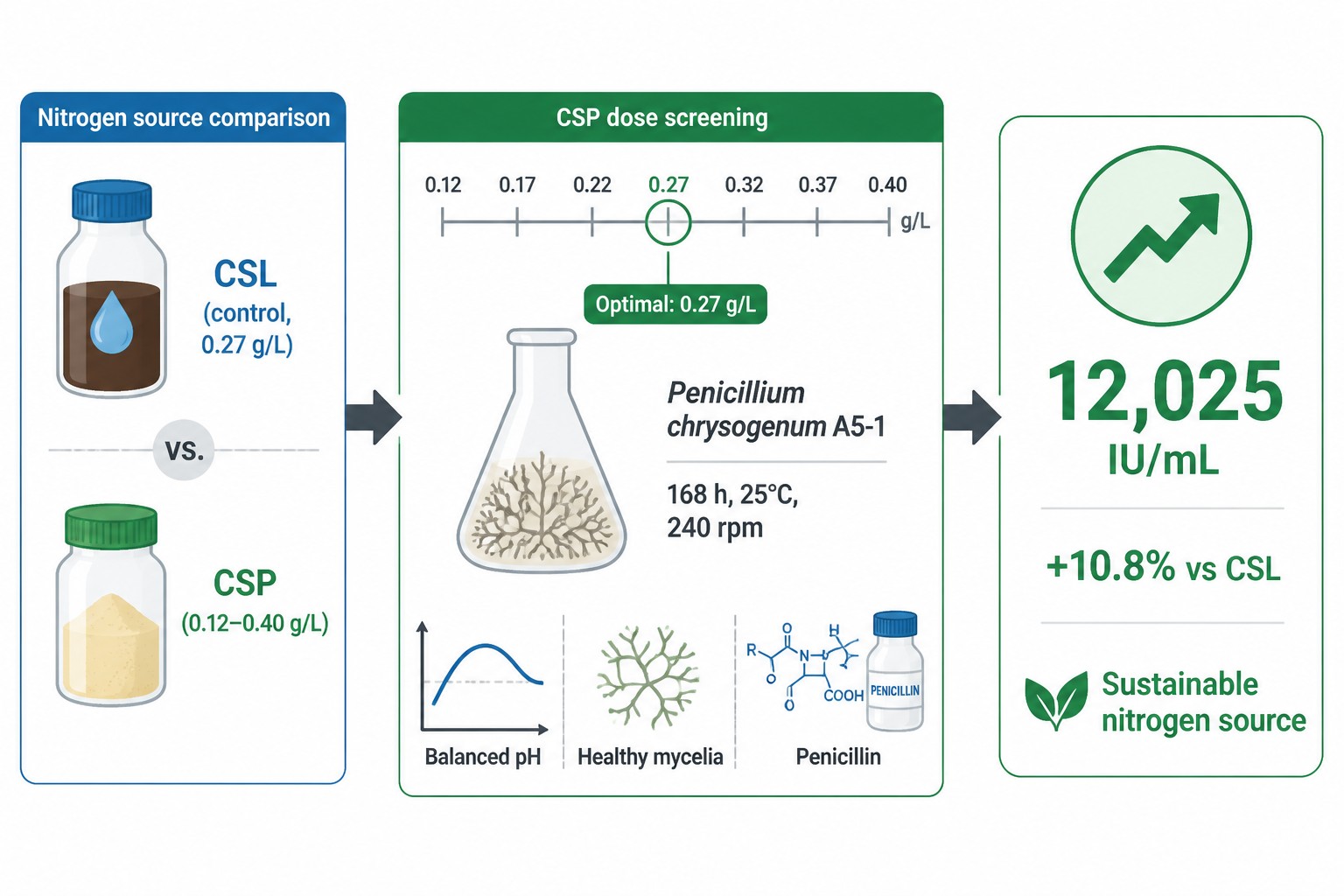
Background and Aim: This study investigated the efficiency of corn steep powder (CSP) as an alternative nitrogen source for penicillin production by Penicillium chrysogenum A5-1.
Material and Methods: Fermentation was carried out within 168 h, comparing various CSP concentrations (0.12–0.40 g l-1) against a traditional corn steep liquor (CSL) control. Kinetic analysis and Luedeking-Piret modeling were used to assess growth and production mechanisms, complemented by microscopic observations of fungal morphology.
Results and Conclusion: The assessment identified 0.27 g l-1 as the optimal CSP concentration, yielding a maximum penicillin titer of 12,025 IU ml-1 and representing 10.8% increase over the CSL control (10,850 IU ml-1). Kinetic analysis at the optimal concentration revealed specific growth rate (µ) of 0.085 h⁻¹, volumetric productivity (QP) of 71.58 IU ml⁻¹ h⁻¹, and yield coefficient (YP/X) of 0.39 IU mg-1 biomass. Luedeking-Piret modeling (α = 0.12, β = 0.027) indicated a mixed-mode production mechanism. Microscopic observations linked peak production with the maintenance of branched hyphal morphology prior to fragmentation and autolysis. These findings demonstrate that CSP is a viable, cost-effective nitrogen source that optimizes growth kinetics and antibiotic biosynthesis, offering a sustainable alternative for industrial penicillin fermentation.
- INTRODUCTION
Penicillin is a major beta-lactam antibiotic produced by submerged fermentation using Penicillium chrysogenum. Its yield is strongly affected by media composition and cultivation conditions, since fungal growth and secondary-metabolite biosynthesis depend on nutrient availability and environmental factors such as pH, temperature, carbon supply and fermentation time [1, 2]. Early studies using corn steep-based media showed that carbon-feeding strategies could affect penicillin biosynthesis during fermentation [1]. Corn steep powder (CSP) is a dehydrated corn-derived complex nutrient source. Its liquid counterpart, corn steep liquor, contains amino acids, vitamins, minerals and other growth-promoting compon-ents and has been recognized as a useful nutrient resource for microbial bioprocesses [3,4]. In P. chrysogenum cultivation, the composition and bioavailability of corn steep-derived nutrients can affect fungal physiology and process performance [4]. However, liquid corn-derived materials may present practical limitations linked to compositional variability, storage stability, handling and batch-to-batch consistency during industrial use. So, identifying alternative nitrogen sources with improved physical stability and further reproducible performance is practically important for fermentation processes. As a powdered material, CSP may provide advantages in storage, dosing, transport and operational consistency, while supporting the valorization of corn-derived coproducts.
Despite this potential, its appropriateness as a nitrogen source for penicillin fermentation is insufficiently understood. In particular, effects of CSP level on antibiotic yield, biomass accumulation, culture pH, mycelial mor-phology and fermentation behavior have not system-atically been assessed. Recent studies have approached penicillin improvement through strain engineering, molecular characterization, precursor management and carbon-source optimization. The development of engineered P. rubens platform strains has broadened the possibilities for rational control of secondary-metabolite production [5]. Other investigations have assessed strain selection with process variables such as precursor concentration, inoculum size, pH, temp-erature and cultivation time for penicillin V production [6]. Similarly, strain improvement combined with carbon-source optimi-zation has been reported as a strategy for increasing antibiotic yield [7]. The valorization of agroindustrial coproducts has gained interest in the development of more economical and sustainable bio-processes [8]. Effect of dehydrated CSP on the growth pattern, morphology, pH profile, kinetic behavior and penicillin productivity of P. chrysogenum has not clearly been established.
Therefore, this study investigated if CSP could support efficient penicillin production by P. chrysogenum A5-1 and identified an effective concentration range. The media were compared for biomass formation, culture pH, fungal morphology, penicillin titer, volumetric productivity and fermentation kinetics. The Luedeking-Piret model was further used to investigate the relationship between fungal growth and penicillin formation. This not only allowed assessment of the most appropriate CSP level but also assessed if penicillin biosynthesis under the conditions was majorly growth-associated, non-growth-associated or partially linked to growth. By linking nitrogen-source level to physiological, morphological and kinetic responses, this study provided a basis for assessing powdered corn-derived nutrients for penicillin fermentation and might contribute to the development of further stable and reproducible media formulations.
- MATERIALS AND METHODS
2.1. Chemicals and Strain
Penicillium chrysogenum A5-1 was purchased from Safa Farmod, Tehran, Iran. Potassium dihydrogen phos-phate (KH₂PO₄), high-performance liquid chromatography (HPLC)-grade acetonitrile, and penicillin G standard were purchased from Merck, Darmstadt, Germany. Deionized water was used throughout all experiments. Corn steep liquor (CSL) and CSP were used as nitrogen sources in the fermentation media. The CSL contained 40.7% protein, 10.8% acidity, and 0.07% free sulfur dioxide, whereas CSP contained 64.89% protein, 7.94% acidity and 0.18% free sulfur dioxide. The higher reported protein content of CSP was a relevant compositional characteristic when compa-ring the two nitrogen sources. However, total nitrogen and nitrogen bioavailability were not directly assessed in this study. The powder form of CSP might offer practical advantages in handling, storage stability and dosing consistency, compared with liquid CSL. The reported differences in protein content and acidity were therefore highlighted when interpreting fermentation performance. The initial pH of the complete fermentation media was adjusted to 6.2–6.4 before sterilization, as described in Section 2.2.3.
2.1.1. Selective colony media
The selective colony media consisted of glycerol, brown sugar, salt, calcium sulfate, yeast extract, potassium dihydrogen phosphate, calcium carbonate (CaCO3), magnesium sulfate, copper sulfate, agar, distilled water (DW) and ammonium ferrous sulfate, prepared based on a method described by Muller et al. [9].
2.2. Methods
2.2.1.Preparation of selective colony media
The selective colony media were sterilized at 121 °C for 20 min using autoclave. Then, 35 ml of sterile media were poured into sterile glass Petri dishes and incubated at 37 °C for 3 d to check for contamination using an incubator. For slant preparation, 50 ml of media were dispensed into 250 ml Rex bottles, stoppered with cotton plugs, wrapped with sterile gauze, and sterilized under similar conditions. The bottles were then incubated in a tilted position at room temperature for surface drying and checked for contamination after 3 d [10].
2.2.2. Inoculation and cultivation
After sterilization, 1 ml of P. chrysogenum suspension was inoculated into the first tube of a serial dilution series and dilutions were prepared up to 10⁻⁹. A 100 µl aliquot from the 10⁻³ dilution was spread onto selective colony media plates in triplicate. The plates were incubated at 25–30 °C for 7 d. A well‑isolated colony was selected, harvested with a sterile spatula and transferred to a sterile mortar or grinder. After incubation, 2 ml of mycelium from the slant surface were scraped, suspended in 28 ml of sterile DW and used as the inoculum. The resulting suspension was used to inoculate Rex bottles, containing selective colony media, which were incubated at 25 °C for 9 d at 35–40% relative humidity [1].
2.2.3. Fermentation media and conditions
The fermentation media consisted of lactose, ammon-ium sulfate, calcium carbonate, potassium dihydrogen phosphate, sugar, corn oil, DW and CSP or CSL as the nitrogen source. The initial pH of the media was adjusted to 6.2–6.4 prior to sterilization. Each 250 ml Erlenmeyer flask contained 50 ml of the medium. The flasks were sterilized at 121 °C for 20 min. After cooling, inoculation was carried out aseptically using a laminar flow hood. The inoculated flasks were incubated at 25 °C and 240 rpm using a rotary shaker. An initial propagation phase of 24 h was set before the first precursor addition. Starting at 24 h of incubation, 0.2 ml of a 13% (w/v) phenylacetic acid precursor solution was added daily to each flask for 6 d [11–12].
2.2.4. Experimental treatments
Seven concentrations of CSP, 0.12, 0.17, 0.22, 0.27, 0.32, 0.37 and 0.40 g l-1, were assessed as alternative nitrogen-source levels in the fermentation media. All treatments were carried out in triplicate. A control treatment CSL was included for comparison with the CSP-supplemented media.
2.2.5. Sampling and analysis
Sampling was carried out aseptically on fermentation Days 0, 4, 6, 7 and 8. At each sampling point, pH, biomass percentage and penicillin concentration were assessed. Penicillin concentration was assessed using a Knauer isocratic HPLC system equipped with an Agilent XDB C8 column (150 × 4.6 mm) (Agilent, USA). The mobile phase consisted of 7.4 g of potassium dihydrogen phosphate dissolved in 700 ml of deionized water and 295 ml of acetonitrile, with the pH adjusted to 4.3–4.6. To prepare the samples, 5 ml of fermentation broth were collected, diluted to a final volume of 100 ml with DW and filtered through a 0.25-µm membrane filter prior to HPLC analysis. The HPLC operating conditions were as follows. Flow rate, 0.75 ml min-1; and detection wavelength, 215 nm. Calibr-ation was carried out using penicillin G standard solutions, each injected four times to generate the calibration curve. All fermentation samples were analyzed in duplicate [9].
2.2.6.Microscopic analysis and morpholog-ical characterization
To monitor the morphological evolution of P. chrysogenum during fermentation, mycelial samples were collected at specific intervals (Days 0, 4, 6, 7 and 8) from flasks of the control (CSL) and optimized (CSP) media. The samples were prepared for observation using standard fungal staining technique (e.g., lactophenol cotton blue or methylene blue) to enhance the contrast of the hyphal structures. The stained specimens were investigated using the Nikon YS2-T microscope, Japan, at multiple magnif-ications to assess hyphal branching, fragmentation, and cellular integrity.
2.2.7. Kinetic calculations
Kinetic analysis was carried out to quantitatively compare the fermentation performance of CSP and CSL over time and to investigate how each nitrogen source affected biomass formation, penicillin biosynthesis and media pH during the transition from primary growth to secondary metabolism. This analysis provided a mechanistic basis for assessing substrate efficiency in addition to final product yield alone and for assessing if CSP could serve as a stable effective alternative to CSL without damaging growth behavior or penicillin production kinetics. The kinetic parameters describing biomass growth, penicillin production, and pH evolution were assessed using time-course data collected on Days 0, 4, 6, 7, and 8 of fermentation. Calculations were carried out based on standard biochemical engineering approaches [13]. The assessed parameters included specific growth rate (μ), doubling time (td), volumetric productivity (QP), yield coefficient (YP/X) and Luedeking-Piret kinetic parameters (α and β). These parameters were used to compare the fermentation performance of CSP and CSL and characterize the metabolic transition from primary growth to secondary penicillin biosynthesis.
2.2.7.1 Specific growth rate (µ)
The specific growth rate (μ) and doubling time (td) quantified how rapidly P. chrysogenum replicated under a media composition. Estimating these parameters during exponential growth enabled a direct comparison of the effectiveness with which CSP and CSL supported biomass formation. A higher μ or a shorter td indicated a nitrogen source that was further readily assimilated and that sustained faster accumulation of biomass during the trophophase (primary growth). During the exponential phase (Days 0–4), μ was calculated from biomass data using Eq. (1) [13]:
µ = (ln X₂ − ln X₁) / (t₂ − t₁) (Eq. 1)
Where, X₁ and X₂ represented biomass concentrations at times t₁ and t₂, respectively. The doubling time (td) was calculated as (Eq. 2):
td = ln(2) / µ (Eq. 2)
2.2.7.2 Penicillin production rate (rP)
The penicillin production rate (rP) and volumetric productivity (QP) described how quickly antibiotic accumulated in the broth. The rP reflected the instantaneous biosynthetic activity between sampling times, whereas QP summarized overall process output per unit volume over the full fermentation. Collectively, these helped locate the shift from trophophase to idiophase (secondary metabolism) and compare practical throughput between CSP and CSL conditions. The mean penicillin production rate between consecutive samples was calculated as Eq.3. [13]: rP = (P₂ − P₁) / (t₂ − t₁) (Eq. 3)
Where, P1 and P2 were penicillin concentrations (IU ml⁻¹) at t1 and t2, respectively (e.g., IU ml⁻¹ d⁻¹ for rP when t was in days). End-of-run volumetric productivity was reported as Eq. 4):
QP = Pmax / tharvest (Eq. 4)
Where, Pmax was the maximum penicillin concentration attained and tharvest was the fermentation duration at harvest (e.g., IU ml⁻¹ d⁻¹).
2.2.7.3 Yield coefficients
The yield of penicillin on biomass YP/X expressed how much antibiotic was produced per unit increase in biomass. It indicated whether the nitrogen source favors allocation of carbon and nitrogen to cell growth or secondary biosynthesis. Comparing YP/X for CSP against CSL therefore complemented growth-rate and productivity metrics, when interpreting media performance.
YP/X was estimated from paired biomass and penicillin data (Eq. 5):
YP/X = (P₂ − P₁) / (X₂ − X₁) (Eq. 5)
Where, X1 and X2 were biomass values (%) at t1 and t2, and P1 and P2 were penicillin concentrations (IU ml⁻¹) at the same times.
2.2.7.4 Luedeking-Piret model parameters
The Luedeking-Piret model related product formation to growth and biomass concentration. The growth-associated coefficient (α) captured penicillin formed in proportion to the rate of biomass increase; the non-growth-associated coefficient (β) captured production linked to available biomass, typical of idiophase metabolism. Estimating α and β clarified whether antibiotic synthesis was coupled to active growth or sustained largely by non-growing or slowly growing cells during secondary metabolism. Product formation was described by (Eq. 6) [13]:
dP / dt = α(dX / dt) + βX (Eq. 6)
Where, α was the growth-associated coefficient, β was the non-growth-associated coefficient, X was biomass and P was the penicillin concentration. Coefficients were achieved by multiple linear regression of dP / dt against dX / dt and X (or equivalent interval-based estimates derived from experimental data).
2.2.7.5. The pH shift kinetics
Extracellular pH affects nutrient uptake, cell morphology and enzymes in the penicillin biosynthetic pathway. The rate of pH change (rpH) served as a simple kinetic indicator of metabolic state; acidification often accompanied rapid growth and organic acid production, whereas a later increase to alkalinity could reflect ammonium release and deamination as metabolism shifted to secondary product formation. Comparing rpH between CSP and CSL fermentations helps relate medium composition to physiological transitions during the run. The pH change rate was calculated as Eq. 7 [13]:
rpH = (pH₂ − pH₁) / (t₂ − t₁) (Eq. 7)
Where pH1 and pH2 were values at t1 and t2 (e.g., pH units d⁻¹ when time was in days). Two phases were addressed as 0–96 h as acidification phase associated with active growth and 96–168 h as the alkalinization phase associated with ammonium release during secondary metabolism.
2.2.8. Statistical analysis
All experiments were carried out in triplicate and results were presented as mean ±SD (standard deviation). Statistical analysis was carried out using SPSS v.11. Differences between the treatments were assessed using one‑way analysis of variance (ANOVA) followed by Tukey’s post-hoc test. Differences were reported statistically significant at p < 0.05.
- RESULTS AND DISCUSSION
3.1.Effects of Nitrogen Source on pH Dynamics During Penicillium Fermentation
Fermentation under CSL and CSP conditions was based on a consistent biphasic pH pattern (initial acidification within Days 0–4 followed by alkalinization within Days 4–8), with the optimal CSP treatment (0.27 g l-1) promoting further pronounced pH recovery (pH 6.92), compared to the control (pH 6.78); thereby, stabilizing the physiological environment for penicillin biosynthesis (Figure 1).
The pH profile during P. chrysogenum fermentation showed a characteristic biphasic pattern under control and CSP-supplemented conditions. In the control media, the initial pH was approximately 6.3, which was within the favorable range for fungal growth and penicillin production. During the early fermentation phase, pH decreased to 5.75 on Day 4 (Figure 1a). This initial acidification might be attributed to active carbohydrate metabolism and accumulation of organic acids during the trophophase, when rapid mycelial growth and nutrient assimilation occurred [14]. Similar decreases in pH levels during the early stages of fungal fermentation have been widely documented because of acidic metabolite production and consumption of available carbon sources.
After Day 4, pH gradually increased, reaching 6.20 on Day 6 and 6.78 on Day 8 (Figure 1a). This increase in pH might reflect a metabolic shift from active growth to secondary metabolism, including penicillin biosynthesis [15]. During this later phase, depletion of primary carbon sources shifted the metabolic pathways to utilization of complex nitrogenous compounds. The catabolic deamination of amino acids released alkaline metabolites, primarily ammonium ions (NH4+) and free ammonia (NH3), into the culture broth. This basic release neutralized previously accumulated organic acids and drove the upward shift in pH [15].
Media supplemented with various concentrations of CSP demonstrated a similar biphasic pH (Figure 1b). Within CSP concentrations, pH decreased during the initial fermentation and then increased during the later stages. The recovery of pH was further pronounced at higher CSP concentrations, suggesting that CSP affected nitrogen availability and improved pH stability during fermentation. As CSP was a complex organic nitrogen source, its gradual hydrolysis might provide a slow-release supply of nitrogen, which supported fungal metabolism during the production phase and decreased unexpected pH fluctuations. This gradual nutrient release was likely beneficial for preserving a physiological environment favorable for penicillin biosynthesis [15].
The optimal CSP treatment was generally similar, with the pH decreasing to 5.82 on Day 4 and subsequently increasing to 6.92 on Day 8 (Figure 1c). Compared with the control media, the optimal CSP condition resulted in a stronger pH recovery during the later fermentation time. This might be explained by improved nitrogen utilization from CSP and release of alkaline metabolites such as ammonia. The buffering capacity of CaCO3 present in the fermentation media might further contribute to pH stabilization by neutralizing organic acids formed during the early growth phase. Preserving pH near the neutral to slightly alkaline range is important for penicillin production by P. chrysogenum. Penicillin biosynthesis is a secondary metabolic process strongly affected by environmental factors, including pH, carbon source, nitrogen source and phosphate availability [14–15]. Ambient pH regulation in filamentous fungi is mediated majorly through the PacC/Rim101 signaling pathway. Under alkaline conditions, PacC is activated and regulates the expression of pH-responsive genes [16–17]. Several studies have indicated that pH regulation directly affects secondary metabolism, including β-lactam biosynthesis, in filamentous fungi. Therefore, the improved pH recovery in the CSP-supplemented media might create a further favorable environment for penicillin biosynthesis, contributing to the observed increase in penicillin titer, compared with the control.
Overall, the fermentation process showed two distinct pH phases of an initial acidification phase from Day 0 to Day 4, associated majorly with active growth and carbon metabolism, followed by an alkalinization phase from day 4 to Day 8, coinciding with the transition to secondary metabolism and penicillin production.
The optimal CSP treatment improved pH recovery and set the media with a favorable range for penicillin biosynthesis. These results suggested that CSP could serve as an effectively alternative organic nitrogen source for improving the fermentation environment and enhancing penicillin production by P. chrysogenum.
3.2 Biomass Production Dynamics
The two nitrogen sources supported a sigmoidal biomass profile, with maximum biomass observed on Day 4. The optimal CSP treatment reached a peak biomass of 31%, which was close to that with the CSL control (33%), while the two treatments showed a similar final biomass value of 27% on Day 8.
These results indicated that CSP supported sustained biomass retention throughout the fermentation, although fungal viability was not directly assessed. In the control media containing CSL (Figure 2a), biomass accumulation showed a typical sigmoidal growth pattern. The initial biomass was 14% on Day 0 and increased rapidly during the exponential phase, reaching a maximum of 33% on Day 4. This peak represented the highest mycelial density before the culture entered the stationary phase. From Day 4 to Day 8, biomass gradually decreased to 30, 28 and 27%. Such a decrease during the late stages of P. chrysogenum fermentation might be associated with nutrient depletion, cellular aging, decreased net growth and partial mycelial autolysis [18]. Autolysis of P. chrysogenum has previously been reported under nutrient-limited conditions, particularly during glucose starvation. Trinci and Righelato [19] demonstrated that glucose-starved P. chrysogenum included significant changes in hyphal constituents and ultrastructure during autolysis. Therefore, the biomass decrease after Day 4 in the CSL control might indicate the onset of nutrient limitation and degradation of older hyphal compartments. However, residual nitrogen and carbon concentrations were not assessed in the present study; thus, the contribution of nitrogen limitation to this decrease could not be verified directly. This behavior was consistent with filamentous fungal fermentations; in which rapid biomass accumulation occurred during the trophophase, whereas the later idiophase was characterized by decreased growth and increased secondary-metabolite production.
When the effect of CSP concentration was assessed (Figure 2b), a similar growth pattern was observed across all treatments. Higher CSP concentrations generally supported greater peak biomass, suggesting that nitrogen availability at lower CSP levels might inhibit mycelial growth. This finding indicated that CSP supplied assimilable nutrients needed for fungal growth and mycelial development. Nevertheless, insufficient and excessive nitrogen availabilities might alter the balance between biomass formation and secondary-metabolite biosynthesis. Complex nitrogen sources are important in penicillin fermentation because they provide amino acids, peptides and other growth-promoting compounds that support vegetative growth and antibiotic production. For example, CSL has widely been used because of its complex composition and contribution of nitrogen-containing compounds, including amino acids and peptides [20].
The optimal CSP treatment (Figure 2c) was based on a trajectory similar to that of the CSL control, reaching a peak biomass of 31% on Day 4. Although this value was slightly lower than the 33% peak biomass with CSL, the two treatments reached a similar final biomass value of 27% on Day 8. The similar final biomass retention suggested that CSP was able to support fungal biomass throughout the production cycle. Overall, CSL and CSP supported the growth of P. chrysogenum, with maximum biomass accumulation occurring on Day 4. The decrease in biomass was similar to that of the transition to late-stage fermentation and might involve nutrient depletion, decreased net growth, cellular aging and partial mycelial autolysis. Although CSL resulted in a slightly higher maximum biomass, CSP provided a similar final biomass retention and might serve as an effectively alternative nitrogen source for penicillin fermentation [15].
3.3 Penicillin Production Dynamics
The optimal CSP treatment (0.27 g l-1) achieved a penicillin titer of 12,025 IU ml⁻¹ on Day 7, compared with 10,850 IU ml⁻¹ in the CSL control, corresponding to a 10.8% higher titer. The statistical significance of this difference should be reported with the corresponding p-value or statistical grouping in the associated table or figure. The higher production achieved with CSP might be associated to differences in the composition and bioavailability of nitrogen-containing compounds. However, nitrogen-release kinetics and nitrogen assimilation were not directly assessed in the present study. In the control CSL media (Figure 3a), penicillin concentration increased progressively throughout fermentation and reached 10,850 IU ml⁻¹ on Day 7. A slight increase to 10,902 IU ml⁻¹ was observed on Day 8, indicating that production largely reached a plateau by Day 7. Therefore, Day 7 was reported as the practical production endpoint for comparison, although the absolute maximum value was recorded on Day 8. This distinction was used to ensure consistency with the defined operational endpoint and avoid interpreting the small Day-8 increase as a substantial improvement in process performance.
In the optimal CSP media (Figure 3c), penicillin accumulation demonstrated a similar overall pattern but reached higher titer values than that the CSL control did. Penicillin concentration increased progressively and reached 12,025 IU ml⁻¹ on Day 7, followed by a small increase to 12,102 IU ml⁻¹ on Day 8. The limited difference between Days 7 and 8 suggested that the major production phase was completed on Day 7. This was fitted to the physiology of P. chrysogenum; in which, secondary-metabolite formation generally became further pronounced during the transition from active vegetative growth or trophophase to the stationary and production phase or idiophase.
Comparison of various CSP concentrations (Figure 3b) showed that penicillin production increased as the CSP concentration increased from 0.12 to 0.27 g l-1, with the highest production value at 0.27 g l-1. The further increase in CSP concentration did not provide an additional improvement in titer, indicating that the effect of CSP was not simply proportional to its concentration. This response might reflect a balance between the availability of nitrogen-containing nutrients needed for fungal development and metabolic conditions favorable for secondary-metabolite biosynthesis.
Excessive nitrogen availability could potentially favor biomass formation over antibiotic production, whereas insufficient nitrogen might restrict fungal growth and biosynthetic capacity. Because residual nitrogen was not quantified, these interpretations should be addressed as possible explanations rather than directly demonstrated mechanisms.
The superior performance of CSP in this study suggested that its nutrient release profile might be better synchronized with the metabolic demands of the idiophase. Complex nitrogen substrates such as CSL and CSP provide a reservoir of amino acids and peptides. The rate; at which, these nutrients became bioavailable could affect repression or induction of secondary metabolism. Recent studies indicate that the uptake rates of nitrogenous compounds from complex media such as CSL depend strongly on the release kinetics of bound amino acids [20]. A better-timed availability of nitrogen from CSP could theoretically decrease excessive nitrogen availability during the onset of secondary metabolism, potentially avoiding or modifying carbon/nitrogen catabolite repression that could limit penicillin G yields [21]
Overall, CSP supported penicillin production with biomass and pH profiles similar to those in the CSL-containing media. At the selected operational endpoint of Day 7, the optimal CSP treatment produced 12,025 IU ml⁻¹ penicillin, which was 10.8% higher than that the CSL control did. These findings indicated that CSP was a promising alternative corn-derived nitrogen source under the current fermentation conditions. Further studies assessing nitrogen-release kinetics, residual nitrogen compounds, amino-acid uptake and regulatory responses are needed to verify mechanistic basis of its effect on penicillin biosynthesis.
3.4. Morphological Changes of Penicillium chrysogenum
The kinetic observations were further supported by microscopic analysis of P. chrysogenum morphology during fermentation (Figure 4). During the peak growth phase on Day 4, dense, long and highly branched vegetative hyphae were observed in the CSL control and optimal CSP treatment (Figures 4a, b), reflecting vigorous log-phase growth and correlating with the high biomass values recorded at this stage.
As fermentation progressed into the idiophase, structural changes became evident. On Day 6, hyphae became shorter and partial fragmentation was observed in the two treatments (Figures 4c, d). This process intensified on Day 7, with extensive fragmentation and early signs of cellular autolysis (Figures 4e, f), coinciding with the stabilization of penicillin titers and transition to the late production phase. On Day 8, the culture entered an advanced decline phase and the mycelium decreased to small fragments and cellular debris (Figures 4g, h). This morphological sequence corresponded closely to the fermentation and biomass kinetics. Branched hyphal expansion was associated to the active growth phase and peak biomass on Day 4, while fragmentation during Days 6 and 7 coincided with slowed net growth and increased penicillin biosynthesis. Advanced lysis on Day 8 corresponded with the plateau in penicillin production and decreases in total biomass. The temporal transition from hyphal elongation to fragmentation and autolysis suggested that secondary metabolite production became dominant after primary vegetative growth slowed, a progression that is well-documented for P. chrysogenum in batch fermentations [18–19].
Importantly, the optimal CSP treatment preserved a morphological pattern similar to that of the CSL control, while yielding a 10.8% higher penicillin titer on Day 7. This indicated that the alternative nitrogen source supported the necessary structural transitions without inducing premature autolysis or aberrant hyphal structures that could damage nutrient uptake, oxygen transfer or rheological characteristics in the bioreactor.
While the exact nutrient availability profile was not directly monitored, these results suggested that CSP at 0.27 g l-1 provided a nutrient balance that supported secondary-metabolite biosynthesis during the production phase without adversely affecting the necessary morphological progression of the fungus.
3.5. Kinetic Results
Kinetic parameters calculated from the fermentation data are summarized in Table 1. These parameters provided insight into the effects of the nitrogen source on biomass
formation, penicillin-production rate and efficiency and pH development during fermentation. Overall, the optimal CSP treatment (0.27 g l-1) showed favorable kinetic characteristics, compared with the CSL control.
3.5.1. Growth kinetics
The specific growth rate (μ) during the exponential phase (Days 0–4) was highest for the optimal CSP concentration of 0.27 g l-1, reaching 0.085 h-1, compared with 0.079 h-1 for the CSL control. Similarly, the doubling time (td) was shorter under the optimal CSP treatment (8.15 h) than under CSL (8.77 h), indicating further rapid biomass accumulation. This suggested that CSP supported active fungal growth under the assessed conditions. Because nitrogen-release kinetics and metabolic repression were not directly assessed, no definitive conclusion regarding the underlying mechanism could be made. Although the maximum biomass values were similar within the treatments, with 31% for CSP at 0.27 g l-1 and 33% for CSL, the kinetic data indicated that the nitrogen source included a stronger effect on growth rate than on final biomass yield. These observations were similar to that of the biomass shown in Figure 2.
3.5.2. Penicillin production kinetics
Penicillin production was enhanced by the optimal CSP concentration. The highest titer, 12,025 IU ml-1, was achieved on Day 7 with CSP at 0.27 g l-1, representing a 10.8% increase over the CSL control of 10,850 IU ml-1. Volumetric productivity (QP), calculated by dividing the selected penicillin titer by the total 168-h fermentation time, reached 71.58 IU ml⁻¹ h⁻¹ under the optimal CSP condition, compared with 64.58 IU ml⁻¹ h⁻¹ for the CSL control. The Lower and the higher CSP concentrations produced intermediate titers, with 11,400 IU ml-1 at 0.22 g l-1 and 11,850 IU ml-1 at 0.32 g l-1, corresponding to volumetric productivities of 67.86 and 70.54 IU ml⁻¹ h⁻¹, respectively. These results indicated that CSP improved not only the final penicillin titer but also the overall production efficiency under the assessed conditions.
The improved productivity under CSP might be associated to differences in the composition and bioavailability of nitrogen-containing compounds. In penicillin fermentation, excessive readily available nitrogen can affect secondary metabolism, whereas a balanced nutrient supply may support sustained production during the idiophase [20–21]. However, nitrogen-release kinetics, residual nitrogen concentrations, amino-acid uptake and regulatory responses were not assessed in the present study. Therefore, the superior performance of CSP at 0.27 g l-1 should be interpreted as evidence of improved process performance rather than direct proof of a specific nitrogen-release mechanism.
3.5.3. Yield coefficients and Luedeking-Piret analysis
The yield coefficient (YP/X) was higher for the optimal CSP treatment (0.39 IU mg-1 biomass) than for the CSL control (0.33 IU mg-1 biomass), indicating further efficient conversion of biomass into penicillin. This result supported the view that CSP improved the metabolic efficiency of the culture rather than merely stimulating additional biomass.
Luedeking-Piret analysis further supported the mixed-mode nature of penicillin biosynthesis. For the optimal CSP treatment, the growth-associated coefficient (α) was 0.12 IU mg⁻¹ and the non-growth-associated coefficient (β) was 0.027 IU mg⁻¹ h⁻¹, respectively compared with 0.10 IU mg⁻¹ and 0.024 IU mg⁻¹ h⁻¹ for the CSL control. These findings indicated that CSP enhanced growth-linked initiation of penicillin synthesis and sustained production phase after active biomass accumulation was slowed. These findings are similar to those of mixed growth-associated and non-growth-associated natures of penicillin biosynthesis.
3.5.4. The pH shift kinetics
The pH profile demonstrated a biphasic pattern in all treatments, as shown in Figure 1. During the first phase (0–96 h), the media became progressively further acidic, with acidification rates of -0.0045 and -0.0042 pH U h-1 for CSL and optimal CSP, respectively. During the second phase (96–168 h), pH gradually increased, with alkalization rates of 0.0032 pH U h-1 for CSL and 0.0038 pH U h-1 for CSP. The slightly slower acidification and faster alkalization observed under CSP might reflect differences in substrate utilization and nitrogen metabolism. Such pH transitions are important because they affect enzyme activity, nutrient availability and physiological conditions majorly affecting secondary metabolite production.
3.5.5. Interpretation
Overall, the kinetic analysis verifies that CSP at 0.27 g l-1 provided the most favorable balance between the fungal growth and penicillin biosynthesis. Compared with the CSL control, this treatment produced higher specific growth rate, shorter doubling time, improved yield coefficient and greater penicillin productivity. The Luedeking-Piret parameters suggested that CSP supported the early growth-linked phase and the later non-growth-associated phase of production, while the pH shift kinetics indicated a metabolic environment similar to that of the efficient secondary metabolism. Collectively, these results identified CSP as a promising alternative nitrogen source for penicillin fermentation under the assessed conditions [21].
- CONCLUSION
4.1. Summary of Key Findings
This study assessed corn steep powder (CSP) as an alternative nitrogen source to conventional corn steep liquor (CSL) for P. chrysogenum penicillin fermentation. From the assessed concentrations, CSP at 0.27 g l-1 delivered the best overall performance. Compared with the CSL control, the optimal CSP condition increased the maximum penicillin titer from 10,850 to 12,025 IU ml-1, corresponding to a
10.8% improvement. Kinetic analysis further showed improved fermentation metrics, including µ = 0.085 h-1, td = 8.15 h, QP = 71.58 IU ml-1 h-1, QP = 71.58 IU ml-1 h-1 and Yp/x = 0.39 IU mg-1 biomass.
4.2.Mechanistic Insights Interpretation
The kinetic results indicated that CSP at the optimal concentration supported faster biomass accumulation (higher µ and shorter td) while improving penicillin formation per unit biomass (Yp/x). Luedeking-Piret modeling suggested a mixed-mode production behavior, with growth-associated and non-growth-associated contributions (α = 0.12, β = 0.027). In addition, microscopy supported the process interpretation by showing that the optimal CSP treatment preserved a healthier, branched hyphal morphology during the transition to peak production, followed by fragmentation and autolysis at later stages. Because residual nitrogen species, nitrogen release profiles and regulatory responses were not directly assessed, these observations were presented as process-level kinetic and morphological interpretations, rather than proof of a specific biochemical mechanism.
4.3. Industrial Significance
Overall, the results demonstrated that CSP could function as a practical nitrogen source for penicillin fermentation, improving productivity and yield metrics under the assessed conditions. As a dry-format ingredient, CSP might offer advantages for industrial operations (e.g., handling, dosing consistency and storage stability) linked to liquid CSL, while delivering higher penicillin titers and favorable kinetics at the identified optimal concentration. These findings provided a usable framework for nitrogen-source optimization to enhance antibiotic fermentation performance.
4.4. Future Perspectives
Future studies should (i) quantify residual nitrogen and key nitrogenous metabolites through fermentation to substantiate the suggested nutritional interpretation; (ii) assess scale-up performance (oxygen transfer, viscosity and morphology control) in bioreactor systems; (iii) optimize CSP in combination with carbon feeding and precursor strategies to further improve productivity; and (iv) carry out a formal techno-economic sustainability assessment to verify cost-effectiveness within the supply chains and production scales.
- DECLARATION STATEMENTS
5.1. Acknowledgment
The authors thank Standard Research Institute of Iran for providing research facilities. No external funds were received.
5.2. Funding
The authors declare that no funds, grants or other support were received during the preparation of this manuscript.
5.3. Conflict of Interest
No conflict of interest.
5.4. Data Sharing
Data are available on requests from the authors.
- Penicillium chrysogenum
- Penicillin
- Corn steep powder
- Fermentation kinetics
- Luedeking-Piret Model
- Morphological analysis
How to Cite
References
[1] Davey VF, Johnson MJ. Penicillin production in corn steep media with continuous carbohydrate addition. Appl Microbiol. 1953;1 (4): 208-211. https://doi.org/10.1128/am.1.4.208-211.1953.
[2] Singh V, Haque S, Niwas R, Srivastava A, Pasupuleti M, Tripathi CKM. Strategies for fermentation medium optimization: An in-depth review. Front Microbiol. 2016; 7: 2087. https://doi.org/10.3389/fmicb.2016.02087.
[3] Chang Y, Zhao XQ, Zhang X, Jiao Y. Corn steep liquor as an efficient bioresource for functional components production by biotransformation technology. Foods. 2025;14 (13): 2158. https://doi.org/10.3390/foods14132158.
[4] Hofer A, Hauer S, Kroll P, Fricke J, Herwig C. In-depth characterization of the raw material corn steep liquor and its bioavailability in bioprocesses of Penicillium chrysogenum. Process Biochem. 2018; 70: 20-28. https://doi.org/10.1016/j.procbio.2018.04.008.
[5] Pohl C, Polli F, Schütze T, Viggiano A, Mózsik L, Jung S, de Vries M, Bovenberg RA, Meyer V, Driessen AJ. A Penicillium rubens platform strain for secondary metabolite production. Sci Rep. 2020;10:7630. https://doi.org/10.1038/s41598-020-64893-6.
[6] Sawant A, Navale VD, Vamkudoth KR. Isolation and molecular characterization of indigenous Penicillium chrysogenum/rubens strain portfolio for penicillin V production. Microorganisms. 2023; 11 (5): 1132. https://doi.org/10.3390/microorganisms11051132.
[7] Barimani Varandi MA, Tajick Ghanbary MA, Babaiezad V, Moradi Z, Dashtmiani W. Enhancing penicillin production in Penicillium chrysogenum through gamma radiation-induced mutagenesis and carbon source optimization. Mycologia Iranica. 2025; 12 (2): 21-29. https://doi.org/10.22092/mi.2025.369126.1309.
[8] Perwez M, Al Asheh S. Valorization of agro-industrial waste through solid-state fermentation: Mini review. Biotechnol Rep. 2025; 45: e00873. https://doi.org/10.1016/j.btre.2024.e00873.
[9] Müller WH, van der Krift TP, Knoll G, et al. A preparation method of specimens of the fungus Peni-cillium chrysogenum for ultrastructural and immuno-electron microscopical studies. J Microsc. 1991;164 (Pt 1):29-41.https://doi.org/10.1111/j.1365-2818.1991.tb03189.x.
[10] Haque MA, et al. Harnessing biotechnology for penicillin production: Opportunities and environmental considerations. Sci Total Environ. 2024. 946. 174236. https://doi.org/10.1016/j.scitotenv.2024.174236.
[11] Kosalková K, Sánchez-Orejas IC, Cueto L, García-Estrada C. Penicillium chrysogenum fermentation and analysis of benzylpenicillin by bioassay and HPLC. In: Methods in Molecular Biology. 2021; 2296.:195-207. https://doi.org/10.1007/978-1-0716-1358-0_11.
[12] Hersbach GJM, Van der Beek CP, van Dijck PWM, Erick J. Biotechnology of industrial antibiotics. In: Drugs and the Pharmaceutical Sciences. Vol 22. New York: Marcel Dekker; 1984. p. 70-104. https://catalogue.nla.gov.au/catalog/2522093.
[13] Hartmann T. Influence of growth rate (µ) on the specific penicillin production rate (qPen) during a fermentation with the filamentous fungus Penicillium chrysogenum [diploma thesis]. Vienna: Technische Universität Wien; 2019. https://doi.org/10.34726/hss.2019.38873.
[14] Brakhage AA. Molecular regulation of beta-lactam biosynthesis in filamentous fungi. Microbiol Mol Biol Rev. 1998; 62 (3): 547-585. https://doi.org/10.1128/MMBR.62.3.547-585.1998.
[15] Liu X, Gu H, Wang H, Tang Z, Chen S, Li H, et al. Optimization of fermentation conditions for the prod-uction of 2,3,5-trimethylpyrazine by recombinant Bacillus licheniformis. Microorganisms. 2025; 13 (7): 1477. https://doi.org/10.3390/microorganisms13071477.
[16] Tilburn J, Sarkar S, Widdick DA, Espeso EA, Orejas M, Mungroo J, et al. The Aspergillus nidulans pacC zinc finger transcription factor mediates regulation of both acid- and alkaline-expressed genes by ambient pH. EMBO J. 1995; 14 (4): 779-790. https://doi.org/10.1002/j.1460-2075.1995. tb07056.x.
[17] Peñalva MA, Arst HN Jr. Regulation of gene expression by ambient pH in filamentous fungi and yeasts. Microbiol Mol Biol Rev. 2002;66 (3):426-446. https://doi.org/10.1128/MMBR.66.3.426-446.2002.
[18] Peñalva MA, Rowlands RT, Turner G. The optimization of penicillin biosynthesis in fungi. Trends Biotechnol. 1998; 16 (11): 483-489. https://doi.org/10.1016/S0167-7799(98)01229-3
[19] Trinci APJ, Righelato RC. Changes in constituents and ultrastructure of hyphal compartments during autolysis of glucose-starved Penicillium chrysogenum. J Gen Microbiol. 1970; 60 (2): 239-249. https://doi.org/10.1099/00221287-60-2-239.
[20] Hauer SF. Investigation of the effect of complex raw materials using metabolic flux balancing: A case study on penicillin fermentation [diploma thesis]. Vienna: Technische Universität Wien; 2020. https://doi.org/10.34726/hss.2020.80661.
[21] Sun X, Yang H, Huo G, Li L, Lyu G. Study on enzyme activities and metabolomics of two Penicillium chrysogenum strains during fermentation of soybean paste. Front Microbiol. 2025; 16: 1570939. https://doi.org/10.3389/fmicb.2025.1570939.
- Abstract Viewed: 182 times
- PDF Downloaded: 109 times