Probiotic Dairy Products: An overview and Health Policy Health Policy of probiotic dairy product
Applied Food Biotechnology,
Vol. 13 No. 1 (2026),
7 December 2025
,
Page e16 (1-21)
https://doi.org/10.22037/afb.v13i1.52656
Abstract
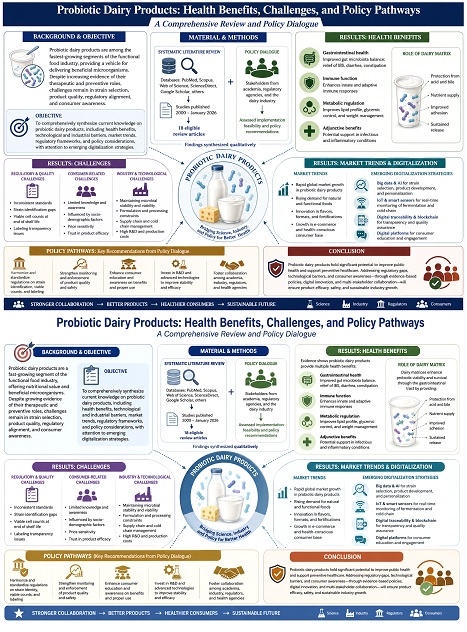
Background and Objective: Probiotic dairy products are offering nutritional value and reliable vehicle for delivering beneficial microorganisms. This review has provided a comprehensive synthesis of current knowledge on probiotic dairy products, including their health benefits, technological and industrial challenges, market trends, regulatory frameworks and policy considerations, with focus on emerging digitalization strategies.
Materials and Methods: A literature search was carried out within major databases for studies published between 2000 and January 2026, resulting in 18 eligible review articles. Due to methodological variability, findings were synthesized qualitatively. Additionally, a structured policy dialogue involving a diverse group of stakeholders from academia, regulatory agencies, scientific associations and dairy industry was used to assess their viewpoints. Participants were selected through purposive sampling and invited to provide their perspectives on the prioritization of proposed strategies, potential limitations of each strategy, their feasibility and possible obstacles, with the study objectives.
Results and Conclusion: The evidence demonstrates that probiotic dairy products support gastrointestinal health, immune function and metabolic regulation, with potential adjunctive benefits in managing infectious and inflammatory conditions. These effects are strain-specific, dose-dependent and condition-specific. Dairy matrices play a critical role in enhancing probiotic viability and survival through the gastrointestinal tract. However, inconsistencies are between regulatory standards and commercial practices, particularly in strain identification, viable cell counts at shelf life and labeling transparency. Consumer behavior is affected by knowledge, sociodemographic factors and price sensitivity, while industry challenges include maintaining microbial stability and overcoming technological and regulatory constraints. Policy discussions emphasized the need of standardized regulations, improved monitoring, consumer education and investment in advanced technologies. Strengthened collaboration within stakeholders is essential to ensure product efficacy, safety and sustainable growth.
- Probiotics
- Dairy products
- Health Policy
- Monitoring
- Standardized regulations
How to Cite
References
1. Sanchez B, De Los Reyes‐gavilán CG, Margolles A, Gueimonde M. Probiotic fermented milks: present and future. Int J Dairy Technol. 2009;62[4]:472-83. https://doi.org/10.1111/j.1471-0307.2009.00528.x
2. Shimizu T. Health claims and scientific substantiation of functional foods-Japanese system aiming the global standard. CurrTopic Nutrac Res 2003; 1[ 3]:213-224. https://doi.org/10.1079/nrr200363
3. Roberfroid MB. Concepts and strategy of functional food science: the European perspective. Amer J Clinic Nutr. 2000; 71[6]: 1660S-4S. https://doi.org/10.1093/ajcn/71.6.1660s
4. Yang Y. Scientific substantiation of functional food health claims in China. J Nutr. 2008; 138[6]: 1199S-205S. https://doi.org/10.1093/jn/138.6.1199s
5. Ozen AE, Pons A, Tur JA. Worldwide consumption of functional foods: a systematic review. Nutr Rev. 2012; 70[8]: 472-81. https://doi.org/10.1111/j.17534887.2012.00492.x
6. Granato D, Branco GF, Cruz AG, Faria JdAF, Shah NP. Probiotic dairy products as functional foods. Comp Rev Food Sci Food Safety. 2010;9[5]:455-70. https://doi.org/10.1111/j.1541-4337.2010.00120.x
7. Elshaghabee FM. Probiotics in dairy foods: Advantages and disadvantages. Egyp J Agr Sci. 2023; 74(1): 1-18. https://doi.org/10.21608/ejarc.2023.304665.
8. Foroutan NS, Tabandeh F, Khodabandeh M, Mojgani N, Maghsoudi A, Moradi M. Isolation and identification of an indigenous probiotic Lactobacillus strain: Its encapsulation with natural branched polysaccharids to improve bacterial viability. Appl Food Biotechnol. 2017; 4[3]: 133-142. https://doi.org/10.22037/afb.v4i3.16471
9. Bazhan M, Kalantari N, Keshavarz-Mohammadi N, Hosseini H, Eini-Zinab H, Alavi-Majd H. Applying social marketing mix to identify consumers’ preferences towards functional dairy products in Iran. Nutr Food Sci. 2018; 48[1]: 45-60. https://doi.org/10.1108/NFS-04-2017-0067
10. Heller KJ. Probiotic bacteria in fermented foods: product characteristics and starter organisms. Amer J Clinic Nutr. 2001; 73[2]: 374s-9s. https://doi.org/10.1093/AJCN/73.2.374S
11. Ranadheera R, Baines SK, Adams MC. Importance of food in probiotic efficacy. Food Res Int. 2010; 43[1]: 1-7. https://doi.org/10.1016/j.foodres.2009.09.009
12. Urrutia-Baca V, Hernández-Hernández S, Martínez L, Dávila-Vega J, Chuck-Hernández C. The role of probiotics in dairy Foods and Strategies to evaluate their functional modifications. Food Rev Int. 2024; 40[1]: 434-56. https://doi.org/10.1080/87559129.2023.2172426
13. Widodo W, Fanani TH, Fahreza MI, Sukarno AS. Cholesterol assimilation of two probiotic strains of Lactobacillus casei used as dairy starter cultures. Appl Food Biotechnol. 2021; 8[2]: 103-12. https://doi.org/10.22037/afb.v8i2.30661
14. Ibrahim AMO, Alshahrani RH. Antibacterial activity of Lactiplantibacillus strains isolated from commercial yogurt against foodborne pathogenic bacteria. Appl Food Biotechnol. 2024; 11[1]: 1-12. https://doi.org/10.22037/afb.vilil.43275
15. Golshahi M, Pirnia MM, Jafari P, Ebrahimi E, Tafvizi F, Dameshghian M, et al. Characterization of effective native lactic acid bacteria as potential oral probiotics on growth inhibition of Streptococcus mutans. App Food Biotechnol. 2021; 8[3]: 201-12. http://dx.doi.org/10.22037/afb.v8i3.33704
16. Han J, Wang J. Dairy cow nutrition and milk quality. Agr. 2023; 13[3]: 702. https://doi.org/10.3390/agriculture13030702
17. Fakruddina M, Shishirb MA, Yousufa Z, Khanc MSS. Next-generation probiotics-the future of biotherapeutics. Microbial Bioactives. 2022; 5[1]: 156-63. https://doi.org/10.25163/microbbioacts.514309
18. Holzapfel WH, Haberer P, Geisen R, Björkroth J, Schillinger U. Taxonomy and important features of probiotic microorganisms in food and nutrition. Amer J Clini Nutri. 2001; 73[2]: 365s-73s. https://doi.org/10.1093/ajcn/73.2.365s
19. Karimi N, Jabbari V, Nazemi A, Ganbarov K, Karimi N, Tanomand A, et al. Thymol, cardamom and Lactobacillus plantarum nanoparticles as a functional candy with high protection against Streptococcus mutans and tooth decay. Microb Pathogen. 2020; 148: 104481. https://doi.org/10.1016/j.micpath.2020.104481
20. Bazzaz S, Abbasi A, Ghotbabad AG, Pourjafar H, Hosseini H. Novel encapsulation approaches in the functional food industry: With a focus on probiotic cells and bioactive compounds. Prob Antimicrob Proteins. 2025; 17[3]:1132-70.https://doi.org/10.1007/s12602-024-10364-7
21. SURE Guides for Preparing and Using Evidence-Based Policy Briefs: 5. Identifying and addressing barriers to implementing policy options. Version 2.1 [updated November 2011]. The SURE Collaboration, 2011. Available from www.evipnet.org/sure
22. Andersson H, Asp N-G, Bruce Å, Roos S, Wadström T, Wold AE. Health effects of probiotics and prebiotics A literature review on human studies. Näringsforskning. 2001; 45[1]: 58-75. https://doi.org/10.3402/fnr.v45i0.1790
23. Chugh B, Kamal-Eldin A. Bioactive compounds produced by probiotics in food products. Curr Opin Food Sci. 2020; 32: 76-82. https://doi.org/10.1016/j.cofs.2020.02.003
24. Yeşilyurt N, Yılmaz B, Ağagündüz D, Capasso R. Involvement of probiotics and postbiotics in the immune system modulation. Biologics. 2021; 1[2]: 89-110. https://doi.org/10.3390/biologics1020006
25. Plaza-Diaz J, Ruiz-Ojeda FJ, Gil-Campos M, Gil A. Mechanisms of action of probiotics. Adv Nutr. 2019; 10: S49-S66. https://doi.org/10.1093/advances/nmy063
26. O’Toole PW, Marchesi JR, Hill C. Next-generation probiotics: the spectrum from probiotics to live biotherapeutics. Nature Microbiol. 2017;2[5]:1-6. https://doi.org/10.1038/nmicrobiol.2017.57
27. Walker WA. Mechanisms of action of probiotics. ClinicInfec Dis. 2008; 46[Supplement_2]: S87-S91. https://doi.org/10.1086/523335
28. Zhang R, Zhou M, Tu Y, Zhang N, Deng K, Ma T, et al. Effect of oral administration of probiotics on growth performance, apparent nutrient digestibility and stress‐associated indicators in Holstein calves. J Anim Physiol Anim Nutr. 2016; 100[1]: 33-8. https://doi.org/10.1111/jpn.12338
29. Sarita B, Samadhan D, Hassan MZ, Kovaleva EG. A comprehensive review of probiotics and human health-current prospective and applications. Front Microbiol. 2025; 15: 1487641. https://doi.org/10.3389/fmicb.2024.1487641
30. Gul S, Durante-Mangoni E. Unraveling the puzzle: health benefits of probiotics- A comprehensive review. J Clinic Med. 2024; 13[5]: 1436. https://doi.org/10.3390/jcm13051436
31. Sohail A, Cheema HA, Mithani MS, Shahid A, Nawaz A, Hermis AH, et al. Probiotics for the prevention and treatment of COVID-19: a rapid systematic review and meta-analysis. Front Nutr. 2023; 10: 1274122. https://doi.org/10.3389/fnut.2023.1274122
32. Barkhidarian B, Roldos L, Iskandar MM, Saedisomeolia A, Kubow S. Probiotic supplementation and micronutrient status in healthy subjects: a systematic review of clinical trials. Nutr. 2021; 13[9]: 3001. https://doi.org/10.3390/nu13093001
33. Gorji A, Ghadiri MK. Potential roles of micronutrient deficiency and immune system dysfunction in the coronavirus disease 2019 [COVID-19] pandemic. Nutr. 2021; 82: 111047. https://doi.org/10.1016/j.nut.2020.111047
34. Sarao LK, Arora M. Probiotics, prebiotics and microencapsulation: A review. Critical reviews in food science and nutrition. 2017; 57[2]: 344-71. https://doi.org/10.1080/10408398.2014.887055
35. Fontana L, Bermudez-Brito M, Plaza-Diaz J, Munoz-Quezada S, Gil A. Sources, isolation, characterisation and evaluation of probiotics. British J Nutr. 2013; 109[S2]: S35-S50. https://doi.org/10.1017/s0007114512004011
36. Szajewska H, Canani RB, Guarino A, Hojsak I, Indrio F, Kolacek S, et al. Probiotics for the prevention of antibiotic‐associated diarrhea in children. J Pediat Gastroenterol Nutr. 2016; 62[3]: 495-506. https://doi.org/10.1097/mpg.0000000000001081
37. Abouelela ME, Helmy YA. Next-generation probiotics as novel therapeutics for improving human health: current trends and future perspectives. Microorganisms. 2024; 12[3]: 430. https://doi.org/10.3390/microorganisms12030430
38. Aljutaily T, Huarte E, Martinez-Monteagudo S, Gonzalez-Hernandez JL, Rovai M, Sergeev IN. Probiotic-enriched milk and dairy products increase gut microbiota diversity: a comparative study. Nutr Res. 2020; 82: 25-33. https://doi.org/10.1016/j.nutres.2020.06.017
39. Taha-Abdelaziz K, Singh M, Sharif S, Sharma S, Kulkarni RR, Alizadeh M, et al. Intervention strategies to control Campylobacter at different stages of the food chain. Microorganisms. 2023; 11[1]: 113. https://doi.org/10.3390/microorganisms11010113
40. Etebarian A, Alhouei B, Mohammadi‐Nasrabadi F, Esfarjani F. Propolis as a functional food and promising agent for oral health and microbiota balance: A review study. Food Sci Nutr. 2024; 12[8]: 5329-40. https://doi.org/10.1002/fsn3.4216
41. Salehi S, Abedi A, Balakrishnan S, Gholamrezanezhad A. Coronavirus disease 2019 [COVID-19]: a systematic review of imaging findings in 919 patients. Amer J Roentgenol. 2020; 215[1]: 87-93. https://doi.org/10.2214/ajr.20.23034
42. Mohammadi-Nasrabadi F, Ghodsi D, Haghighian-Roudsari A, Esfarjani F, Khoshfetrat M-R, Houshialsadat Z, et al. Economic sanctions affecting household food and nutrition security and policies to cope with them: a systematic review. Int J Health Polic Manag. 2023; 12: 7362. https://doi.org/10.34172/ijhpm.2023.7362
43. Robert E, Rajan D, Koch K, Weaver AM, Porignon D, Ridde V. Policy dialogue as a collaborative tool for multistakeholder health governance: a scoping study. BMJ Global Health. 2020;4[Suppl 7]: e002161. https://doi.org/10.1136/bmjgh-2019-002161
44. Boylston TD, Vinderola CG, Ghoddusi HB, Reinheimer JA. Incorporation of bifidobacteria into cheeses: challenges and rewards. Int Dairy J. 2004; 14[5]: 375-87. https://doi.org/10.1016/j.idairyj.2003.08.008
45. Elshaghabee FM, Rokana N, Gulhane RD, Sharma C, Panwar H. Bacillus as potential probiotics: status, concerns and future perspectives. Front Microbiol. 2017; 8: 1490. https://doi.org/10.3389/fmicb.2017.01490
46. Jackson SA, Schoeni JL, Vegge C, Pane M, Stahl B, Bradley M, et al. Improving end-user trust in the quality of commercial probiotic products. Front Microbiol. 2019; 10: 739. https://doi.org/10.3389/fmicb.2019.00739
47. Plaza-Díaz J, Ruiz-Ojeda FJ, Gil-Campos M, Gil A. Immune-mediated mechanisms of action of probiotics and synbiotics in treating pediatric intestinal diseases. Nutrients. 2018; 10[1]: 42. https://doi.org/10.3390/nu10010042
48. Binda S, Hill C, Johansen E, Obis D, Pot B, Sanders ME, et al. Criteria to qualify microorganisms as “probiotic” in foods and dietary supplements. Front Microbiol. 2020; 11: 1662. https://doi.org/10.3389/fmicb.2020.01662
49. Joint F. WHO Working Group 2002 Report on Drafting Guidelines for the Evaluation of Probiotics in Food. Report on Drafting Guidelines for the Evaluation of Probiotics in Food London, Ontario, Canada.5. https://isappscience.org/wp-content/uploads/2019/04/probiotic_guidelines.pdf
50. Guarner F, Khan AG, Garisch J, Eliakim R, Gangl A, Thomson A, et al. Probiotics and prebiotics. World Gastroenterology Organisation Global Guidelines. 2011; 46[6]: 468-881. https://doi.org/10.1097/mcg.0b013e3182549092
51. Hill C, Guarner F, Reid G, Gibson GR, Merenstein DJ, Pot B, et al. The international scientific association for probiotics and prebiotics consensus statement on the scope and appropriate use of the term probiotic. Nature Rev Gastroenterol Hepatol. 2014; 11[8]: 506-14. https://doi.org/10.1038/nrgastro.2014.66
52. Binda¹ S, Hill C, Johansen E. Criteria to qualify microorganisms as probiotic in foods and dietary: Insights of gut microbiota: Prob Bioact Comp. 2021: 57413707. https://doi.org/10.3389/fmicb.2020.01662
53. Yilmaz-Ersan L, Ozcan T, Akpinar-Bayizit A. Assessment of socio-demographic factors, health status and the knowledge on probiotic dairy products. Food Sci Human Well. 2020; 9[3]: 272-9. https://doi.org/10.1016/j.fshw.2020.05.004
54. Fotopoulos C, Krystallis A. Organic product avoidance: reasons for rejection and potential buyers’ identification in a countrywide survey. British Food J. 2002; 104[3/4/5]: 233-60. https://doi.org/10.1108/00070700210425697
55. Verbeke W. Consumer acceptance of functional foods: socio-demographic, cognitive and attitudinal determinants. Food Qual Prefer. 2005; 16[1]: 45-57. https://doi.org/10.1016/j.foodqual.2004.01.001
56. Draper K, Ley C, Parsonnet J. A survey of probiotic use practices among patients at a tertiary medical centre. Benef Microb. 2017; 8[3]: 345-52. https://doi.org/10.3920/bm2016.0148
57. Draper K, Ley C, Parsonnet J. Probiotic guidelines and physician practice: a cross-sectional survey and overview of the literature. Benef Microb. 2017; 8[4]: 507-20. https://doi.org/10.3920/bm2016.0146
58. Brinich MA, Mercer MB, Sharp RR. An analysis of online messages about probiotics. BMC Gastroenterol. 2013; 13[1]: 5. https://doi.org/10.1186/1471-230x-13-5
59. Kolaček S, Hojsak I, Berni Canani R, Guarino A, Indrio F, Orel R, et al. Commercial probiotic products: a call for improved quality control. A position paper by the ESPGHAN working group for probiotics and prebiotics. J Ped Gastroenter Nutr. 2017; 65[1]: 117-24. https://doi.org/10.1097/mpg.0000000000001603
60. Mesias FJ, Fernández JA, Horrillo A, Escribano AJ. An approach to the perceptions of Spanish consumers on food sustainability through the use of projective techniques. New Medit: A Med J Econom Agr Env, 2023: 22 (1): nm2301c. https://doi.org/10.30682/nm2301c
61. Taşkoparan Ş, Altınay C, Özer HB. Recent updates of probiotic dairy-based beverages. Food Funct. 2025; 16[5]: 1656-69. https://doi.org/10.1039/D4FO06322H
62. Glanville J, King S, Guarner F, Hill C, Sanders ME. A review of the systematic review process and its applicability for use in evaluating evidence for health claims on probiotic foods in the European Union. Nutr J. 2015; 14[1]: 16. https://doi.org/10.1186/s12937-015-0004-5
63. Hotel ACP, Cordoba A. Health and nutritional properties of probiotics in food including powder milk with live lactic acid bacteria. Prevention. 2001;5[1]:1-10. https://www.iqb.es/digestivo/pdfs/probioticos.pdf
64. Organization WH. Food and agriculture organization of the United Nations. Vit Min Requir Human Nutr. 2004; 2: 17-299. https://www.fao.org/ag/humannutrition/36659-04427f866c8b2539d8e47d408cad5f3f9.pdf
65. Taibi A, Comelli EM. Practical approaches to probiotics use. Appl Physiol, Nutr Metabol. 2014; 39[8]: 980-6. https://doi.org/10.1139/apnm-2013-0490
66. Clarke TC, Black LI, Stussman BJ, Barnes PM, Nahin RL. Trends in the use of complementary health approaches among adults: United States, 2002–2012. National health statistics reports. 2015[79]: 1.
67. Damari B, Ebrahimi MT, Jafarvand E. Probiotics industry: review of current challenges and the future roadmap. J Iran Inst Health Sci Res . 2021; 20[3]. http://dx.doi.org/10.52547/payesh.20.3.263
68. Kazemi F, Sharifi A, Mahmoudi R. Evaluation of viability of probiotic bacteria in some iranian probiotic dairy products. J Food Bioproc Eng. 2024; 7[1]: 72-8. https://doi.org/10.22059/jfabe.2024.377510.1179
69. ECO D. OECD economic surveys. 2011. https://doi.org/10.1787/eco_surveys-isr-2011-en
70. Asadi S, Ashrafi F, Kebriti K, Moulavi P, Hosseini S. A review examining techniques for enhancing the health and longevity of Lactobacillus bacteria within probiotic food items. Casp J Veter Sci. 2025; 2[2]: 7-20. https://doi.org/10.22034/CJVS.2025.522095.1037
71. Khosravi-Darani K, Rezaei-Savadkouhi N, Zerafati-Shoae N. Innovative solutions in food biotechnology: advancing sustainable, resilient and health-oriented food systems. Appl Food Biotechnol. 12[1]: 1-5 [e34]. https://doi.org/10.22037/afb.v12i1.52439
- Abstract Viewed: 139 times
- pdf Downloaded: 76 times