L-Lysine: A Comprehensive Review of Biosynthesis Pathways, Industrial Production Methods, and Diverse Applications L-Lysin bioproduction
Applied Food Biotechnology,
Vol. 13 No. 1 (2026),
7 December 2025
,
Page 1-16 (e19)
https://doi.org/10.22037/afb.v13i1.52636
Abstract
Background and Objective: L‑Lysine, an essential amino acid, plays critical roles in protein synthesis, metabolic regulation and structural integrity. This review aimed to comprehensively summarize the amino acid chemical characteristics, biosynthesis pathways, industrial production strategies and diverse uses in nutrition, medicine and biotechnology.
Literature Search Strategy: A literature search was carried out using PubMed, Scopus and Web of Science up to 2025. Keywords included "L‑lysine", "biosynthesis", "fermentation", "Corynebacterium glutamicum" and "applications". Relevant original research, reviews and patents from major patent authorities (e.g., USPTO, WIPO and EPO) were critically assessed. As a narrative review, the synthesis focused on providing a broad overview of the field rather than a quantitative meta-analysis.
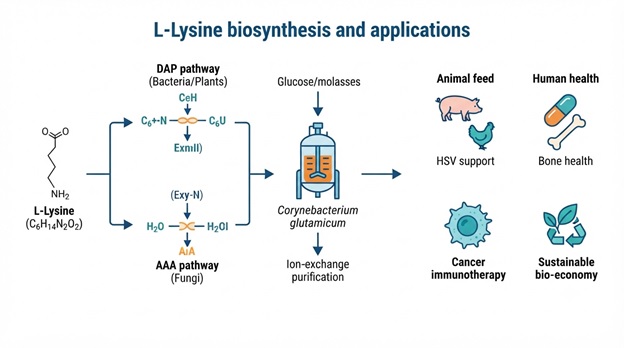
Results and conclusion: The diaminopimelic acid pathway in bacteria and plants and the α‑aminoadipic acid pathway in fungi were detailed. Industrial production depended on engineered Corynebacterium glutamicum strains with feedback‑resistant aspartokinase, optimized biotin levels and downstream ion‑exchange purification. Key uses included animal feed supplementation, antiviral therapy, bone health, anxiety reduction and emerging roles in cancer immunotherapy. Recent advances in CRISPR/Cas9, metabolic flux analysis and sustainable feedstocks were highlighted.L‑Lysine is a cornerstone of the global bioeconomy with expanding pharmaceutical and material uses. Precision metabolic engineering and circular bioeconomy approaches drive further innovations
- Biosynthesis
- Corynebacterium glutamicum
- Flux analysis
- Industrial production
- L Lysine
How to Cite
References
1. Hashim, M., El-Saber, M., Al-Salami, A., Comprehen-sive review of L-lysine: Chemistry, occurrence, and physiological roles. Curr. Protein Pept. Sci., 2025. 27(2): 150-162. https://doi.org/10.2174/0113892037381647250526073248.
2. Wu, G., Amino acids: biochemistry and nutrition. 2021: CRC press.
3. Zhou, H. X. Pang, X., Electrostatic interactions in protein structure, folding, binding, and condensation. Chem. Rev., 2018. 118(4): 1691-1741. https://doi.org/10.1021/acs.chemrev.7b00305.
4. Yamauchi, M., Terajima, M., Shiiba, M., Lysine Hydroxylation and Cross-Linking of Collagen, in Post-Translational Modification of Proteins: Tools for Functional Proteomics, Kannicht, C., Editor. 2019, Springer New York: New York, NY. p. 309-324.
5. Holeček, M. Lysine: sources, metabolism, physiological importance, and use as a supplement. Int. J. Mol. Sci., 2025. 26(18): 8791.
6. Hashim M, Alam I, Ahmad M, Badruddeen, Akhtar J, Khan MI, Islam A, Parveen S. Comprehensive Review of L-Lysine: Chemistry, Occurrence, and Physiological Roles. Curr Protein Pept Sci. 2026; 27(2): 150-162. https://10.2174/0113892037381647250526073248. PMID: 40626529.
7. Pedrazini, M. C., da Silva, M. H., Groppo, F. C., L-lysine: Its antagonism with L-arginine in controlling viral infection. Narrative literature review. Br. J. Clin. Pharmacol., 2022. 88(11): 4708-4723. https://doi.org/10.1111/bcp.15443.
8. Duparc, C., Lemaire, C., Petit, J., l-Lysine acts as a serotonin type 4 receptor antagonist to counteract in vitro and in vivo the stimulatory effect of serotonergic agents on aldosterone secretion in man. Horm. Metab. Res., 2017. 49(04): 269–275. https://doi.org/10.1055/s-0042-121423.
9. Liu, J., Zhang, Y., Wang, L., Industrial production of L-lysine in Corynebacterium glutamicum: Progress and prospects. Microbiol. Res., 2022; 262: 127101. https://doi.org/10.1186/s40643-024-00753-9.
10. Cheng, J., Li, X., Zhao, H., Expanding lysine industry: industrial biomanufacturing of lysine and its derivatives. J. Ind. Microbiol. Biotechnol., 2018. 45(8): 719-734. https://doi.org/10.1007/s10295-018-2030-8.
11. Ciprandi, G., Rossi, A., Bianchi, L., Ibuprofen lysine salt complexed with beta-cyclodextrin oral suspension: an innovative pediatric formulation with clinical advantages. Minerva Pediatr. 2025. https://doi.org/10.23736/S2724-5276.25.07862-0.
12. Yang, Q., Zhang, J., Liu, Y., Lysine biofortification of crops to promote sustained human health in the 21st century. J. Exp. Bot., 2022. 73(5): 1258-1267. https://doi.org/10.1093/jxb/erab482.
13. Stagi, L., Moretti, S., Ferrari, R., Modulating the poly-l-lysine structure through the control of the protonation–deprotonation state of l-lysine. Sci. Rep., 2022. 12(1): 19719. https://doi.org/10.1038/s41598-022-24109-5.
14. Eggeling, L. and Bott, M., A giant market and a powerful metabolism: L-lysine provided by Corynebacterium glutamicum. Appl. Microbiol. Biotechnol. 2015. 99(8): 3387–3394. https://doi.org/10.1007/s00253-015-6508-2.
15. Liu, J., Zhang, Y., Wang, L., Industrial production of L-lysine in Corynebacterium glutamicum: Progress and prospects. Microbiol. Res., 2022; 262: 127101. 10.1016/j.micres.2022.127101.
16. EFSA, Panel on additives and products or substances used in animal feed, safety and efficacy of l‐lysine monohydrochloride and l‐lysine sulfate produced using Corynebacterium glutamicum CGMCC 7.266 for all animal species. EFSA J., 2020. 18(2): e06019 . https://doi.org/10.2903/j.efsa.2020.6019.
17. Hashim, M., El-Saber, M., Al-Salami, A., Comprehensive Review of L-Lysine: Chemistry, Occurrence, and Physiological Roles. Curr. Protein Pept. Sci., 2026. 27(2): 150–162. 10.2174/0113892037381647250526073248.
18. Dong, X., Li, H., Wang, J., Characterization of aspartate kinase and homoserine dehydrogenase from Corynebacterium glutamicum IWJ001 and systematic investigation of L-isoleucine biosynthesis. J. Ind. Microbiol. Biotechnol., 2016. 43(6): 873–885. https://doi.org/10.1007/s10295-016-1763-5.
19. Son, H. F. and Kim, K.-J., Structural basis for substrate specificity of meso-diaminopimelic acid decarboxylase from Corynebacterium glutamicum. Biochem. Biophys. Res. Commun., 2018. 495(2): 1815–1821. https://doi.org/10.1016/j.bbrc.2017.11.097.
20. Zhang, Y., Chen, L., Wu, X., Efficient biosynthesis of α‐aminoadipic acid via lysine catabolism in Escherichia coli. Biotechnol. Bioeng., 2023. 120(1): 312–317. https://doi.org/10.1002/bit.28256.
21. Hall, C. J., Zhao, S., Yan, J., Differential lysine‐mediated allosteric regulation of plant dihydrodipicolinate synthase isoforms. FEBS J., 2021. 288(16): 4973-4986. https://doi.org/10.1111/febs.15766.
22. Liu, J., Zhang, Y., Wang, L., Reconstruction the feed-back regulation of amino acid metabolism to develop a non-auxotrophic L-threonine producing Corynebacterium glutamicum. Bioresour. Bioprocess., 2024. 11(1): 43. https://doi.org/10.1016/j.micres.2022.127101.
23. Sadeghiyan-Rizi, T., Saghari, M., Esmaeili, M., Optimization of L-tryptophan biosynthesis from L-serine of processed Iranian beet and cane molasses and indole by induced Escherichia coli ATCC 11303 cells. Jundishapur J. Microbiol., 2014. 7(6): e10589. https://doi.org/10.5812/jjm.10589.
24. Ochiai, T., Wachi, M., Hirasawa, T., Biotin concentration affects anaplerotic reactions functioning in glutamic acid production in Corynebacterium glutamicum. Microbiology, 2024. 170(10): 001507. https://doi.org/10.1099/mic.0.001507.
25. Plháčková, K., Vojtíšek, V., Plachý, J., Enzymic synthesis of l-Lysine fromdl-α-Amino-ε-caprolactam by new microbial strains. Folia Microbiol., 1982. 27(6): 382-389. https://doi.org/10.1007/BF02876448.
26. Félix, F.K.D.C., Mendes, R., Oliveira, S., L-lysine production improvement: a review of the state of the art and patent landscape focusing on strain development and fermentation technologies. Crit. Rev. Biotechnol., 2019. 39(8): 1031–1055. https://doi.org/10.1080/07388551.2019.1663149.
27. Kortmann, M., Weidmann, T., Schick, M., Pyruvate carboxylase variants enabling improved lysine production from glucose identified by biosensor-based high-throughput fluorescence-activated cell sorting screening. ACS Synth. Biol., 2019. 8(2): 274–281. https://doi.org/10.1021/acssynbio.8b00510.
28. Kananykhina, O., Turpurova, T., Soloviova, A., Feed lysin. meaning and synthesis. Grain Prod. Mix. Fodder’s, 2024. 24(4).
29. Sobotka, W., Drażbo, A., The effect of dietary protein restriction in phase feeding systems on nitrogen metabolism and excretion in pig production. Animals, 2025. 15(11): 1521. https://doi.org/10.3390/ani15111521.
30. Mailoo, V.J., Rampes, S., Lysine for herpes simplex prophylaxis: a review of the evidence. Integr. Med., 2017. 16(3): 42.
31. Ivanov, V., Gurova, E., Petrova, M., Anti-atherogenic effects of a mixture of ascorbic acid, lysine, proline, arginine, cysteine, and green tea phenolics in human aortic smooth muscle cells. J. Cardiovasc. Pharmacol., 2007. 49(3): 140–145. https://doi.org/10.1097/FJC.0b013e3180308489.
32. Tavafoghi, M., Cerruti, M., The role of amino acids in hydroxyapatite mineralization. J. R. Soc. Interface, 2016. 13(123): https://doi.org/10.1098/rsif.2016.0462.
33. Saito, M., Sato, Y., Tanaka, H., Diabetes, collagen, and bone quality. Curr. Osteoporos. Rep., 2014. 12(2): 181-188. https://doi.org/10.1007/s11914-014-0202-7.
34. Jalal, K., Al-Salami, A., Hassan, S., Anxiolytic, anti-nociceptive and body weight reducing effects of L-lysine in rats: relationship with brain serotonin an in-vivo and in-silico study. Biomed. Pharmacother., 2022. 152(113235). https://doi.org/10.1016/j.biopha.2022.113235.
35. Meybodi, N. M., Rezai, M., Mohammadi, A., Wheat bread: Potential approach to fortify its lysine content. Curr. Nutr. Food Sci., 2019. 15(7): 630–637. https://doi.org/10.2174/1573401315666190228125241.
36. Lu, X., Wang, Y., Zhang, L., Multi-omics profiling reveals downregulated tumor lysine metabolism reshaping the immune microenvironment and therapeutic responses in hepatocellular carcinoma. J. Transl. Med., 2025. 23(1): 1117.https://doi.org/10.1186/s12967-025-07056-3.
37. Besermenji, K. and Petracca, R., Rewiring lysine catabolism in cancer leads to increased histone crotonylation and immune escape. Chem BioChem, 2024. 25(24): e202400638. https://doi.org/10.1002/cbic.202400638.
38. Park, J. and Woo, H. M., Co-production of l-lysine and heterologous squalene in CRISPR/dCas9-assisted Corynebacterium glutamicum. J. Agric. Food Chem., 2022. 70(46): 14755-14760. https://doi.org/10.1021/acs.jafc.2c07981.
39. Yuan, L., Li, Z., Wang, Q., Enhancing intracellular NADPH bioavailability through improving pentose phosphate pathway flux and its application in biocatalysis asymmetric reduction reaction. J. Biosci. Bioeng., 2022. 134(6): 528–533. https://doi.org/10.1016/j.jbiosc.2022.08.010.
40. Vrljic, M., Sahm, H., Eggeling, L., A new type of transporter with a new type of cellular function: l‐lysine export from Corynebacterium glutamicum. Mol. Microbiol., 1996. 22(5): 815-826. https://doi.org/10.1046/j.1365-2958.1996.01527.x.
41. Choi, J. W., Jeon, E. J., Jeong, K. J., Recent advances in engineering Corynebacterium glutamicum for utilization of hemicellulosic biomass. Curr. Opin. Biotechnol., 2019. 57(17–24). https://doi.org/10.1016/j.copbio.2018.12.004.
42. Vasudevan, U. M., Selvaraj, K., Karthikeyan, R., Yeast as C1 cell factory: Transforming methanol and formate into high-value compounds. Biotechnol. Adv., 2025. 108641. https://doi.org/10.1016/j.biotechadv.2025.108641.
43. Lira-Parada, P. A., Alarcón, M., González, J., Linking process and metabolic modelling for the estimation of carbon flux distribution in Corynebacterium glutamicum growth in spent sulfite liquor. IFAC-Pap. OnLine, 2022. 55(7): 228–233. https://doi.org/10.1016/j.ifacol.2022.07.433.
44. Sinner, P., Müller, S., Schmidt, M., Online estimation of changing metabolic capacities in continuous Coryne-bacterium glutamicum cultivations growing on a complex sugar mixture. Biotechnol. Bioeng., 2022. 119(2): 575-590. https://doi.org/10.1002/bit.27987.
45. Konishi, M., High cell density cultivation of Coryne-bacterium glutamicum by deep learning-assisted medium design and the subsequent feeding strategy. J. Biosci. Bioeng., 2024. 137(5): 396–402. https://doi.org/10.1016/j.jbiosc.2024.01.018.
46. Butean, A., Popescu, D., Ionescu, C., A review of artificial intelligence applications for biorefineries and bioprocessing: from data-driven processes to optimization strategies and real-time control. Processes, 2025. 13(8): 2544. https://doi.org/10.3390/pr13082544.
47. Peng, X., Wang, Y., Li, Z., Engineering bacterium for biofilm formation and L-lysine production in continuous fermentation. Bioresour. Technol., 2024. 414 (131567). https://doi.org/10.1016/j.biortech.2025.133366.
48. Peng, X., Zhang, H., Liu, S., Constructing elongated Corynebacterium glutamicum and its application in efficient l-lysine production during continuous fermentation. Bioresour. Technol., 2025. 133366.https://doi.org/10.1016/j.biortech.2024.131567.
69. ECO D. OECD economic surveys. 2011. https://doi.org/10.1787/eco_surveys-isr-2011-en
70. Asadi S, Ashrafi F, Kebriti K, Moulavi P, Hosseini S. A review examining techniques for enhancing the health and longevity of Lactobacillus bacteria within probiotic food items. Casp J Veter Sci. 2025; 2[2]: 7-20. https://doi.org/10.22034/CJVS.2025.522095.1037
71. Khosravi-Darani K, Rezaei-Savadkouhi N, Zerafati-Shoae N. Innovative solutions in food biotechnology: advancing sustainable, resilient and health-oriented food systems. Appl Food Biotechnol. 12[1]: 1-5 [e34]. https://doi.org/10.22037/afb.v12i1.52439
- Abstract Viewed: 171 times
- PDF Downloaded: 180 times