Nutritional and Functional Biovalorization of Potato Pulp through Simultaneous and Two-Stage Fermentations
Applied Food Biotechnology,
Vol. 13 No. 1 (2026),
7 December 2025
,
Page 1-13 (e11)
https://doi.org/10.22037/afb.v13i1.51825
Abstract
Background and Objective: Potato pulp, a major agro-industrial by-product, contains valuable nutrients, which are still underused due to their limited bioavailability and functional characteristics. This study aimed to enhance the nutritional and functional qualities of potato pulp through solid-state fermentation (SSF) using Lactobacillus fermentum MT-ZH893 (LF) in combination with Aspergillus oryzae (AOR) and Rhizopus oryzae (ROR).
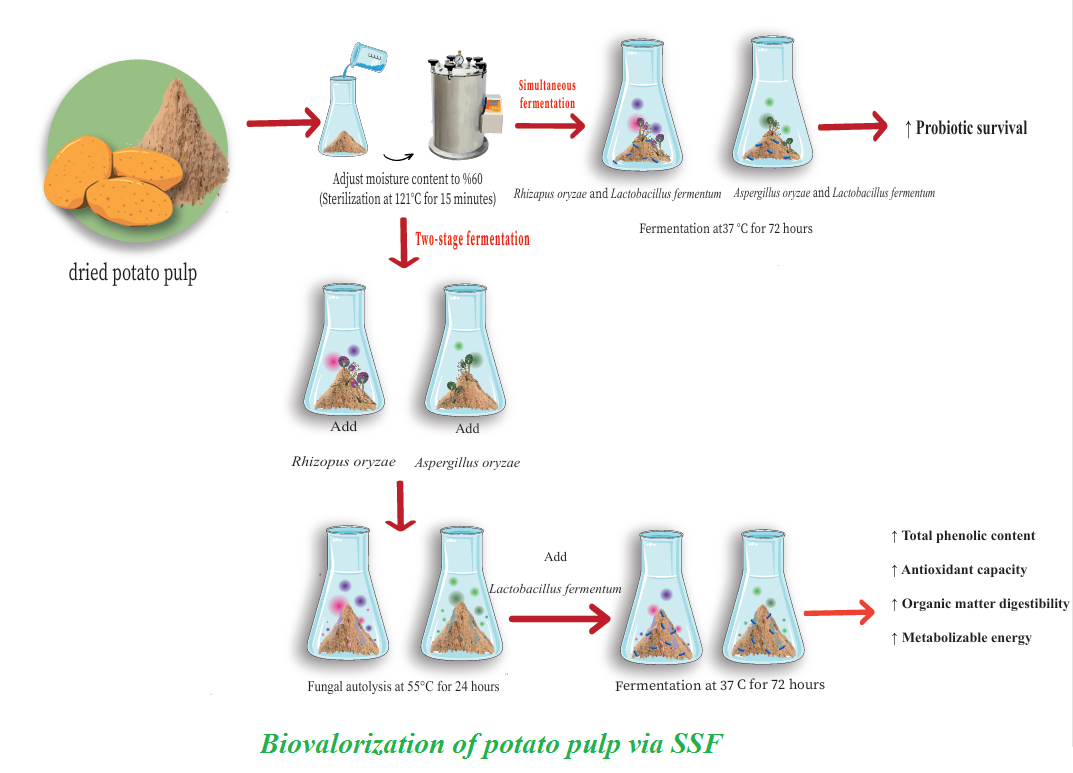
Material and Methods: Potato pulp was utilized as the substrate for solid-state fermentation. Four strategies combining Lactobacillus fermentum with fungi were investigated, including: simultaneous fermentation (LF+AOR and LF+ROR) and two-stage fermentation (fungi inoculated first, followed by the bacteria of; AORLF and RORLF). Key parameters assessed included crude protein content, probiotic viability, total phenolic content, antioxidant capacity (2,2′-azinobis-(3-ethylbenzothiazoline-6-sulphonate and 2,2-diphenyl-1-picrylhydrazyl assays), organic matter digestibility and metabolizable energy.
Results and Conclusion: Simultaneous fermentation with Aspergillus oryzae increased crude protein content, whereas treatments involving Rhizopus oryzae resulted in a significant decrease in crude protein. Simultaneous fermentation significantly enhanced probiotic viability. In contrast, the two-stage process using Rhizopus oryzae produced superior outcomes in total phenolic content (1011 mg Gallic acid equivalents per gram of dry material, antioxidant capacity (2,2′-azinobis-(3-ethylbenzothiazoline-6-sulphonate, 934.9 μmol Trolox; 2,2-diphenyl-1-picrylhydrazyl, 97.01%), organic matter digestibility and metabolizable energy. These results indicated that while simultaneous fermentation optimized probiotic viability and protein content (with Aspergillus oryzae), the two-stage approach with Rhizopus oryzae significantly enhanced the functional characteristics and digestibility of potato pulp, presenting promising strategies for value-added bioprocessing of agro-industrial residues.
Keywords: Agroindustrial byproducts, Aspergillus oryzae, Lactobacillus fermentum, Potato pulp, Rhizopus oryzae, Solid-state fermentation
- Introduction
Potatoes rank as the world’s fourth most significant food crop, contributing profoundly to global food security [1]. With their extensive consumption and industrial processing, vast quantities of wastes, particularly potato peels and pulp, are generated, which are projected to reach over 8 million tons by 2030, emitting nearly 5 million tons of CO₂ equivalents [2]. While such wastes pose serious environmental challenges, these represent a valuable reservoir of bioactive compounds and fermentable substrates with great potential for sustainable bio-valorization [3]. Potato pulp, achieved at roughly 0.75 tons per ton of extracted starch [4], is a lignocellulose-rich byproducts consisting of water, starch, cellulose, hemicellulose, pectin, protein, fibrous carbohydrates, phenolic compounds and minerals. Despite its valuable composition, economic and technical barriers linked to preservation and transport currently limit its industrial use [5].
To overcome these limitations and safely use these agro‑industrial residues, various strategies have been suggested. From these suggestions, microbial fermentation has significantly been interested as a highly effective approach for increasing the nutritional values and functional characteristics of such byproducts. By converting complex macromolecules into simpler further digestible components, fermentation not only improves the overall nutritional quality of the residue but also facilitates its stabilization and further use.
Therefore, solid-state fermentation (SSF) has emerged as a compelling solution to increase the added value of potato pulp. Rather than fundamentally solving economic transport barriers, SSF represents an economically viable and environmentally friendly bioprocess characterized by low water and energy consumption. The efficiency of SSF is ruled by several key variables, including moisture content, temperature, fermentation time and inoculation strategy. Use of probiotics such as Lactobacillus fermentum with filamentous fungi such as Aspergillus oryzae and Rhizopus oryzae in SSF systems is particularly advantageous. The L. fermentum shows immunomodulatory, anti-inflammatory and microbiota‑balancing effects. Complementarily, these fungal species secrete hydrolytic enzymes that facilitate starch and protein degradation, improving substrate digestibility and supporting probiotic viability [6]. This integration promotes circular bioeconomy principles by transforming agri‑food wastes into high‑value health‑promoting products [7].
Furthermore, numerous studies have directly highlighted the efficacy of SSF in valorizing potato byproducts. For example, potato pulp has been used as a substrate for enzyme production using recombinant A. oryzae strain [8]. Moreover, SSF of potato peels uses R. oryzae enriched fungal biomass with proteins and essential amino acids (EAA) [9]. A two‑stage fermentation converted potato starch wastes into high-quality animal feed using mutant A. niger followed by Bacillus licheniformis [10]. More recently, enzyme-assisted fermentation of potato pulp promoted the growth of L. plantarum, increasing organic acid production and altering microstructural characteristics to facilitate rapid drying [11]. Co‑fermentation of Aspergillus spp. with B. subtilis improved physicochemical characteristics and decreased spoilage of potato pulp [12].
Regarding sequential strategies aimed at probiotic enrichment, fungal pretreatment with A. oryzae enhanced the viability of Pediococcus acidilactici by degrading the rigid lignocellulosic structure of the substrate [13]. Similarly, SSF of industrial potato wastes with L. plantarum, S. cerevisiae and A. oryzae increased phenolic compounds, antioxidant capacity and simultaneously decreased anti-nutritional factors such as phytic acid [14]. Despite these advancements, studies specifically assessing the SSF of potato pulp that use simultaneous or sequential cultures of L. fermentum with A. oryzae or R. oryzae are still limited.
Accordingly, the overall strategy of this study was to valorize potato pulp through solid-state fermentation by comparing simultaneous and two-stage fermentation systems of L. fermentum with either A. oryzae or R. oryzae. By focusing on interspecies metabolic interactions, the study aimed to systematically investigate the effects of various inoculation strategies on nutritional quality, antioxidant enrichment, probiotic stability and substrate digestibility. Ultimately, this study was carried out with the goal of developing a value-added bio-based feed additive from this starchy agro-industrial waste; thereby, identifying the optimal approach for its microbial upcycling.
- Materials and Methods
2.1. Materials
2.1.2. Potato pulp and microorganisms
Potato pulp was sourced from Alvand Starch, Iran, dried at 50 °C for 48 h and stored at -18 °C. The L. fermentum MT.ZH893 was isolated from Mazandaran local cheese at the Food Science and Engineering Department, Tarbiat Modares University, Tehran, Iran [15]. The A. oryzae PTCC 5163 was provided from the microbial collection of the Faculty of Veterinary Medicine, University of Tehran, Tehran, Iran, and R. oryzae PTCC 5176 was provided by Persian Type Culture Collection (PTCC), Iranian Research Organization for Science and Technology (IROST), Tehran, Iran.
2.1.3. Materials and Reagents
The chemicals and culture media used in this study were as follows. Briefly, de Man, Rogosa and Sharpe (MRS) agar media were purchased from Ibresco, Iran; methanol (CH₃OH) was purchased from Majalli Industrial Chemicals, Iran; 2,2-diphenyl-1-picrylhydrazyl radical [2,2-diphenyl-1-picrylhydrazyl (DPPH⁺) ≥ 98% purity], 2,2’-azino-bis(3-ethylbenzothiazoline-6-sulfonic acid) diammonium salt [2,2′-azinobis-(3-ethylbenzothiazoline-6-sulphonate (ABTS+) ≥ 98% purity] and Folin-Ciocalteu phenol reagent were purchased from Sigma-Aldrich, USA. Trichloroacetic acid (TCA) and sulfuric acid were purchased from Merck, Germany. All reagents included analytical grade or higher and were used without further purification unless otherwise stated.
2.2. Methods
2.2. Fermentation process
In the two-stage fermentation, 20 g of dried potato pulp were transferred into a 250-ml Erlenmeyer flask, brought to 60 % humidity and sterilized at 121∘ C for 15 min using autoclave. Then, 1 ml of fungi [A. oryzae or R. oryzae (108 cfu ml-1)] was added to the media and incubated at 30 ∘ C for 24 h. The mixture was autolyzed at 55 ∘C for 24 h. After cooling down, the probiotic L. fermentum was added to the potato pulp at a concentration of 1.5 × 10⁸ cfu ml-1 and incubated at 37 ∘C for 72 h. In the simultaneous fermentation, fungi and L. fermentum were inoculated in a single step. The fermentation condition was microaerophilic [16,17]
2.3. Viability analysis
After the fermentation period, 1 g of the fermented substrate was weighed using conical tube (15 ml) with physiological serum under sterile conditions and diluted serially after complete homogenization. Then, 0.1 ml of each dilution was surface-cultured on MRS agar media, which was incubated at 37 °C for 72 h. With known percentage of moisture in the fermented substrate, the colony count was calculated based on dry matter (g) of the substrate as cfu per gdry weight substrate (cfu gdws-1) [18]
2.4. Total protein and total nitrogen
The total nitrogen content of digested samples was assessed using micro-Kjeldahl apparatus. For the analysis, 0.2 g of dried sample and 1 g of Kjeldahl digestion catalyst (sodium sulfate with copper sulfate and/or selenium) were transferred into the designated digestion tube of the system. Then, 7.5 ml of concentrated sulfuric acid (H₂SO₄, 98%) were added and digestion was carried out at 360°C for 5–6 h. The total nitrogen value was multiplied by 6.25 to calculate the total protein percentage [19].
2.5. True protein
To assess true protein content, the fresh samples were first dried at 50 °C for 24 h until constant weight using oven. The dried samples were thoroughly mixed and homogenized to ensure uniformity; then, 0.5 g was accurately weighed using laboratory balance. The weighed sample was transferred into a standard laboratory glass beaker and mixed with 50 ml of distilled water (DW). The mixture was set at room temperature (RT) for 30 min. Then, 10 ml of 10% trichloroacetic acid (TCA) were added and the sample was set standing for 30 min at RT. The precipitated proteins were filtered through Whatman filter paper no. 1 and the residue was dried using oven. The nitrogen content of the dried residue was assessed using micro-Kjeldahl method and the non-protein nitrogen (NPN) content was calculated as difference between the total nitrogen and the protein nitrogen from the filtrate [20].
2.6. Assessment of gas production, organic matter digestibility and metabolizable energy
Gas production resulting from fermentation was assessed based on a method of Menke et al. (1979). First, samples were ground using a sieve with a 1 mm pore size. A 200 mg portion of the dried sample (60 °C) was transferred into each calibrated glass syringe. After sample loading, the plunger walls were lubricated with petroleum jelly and the syringes were pre-incubated at 39 °C to equilibrate with the temperature of the rumen fluid–artificial saliva mixture. Blank syringes were included at the beginning, midpoint and end of each incubation series. Additionally, a standard feed substrate with a known gas production value (e.g., standard hay or concentrate) was used for calibration purposes.
Rumen fluid was collected from at least two rumen-fistulated wethers and strained through layers of cheesecloth to remove large particles. The collected fluid, containing solid and liquid fractions, was homogenized thoroughly. Donor animals were maintained on a diet containing 30–50% concentrate to ensure forage quality. Artificial saliva was prepared by mixing macro-mineral, micro-mineral, buffer, resazurin and reducing solutions. The DW, buffer and mineral solutions were mixed together using flask, incubated at 39 °C using water bath and supplemented with resazurin to produce a blue solution. This mixture was stirred continuously while a gentle stream of CO₂ was passed through. A reducing solution was added to the mixture until the color changed from blue (oxidized) to purple and then cleared (reduced). The CO₂ flushing continued for nearly 10 min (occasionally up to 15–20 min) to achieve full reduction. Rumen fluid was added to the artificial saliva at a 2:1 ratio, followed by 10 min of CO₂ flushing. The CO₂ inlet was positioned above the fluid surface and flow was adjusted to maintain an anaerobic atmosphere.
Thirty milliliters of the inoculum mixture were injected into each syringe containing the feed substrate. Excess air was expelled by holding the syringe vertically, opening the clamp and adjusting the plunger. Syringes were incubated at 39 °C and cumulative gas volumes were recorded regularly for up to 120 h, until gas production plateaued (e.g., equal readings at three consecutive time points). Organic matter digestibility (OMD) was calculated from the 24 h gas volume (GP₍₂₄₎) from fermentation of 200 mg DM using Eq. 1:
(1)
Where, GP₍₂₄₎ was gas volume after 24-h incubation (ml/200 mg DM), CP was crude protein (g kgDM-1) and XA was ash content (g kgDM-1). Metabolizable energy (ME) was calculated based on Eq. 2:
(2)
Where, ME was Metabolizable energy, expressed in megajoules per kilogram of dry matter; GP₍₂₄₎ was gas volume produced after 24 h; CP was crude protein concentration, expressed in grams per kilogram of dry matter; and EE was ether extract, expressed in grams per kilogram of dry matter [21].
2.7. Total phenolic content
For the quantification of total phenolic content (TPC) in the samples, Folin-Ciocalteu method was used. In this procedure, the fermented sample extracts were achieved by centrifuging the samples at 26,832 g for 15 min using refrigerated centrifuge (Kubota 6900, Japan). A volume of 200 µl of the prepared extracts was mixed with 500 µl of Folin’s reagent (diluted 10-fold with DW) in 2-ml vials, which were set in dark for 5 min. Then, 1 ml of 5.7% sodium carbonate (Na₂CO₃) solution was added to each vial. After vortexing, the samples were set in dark for 1 h. The control sample was prepared similarly with the exception that DW replaced the sample. After the incubation period, absorbance of the samples was measured at 765 nm using spectrophotometer. Gallic acid standard curve was plotted with concentrations ranging 0–250 ppm and the phenolic content was expressed as milligrams of Gallic acid equivalents per gram of dry matter (mg GAE gDM-1) [22].
2.8. The DPPH radical scavenging assay
The antioxidant activity of the samples was investigated using DPPH free radical scavenging method. Briefly, 0.1-mM DPPH solution in methanol was prepared and thoroughly vortexed. The extracts of the fermented samples were achieved by centrifugation at 4000 rpm for 15 min. Then, 500 µl of the sample extract and 500 µl of the DPPH solution were mixed and vortexed using 2-ml vials. Furthermore, a control sample consisting of 500 µl of methanol and 500 µl of DPPH solution was prepared. The vials were set in dark for 30 min; then, their absorbance was measured at 517 nm using spectrophotometer. The radical scavenging activity (RSA) was calculated using Eq. 3 [23].
Radical scavenging activity (%) = (3)
Where, Acontrol was absorbance of the control and Asample was absorbance of the sample.
2.9. The ABTS radical scavenging assay
The ABTS cation radical scavenging activity was calculated based on the reduction in the green-blue color of this radical by antioxidant compounds. To prepare the reagent solution, 7 mM ABTS solution and 2.45 mM potassium persulfate were mixed in a 1:1 ratio and set in dark for 12–16 h. Then, 600 μl of the resulting solution were diluted with 40 ml of DW to adjust the absorbance to approximately 0.7 at 734 nm. For the assay, 20 μl of the sample extract were mixed with 980 μl of the ABTS solution and set in dark for 10 min; the control was prepared by replacing the extract with DW. Absorbance of the samples was measured at 734 nm and ABTS radical scavenging ability of the samples was calculated in micromoles based on the Trolox standard curve [24].
2.10. Scanning electron microscopy
The fermented potato pulp samples were frozen at -74 °C for 24 h, followed by freeze-drying using laboratory freeze dryer. The dried samples were ground and sieved through a 40‑mesh sieve (0.45-mm aperture). Then, the powdered samples were coated with a thin layer of gold and studied using scanning electron microscope (SEM) operated at an accelerating voltage of 5.0 kV [11].
2.10. Statistical analysis
Data were analyzed using one-way ANOVA. To analyze the significance of the means, JMP Pro 18 software (SAS, USA) was used, providing robust statistical tools to handle the various data sets generated throughout the study. The Tukey test was used to compare the means and to assess the statistical significance of differences in all stages. All graphs were generated using Excel 365 v.2508 (Microsoft, USA). All assessments were carried out in triplicate.
- Results and Discussion
3.1. Viability of Lactobacillus fermentum
As shown in Figure 1, fungal pretreatment, whether through simultaneous inoculation or two-stage fermentation, generally enhanced the survival of L. fermentum. In the simultaneous inoculation method, the fungus and probiotic bacteria were introduced into the culture substrate at the same time, initiating a multi-faceted synergistic interaction. This interaction is environmental and nutritional as A. oryzae consumed oxygen during its initial growth phase, creating microaerophilic conditions that stimulated growth of the facultative anaerobic L. fermentum. Simultaneously, the fungus secreted a range of hydrolytic enzymes such as cellulase, amylase and protease, which broke down complex substrates into simpler further absorbable monomers for the bacteria [25]. The ability of A. oryzae to produce cellulase is particularly effective for the hydrolysis of lignocellulosic wastes [26]. These effects provided conditions that significantly increased the survival of L. fermentum.
In the two-stage fermentation method, the fungus was first grown alone, allowing it sufficient time to produce and secrete a maximum level of macromolecule-degrading enzymes; hence, creating favorable conditions for bacterial growth and survival [27]. This fungal pretreatment improved nutrient availability by enzymatically degrading macromolecules while preventing the excessive consumption of fermentable sugars; thereby, minimizing the production of inhibitory compounds such as furfural [28]. Furthermore, as the fungus grew, its mycelia penetrated the substrate, which decreased particle size and created a further suitable physical environment for the bacteria. Then, fungal autolysis could release intracellular nutrients back into the media [17]. These processes collectively improved the growth substrate for the bacteria; however, the accumulation of fungal metabolites and the consequent pH decrease following pretreatment might shift the environment away from the optimal range for L. fermentum. This acidic stress could be detrimental, as it might force bacteria into a lag phase or impair growth by decreasing the uptake of essential elements such as iron and phosphorus, even if food sources were available [27]. Overall, the two methods, through the degradation of lignocellulosic compounds and the production of beneficial metabolites, enhanced probiotic survival. Nevertheless, the simultaneous inoculation method in this study demonstrated a statistically significant improvement in the survival of the probiotic bacteria.
3.2. Crude protein and true protein
Based on the results presented in Figure 2, the LF+AOR treatment showed the highest crude protein content (15.91%) in all treatments (p ≤ 0.05). The LF and AOR LF treatments contained 15.4 and 14.5% of crude protein, respectively. The control treatment (PP) included 13.96% of crude protein, while the lowest value (12.5%) was observed in the LF+ROR treatment (p ≤ 0.05). The fermentation process could cause significant changes in the protein content of potato pulp. Based on the results, simultaneous fermentation, especially with A. oryzae, led to a significant increase in crude protein, compared to the control and other treatments (p ≤ 0.05). The increase in protein during fermentation could be attributed to various factors such as the accumulation of fungal and bacterial biomass on the fermented potato pulp substrate [29,30] or secretion of extracellular enzymes by microorganisms during cellular metabolism, which were proteinaceous in nature. An increase in protein content played a critical role in improving the nutritional value of animal feed. The results indicated that solid-state and submerged fermentation of fruit and vegetable wastes could produce fermented products with high protein contents. Fermentation by fungi, whether in solid or liquid form, represented a successful strategy for valorizing waste materials to produce valuable and sustainable alternative protein sources for animal feed formulations [31]
The increase in protein content during fermentation could be attributed to several biological and biochemical mechanisms. These included the production of proteolytic enzymes by microorganisms during cellular metabolism, which facilitated breakdown of complex proteins, bioconversion of carbohydrates and lipids into proteinaceous compounds, and growth and proliferation of fungal mycelia that contributed to the overall protein biomass. Additionally, the decrease in pH during fermentation helped prevent nitrogen loss, while the conversion of non-protein nitrogen into microbial protein further enhanced total protein levels. Other contributing factors included the accumulation of fungal and bacterial biomass on the potato pulp substrate after fermentation [29,31,32]. Another study assessed the effect of fermentation on the composition of Irish and sweet potato peels, reporting increases in moisture, ash, fat and proteins with decreases in crude fibers and carbohydrate contents [34].
Based on the results in Figure 2, the highest true protein content (11.87%) was observed in the control treatment (PP), whereas the lowest value (5.97%) was recorded for the LF+ROR treatment (p ≤ 0.05). The LF and AOR LF treatments contained 8.36 and 8.72% true protein, respectively, the two showing significant differences compared to the control group (p ≤ 0.05). The LF+AOR treatment demonstrated 9.15% of true protein, while the two-stage ROR LF treatment showed 7.76%. In this experiment, fermentation particularly in combined treatments, resulted in a significant decrease in true protein content, compared to the control (p ≤ 0.05). The discrepancy between crude protein and true protein suggested that protein structure was modified during fermentation, potentially enhancing amino acid availability, but not all the nitrogen was retained in a form measurable as true protein. Previous studies have reported variable effects of fermentation on true protein content, depending on microbial strains and process conditions. For example, in the solid-state fermentation of sweet potato industry residues, the highest true protein yield was achieved by co-culturing of A. oryzae with B. subtilis that led to an overall increase in protein components after fermentation [35].
Similarly, Borras et al. (2020) detected that true protein in fermented potato wastes increased by 2.7 U within 24 h at 25 °C [36]. In contrast, Djukic-Vukovic et al. (2015) reported that in lactic acid and animal feed production from distillery stillage using L. rhamnosus, protein contents decreased after fermentation while total nitrogen increased, compared to unfermented samples. Similarly, Dadkhodazadeh et al. (2024) observed that solid-state fermentation of fish wastes with probiotic strains led to an increase in non-protein nitrogen accompanied by a decrease in true protein [37,38]. These findings collectively indicated that under certain conditions such as high proteolytic activity or imbalance between protein degradation and microbial protein synthesis, fermentation might decrease measurable true protein despite increasing crude protein, highlighting the need to optimize process parameters to maximize nitrogen retention in its most digestible form.
3.3. Organic matter digestibility and metabolizable energy
Based on the results in Figures 3 and 4, the effects of treatment type on organic matter digestibility (OMD) and metabolizable energy (ME) of potato pulp were clearly evident. Two-stage treatments involving fungal fermentation followed by L. fermentum (AOR LF and ROR LF) demonstrated the highest OMD and ME values, which were significantly different from other treatments (p < 0.05). The observed increase in two-stage treatments was likely attributed to the effective degradation of cell wall structures by fungal enzymes (e.g., cellulase and hemicellulase) during the first stage, followed by the production of beneficial metabolites (organic acids and proteolytic enzymes) by L. fermentum in the second stage, resulting in enhanced nutrient release and digestibility. In contrast, simultaneous co-cultures (LF+ROR and LF+AOR) showed lower performance, possibly due to microbial competition and limited specific enzymatic activities, compared to two-stage treatments. Single-stage fermentation with L. fermentum (LF) induced a moderate improvement in OMD and ME, compared to the control (PP). These findings emphasized that the two-stage fungus-bacteria fermentation strategy was more effective in enhancing digestibility and energy value than that simultaneous and single-stage fermentations were, which could be explained by synergistic enzymatic and biometabolic mechanisms.
The results demonstrated that two-stage fermentation, using R. oryzae and A. oryzae in the initial stage followed by L. fermentum in the subsequent stage, facilitated structural cell wall component breakdown and nutrient release through synergistic microbial activities, significantly improving the digestibility and nutritional value of plant-based substrates [38–40]. Fungi secrete enzymes such as cellulose, xylanase [41,42] and proteases for protein hydrolysis [43,44], effectively pretreating the substrate. In the second stage, L. fermentum produced lactic acid and organic acids that decreased pH and facilitated complex molecule degradation, improving flavor profile and nutritional indices [45,46]. The findings of this study, which included an increase in OMD and ME after fermenting the samples, were similar to those of previous studies [47–50]. These results indicated that microbial fermentation, improved organic matter digestibility and feed energy use through the degradation of lignocellulosic structures.
3.4. Total phenols and antioxidant capacity
In this study, it was observed that fermentation with L. fermentum increased TPC (Figure 5) and antioxidant capacity (Figures 6 and 7). The R. oryzae facilitated the enzymatic degradation of cell wall components during solid-state fermentation, releasing bound phenolic compounds. When coupled with L. fermentum, the liberated phenolics could be involved in further biotransformation, leading to increased antioxidant activity. This synergistic interaction was especially effective in two-stage fermentations, where initial fungal pre-treatment maximized phenolic release, followed by bacterial fermentation that stabilized and enhanced the antioxidant potential. Such improvements have been verified in various fermented food substrates such as wheat and corn kernels, with significant increases in TPC and antioxidant activity measured through DPPH, ABTS and FRAP assessments [51,52].
The combined fermentation of food matrices with R. oryzae or A. oryzae with L. fermentum significantly enhanced total phenolics, flavonoids and antioxidant indices. These effects were attributed to the enzymatic activity of R. oryzae (e.g., β-glucosidase and polysaccharidases) and the strong cell wall-degrading ability of A. oryzae, which promoted the release and stabilization of antioxidant compounds [53]. Similar to [54] who reported an increase in TPC and antioxidant activity of fermented malt cake as a result of solid-state fermentation with fungal strains, the present study demonstrated that fermentation of potato pulp samples led to the release of bound phenolic compounds and improvement in free radical scavenging capacity. This effect was likely attributed to the production of hydrolytic enzymes by the microorganisms and the cleavage of bonds between the phenolic compounds and the cell matrix during the fermentation process. Overall, the integration of these microbes in fermentation processes not only boosted antioxidant characteristics but also ensured greater bioactive functionality, as consistently demonstrated through DPPH and ABTS assessments.
3.5. Scanning electron microscopy analysis
The SEM analysis provided mechanistic insights into the structural degradation of potato pulp during fermentation (Figure 8). The unfermented control (Figure 8A; PP) showed intact, smooth starch granules encased within a cohesive matrix, representing a significant physical barrier to nutrient bioavailability, whereas monoculture fermentation with L. fermentum (Figure 8B; LF) initiated structural erosion via surface pitting and micro-cracks, indicating early-stage enzymatic and acid-driven disruption. Furthermore, simultaneous co-fermentation strategies (Figure 8C, LF+ROR; and Figure 8D, LF+AOR) revealed synergistic breakdown with profound starch granule collapse, extensive cell wall degradation and network-like microbial clusters, facilitating highly efficient substrate depolymerization. Sequential two-stage fermentations (Figure 8E, ROR-LF; and Figure 8F, AOR-LF) demonstrated the most severe microstructural dismantling, where the original matrix was completely replaced by fragmented debris, proving that fungal pretreatment successfully maximizes subsequent bacterial penetration. These microstructural shifts verified that complex fungal-bacterial fermentation strategies fundamentally dismantled the inherent physical barriers of potato pulp, significantly amplifying substrate accessibility and its ultimate nutritional value.
- Conclusion
This study highlighted the novelty and efficiency of integrating L. fermentum with filamentous fungi (A. oryzae and R. oryzae) through solid‑state fermentation to valorize low‑value potato pulp into a functional livestock feed. Comparative analysis of inoculation strategies demonstrated that while simultaneous fermentation maximized probiotic viability, the two‑stage process (fungal pretreatment followed by bacterial fermentation) achieved the most comprehensive nutritional enhancement. This approach effectively used fungal enzymatic activity to degrade complex fibers, improving digestibility, energy value and releasing bound phenolics that enhanced antioxidant capacity. Overall, the synergistic and eco‑friendly bioprocessing model provided a sustainable framework for converting agro‑industrial residues into functionally enriched feed ingredients, supporting waste decrease and the circular bio‑economy in animal nutrition.
- Agroindustrial byproducts
- Aspergillus oryzae
- Lactobacillus fermentum
- Potato pulp
- Rhizopus oryzae
- Solid-state fermentation
How to Cite
References
1. Mulla MZ, Bharadwaj VR, Annapure US, Variyar PS, Sharma A, Singhal RS. Acrylamide content in fried chips prepared from irradiated and non-irradiated stored potatoes. Food Chem. 2011;127(4):1668-1672. https://doi.org/10.1016/j.foodchem.2011.02.034
2. Ebrahimian F, Denayer JFM, Karimi K. Potato peel waste biorefinery for the sustainable production of biofuels, bioplastics and biosorbents. Bioresour Technol. 2022; 360: 127609. https://doi.org/10.1016/j.biortech.2022.127609
3. Khanal S, Karimi K, Majumdar S, Kumar V, Verma R, Bhatia SK, Kuca K, Esteban J, Kumar D. Sustainable utilization and valorization of potato waste: state of the art, challenges and perspectives. Biomass Convers Biorefin. 2023;14(19):23335-23360. https://doi.org/10.1007/s13399-023-04521-1
4. Fritsch C, Staebler A, Happel A, Márquez MAC, Aguiló Aguayo I, Abadias M, Gallur M, Cigognini IM, Montanari A, López MJ, Suárez Estrella F, Brunton N, Luengo E, Sisti L, Ferri M, Belotti G. Processing, valorization and application of bio-waste derived compounds from potato, tomato, olive and cereals: A review. Sustainability. 2017;9(8):1492. https://doi.org/10.3390/su9081492
5. Zhao L, Cheng L, Deng Y, Li Z, Hong Y, Li C, Ban X, Gu Z. Study on rapid drying and spoilage prevention of potato pulp using solid-state fermentation with Aspergillus aculeatus. Bioresour Technol. 2020; 296: 122323. https://doi.org/10.1016/j.biortech.2019.122323
6. Pouris J, Kolyva F, Bratakou S, Vogiatzi CA, Chaniotis D, Beloukas A. The role of fungi in food production and processing. Appl Sci. 2024;14(12):5046. https://doi.org/10.3390/app14125046
7. Benabda O, M'Hir S, Kasmi M, Mnif W, Hamdi M. Optimization of protease and amylase production by Rhizopus oryzae cultivated on bread waste using solid-state fermentation. J Chem. 2019;2019(1):3738181. https://doi.org/10.1155/2019/3738181
8. Suzuki S, Fukuoka M, Tada S, Matsushita Morita M, Hattori R, Kitamoto N, Kusumoto K I. Production of polygalacturonase by recombinant Aspergillus oryzae in solid-state fermentation using potato pulp. Food Sci Technol Res. 2010;16(5):517-521. https://doi.org/10.3136/fstr.16.517
9. Ibarruri J, Hernández I. Rhizopus oryzae as fermentation agent in food derived sub-products. Waste Biomass Valoriz. 2018;9(11):2107-2115. https://doi.org/10.1007/s12649-017-0017-8
10. Liu B, Li Y, Song J, Zhang L, Dong J, Yang Q. Production of single-cell protein with two-step fermentation for treatment of potato starch processing waste. Cellulose. 2014;21(5):3637-3645. https://doi.org/10.1007/s10570-014-0400-6
11. Du J, Hong Y, Cheng L, Gu Z, Li Z, Li C. Enzyme-assisted fermentation improves the antimicrobial activity and drying properties of potato pulp. LWT. 2021; 141:110874.
https://doi.org/10.1016/j.lwt.2021.110874
12. Zhao Y, Hong K, Zhao J, Zhang H, Zhai Q, Chen W. Lactobacillus fermentum and its potential immunomodulatory properties. J Funct Foods. 2019; 56: 21-32. https://doi.org/10.1016/j.jff.2019.02.044
13. Shokouhi M, Hamidi-Esfahani Z, Karimi-Torshizi MA. Fungal pretreatment strategy to enhance growth of Pediococcus acidilactici via solid-state fermentation of spent malt grain. Appl Food Biotechnol. 2024;11(1): e32. https://dx.doi.org/10.22037/afb.v11i1.46281
14. Afaka MS, Suyub IB, Nobilly F, Yaakub H. Effects of treatments and fermentation time on phenolic compounds, glycoalkaloid contents and antioxidant capacity of industrial potato waste. Pertanika J Trop Agric Sci. 2024;47(4):1325-1341. https://doi.org/10.47836/pjtas.47.4.16
15. Tavakoli M, Hamidi-Esfahani Z, Hejazi MA, Azizi MH, Abbasi S, Characterization of probiotic abilities of Lactobacilli isolated from Iranian Koozeh traditional cheese, Pol J Food Nutr Sci. 2017;67(1):41-48. https://doi.org/10.1515/pjfns-2016-0003
16. Tarraran L, Mazzoli R. Alternative strategies for lignocellulose fermentation through lactic acid bacteria: the state of the art and perspectives. FEMS Microbiol Lett. 2018; 365: fny126. https://doi.org/10.1093/femsle/fny126
17. Patel HM, Wang R, Chandrashekar O, Pandiella SS, Webb C. Proliferation of Lactobacillus plantarum in solid-state fermentation of oats. Biotechnol Prog. 2008; 20: 110-116. https://doi.org/10.1021/bp034176r
18. Maia MS, Domingos MM, de Sao Jose JFB. Viability of probiotic microorganisms and the effect of their addition to fruit and vegetable juices. Microorganisms. 2023;11(5):1335. https://doi.org/10.3390/microorganisms11051335
19. Terefe ZK, Omwamba MN, Nduko JM, Effect of solid state fermentation on proximate composition, antinutritional factors and in vitro protein digestibility of maize flour, Food Sci Nutr. 2021;9(11):6343-6352. https://doi.org/10.1002/fsn3.2599
20. Rajoka MI, Ahmed S, Hashmi AS, Athar M. Production of microbial biomass protein from mixed substrates by sequential culture fermentation of Candida utilis and Brevibacterium lactofermentum. Ann Microbiol. 2011;62(3):1173-1179. https://doi.org/10.1007/s13213-011-0357-8
21. Menke KH, Raab L, Salewski A, Steingass H, Fritz D, Schneider W. The estimation of the digestibility and metabolizable energy content of ruminant feedingstuffs from the gas production when they are incubated with rumen liquor in vitro. J Agric Sci. 1979;93(1):217-222. https://doi.org/10.1017/S0021859600086305
22. Lamuela-Raventós RM. Folin-Ciocalteu method for the measurement of total phenolic content and antioxidant capacity. In: Apak R, Capanoglu E, Shahidi F. Measurement of antioxidant activity and capacity: recent trends and applications, Hoboken, John Wiley & Sons, 2017:107-115. https://doi.org/10.1002/9781119135388.ch6
23. Karimi A, Azizi MH, Ahmadi Gavlighi H. Fractionation of hydrolysate from corn germ protein by ultrafiltration: In vitro antidiabetic and antioxidant activity. Food Sci Nutr. 2020;8(5):2395-2405. https://doi.org/10.1002/fsn3.1529
24. Xiao F, Xu T, Lu B, Liu R, Guidelines for antioxidant assays for food components, Food Front. 2020;1(1):60-69. https://doi.org/10.1002/fft2.10
25. Prabhu G, Bhat D, Bhat RM, Selvaraj S. A critical look at bioproducts co-cultured under solid state fermentation and their challenges and industrial applications. Waste Biomass Valoriz. 2022;13(7):3095-3111. https://doi.org/10.1007/s12649-022-01721-0
26. Hui L, Wan C, Ding HT, Chen XJ, Zhang QF, Zhao YH. Direct microbial conversion of wheat straw into lipid by a cellulolytic fungus of Aspergillus oryzae A-4 in solid-state fermentation. Bioresour Technol. 2010;101(19):7556-7562. https://doi.org/10.1016/j.biortech.2010.04.027
27. Cotter PD, Hill C. Surviving the acid test: responses of gram-positive bacteria to low pH. Microbiol Mol Biol Rev. 2003;67(3):429-453. https://doi.org/10.1128/MMBR.67.3.429-453.2003
28. Mishra S, Singh PK, Dash S, Pattnaik R. Microbial pretreatment of lignocellulosic biomass for enhanced biomethanation and waste management. 3 Biotech. 2018;8(11). https://doi.org/10.1007/s13205-018-1480-z
29. Darwish GAM A, Bakr AA, Abdallah MMF. Nutritional value upgrading of maize stalk by using Pleurotus ostreatus and Saccharomyces cerevisiae in solid state fermentation. Ann Agric Sci. 2012;57(1):47-51. https://doi.org/10.1016/j.aoas.2012.03.005
30. Terrasan CRF, Carmona EC, Solid-state fermentation of brewer's spent grain for xylanolytic enzymes production by Penicillium janczewskii and analyses of the fermented substrate, Biosci J. 2015;31(6):1826-1836. https://doi.org/10.14393/BJ-v31n6a2015-30044
31. Ibarruri J, Cebrián M, Hernández I. Valorisation of fruit and vegetable discards by fungal submerged and solid-state fermentation for alternative feed ingredients production. J Environ Manag. 2021; 281: 111901. https://doi.org/10.1016/j.jenvman.2020.111901
32. Akintomide MJ, Antai SP. Protein enrichment of Irish potato (Solanum tuberosum) peels through solid substrate fermentation by Saccharomyces cerevisiae and Aspergillus niger. J Environ Sci. 2012; 1:15-19. https://doi.org/10.9790/2402-0151519
33. Adegunloye DV, Oparinde TC. Effects of fermentation on the proximate composition of Irish (Solanum tuberosum) and sweet potato (Ipomoea batatas) peels. Adv Microbiol. 2017;7(7):565-574. https://doi.org/10.4236/aim.2017.77044
34. Zuo SS, Niu DZ, Ning TT, Zheng ML, Jiang D, Xu CC, Protein enrichment of sweet potato beverage residues mixed with peanut shells by Aspergillus oryzae and Bacillus subtilis using central composite design, Waste Biomass Valorization. 2018;9(5):835-844. https://doi.org/10.1007/s12649-017-9844-x
35. Borrás LM, Valiño E, Elías A, Martínez JJ, Sanabria AM, Becerra M. Solid-state fermentation of post-harvest wastes of Solanum tuberosum and a microbial preparation. Cuban J Agric Sci. 2020;54(4). https://www.cjascience.com/index.php/cjas/article/view/985/1231
36. Djukić-Vuković AP, Mojović LV, Semenčenko VV, Radosavljević MM, Pejin JD, Kocić-Tanackov SD. Effective valorisation of distillery stillage by integrated production of lactic acid and high quality feed. Food Res Int. 2015; 73: 75-80. https://doi.org/10.1016/j.foodres.2014.07.048
37. Dadkhodazadeh V, Hamidi-Esfahani Z, Khan-Ahmadi M. Improvement of the valuable compounds of fish waste through solid-state fermentation with probiotics. Appl Food Res. 2024;4(2):100534. https://doi.org/10.1016/j.afres.2024.100534
38. Batbayar B, Kryachko Y, Nickerson MT, Korber DR, Tanaka T. Solid-state and submerged fermentation effects on functional properties of pea protein-enriched flour. Cereal Chem. 2023;100(5):1092-1105. https://doi.org/10.1002/cche.10691
39. Romano D, Gandolfi R, Gualandris R, Romano A, Starace F, Villa R, Molinari F. Solid state fermentation for the production of lipolytic fungal enzymes. Ann Microbiol. 2007;57(4):561-564. https://doi.org/10.1007/BF03175355
40. Ye G, Guan L, Zhang M. Research progress on processing and nutritional properties of fermented cereals. J Food Sci Technol. 2025;62(2):197-212. https://doi.org/10.1007/s13197-024-06099-6
41. Devi A, Singh A, Kothari R. Fungi based valorization of wheat straw and rice straw for cellulase and xylanase production. Sustain Chem Environ. 2024; 5: 100077. https://doi.org/10.1016/j.scenv.2024.100077
42. Tanveer A, Gupta S, Dwivedi S, Yadav K, Yadav S, Yadav D. Innovations in papermaking using enzymatic intervention: an ecofriendly approach. Cellulose. 2023;30(12):7393-7425. https://doi.org/10.1007/s10570-023-05333-2
43. Archer AC, Halami PM. Probiotic attributes of Lactobacillus fermentum isolated from human feces and dairy products. Appl Microbiol Biotechnol. 2015;99(19):8113-8123. https://doi.org/10.1007/s00253-015-6679-x
44. Du T, Huang J, Xiong S, Zhang L, Xu X, Xu Y, Peng F, Huang T, Xiao M, Xiong T. Effects of enzyme treatment on the antihypertensive activity and protein structure of black sesame seed (Sesamum indicum L.) after fermentation pretreatment. Food Chem. 2023;428. https://doi.org/10.1016/j.foodchem.2023.136781
45. Gu Y, Qiao R, Jin B, He Y, Tian J. Effect of Limosilactobacillus fermentum 332 on physicochemical characteristics, volatile flavor components and Quorum sensing in fermented sausage. Sci Rep. 2023;13(1):21287. https://doi.org/10.1038/s41598-023-31161-2
46. Li YN, Peng MY, Lu ZM, Dong YL, Chai LJ, Shi JS, Zhang XJ, Xu ZH. Lactiplantibacillus plantarum and Komagataeibacter europaeus enhance energy metabolism, acetic acid and aromatic amino acids catabolism flux in cider vinegar fermentation. LWT. 2024; 198: 115968. https://doi.org/10.1016/j.lwt.2024.115968
47. Akinfemi A, Adu OA, Doherty F. Conversion of sorghum stover into animal feed with white-rot fungi: Pleurotus ostreatus and Pleurotus pulmonarius. Afr J Biotechnol. 2010;9(11):1706-1712. https://doi.org/10.5897/AJB10.1453
48. Khan NA, Khan M, Sufyan A, Saeed A, Sun L, Wang S, Nazar M, Tan Z, Liu Y, Tang S. Biotechnological processing of sugarcane bagasse through solid-state fermentation with white rot fungi into nutritionally rich and digestible ruminant feed. Fermentation. 2024;10(4):181.
https://doi.org/10.3390/fermentation10040181
49. Saghebi M, Khalilvandi-Behroozyar H, Pirmohammadi R, Donyadoust-Chelan M. Evaluation the effects of biological processing of wheat straw by Aspergillus oryzae on rumen fermentation parameters and fiber degradability in ruminants. J Ruminant Res. 2023;10(4):1-20. https://doi.org/10.22069/ejrr.2022.19674.1818
50. Shrivastava B, Nandal P, Sharma A, Jain KK, Khasa YP, Das TK, Mani V, Kewalramani NJ, Kundu SS, Kuhad RC, Solid state bioconversion of wheat straw into digestible and nutritive ruminant feed by Ganoderma sp. rckk02, Bioresour Technol. 2012;107:347-351. https://doi.org/10.1016/j.biortech.2011.12.096
51. Bhanja Dey T, Kuhad RC. Upgrading the antioxidant potential of cereals by their fungal fermentation under solid-state cultivation conditions. Lett Appl Microbiol. 2014;59(5):493-499. https://doi.org/10.1111/lam.12300
52. Chen G, Chen B, Song D. Co-microbiological regulation of phenolic release through solid-state fermentation of corn kernels (Zea mays L.) to improve their antioxidant activity. LWT. 2021; 142: 111003. https://doi.org/10.1016/j.lwt.2021.111003
53. Ibarruri J, Cebrián M, Hernández I. Solid State Fermentation of Brewer's Spent Grain Using Rhizopus sp. to Enhance Nutritional Value. Waste Biomass Valoriz. 2019;10(12):3687-3700. https://doi.org/10.1007/s12649-019-00654-5
54. Da Costa Maia I, Dos Santos D'Almeida CT, Freire DMG, Cavalcanti EdAC, Cameron LC, Dias JF, Ferreira MSL. Effect of solid-state fermentation over the release of phenolic compounds from brewer's spent grain revealed by UPLC-MSE. LWT. 2020; 133: 110136. https://doi.org/10.1016/j.lwt.2020.110136
- Abstract Viewed: 211 times
- Pdf Downloaded: 80 times