
Optimization of Medium Composition and Fermentation Conditions to Maximize Viable Cells and Biomass Production of Lactiplantibacillus plantarum DLBSK207 Using Response Surface Methodology
Applied Food Biotechnology,
Vol. 12 No. 1 (2025),
4 January 2025
,
Page 1-15 (e3)
https://doi.org/10.22037/afb.v12i1.45961
Abstract
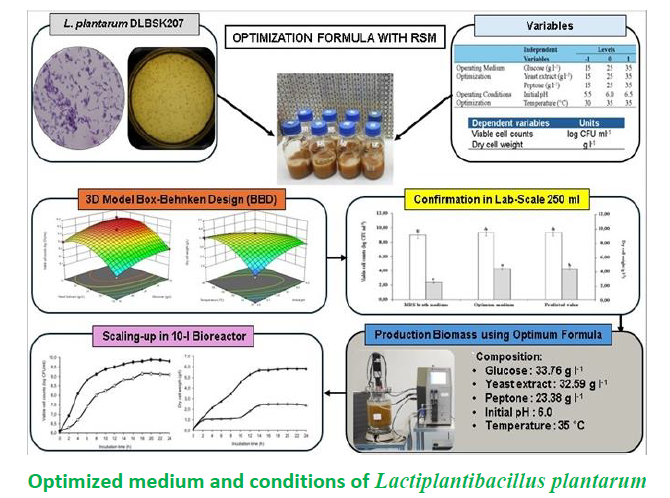
Background and Objective: The aim of this study was to increase the viable cell and biomass production of a potential probiotic strain, Lactiplantibacillus plantarum DLBSK207, by optimizing the ideal concentrations of key nutrients and fermentation conditions parameters using statistical method. such as (RSM) with Box-Behnken Design (BBD).
Material and Methods: The experiments investigated two key variables for medium composition and fermentation conditions. Based on the OFAT result, six factors were selected for the Plackett-Burman Design to evaluate whether the variables had significant effects to the response. The medium contains carbon (glucose) and nitrogen sources (yeast extract and peptone), while the fermentation conditions include initial pH and temperature. The basal medium, consisting of sodium acetate, MgSO4 7H2O, K2HPO4, MnSO4 H2O, and Tween 80, was kept constant. Using RSM, the concentrations of glucose, yeast extract, and peptone, as well as the initial pH and temperature, were optimized to maximize viable cell counts and biomass.
Results and Conclusion: The optimum medium concentrations determined by RSM were 33.76 g l˗1 glucose, 32.59 g l˗1 yeast extract, and 28.38 g l˗1peptone at an initial pH of 6.0 and a temperature of 35 °C. Under these optimized conditions, this study achieved a viable cell counts of 9.30 log CFU.ml˗1 and a dry cell weight of 4.319 g l˗1, representing a 1.82-fold increase compared to standard MRS broth. The experimental results were in closely matched the predicted values of 9.30 log CFU.ml˗1 and 4.280 g l˗1. Scaling up the process in a 10-l bioreactor controlled at pH 6.0 resulted in even higher biomass production, reaching a maximum viable cell counts of 9.88 log CFU.ml˗1 and a dry cell weight of 5.819 g l˗1after 20 h of incubation.
Conflict of interest: The authors declare no conflict of interest.
- Box-Behnken Design
- Controlled pH
- Plackett-Burman Design
- Probiotic
- Scaling up
How to Cite
References
Manzoor A, Qazi JI, Haq IU, Mukhtar H, Rasool A. Significantly enhanced biomass production of a novel bio-therapeutic strain Lactobacillus plantarum (AS-14) by developing low-cost media cultivation strategy. J Biol Eng. 2017;11(1):1-10. https://doi.org/10.1186/s13036-017-0059-2
Hatti-Kaul R, Chen L, Dishisha T, Enshasy H El. Lactic acid bacteria: From starter cultures to producers of chemicals. FEMS Microbiol Lett. 2018;365(20):1-20. https://doi.org/10.1093/femsle/fny213
Li X, Wang Q, Hu X, Liu W. Current status of probiotics as supplements in the prevention and treatment of infectious diseases. Front Cell Infect Microbiol. 2022;12(3):1-12. doi:10.3389/fcimb.2022.789063.https://doi.org/10.3389/fcimb.2022.789063
Choi GH, Lee NK, Paik HD. Optimization of medium composition for biomass production of Lactobacillus plantarum 200655 using response surface methodology. J Microbiol Biotechnol. 2021;31(5):717-725. https://doi.org/10.4014/jmb.2103.03018
Nuraida L. A review: Health promoting lactic acid bacteria in traditional Indonesian fermented foods. Food Sci Hum Wellness.2015;4(2):47-55. https://doi.org/10.1016/j.fshw.2015.06.001
Bundele J, Deshmukh R. Probiotics market global opportunity analysis and industry forecast 2021-2030. Available from:
https://www.alliedmarketresearch.com/press-release/probiotics-market.html [Accessed 10 July 2024].
Yu HS, Lee NK, Kim WJ, Lee DU, Kim JH, Paik HD. Optimization of an industrial medium and culture conditions for probiotic Weissella cibaria JW15 biomass using the Plackett-Burman Design and Response Surface Methodology. J Microbiol Biotechnol. 2022;32(5):630-637. https://doi.org/10.4014/jmb.2202.02020
Othman NZ, Mohd Din ARJ, Mohammad Z, Rosli MA, Sarmidi MR. Statistical optimization of medium compositions for high cell mass and exopolysaccharide production by Lactobacillus plantarum ATCC 8014. Appl Food Biotechnol. 2018;5(2):87-96.https://doi.org/10.22037/afb.v5i2.19299
Yeo S, Shin HS, Lee HW, Hong D, Park H, Holzapfel W, Kim EB, Huh CS. Determination of optimized growth medium and cryoprotective additives to enhance the growth and survival of Lactobacillus salivarius. J Microbiol Biotechnol. 2018;28(5):718-731.https://doi.org/10.4014/jmb.1801.01059
Ren H, Zentek J, Vahjen W. Optimization of production parameters for probiotic Lactobacillus strains as feed additive. Molecules. 2019; 24(18). https://doi.org/10.3390/molecules24183286
Singh V, Haque S, Niwas R, Srivastava A, Pasupuleti M, Tripathi CKM. Strategies for fermentation medium optimization: An in-depth review. Front Microbiol. 2017;7(1).https://doi.org/10.3389/fmicb.2016.02087
Tjandrawinata RR, Kartawijaya M, Hartanti AW. In vitro evaluation of the anti-hypercholesterolemic effect of Lactobacillus isolates from various sources. Front Microbiol. 2022;13(2).https://doi.org/10.3389/fmicb.2022.825251
Hwang CF, Chang JH, Houng JY, Tsai CC, Lin CK, Tsen HY. Optimization of medium composition for improving biomass production of Lactobacillus plantarum Pi06 using the Taguchi array design and the Box-Behnken method. Biotechnol Bioprocess Eng. 2012;17(4):827-834. https://doi.org/10.1007/s12257-012-0007-4
FDA. Bacteriological Analytical Manual. Chapter 3 aerobic plate count. United States Food and Drug Adm. 2001;(1):10.
Elsayed EA, Othman NZ, Malek R, Tang T, El Enshasy HA. Improvement of cell mass production of Lactobacillus delbrueckii sp. bulgaricus WICC-B-02: A newly isolated probiotic strain from mother’s milk. J Appl Pharm Sci. 2014;4(11):8-14.https://doi.org/10.7324/JAPS.2014.4112
Lee NK, Park YL, Choe GJ, Chang HI, Paik HD. Medium optimization for the production of probiotic Lactobacillus acidophilus A12 using Response Surface Methodology. Korean J Food Sci Anim Resour. 2010;30(3):359-364. https://doi.org/10.5851/kosfa.2010.30.3.359
Heidarrezaei M, Dailin DJ, Malek RA, Hanapi SZ, El-Enshasy HA. Statistical medium optimization for enhancing high biomass production of Lactobacillus reuteri using Response Surface Methodology. Asia Pac J Sci Technol. 2022;27(6):10. https://doi.org/10.14456/apst.2022.94
Eyahmalay J, Elsayed EA, Dailin DJ, Ramli S, Sayyed RZ, El-Enshasy HA. Statistical optimization approaches for high cell biomass production of Lactobacillus casei. J Sci Ind Res. 2020;79(2-3):216-221. https://doi.org/10.56042/jsir.v79i3.68645
Hayek SA, Ibrahim SA. Current limitations and challenges with lactic acid bacteria: a review. Food Nutr Sci. 2013;(11):73-87. https://doi.org/10.4236/fns.2013.411A010
Selvamani S, Dailin DJ, Rostom M, Malek RA, Gupta VK, El-Enshasy HA. Optimizing medium components to enhance high cell mass production of biotherapeutic strain Lactobacillus reuteri DSM 20016T by statistical method. J Sci Ind Res. 2020;79(9):798-803.https://doi.org/10.56042/jsir.v79i9.41715
Fonteles TV, Costa MGM, de Jesus ALT, Rodrigues S. Optimization of the fermentation of cantaloupe juice by Lactobacillus casei NRRL B-442. Food Bioprocess Tech. 2012;(5):2819-2826.https://doi.org/10.1007/s11947-011-0600-0
- Abstract Viewed: 1085 times
- pdf Downloaded: 444 times