Secondary Modeling and Strain Variability of Listeria monocytogenes Isolated from Seafood and Clinical Samples at Various Environmental Conditions Using High-Throughput Turbidity Method
Applied Food Biotechnology,
Vol. 8 No. 3 (2021),
15 June 2021
,
Page 225-236
https://doi.org/10.22037/afb.v8i3.33746
Abstract
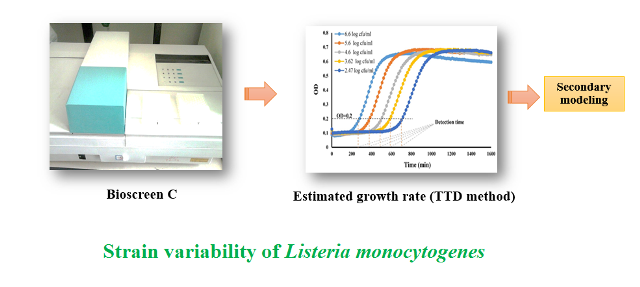
Background and Objective: Variability of foodborne pathogens plays important roles in microbial risk assessment. In the present study, kinetic behaviors of seven Listeria monocytogenes and two Listeria innocua strains from various sources were assessed at various pH (4.5, 5.0, 5.5, 6.8 and 7.0) and salinity (0.5, 2.5, 3.5, 5, 7 and 10% NaCl).
Material and Methods: Maximum specific growth rates (µmax) were assessed using Bioscreen C (time-to-detection method). Nearly 1500 curves were produced for Listeria monocytogenes and Listeria innocua strains and secondary models were developed for the bacteria as a function of NaCl, pH, temperature and undissociated lactic acid concentrations.
Results and Conclusion: Variability of µmax enhanced as the growth environment became unfavorable. Coefficient of variation of µmax in Listeria monocytogenes strains were 6.5 and 20% at 0.5 and 7.5% NaCl (pH 7.26), respectively. After selecting the most robust strain, models demonstrating relationships between the growth rate and environmental conditions (NaCl, pH and undissociated form of lactic acid) were generated using Origin 2018 Software and polynomial and nonlinear surface fitting. In conclusion, intraspecies variability of the growth kinetic behaviors and developed models based on the worst case (e.g., the most robust Listeria monocytogenes strain) include important uses in food industries.
Conflict of interest: The authors declare no conflict of interest.
- ▪ Bioscreen ▪ Growth rate ▪ lactic acid ▪ Listeria innocua ▪ NaCl ▪ Undissociated
How to Cite
References
Horan CJ. Listeriosis Outbreaks: Symptoms, Risk Factors and Treatment. 1th Edition. Nova Science Publishers. 2019: 10-30.
Hächler H, Marti G, Giannini P, Lehner A, Jost M, Beck J, Weiss F, Bally B, Jermini M, Stephan R, Baumgartner A. Outbreak of listerosis due to imported cooked ham, Switzerland 2011. Eurosurveillance. 2013; 18(18): 20469.
Lianou A, Koutsoumanis KP. Strain variability of the behavior of foodborne bacterial pathogens: a review. Int. J. Food Microbiol. 2013; 167(3): 310-321.
doi: 10.1016/j.ijfoodmicro.2013.09.016
Lianou A, Koutsoumanis KP. Effect of the growth environment on the strain variability of Salmonella enterica kinetic behavior. Food Microbiol. 2011; 28(4): 828-837.
doi: 10.1016/j.fm.2010.04.006
Spanu C, Scarano C, Ibba M, Pala C, Spanu V, De Santis EPL. Microbiological challenge testing for Listeria monocytogenes in ready-to-eat food: a practical approach. Ital. J. Food Saf. 2014; 3(4): 231-237.
doi: 10.4081/ijfs.2014.4518
Scott VN, Swanson KM, Freier TA, Pruett Jr WP, Sveum WH, Hall PA, Smoot LA, Brown DG. Guidelines for conducting Listeria monocytogenes challenge testing of foods. Food Prot. Trends. 2005; 25(11); 818-825.
Nauta MJ, Dufrenne JB. Variability in growth characteristics of different E. coli O157: H7 isolates, and its implications for predictive microbiology. Quantitative Microbiol.1999; 1(2): 137-155.
Rosenow EM, Marth EH. Growth of Listeria monocytogenes in skim, whole and chocolate milk, and in whipping cream during incubation at 4, 8, 13, 21 and 35 C. J. Food Prot.1987; 50(6): 452-459.
doi: 10.4315/0362-028X-50.6.452
De Jesús AJ, Whiting RC. Thermal inactivation, growth, and survival studies of Listeria monocytogenes strains belonging to three distinct genotypic lineages. J. Food Prot. 2003; 66(9): 1611-1617.
doi: 10.4315/0362-028x-66.9.1611
Uyttendaele M, Rajkovic A, Benos G, Francois K, Devlieghere F, Debevere J. Evaluation of a challenge testing protocol to assess the stability of ready-to-eat cooked meat products against growth of Listeria monocytogenes. Int. J. Food Microbiol. 2004; 90(2): 219-236.
doi: 10.1016/s0168-1605(03)00305-2
Lianou A, Stopforth JD, Yoon Y, Wiedmann M, Sofos JN. Growth and stress resistance variation in culture broth among Listeria monocytogenes strains of various serotypes and origins. J. Food Prot. 2006; 69(11): 2640-2647.
doi: 10.4315/0362-028x-69.11.2640
Bannenberg JW, Abee T, Zwietering MH, den Besten HM. Variability in lag duration of Listeria monocytogenes strains in half Fraser enrichment broth after stress affects the detection efficacy using the ISO 11290-1 method. Int. J. Food Microbiol. 2021; 337: 108914.
doi: 10.1016/j.ijfoodmicro.2020.108914
Díez-García M, Capita R, Alonso-Calleja C. Influence of serotype on the growth kinetics and the ability to form biofilms of Salmonella isolates from poultry. Food Microbiol. 2012; 31(2): 173-180.
doi: 10.1016/j.fm.2012.03.012
Baka M, Noriega E, Stamati I, Logist F, Van Impe JF. Critical assessment of the time‐to‐detection method for accurate estimation of microbial growth parameters. J. Food Saf. 2015; 35(2): 179-192.
doi: 10.1111/jfs.12170
Aalto-Araneda M, Pöntinen A, Pesonen M, Corander J, Markkula A, Tasara T, Stephan R, Korkeala H. Strain Variability of Listeria monocytogenes under NaCl Stress Elucidated by a High-Throughput Microbial Growth Data Assembly and Analysis Protocol. Appl. Environ. Microbiol. 2020; 86(6).
doi: 10.1128/AEM.02378-19
Abdollahzadeh E, Rezaei M, Hosseini H. Antibacterial activity of plant essential oils and extracts: The role of thyme essential oil, nisin, and their combination to control Listeria monocytogenes inoculated in minced fish meat. Food Control. 2014; 35(1): 177-183.
doi: 10.1016/j.foodcont.2013.07.004
Wemmenhove E, van Valenberg HJ, Zwietering MH, van Hooijdonk TC, Wells-Bennik MH. Minimal inhibitory concentrations of undissociated lactic, acetic, citric and propionic acid for Listeria monocytogenes under conditions relevant to cheese. Food Microbiol. 2016; 58: 63-67.
doi: 10.1016/j.fm.2016.03.012
Whiting RC, Golden MH. Variation among Escherichia coli O157: H7 strains relative to their growth, survival, thermal inactivation, and toxin production in broth. Int. J. Food Microbiol. 2002; 75(1-2): 127-133.
doi: 10.1016/s0168-1605(02)00003-x
Dengremont E, Membré JM. Statistical approach for comparison of the growth rates of five strains of Staphylococcus aureus. Appl. Environ. Microbiol. 1995; 61(12): 4389-4395.
Lindqvist R. Estimation of Staphylococcus aureus growth parameters from turbidity data: characterization of strain variation and comparison of methods. Appl. Environ. Microbiol. 2006; 72(7): 4862-4870.
doi: 10.1128/AEM.00251-06
Buncic S, Avery SM, Rocourt J, Dimitrijevic M. Can food-related environmental factors induce different behaviour in two key serovars, 4b and 1/2a, of Listeria monocytogenes?. Int. J. Food Microbiol. 2001; 65(3): 201-212.
doi: 10.1016/s0168-1605(00)00524-9
Baranyi J, Pin C. Estimating bacterial growth parameters by means of detection times. Appl. Environ. Microbiol. 1999; 65(2): 732-736.
Augustin JC, Rosso L, Carlier V. Estimation of temperature dependent growth rate and lag time of Listeria monocytogenes by optical density measurements. J. Microbiol. Methods. 1999; 38(1-2): 137-146.
doi: 10.1016/s0167-7012(99)00089-5
Dalgaard P, Koutsoumanis K. Comparison of maximum specific growth rates and lag times estimated from absorbance and viable count data by different mathematical models. J. Microbiol. Methods. 2001; 43(3), 183-196.
doi: 10.1016/S0167-7012(00)00219-0
Nauta MJ. Modelling bacterial growth in quantitative microbiological risk assessment: is it possible?. Int. J. Food Microbiol. 2002; 73(2-3): 297-304.
doi: 10.1016/s0168-1605(01)00664-x
Membré JM, Leporq B, Vialette M, Mettler E, Perrier L, Thuault D, Zwietering M. Temperature effect on bacterial growth rate: quantitative microbiology approach including cardinal values and variability estimates to perform growth simulations on/in food. Int. J. Food Microbiol. 2005; 100(1-3): 179-186.
doi: 10.1016/j.ijfoodmicro.2004.10.015.
Glaser P, Frangeul L, Buchrieser C, Rusniok C, Amend A, Baquero F, Berche P, Bloecker H, Brandt P, Chakraborty T, Charbit A. Comparative genomics of Listeria species. Science. 2001; 294(5543): 849-852.
doi: 10.1126/science.1063447
Milillo SR, Friedly EC, Saldivar JC, Muthaiyan A, O'bryan C, Crandall PG, Johnson MG, Ricke SC. A review of the ecology, genomics, and stress response of Listeria innocua and Listeria monocytogenes. Crit. Rev. Food Sci. Nutr. 2012; 52(8): 712-725.
doi: 10.1080/10408398.2010.507909
Fan L, Song J, McRae KB, Walker BA, Sharpe D. Gaseous ozone treatment inactivates Listeria innocua in vitro. J. Appl. Microbiol. 2007; 103(6): 2657-2663.
doi: 10.1111/j.1365-2672.2007.03522.x
Milly PJ, Toledo RT, Chen J. Evaluation of liquid smoke treated ready‐to‐eat (RTE) meat products for control of Listeria innocua M1. J. Food Sci. 2008; 73(4): 179-183.
doi: 10.1111/j.1750-3841.2008.00714.x
Shi Y, Tang J, Yue T, Rasco B, Wang S. Pasteurizing cold smoked salmon (Oncorhynchus nerka): Thermal inactivation kinetics of Listeria monocytogenes and Listeria innocua. J. Aquat. Food Prod. Technol. 2015; 24(7): 712-722.
doi: 10.1080/10498850.2013.808303
Mohan V, Wibisono R, de Hoop L, Summers G, Fletcher GC. Identifying suitable Listeria innocua strains as surrogates for Listeria monocytogenes for horticultural products. bioRxiv. 2019; 586016.
doi: 10.3389/fmicb.2019.02281
Friedly EC, Crandall PG, Ricke S, O'bryan CA, Martin EM, Boyd LM. Identification of Listeria innocua surrogates for Listeria monocytogenes in hamburger patties. J. Food Sci. 2008; 73(4); 174-178.
doi: 10.1111/j.1750-3841.2008.00719.x
Tienungoon S, Ratkowsky DA, McMeekin TA, Ross T. Growth limits of Listeria monocytogenes as a function of temperature, pH, NaCl, and lactic acid. Appl. Environ. Microbiol. 2000; 66(11): 4979-4987.
doi: 10.1128/aem.66.11.4979-4987.2000
Van Der Veen S, Moezelaar R, Abee T, Wells‐Bennik MH. The growth limits of a large number of Listeria monocytogenes strains at combinations of stresses show serotype‐and niche‐specific traits. J. Appl. Microbiol. 2008; 105(5): 1246-1258.
doi: 10.1111/j.1365-2672.2008.03873.x
Vermeulen A, Gysemans KP, Bernaerts K, Geeraerd AH, Van Impe JF, Debevere J, Devlieghere F. Influence of pH, water activity and acetic acid concentration on Listeria monocytogenes at 7 C: data collection for the development of a growth/no growth model. Int. J. Food Microbiol. 2007; 114(3): 332-341.
doi: 10.1016/j.ijfoodmicro.2006.09.023.
Adams MR, Little CL, Easter MC. Modelling the effect of pH, acidulant and temperature on the growth rate of Yersinia enterocolitica. J. Appl. Microbiol. 1991; 71: 65–71.
doi: j.1365-2672.1991.tb04664.x
Presser KA, Ratkowsky DA, Ross T. Modelling the growth rate of Escherichia coli as a function of pH and lactic acid concentration. Appl. Environ. Microbiol. 1997; 63: 2355–2360
Biesta-Peters EG, Reij MW, Gorris LGM, Zwietering MH. Comparing nonsynergistic gamma models with interaction models to predict growth of emetic Bacillus cereus when using combinations of pH and individual undissociated acids as growth-limiting factors. Appl. Environ. Microbiol. 2010;76: 5791–5801.
doi: 10.1128/AEM.00355-10
Aryani DC, Den Besten HMW, Hazeleger WC, Zwietering MH. Quantifying strain variability in modeling growth of Listeria monocytogenes. Int. J. Food Microbiol. 2015; 208: 19-29.
doi: 10.1016/j.ijfoodmicro.2015.05.006
Ratkowsky DA, Olley J, McMeekin TA, Ball A. Relationship between temperature and growth rate of bacterial cultures. J. Bacteriol. 1982; 149: 1–5.
Le Marc Y, Huchet V, Bourgeois CM, Guyonnet JP, Mafart P, Thuault D. Modelling the growth kinetics of Listeria as a function of temperature, pH and organic acid concentration. Int. J. Food Microbiol. 2002; 73: 219–237.
doi: 10.1016/S0168-1605(01)00640-7
Yeh PLH, Bajpai RK, Iannotti EL. An improved kinetic model for lactic acid
fermentation. J. Ferment. Bioeng. 1991; 71: 75–77.
doi: 10.1016/0922-338X(91)90309-5
- Abstract Viewed: 1029 times
- pdf Downloaded: 729 times