Bio-Assisted Synthesis of Food-Grade FeOOH Nanoellipsoids as Promising Iron Supplements for Food Fortification
Applied Food Biotechnology,
Vol. 8 No. 1 (2021),
14 December 2020
,
Page 71-77
https://doi.org/10.22037/afb.v8i1.31193
Abstract
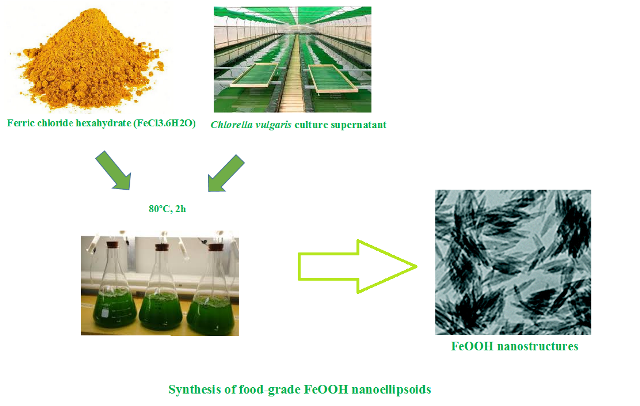
Background and Objective: Nanostructures of FeOOH are approved substitutions for iron salts in treatment of iron deficiencies. These particles can be promising additives to develop iron fortified foods. Researchers are interested to develop cost-effective techniques for the fabrication of food-grade FeOOH nanostructures. Relatively, polyethylenimine is commonly used to fabricate FeOOH nanoellipsoids. However, food industries need to develop novel protocols, which can be used in food processing. In this study, a simple economic technique was developed for the fabrication of food-grade FeOOH nanoellipsoids.
Material and Methods: Ferric chloride hexahydrate (FeCl3.6H2O) was used as iron precursor. BG-11 broth medium was used to cultivate Chlorella vulgaris microalgae. The Chlorella vulgaris culture supernatant was used for the fabrication of FeOOH nanostructures as an approved low-cost medium by the Food and Drug Administration. Nanoellipsoids of FeOOH were synthesized via hydrolysis of ferric ions in culture supernatants with no addition of other chemicals.
Results and Conclusion: Results showed that the prepared nanoellipsoids were β-FeOOH with 51.4-nm average length and 9.2-nm average width. The XRD analysis demonstrated that the secretory compound from Chlorella vulgaris included no negative effects on formation of FeOOH nanocrystals. The current developed technique can be introduced as a promising approach in fabrication of food-grade nanoparticles. Furthermore, the prepared structures can be used for the supplement formulation in pharmaceutical industries.
Conflict of interest: The authors declare no conflict of interest.
- ▪ Akaganeite nanoellipsoids ▪ Food-grade nanoparticles ▪ Iron enrichments ▪ Iron nanoparticles ▪ Microbial compounds
How to Cite
References
Abu-Ouf NM, Jan MM. The impact of maternal iron deficiency and iron deficiency anemia on child’s health. Saudi Med J. 2015; 36(2): 146-149.
doi: 10.15537/smj.2015.2.10289
Taghavi S, Amiri A, Amin A, Ehsani A, Maleki M, Naderi N. Oral iron therapy with polysaccharide iron complex may be useful in increasing ferritin level at short time in patients with dilated cardiomyopathy. Res Cardiovasc Med. 2017; 6(1): e39816.
doi: 10.5812/cardiovascmed.39816
Gera T, Sachdev HS, Boy E. Effect of iron-fortified foods on hematologic and biological outcomes: Systematic review of randomized controlled trials. Am J Clin Nutr. 2012; 96(2): 309-324.
doi: 10.3945/ajcn.111.031500
Martınez-Navarrete N, Camacho M, Martınez-Lahuerta J, Martınez-Monzo J, Fito P. Iron deficiency and iron fortified foods a review. Food Res Int. 2002; 35(2-3): 225-231.
doi: 10.1016/S0963-9969(01)00189-2
Hurrell RF. Preventing iron deficiency through food forti-fication. Nutr Rev. 1997; 55(6): 210-222.
doi: 10.1111/j.1753-4887.1997.tb01608.x
Boccio JR, Zubillaga MB, Caro RA, Gotelli CA, Gotelli MJ, Weill R. A new procedure to fortify fluid milk and dairy products with high-bioavailable ferrous sulfate. Nutr Rev. 1997; 55(6): 240-246.
doi: 10.1111/j.1753-4887.1997.tb01611.x
Durfey CL, Swistek SE, Liao SF, Crenshaw MA, Clemente HJ, Thirumalai RV,Steadman CS, Ryan PL,Willard ST, Feugang JM. Nanotechnology-based approach for safer enrichment of semen with best spermatozoa. J Anim Sci Biotechnol. 2019; 10: 14.
doi: 10.1186/s40104-40018-40307-40104.
Ebrahiminezhad A, Moeeni F, Taghizadeh S-M, Seifan M, Bautista C, Novin D, Ghasemi Y, Berenjian A. Xanthan gum capped ZnO microstars as a promising dietary zinc supple-mentation. Foods 2019; 8(3):1-10
doi: 10.3390/foods8030088.
Von Moos LM, Schneider M, Hilty FM, Hilbe M, Arnold M, Ziegler N, et al. Iron phosphate nanoparticles for food fortification: Biological effects in rats and human cell lines. Nanotoxicology 2017; 11(4): 496-506.
doi: 10.1080/17435390.2017.1314035
Ebrahiminezhad A, Bagheri M, Taghizadeh S, Berenjian A, Ghasemi Y. Biomimetic synthesis of silver nanoparticles using microalgal secretory carbohydrates as a novel anticancer and antimicrobial. Adv Nat Sci. 2016; 7:1-8
doi: 10.1088/2043-6262/1087/1081/015018.
Ghanbariasad A, Taghizadeh S-M, Show PL, Nomanbhay S, Berenjian A, Ghasemi Y, et al. Controlled synthesis of iron oxyhydroxide (FeOOH) nanoparticles using secretory compo-unds from Chlorella vulgaris microalgae.
Bioengineered 2019; 10(1): 390-396.
doi: 10.1080/21655979.2019.1661692
Kasparis G, Erdocio AS, Tuffnell JM, Thanh NTK. Synthesis of size-tuneable β-FeOOH nanoellipsoids and a study of their morphological and compositional changes by reduction. Crystengcomm 2019; 21(8): 1293-1301.
doi: 10.1039/C8CE01778F
Yue J, Jiang X, Yu A. Experimental and theoretical study on the β-FeOOH nanorods: Growth and conversion. J Nanopart Res. 2011; 13(9): 3961-3974.
doi: 10.1007/s11051-011-0320-4
Taghizadeh S-M, Ebrahiminezhad A, Ghoshoon MB, Dehshahri A, Berenjian A, Ghasemi Y. Magnetic immo-bilization of Pichia pastoris cells for the production of recombinant human serum albumin. Nanomater. 2020; 10(1): 111.
doi: 10.3390/nano10010111
Taghizadeh S-M, Jafari S, Ahmad-Kiadaliri T, Mobasher MA, Lal N, Raee MJ, Berenjian A, Ghasemi Y , Ebrahiminezhad A. Magnetic immobilisation as a promising approach against bacteriophage infection. Mater Res Express. 2019; 6: 1250a1258.
Taghizadeh S-M, Berenjian A, Taghizadeh S, Ghasemi Y, Taherpour A, Sarmah AK, Ebrahiminezhad A. One-put green synthesis of multifunctional silver iron core-shell nano-structure with antimicrobial and catalytic properties. Indus Crops Prod. 2019; 130: 230-236.
doi: 10.1016/j.indcrop.2018.12.085
Domingos D, Henriques R, Antunes Xavier J, Libardi N, Costa R. Rising up activated sludge aggregation by magnetite nanoparticles addition. Water Sci Technol. 2019; 79(5): 993-999.
doi: 10.2166/wst.2019.055
Mohapatra J, Mitra A, Tyagi H, Bahadur D, Aslam M. Iron oxide nanorods as high-performance magnetic resonance imaging contrast agents. Nanoscale 2015; 7(20): 9174-9184.
doi: 10.1039/C5NR00055F
Zhu T, Chen JS, Lou XW. Glucose-assisted one-pot synthesis of FeOOH nanorods and their transformation to Fe3O4@ carbon nanorods for application in lithium lon batteries. J Phys Chem C. 2011; 115(19): 9814-9820.
doi: 10.1021/jp2013754
Material properties of stainless steel: BLUCHER, A Watts Water Technologies Company; 2020 [cited 2020 5/26/2020]. Available from:
http://blucherpipe.com/Resources/Technical/Stainless_Steel_Properties.
Taghizadeh S-M, Ghasemi Y, Ebrahiminezhad A. Chemical and biological approaches for the synthesis of iron based nanoparticles. Trends Pharma Sci. 2017; 3(4): 237-244.
Yousef M, Lopez-Lorente A, Diaz-Jimenez M, Consuegra C, Dorado J, Pereira B, Ortiz I, Cardenas S, Hidalgo M. Nano-depletion of acrosome-damaged donkey sperm by using lectin peanut agglutinin (PNA)-magnetic nanoparticles.
Theriogenology 2020; 151: 103-111.
doi: 10.1016/j.theriogenology.2020.04.011
Taghizadeh S-M, Lal N, Ebrahiminezhad A, Moeini F, Seifan M, Ghasemi Y, Berenjian A. Green and economic fabrication of zinc oxide (ZnO) nanorods as a broadband UV blocker and antimicrobial agent. Nanomaterials 2020; 10(3): 1-12
doi: 10.3390/nano10030530
- Abstract Viewed: 1143 times
- pdf Downloaded: 900 times