Next-Generation Antimicrobial Peptides: The Emerging Role of Artificial Intelligence in Addressing Antimicrobial Resistance Artificial intelligence in developing antimicrobial peptides
Trends in Peptide and Protein Sciences,
Vol. 11 No. 1 (2026),
11 Dey 2026
,
Page 1-17 (e1)
https://doi.org/10.22037/tpps.v11i1.53063
Abstract
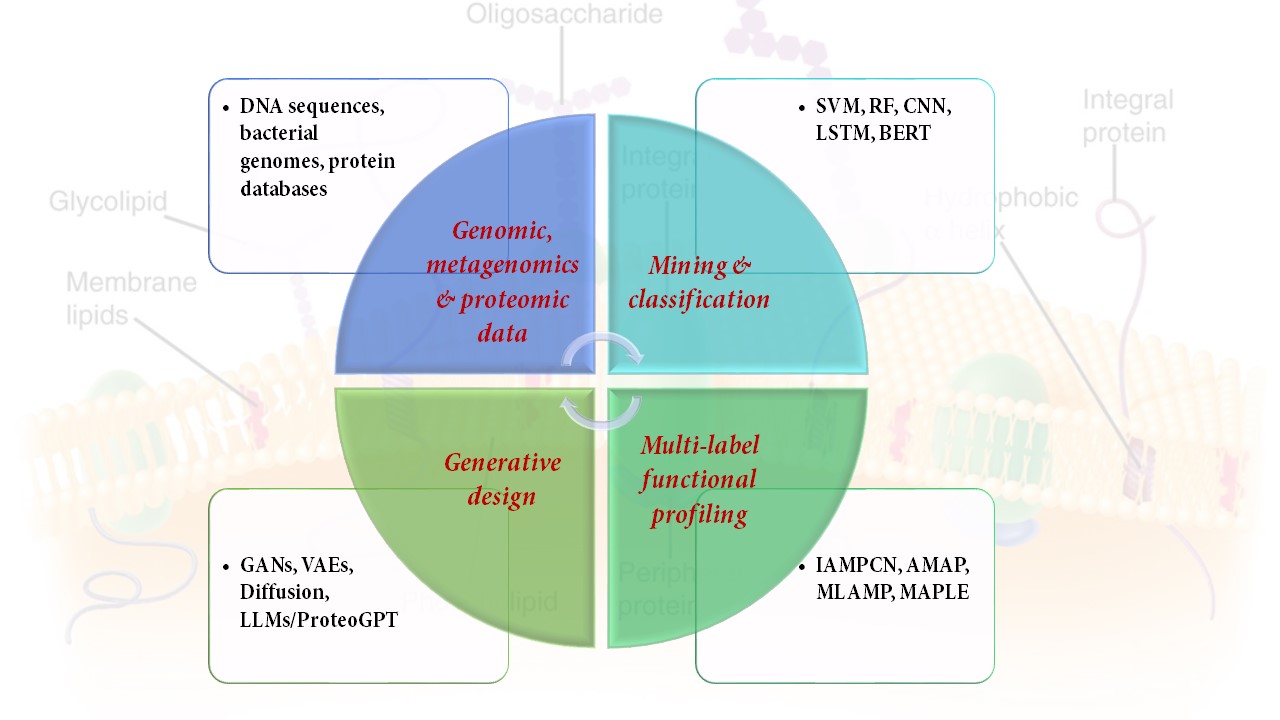
The rising issue of antimicrobial resistance (AMR) is prompting an urgent need for new treatments that go beyond conventional antibiotics. Antimicrobial peptides (AMPs) are emerging as viable options because of their varied actions and lower tendency to develop resistance. This review highlights how artificial intelligence (AI) can play a transformative role in speeding up the discovery, enhancement, and design of these peptides. The current AI methodologies can be classified into three main areas: (i) analyzing genomic and metagenomic data with machine learning tools like the Metagenomic Antimicrobial Peptide Predictor (MACREL) and AMPSphere; (ii) employing protein language models and advanced deep learning techniques, particularly Convolutional Neural Network-Long Short-Term Memory (CNN-LSTM) networks and Transformers, for large-scale functional predictions; and (iii) using generative models such as Generative Adversarial Networks (GANs), Variational Autoencoders (VAEs), and diffusion frameworks to design new peptide candidates in a controlled manner. Challenges like data heterogeneity, inconsistent benchmarking that can lead to exaggerated performance claims, and the gap between computational predictions and their practical applicability in clinical settings were also discussed. Additionally, the emerging strategies that aim to balance enhancing antimicrobial effectiveness with reducing toxicity to the host were discussed. The review tried to draw a forward-looking roadmap proposing a closed-loop, active-learning system that integrates standardized datasets and rigorous laboratory validation. Overall, the fusion of AI and peptide bioengineering represented a significant shift, offering exciting possibilities for developing next-generation AMPs aimed at combating multidrug-resistant pathogens.
HIGHLIGHTS
- Artificial intelligence (AI) accelerates discovery of antimicrobial peptides (AMPs).
- Three key AI approaches in this field are data mining, functional prediction, and generative models.
- The fusion of AI and peptide bioengineering represented a significant shift in AMPs discovery.
- Antimicrobial Peptide
- Artificial Intelligence
- Antimicrobial Resistance
- Generative AI
- Drug Discovery
How to Cite
References
Ahmad, A., Akbar, S., Khan, S., Hayat, M., Ali, F., Ahmed, A. and M. Tahir, (2021). ″Deep-AntiFP: Prediction of antifungal peptides using distant multi-informative features incorporating deep neural networks.″ Chemometrics and Intelligent Laboratory Systems, 208: 104214. DOI: https://doi.org/10.1016/j.chemolab.2020.104214.
Al Musaimi, O. (2025). ″FDA-approved antibacterials and echinocandins.″ Antibiotics, 14(2):166. DOI: https://doi.org/10.3390/antibiotics14020166.
Alzain, M., Daghistani, H., Shamrani, T., Almoghrabi, Y., Daghistani, Y., Alharbi, O. S., Sait, A. M., Mufrrih, M., Alhazmi, W. and M. A. Alqarni, (2025). ″Antimicrobial peptides: mechanisms, applications, and therapeutic potential.″ Infection and Drug Resistance, 18:4385-4426. DOI: https://doi.org/10.2147/IDR.S514825.
Bae, D., Kim, M., Seo, J. and H. Nam, (2025). ″AI-guided discovery and optimization of antimicrobial peptides through species-aware language model.″ Briefings in Bioinformatics, 26(4): bbaf343. DOI: https://doi.org/10.1093/bib/bbaf343.
Bhadra, P., Yan, J., Li, J., Fong, S. and S. W. I. Siu, (2018). ″AmPEP: Sequence-based prediction of antimicrobial peptides using distribution patterns of amino acid properties and random forest.″ Scientific Reports, 8(1): 1697. DOI: https://doi.org/10.1038/s41598-018-19752-w.
Botelho Sampaio de Oliveira, K., Lopes Leite, M., Albuquerque Cunha, V., Brito da Cunha, N. and O. Luiz Franco, (2023). ″Challenges and advances in antimicrobial peptide development.″ Drug Discovery Today, 28(8): 103629. DOI: https://doi.org/10.1016/j.drudis.2023.103629.
Bournez, C., Riool, M., de Boer, L., Cordfunke, R. A., de Best, L., van Leeuwen, R., Drijfhout, J. W., Zaat, S. A. J. and G. J. P. van Westen, (2023). ″CalcAMP: A new machine learning model for the accurate prediction of antimicrobial activity of peptides.″ Antibiotics, 12(4): 725. DOI: https://doi.org/10.3390/antibiotics12040725.
Brizuela, C. A., Liu, G., Stokes, J. M. and C. de la Fuente-Nunez, (2025). ″AI methods for antimicrobial peptides: progress and challenges.″ Microbial Biotechnology, 18(1): e70072. DOI: https://doi.org/10.1111/1751-7915.70072.
Cherkasov, A., Hilpert, K., Jenssen, H., Fjell, C. D., Waldbrook, M., Mullaly, S. C., Volkmer, R. and R. E. W. Hancock, (2008). ″Use of artificial intelligence in the design of small peptide antibiotics effective against a broad spectrum of highly antibiotic-resistant superbugs.″ ACS Chemical Biology, 4(1): 65-74. DOI: https://doi.org/10.1021/cb800240j.
Cisterna-García, A., González-López, A. M., Vozi, A., Esteban, M. A., Egli, A., Jutzeler, C., Palma, J., Sánchez-Ferrer, A. and J. A. J. b. Botía, (2026). ″Antimicrobial peptide databases and prediction tools: Toward a standard evaluation framework.″ bioRxiv, 2026.05: 19.726290. DOI: https://doi.org/10.64898/2026.05.19.726290.
Das, A., Sen, S., Ahmadi, Z. and M. Debnath, (2026). ″Dual-objective protein language model for discovery of non-hemolytic antimicrobial peptides from the bee-melectin sequence space.″ Chemical Engineering Journal, 543: 178296. DOI: https://doi.org/10.1016/j.cej.2026.178296
Du, R., Han, F., Li, Z., Yu, J., Xu, Y., Huang, Y. and Q. Wu, (2025). ″Uncovering encrypted antimicrobial peptides in health-associated Lactobacillaceae by large-scale genomics and machine learning.″ Microbiome, 13(1): 151. DOI: https://doi.org/10.1186/s40168-025-02145-3.
Fathi, F., Alizadeh, B., Tabarzad, M. V. and M. Tabarzad, (2024). ″Important structural features of antimicrobial peptides towards specific activity: Trends in the development of efficient therapeutics.″ Bioorganic Chemistry, 149: 107524. DOI: https://doi.org/10.1016/j.bioorg.2024.107524.
Fernandes, F. C., Cardoso, M. H., Gil-Ley, A., Luchi, L. V., da Silva, M. G. L., Macedo, M. L. R., de la Fuente-Nunez, C. and O. L. Franco, (2023). ″Geometric deep learning as a potential tool for antimicrobial peptide prediction.″ Frontiers in Bioinformatics, 3: 1216362. DOI: https://doi.org/10.3389/fbinf.2023.1216362.
Ferrell, J. B., Remington, J. M., Van Oort, C. M., Sharafi, M., Aboushousha, R., Janssen-Heininger, Y., Schneebeli, S. T., Wargo, M. J., Wshah, S. and J. Li, (2021). ″A Generative approach toward precision antimicrobial peptide design.″ bioRxiv, 2020.10: 02.324087. DOI: https://doi.org/10.1101/2020.10.02.324087.
Fingerhut, L. C. H. W., Miller, D. J., Strugnell, J. M., Daly, N. L. and I. R. Cooke, (2020). ″ampir: an R package for fast genome-wide prediction of antimicrobial peptides.″ Bioinformatics, 36(21): 5262-5263. DOI: https://doi.org/10.1093/bioinformatics/btaa653.
Fjell, C. D., Hancock, R. E. W. and A. Cherkasov, (2007). ″AMPer: a database and an automated discovery tool for antimicrobial peptides.″ Bioinformatics, 23(9): 1148-1155. DOI: https://doi.org/10.1093/bioinformatics/btm068.
Fong, I. W. (2023). ″Antimicrobial resistance: a crisis in the making.″ In: Fong, I. W., (ed.) New Antimicrobials: For the Present and the Future, Cham: Springer International Publishing. pp. 1-21. DOI: https://doi.org/10.1007/978-3-031-26078-0_1.
Fu, H., Cao, Z., Li, M. and S. Wang, (2020). ″ACEP: improving antimicrobial peptides recognition through automatic feature fusion and amino acid embedding.″ BMC Genomics, 21(1): 597. DOI: https://doi.org/10.1186/s12864-020-06978-0.
Gabere, M. N. and W. S. Noble, (2017). ″Empirical comparison of web-based antimicrobial peptide prediction tools.″ Bioinformatics, 33(13): 1921-1929. DOI: https://doi.org/10.1093/bioinformatics/btx081.
Georgoulis, E., Zervou, M. A. and Y. Pantazis, (2025). ″Transfer learning on protein language models improves antimicrobial peptide classification.″ Scientific Reports, 15(1): 37456. DOI: https://doi.org/10.1038/s41598-025-21223-y.
Girdhar, M., Sen, A., Nigam, A., Oswalia, J., Kumar, S. and R. Gupta, (2024). ″Antimicrobial peptide-based strategies to overcome antimicrobial resistance.″ Archives of Microbiology, 206(10): 411. DOI: https://doi.org/10.1007/s00203-024-04133-x.
Gogoladze, G., Grigolava, M., Vishnepolsky, B., Chubinidze, M., Duroux, P., Lefranc, M.-P. and M. Pirtskhalava, (2014). ″DBAASP: database of antimicrobial activity and structure of peptides.″ FEMS Microbiology Letters, 357(1): 63-68. DOI: https://doi.org/10.1111/1574-6968.12489.
Gull, S. and N. Shamim, (2019). ″AMAP: Hierarchical multi-label prediction of biologically active and antimicrobial peptides.″ Computers in Biology and Medicine, 107: 172-181. DOI: https://doi.org/10.1016/j.compbiomed.2019.02.018.
Han, J., Kong, T. and J. Liu, (2024). ″PepNet: an interpretable neural network for anti-inflammatory and antimicrobial peptides prediction using a pre-trained protein language model.″ Communications Biology, 7(1): 1198. DOI: https://doi.org/10.1038/s42003-024-06911-1.
Hanson, M. A., Lemaitre, B. and R. L. Unckless, (2019). ″Dynamic evolution of antimicrobial peptides underscores trade-offs between immunity and ecological fitness.″ Frontiers in Immunology, 10: 2620. DOI: https://doi.org/10.3389/fimmu.2019.02620.
Hetta, H. F., Sirag, N., Alsharif, S. M., Alharbi, A. A., Alkindy, T. T., Alkhamali, A., Albalawi, A. S., Ramadan, Y. N., Rashed, Z. I. and F. E. Alanazi, (2024). ″Antimicrobial peptides: the game-changer in the epic battle against multidrug-resistant bacteria.″ Pharmaceuticals, 17(11): 1555. DOI: https://doi.org/10.3390/ph17111555.
Jan, A., Hayat, M., Wedyan, M., Alturki, R., Gazzawe, F., Ali, H. and F. K. Alarfaj, (2022). ″Target-AMP: Computational prediction of antimicrobial peptides by coupling sequential information with evolutionary profile.″ Computers in Biology and Medicine, 151: 106311. DOI: https://doi.org/10.1016/j.compbiomed.2022.106311.
Jesudason, T. (2024). ″WHO publishes updated list of bacterial priority pathogens.″ The Lancet Microbe, 5(9). DOI: https://doi.org/10.1016/j.lanmic.2024.07.00.
Jhong, J.-H., Yao, L., Pang, Y., Li, Z., Chung, C.-R., Wang, R., Li, S., Li, W., Luo, M., Ma, R., Huang, Y., Zhu, X., Zhang, J., Feng, H., Cheng, Q., Wang, C., Xi, K., Wu, L.-C., Chang, T.-H., Horng, J.-T., Zhu, L., Chiang, Y.-C., Wang, Z. and T.-Y. Lee, (2022). ″dbAMP 2.0: updated resource for antimicrobial peptides with an enhanced scanning method for genomic and proteomic data.″ Nucleic Acids Research, 50(D1): D460-D470. DOI: https://doi.org/10.1093/nar/gkab1080.
Jung, J. H., Zhang, X., Song, S., Sayedahmed, M., Xiang, C., Xu, Y., AbdelKhalek, A., Schneebeli, S. T., Wargo, M. J., Li, J. and S. Wshah, (2026). ″Agentic discovery of non-canonical antimicrobial peptides with AMPGAN v3.″ ArXiv. DOI: https://doi.org/10.48550/arXiv.2606.17127.
Kim, S. H., Min, Y.-H. and M. C. Park, (2025). ″Antimicrobial peptides: current status, mechanisms of action, and strategies to overcome therapeutic limitations.″ Microorganisms, 13(11): 2574. DOI: https://doi.org/10.3390/microorganisms13112574.
Lata, S., Mishra, N. K. and G. P. S. Raghava, (2010). ″AntiBP2: improved version of antibacterial peptide prediction.″ BMC Bioinformatics, 11(1): S19. DOI: https://doi.org/10.1186/1471-2105-11-S1-S19.
Leclercq, M. and A. Droit, (2026). ″Protein language models: applications and perspectives.″ Journal of Proteome Research, 25(2): 507-524. DOI: https://doi.org/10.1021/acs.jproteome.5c00506.
Lee, H.-T., Lee, C.-C., Yang, J.-R., Lai, J. Z. C. and K. Y. Chang, (2015). ″A Large-scale structural classification of antimicrobial peptides.″ BioMed Research International, 2015(1): 475062. DOI: https://doi.org/10.1155/2015/475062.
Lee, H., Lee, S., Lee, I. and H. Nam, (2023). ″AMP-BERT: Prediction of antimicrobial peptide function based on a BERT model.″ Protein Science, 32(1): e4529. DOI: https://doi.org/10.1002/pro.4529.
Li, C., Sutherland, D., Hammond, S. A., Yang, C., Taho, F., Bergman, L., Houston, S., Warren, R. L., Wong, T., Hoang, L. M. N., Cameron, C. E., Helbing, C. C. and I. Birol, (2022). ″AMPlify: attentive deep learning model for discovery of novel antimicrobial peptides effective against WHO priority pathogens.″ BMC Genomics, 23(1): 77. DOI: https://doi.org/10.1186/s12864-022-08310-4.
Li, B., Kang, W., Liu, H., Wang, Y., Yu, C., Zhu, X., Dou, J., Cai, H. and C. Zhou, (2016). ″The antimicrobial activity of cbf-k16 against mrsa was enhanced by β-lactamantibiotics through cell wall non-integrity.″ Archives of Pharmacal Research, 39(7): 978-988. DOI: https://doi.org/10.1007/s12272-016-0769-x.
Li, J., Pu, Y., Tang, J., Zou, Q. and F. Guo, (2020). ″DeepAVP: a dual-channel deep neural network for identifying variable-length antiviral peptides.″ IEEE Journal of Biomedical and Health Informatics (JBHI), 24(10): 3012-3019. DOI: https://doi.org/10.1109/JBHI.2020.2977091.
Lin, T.-T., Yang, L.-Y., Lin, C.-Y., Wang, C.-T., Lai, C.-W., Ko, C.-F., Shih, Y.-H. and S.-H. Chen, (2023). ″Intelligent de novo design of novel antimicrobial peptides against antibiotic-resistant bacteria strains.″ International Journal of Molecular Sciences, 24(7): 6788. DOI: https://doi.org/10.3390/ijms24076788.
Lin, W. and D. Xu, (2016). ″Imbalanced multi-label learning for identifying antimicrobial peptides and their functional types.″ Bioinformatics, 32(24): 3745-3752. DOI: https://doi.org/10.1093/bioinformatics/btw560.
Liu, G.-Y., Yu, D., Fan, M.-M., Zhang, X., Jin, Z.-Y., Tang, C. and X.-F. Liu, (2024). ″Antimicrobial resistance crisis: could artificial intelligence be the solution?″ Military Medical Research, 11(1): 7. DOI: https://doi.org/10.1186/s40779-024-00510-1.
Liu, H., Shi, Y., Guo, F., Wang, J., Li, J., Wang, G., Zhan, D.-C., Hao, H. and G. Yu, (2026). ″MAPLE: interpretable deep learning identifies selective antimicrobial peptides using joint evolutionary–physicochemical analysis.″ Briefings in Bioinformatics, 27(3): bbag318. DOI: https://doi.org/10.1093/bib/bbag318.
Lu, J., He, Y., Han, G. and L. Zeng, (2025). ″iAMP-CRA: Identifying antimicrobial peptides using convolutional recurrent neural network with self-attention.″ Health Information Science and Systems, 13(1): 25. DOI: https://doi.org/10.1007/s13755-025-00342-w.
Ma, Y., Guo, Z., Xia, B., Zhang, Y., Liu, X., Yu, Y., Tang, N., Tong, X., Wang, M., Ye, X., Feng, J., Chen, Y. and J. Wang, (2022). ″Identification of antimicrobial peptides from the human gut microbiome using deep learning.″ Nature Biotechnology, 40(6): 921-931. DOI: https://doi.org/10.1038/s41587-022-01226-0.
Medina-Ortiz, D., Contreras, S., Fernández, D., Soto-García, N., Moya, I., Cabas-Mora, G. and Á. Olivera-Nappa, (2024). ″Protein language models and machine learning facilitate the identification of antimicrobial peptides.″ International Journal of Molecular Sciences, 25(16): 8851. DOI: https://doi.org/10.3390/ijms25168851.
Meher, P. K., Sahu, T. K., Saini, V. and A. R. Rao, (2017). ″Predicting antimicrobial peptides with improved accuracy by incorporating the compositional, physico-chemical and structural features into Chou’s general PseAAC.″ Scientific Reports, 7(1): 42362. DOI: https://doi.org/10.1038/srep42362.
Meng, H. (2026) ″AI-driven discovery and design of antimicrobial peptides: progress, challenges, and opportunities.″ Probiotics and Antimicrobial Proteins, 18(4): 5122-5144. DOI: https://doi.org/10.1007/s12602-025-10856-0.
Miller, W. R. and C. A. Arias, (2024). ″ESKAPE pathogens: antimicrobial resistance, epidemiology, clinical impact and therapeutics.″ Nature Reviews Microbiology, 22(10): 598-616. DOI: https://doi.org/10.1038/s41579-024-01054-w.
Mishra, A. K., Choi, J., Moon, E. and K. H. Baek, (2018). ″Tryptophan-rich and proline-rich antimicrobial peptides.″ Molecules, 23(4): 815. DOI: https://doi.org/10.3390/molecules23040815.
Nguyen, Q. H., Nguyen-Vo, T.-H., Do, T. T. T. and B. P. Nguyen, (2024). ″An efficient hybrid deep learning architecture for predicting short antimicrobial peptides.″ Proteomics, 24(14): 2300382. DOI: https://doi.org/10.1002/pmic.202300382.
Pinacho-Castellanos, S. A., García-Jacas, C. s. R., Gilson, M. K. and C. A. Brizuela, (2021). ″Alignment-free antimicrobial peptide predictors: improving performance by a thorough analysis of the largest available data set.″ Journal of Chemical Information and Modeling, 61(6): 3141-3157. DOI: https://doi.org/10.1021/acs.jcim.1c00251.
Pirtskhalava, M., Amstrong, A. A., Grigolava, M., Chubinidze, M., Alimbarashvili, E., Vishnepolsky, B., Gabrielian, A., Rosenthal, A., Hurt, D. E. and M. Tartakovsky, (2021). ″DBAASP v3: database of antimicrobial/cytotoxic activity and structure of peptides as a resource for development of new therapeutics.″ Nucleic Acids Research, 49(D1): D288-D297. DOI: https://doi.org/10.1093/nar/gkaa991.
Pirtskhalava, M., Gabrielian, A., Cruz, P., Griggs, H. L., Squires, R. B., Hurt, D. E., Grigolava, M., Chubinidze, M., Gogoladze, G., Vishnepolsky, B., Alekseev, V., Rosenthal, A. and M. Tartakovsky, (2016). ″DBAASP v.2: an enhanced database of structure and antimicrobial/cytotoxic activity of natural and synthetic peptides.″ Nucleic Acids Research, 44(D1): D1104-D1112. DOI: https://doi.org/10.1093/nar/gkv1174.
Saleem, N., Kumar, N., El-Omar, E., Willcox, M. and X.-T. Jiang, (2025). ″Harnessing machine learning approaches for the identification, characterization, and optimization of novel antimicrobial peptides.″ Antibiotics, 14(12): 1263. DOI: https://doi.org/10.3390/antibiotics14121263.
Santos-Júnior, C. D., Pan, S., Zhao, X. M. and L. P. Coelho, (2020). ″Macrel: antimicrobial peptide screening in genomes and metagenomes.″ PeerJ: Bioinformatics and Genomics, 8: e10555. DOI: http://dx.doi.org/10.7717/peerj.10555.
Santos-Júnior, C. D., Torres, M. D. T., Duan, Y., Rodríguez del Río, Á., Schmidt, T. S. B., Chong, H., Fullam, A., Kuhn, M., Zhu, C., Houseman, A., Somborski, J., Vines, A., Zhao, X.-M., Bork, P., Huerta-Cepas, J., de la Fuente-Nunez, C. and L. P. Coelho, (2024). ″Discovery of antimicrobial peptides in the global microbiome with machine learning.″ Cell, 187(14): 3761-3778.e16. DOI: https://doi.org/10.1016/j.cell.2024.05.013.
Satei, P., Ghaznavi-Rad, E., Fahimirad, S. and H. Abtahi, (2021). ″Recombinant production of trx-ib-amp4 and trx-e50-52 antimicrobial peptides and antimicrobial synergistic assessment on the treatment of methicillin-resistant staphylococcus aureus under in vitro and in vivo situations.″ Protein Expression and Purification, 188: 105949. DOI: https://doi.org/10.1016/j.pep.2021.105949.
Sharma, R., Shrivastava, S., Kumar Singh, S., Kumar, A., Saxena, S. and Kumar Singh, R. (2021). ″Deep-ABPpred: identifying antibacterial peptides in protein sequences using bidirectional LSTM with word2vec.″ Briefings in Bioinformatics, 22(5): bbab065. DOI: https://doi.org/10.1093/bib/bbab065.
Singh, V., Shrivastava, S., Kumar Singh, S., Kumar, A. and S. Saxena, (2022). ″StaBle-ABPpred: a stacked ensemble predictor based on biLSTM and attention mechanism for accelerated discovery of antibacterial peptides.″ Briefings in Bioinformatics, 23(1): bbab439. DOI: https://doi.org/10.1093/bib/bbab439.
Sun, Z., Wang, X., Kuang, S., Song, J. and C. de la Fuente-Nunez, (2026). ″From generation to validation: Deep generative models for antimicrobial peptide discovery.″ Current Opinion in Chemical Biology, 93: 102685. DOI: https://doi.org/10.1016/j.cbpa.2026.102685.
Szymczak, P. and E. Szczurek, (2023). ″Artificial intelligence-driven antimicrobial peptide discovery.″ Current Opinion in Structural Biology, 83: 102733. DOI: https://doi.org/10.1016/j.sbi.2023.102733.
Szymczak, P., Zarzecki, W., Wang, J., Duan, Y., Wang, J., Coelho, L. P., de la Fuente-Nunez, C. and E. Szczurek, (2025). ″AI-driven antimicrobial peptide discovery: mining and generation.″ Accounts of Chemical Research, 58(12): 1831-1846. DOI: https://doi.org/10.1021/acs.accounts.0c00594.
Tabarzad, M., Torshabi, M., Haeri, A., Fathi, F. and S. M. Mortazavi, (2026) ″Peptide-based antibiotics: structure-driven strategies to tackle toxicity and resistance of antimicrobial peptides.″ Bioorganic & Medicinal Chemistry, 133: 118486. DOI: https://doi.org/10.1016/j.bmc.2025.118486.
Thomas, S., Karnik, S., Barai, R. S., Jayaraman, V. K. and S. Idicula-Thomas, (2010). ″CAMP: a useful resource for research on antimicrobial peptides.″ Nucleic Acids Research, 38(suppl_1): D774-D780. DOI: https://doi.org/10.1093/nar/gkp1021.
Timmons, P. B. and C. M. Hewage, (2021a). ″ENNAACT is a novel tool which employs neural networks for anticancer activity classification for therapeutic peptides.″ Biomedicine and Pharmacotherapy, 133: 111051. DOI: https://doi.org/10.1016/j.biopha.2020.111051.
Timmons, P. B. and C. M. Hewage, (2021b). ″ENNAVIA is a novel method which employs neural networks for antiviral and anti-coronavirus activity prediction for therapeutic peptides.″ Briefings in Bioinformatics, 22(6): bbab258. DOI: https://doi.org/10.1093/bib/bbab258.
Van Oort, C. M., Ferrell, J. B., Remington, J. M., Wshah, S. and J. Li, (2021). ″AMPGAN v2: Machine learning-guided design of antimicrobial peptides.″ Journal of Chemical Information and Modeling, 61(5): 2198-2207. DOI: https://doi.org/10.1021/acs.jcim.0c01441.
Vishnepolsky, B., Grigolava, M., Managadze, G., Gabrielian, A., Rosenthal, A., Hurt, D. E., Tartakovsky, M. and M. Pirtskhalava, (2022) ″Comparative analysis of machine learning algorithms on the microbial strain-specific AMP prediction.″ Briefings in Bioinformatics, 23(4): bbac233. DOI: https://doi.org/10.1093/bib/bbac233.
Vishnepolsky, B. and M. Pirtskhalava, (2019). ″Comment on:‘Empirical comparison of web-based antimicrobial peptide prediction tools’.″ Bioinformatics, 35(15): 2692-2694. DOI: https://doi.org/10.1093/bioinformatics/bty1023.
Waghu, F. H., Barai, R. S., Gurung, P. and S. Idicula-Thomas, (2016). ″CAMPR3: a database on sequences, structures and signatures of antimicrobial peptides.″ Nucleic Acids Research, 44(D1): D1094-D1097. DOI: https://doi.org/10.1093/nar/gkv1051.
Wan, F., Wong, F., Collins, J. J. and C. de la Fuente-Nunez, (2024). ″Machine learning for antimicrobial peptide identification and design.″ Nature Reviews Bioengineering, 2(5): 392-407. DOI: https://doi.org/10.1038/s44222-024-00152-x.
Wang, G., Vaisman, I. I. and M. L. van Hoek, (2022). ″Machine learning prediction of antimicrobial peptides.″ In Simonson, T., (ed.) Computational Peptide Science: Methods and Protocols, New York, NY: Springer US. pp. 1-37. DOI: https://doi.org/10.1007/978-1-0716-1855-4_1.
Wang, Y., Zhao, L., Li, Z., Xi, Y., Pan, Y., Zhao, G. and L. Zhang, (2025). ″A generative artificial intelligence approach for the discovery of antimicrobial peptides against multidrug-resistant bacteria.″ Nature Microbiology, 10(11): 2997-3012. DOI: https://doi.org/10.1038/s41564-025-02114-4.
Xiao, X., Wang, P., Lin, W.-Z., Jia, J.-H. and K. C. Chou, (2013) ″iAMP-2L: A two-level multi-label classifier for identifying antimicrobial peptides and their functional types.″ Analytical Biochemistry, 436(2): 168-177. DOI: https://doi.org/10.1016/j.ab.2013.01.019.
Xu, J., Li, F., Li, C., Guo, X., Landersdorfer, C., Shen, H.-H., Peleg, A. Y., Li, J., Imoto, S., Yao, J., Akutsu, T. and Song, J. (2023). ″iAMPCN: a deep-learning approach for identifying antimicrobial peptides and their functional activities.″ Briefings in Bioinformatics, 24(4): bbad240. DOI: https://doi.org/10.1093/bib/bbad240.
Yan, J., Cai, J., Zhang, B., Wang, Y., Wong, D. F. and S. W. I. Siu, (2022). ″Recent progress in the discovery and design of antimicrobial peptides using traditional machine learning and deep learning.″ Antibiotics, 11(10): 1451. DOI: https://doi.org/10.3390/antibiotics11101451.
Zhao, M., Zhang, Y., Wang, M. and L. Z. Ma, (2024). ″dsAMP and dsAMPGAN: Deep learning networks for antimicrobial peptides recognition and generation.″ Antibiotics, 13(10): 948. DOI: https://doi.org/10.3390/antibiotics13100948.
Zhao, X., Wu, H., Lu, H., Li, G. and Q. Huang, (2013). ″LAMP: A .″ PLOS ONE, 8(6): e66557. DOI: https://doi.org/10.1371/journal.pone.0066557
- Abstract Viewed: 116 times
- PDF Downloaded: 135 times