All manuscripts are subject to strict peer review, by at least two expertise and unsigned reviewers selected by the Editorial Board. The Corresponding Author is notified of the editorials decision to accept, reject, or require revision. The journal will ensure a rapid, double-blind, and unbiased review process.
The peer review process involves 8 steps, which summarized in the following diagram:
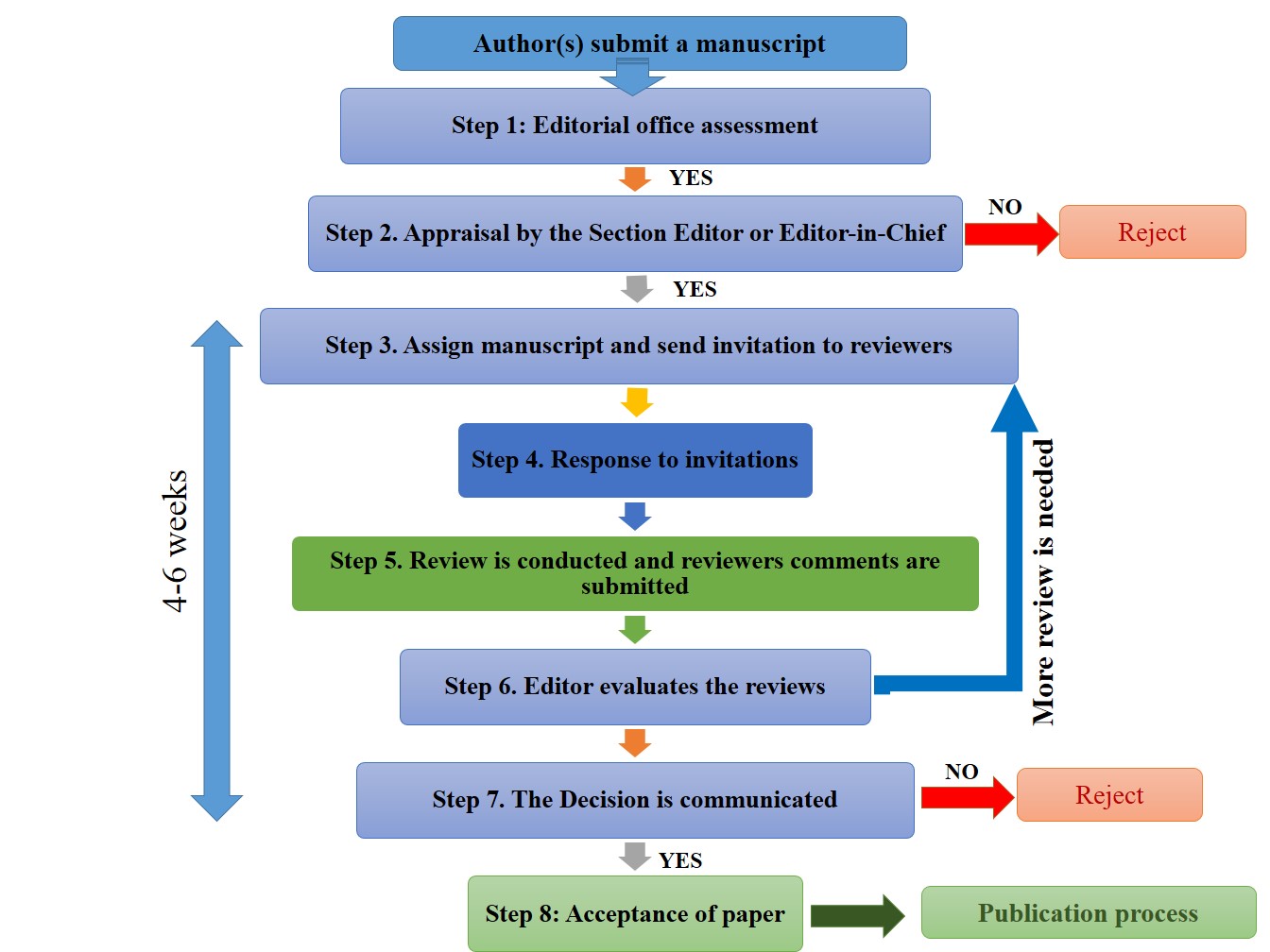
Details of peer-review process are as follow:
Step 1. Editorial office assessment after submission of paper
Upon the corresponding or submitting author submits the paper to the journal, the managing editor checks the paper's composition and arrangement against the journals Author Guidelines to make sure it includes the required sections
Step 2. Appraisal by the section editor or Editor-in-Chief
The Section Editor or Editor-in-Chief checks that the paper is appropriate for the journal and is sufficiently original and interesting. If not, the paper may be rejected without being reviewed any further.
Step 3. Assign manuscript and send invitation to Reviewers
The editor sends invitations to reviewers believed to be appropriate to evaluate the manuscript. As responses are received, further invitations are issued, if necessary, until the required number of acceptances is obtained; commonly this is 2.
Step 4. Response to invitations
Potential reviewers consider the invitation against their own expertise, conflicts of interest, and availability. They then accept or decline. If possible, when declining, they might also suggest alternative reviewers.
Step 5. Review is conducted
The reviewer sets time aside to read the paper several times. The first read is used to form an initial impression of the work. If major problems are found at this stage, the reviewer may feel comfortable rejecting the paper without further work. Otherwise, they will read the paper several more times, taking notes so as to build a detailed point-by-point review. The review is then submitted to the journal, with a recommendation to accept or reject it, or else with a request for revision before it is reconsidered.
Step 6. Editors evaluate the reviews
The editor considers all the returned reviews before making an overall decision. If the reviews differ widely, the editor may invite an additional reviewer so as to get an extra opinion before making a decision.
Step 7. The decision is communicated
The editor sends a decision email to the author including any relevant reviewer comments. The author can revise and submit the revised manuscript again. Then, the review process is repeated for the revised manuscript by assigning the revised version to one of the previous reviewers. According to the reviewer comments on the revised manuscript, the editor decides on its acceptance or rejection.
Step 8: Acceptance of paper
If the editor decides to accept, the decision email is sent to the author, and the paper is sent to production.