Computational Design and Evaluation of scFv-DSH2a as a PSMA-Targeted Immunotoxin for Prostate Cancer Therapy Computational design of scFv-DSH2a as a PSMA-targeted immunotoxin
Trends in Peptide and Protein Sciences,
Vol. 10 No. 1 (2025),
16 March 2025
,
Page 1-13 (e3)
https://doi.org/10.22037/tpps.v10i1.50730
Abstract
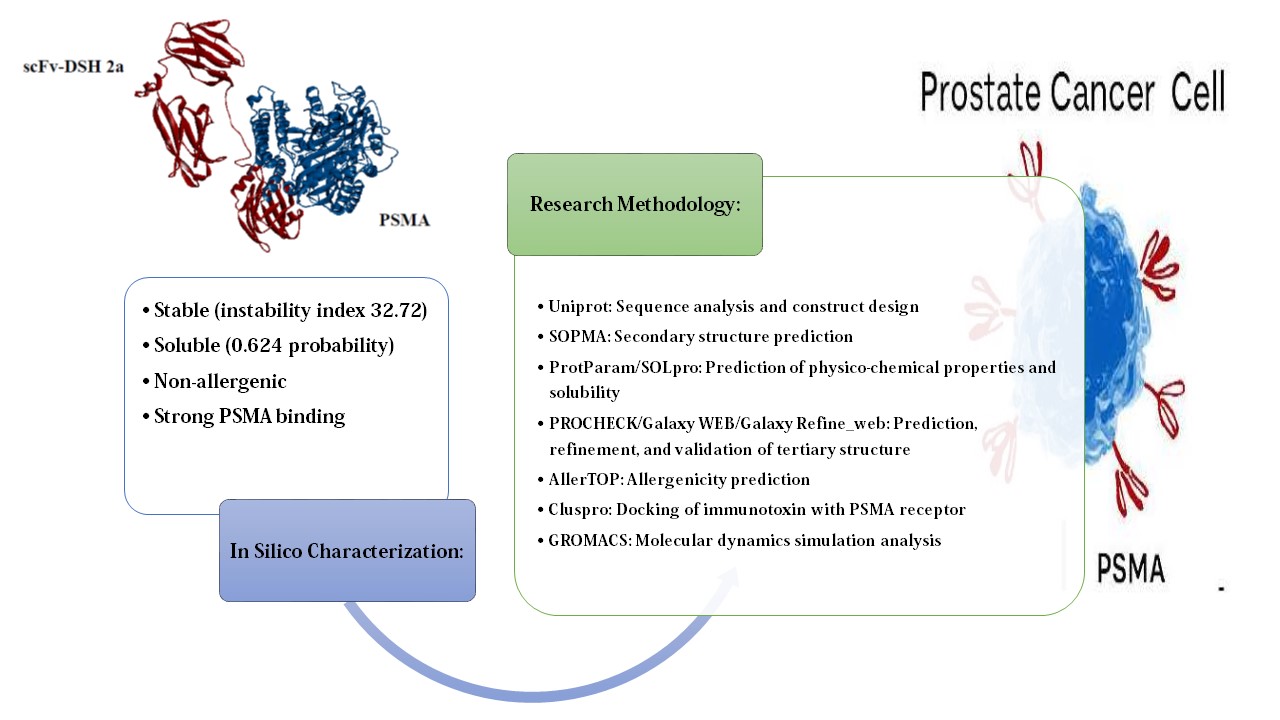
Prostate cancer is one of the most prevalent malignancies in men and a leading cause of cancer-related mortality. The prostate-specific membrane antigen (PSMA), which is highly overexpressed in prostate tumors and internalized upon ligand binding, represents a promising target for immunotoxin-based therapies. In this study, a novel chimeric immunotoxin, scFv-DSH2a, using bioinformatics tools, was designed to selectively target PSMA-expressing cells. The construct was generated by fusing the single-chain variable fragment (scFv) of the J591 antibody to the cytotoxic DELTA-stichotoxin-Hmg2a (DSH2a) via a flexible linker. Structural modeling and refinement were performed using GalaxyWEB and Galaxy Refine, and the model was validated through PROCHECK and ProSA-web. Physicochemical properties were assessed using ProtParam, solubility predicted via SOLpro, and allergenicity evaluated using AllerTOP v.2.0. Protein–protein docking with PSMA was conducted using ClusPro, and molecular dynamics simulations were performed with GROMACS to assess complex stability. The designed immunotoxin exhibited favorable stability (instability index: 32.72), solubility (probability: 0.624), and non-allergenic properties. Docking results revealed strong binding affinity to PSMA, and molecular dynamics simulations confirmed structural stability over 100 nanoseconds, with low root mean square deviation (RMSD) and root mean square fluctuation (RMSF) values and consistent radius of gyration. These findings suggest that scFv-DSH2a is a promising candidate for targeted immunotherapy in prostate cancer, offering specificity, stability, and potential safety for future therapeutic development.
HIGHLIGHTS
- A novel immunotoxin (scFv-DSH2a) was designed to target PSMA in prostate cancer.
- Bioinformatics tools confirmed its stability, solubility, and non-allergenicity.
- Molecular docking showed strong binding affinity to PSMA.
- Molecular dynamics simulations confirmed complex stability over 100 ns.
- scFv-DSH2a is a promising candidate for targeted prostate cancer immunotherapy.
- Bioinformatics
- Immunotoxin
- Prostate cancer
- PSMA
How to Cite
References
Abbasi, M. and S. Basiri, (2017). ″Prostate cancer: A Case Report.″ Journal of Research in Urology, 2(1): 29-32. DOI: https://doi.org/10.30699/acadpub.jru.2.1.29.
Adamaki, M. and Zoumpourlis, V., (2021). "Prostate cancer biomarkers: from diagnosis to prognosis and precision-guided therapeutics." Pharmacology and Therapeutics, 228: 107932. DOI: https://doi.org/10.1016/j.pharmthera.2021.107932.
Ahmad, Z.A., Yeap, S.K., Ali, A.M., Ho, W.Y., Alitheen, N.B.M. and M. Hamid,(2012). "scFv antibody: principles and clinical application." Clinical and Developmental Immunology, 2012(1):980250. DOI: https://doi.org/10.1155/2012/980250.
Buzlea, C., Noor, H., Micu, A., Vîlceanu, I. and V. Pirvut, (2023). "Immunotoxins and their role in prostate cancer treatment." Clinical Cancer Investigation Journal, 12(5-2023):38-42. DOI: https://doi.org/10.51847/Ovv3nzS2Wn.
Dimitrov, I., Flower, D.R. and I. Doytchinova, (2013). "AllerTOP-a server for in silico prediction of allergens." BMC Bioinformatics, 14(Suppl 6):S4. DOI: https://doi.org/10.1186/1471-2105-14-S6-S4.
Dimitrov, I., Naneva, L., Doytchinova, I. and I. Bangov, (2014). "AllergenFP: allergenicity prediction by descriptor fingerprints." Bioinformatics, 30(6): 846-851. DOI: https://doi.org/10.1093/bioinformatics/btt619.
Dohm, A., Diaz, R. and R.H. Nanda, (2021). "The role of radiation therapy in the older patient." Current Oncology Reports, 23(1): 1-14. https://doi.org/10.1007/s11912-020-01000-y.
FitzGerald, D.J., Kreitman, R., Wilson, W., Squires, D. and I. Pastan, (2004). "Recombinant immunotoxins for treating cancer." International Journal of Medical Microbiology, 293(7-8): 577-582. DOI: https://doi.org/10.1078/1438-4221-00302.
Gasteiger, E., Hoogland, C., Gattiker, A., Duvaud, S.E., Wilkins, M.R., Appel, R.D. and A.Bairoch, (2005). "Protein identification and analysis tools on the ExPASy server." In: Walker, J.M. (eds), The Proteomics Protocols Handbook, Totowa, NJ: Humana press. pp. 571-607. DOI: https://doi.org/10.1385/1-59259-890-0:571.
Ghesmati, Z., Mokhtari, S., Parvanak, M., Siahkouhi, H., Taheri-Anganeh, M., Ahmadi, K., Zarezade, V., Vahedi, F., Shajirat, Z., Nezafat, N. and A. Movahedpour, (2022). "Designing a humanized immunotoxin based on DELTA-stichotoxin-Hmg2a toxin: an in silico study." Journal of Molecular Modeling, 28(12):392. DOI: https://doi.org/10.1007/s00894-022-05389-0,
Ghorbanpour, R., Nikbakht, G. and A.H. Jalali, (2019). "Immunobioinformatics study of antigen 43 autotransporter protein of enterotoxigenic Escherichia coli isolated from calf." Journal of Veterinary Research, 74(1): 128-141. DOI: https://doi.org/10.22059/jvr.2018.211721.2504.
Ho, D., T. Olafson and A. Lipman, (2017). "J591 Minibodies and cys-diabodies for targeting human prostat specific Membrane antigen (PSMA) and methods for their use." European Patent Application. Mexico. Google patent: US20110268656A1.
Kem, W.R. and B.M. Dunn, (1988). "Separation and characterization of four different amino acid sequence variants of a sea anemone (Stichodactyla helianthus) protein cytolysin." Toxicon, 26(11): 997-1008. DOI: https://doi.org/10.1016/0041-0101(88)90198-5.
Ko, J., Park, H., Heo, L. and C. Seok, (2012). "GalaxyWEB server for protein structure prediction and refinement." Nucleic Acids Research, 40(W1): W294-W297. DOI: https://doi.org/10.1093/nar/gks493.
Kozakov, D., Hall, D.R., Xia, B., Porter, K.A., Padhorny, D., Yueh, C., Beglov, D. and S. Vajda, (2017). "The ClusPro web server for protein–protein docking." Nature Protocols, 12(2): 255-278. DOI: https://doi.org/10.1038/nprot.2016.169.
Magnan, C.N., Randall, A. and P. Baldi, (2009). "SOLpro: accurate sequence-based prediction of protein solubility." Bioinformatics, 25(17): 2200-2207. DOI: https://doi.org/10.1093/bioinformatics/btp386.
Movahedpour, A., Ahmadi, K., Taheri-Anganeh, M., Amiri, A., Ahmadi, N., Khatami, S.H., Zafaranchi zm, S., Soltani Fard, E., Moazamfard, M., Ghasemi, H. and N. Nezafat, (2022). "Designing a humanized immunotoxin based on HER2 specific scFv and DFF40 toxin against breast cancer: an in-silico study."International Journal of Peptide Research and Therapeutics, 28(5): 130. DOI: https://doi.org/10.1007/s10989-022-10443-9.
Muneer, A., Macrae, B., Krishnamoorthy, S. and A. Zumla, (2019). "Urogenital tuberculosis—epidemiology, pathogenesis and clinical features." Nature Reviews Urology, 16(10): 573-598. DOI: https://doi.org/10.1038/s41585-019-0228-9.
O'Dwyer, E., Bodei, L. and M.J. Morris, (2021). "The role of theranostics in prostate cancer." Seminars in Radiation Oncology, 31(1): 71-82. DOI: https://doi.org/10.1016/j.semradonc.2020.07.004.
Parker, S.A., Diaz, I.L.C., Anderson, K.A. and C.A. Batt, (2013). "Design, production, and characterization of a single-chain variable fragment (ScFv) derived from the prostate specific membrane antigen (PSMA) monoclonal antibody J591." Protein Expression and Purification, 89(2): 136-145. DOI: https://doi.org/10.1016/j.pep.2013.02.016.
Pastan, I., Hassan, R., FitzGerald, D.J. and R.J. Kreitman, (2006). "Immunotoxin therapy of cancer." Nature Reviews Cancer, 6(7): 559-565. DOI: https://doi.org/10.1038/nrc1891.
Psimadas, D., Valotassiou, V., Alexiou, S., Tsougos, I. and P. Georgoulias, (2018). " Radiolabeled mAbs as molecular imaging and/or therapy agents targeting PSMA." Cancer Investigation, 36(2): 118-128. DOI: https://doi.org/10.1080/07357907.2018.1430816.
Samavarchi Tehrani, S., Gharibi, S., Movahedpour, A., Goodarzi, G., Jamali, Z., Khatami, S.H., Maniati, M., Ranjbar, M., Shabaninejad, Z., Savardashtaki, A. and M. Taheri-Anganeh, (2021). "Design and evaluation of scFv-RTX-A as a novel immunotoxin for breast cancer treatment: an in silico approach." Journal of Immunoassay and Immunochemistry, 42(1): 19-33. DOI: https://doi.org/10.1080/15321819.2020.1812640.
Singh, N., Upadhyay, S., Jaiswar, A. and N. Mishra, (2016). "In silico analysis of protein." JSM Bioinformatics, Genomics and Proteomics, 1(2): 1007.
Singh, S., Tank, N.K., Dwiwedi, P., Charan, J., Kaur, R., Sidhu, P. and V.K. Chugh, (2018). "Monoclonal antibodies: a review." Current Clinical Pharmacology, 13(2): 85-99. DOI: https://doi.org/10.2174/1574884712666170809124728.
Strand, S.H., Orntoft, T.F. and K.D. Sorensen, (2014). "Prognostic DNA methylation markers for prostate cancer." International journal of Molecular Sciences, 15(9): 16544-16576. DOI: https://doi.org/10.3390/ijms150916544.
Vasina, M., Velecký, J., Planas-Iglesias, J., Marques, S.M., Skarupova, J., Damborsky, J., Bednar, D., Mazurenko, S. and Z. Prokop, (2022). "Tools for computational design and high-throughput screening of therapeutic enzymes." Advanced Drug Delivery Reviews, 183: 114143. DOI: https://doi.org/10.1016/j.addr.2022.114143.
Wang, Y., Chua, K.L. and H.E. Khoo, (2000). "A new cytolysin from the sea anemone, Heteractis magnifica: isolation, cDNA cloning and functional expression." Biochimica et Biophysica Acta (BBA)-Protein Structure and Molecular Enzymology, 1478(1): 9-18. DOI: https://doi.org/10.1016/S0167-4838(99)00289-7.
Wiederstein, M. and M.J. Sippl, (2007). "ProSA-web: interactive web service for the recognition of errors in three-dimensional structures of proteins." Nucleic Acids Research, 35(suppl_2): W407-W410. DOI: https://doi.org/10.1093/nar/gkm290
Wu, A.M., Tan, G.J., Sherman, M.A., Clarke, P., Olafsen, T., Forman, S.J. and A.A. Raubitschek, (2001). "Multimerization of a chimeric anti-CD20 single-chain Fv-Fc fusion protein is mediated through variable domain exchange." Protein Engineering, 14(12): 1025-1033. DOI: https://doi.org/10.1093/protein/14.12.1025.
- Abstract Viewed: 139 times
- PDF Downloaded: 146 times