Electrosynthesis, in Silico Ligand-Protein Interaction and Pharmacokinetic Studies of Some Aryl Sulfone Derivatives as Potential Acetylcholinesterase Inhibitors Synthesis of aryl sulfones as acetylcholinesterase inhibitors
Trends in Peptide and Protein Sciences,
Vol. 7 (2022),
7 March 2022
,
Page 1-7 (e11)
https://doi.org/10.22037/tpps.v7i.40074
Abstract
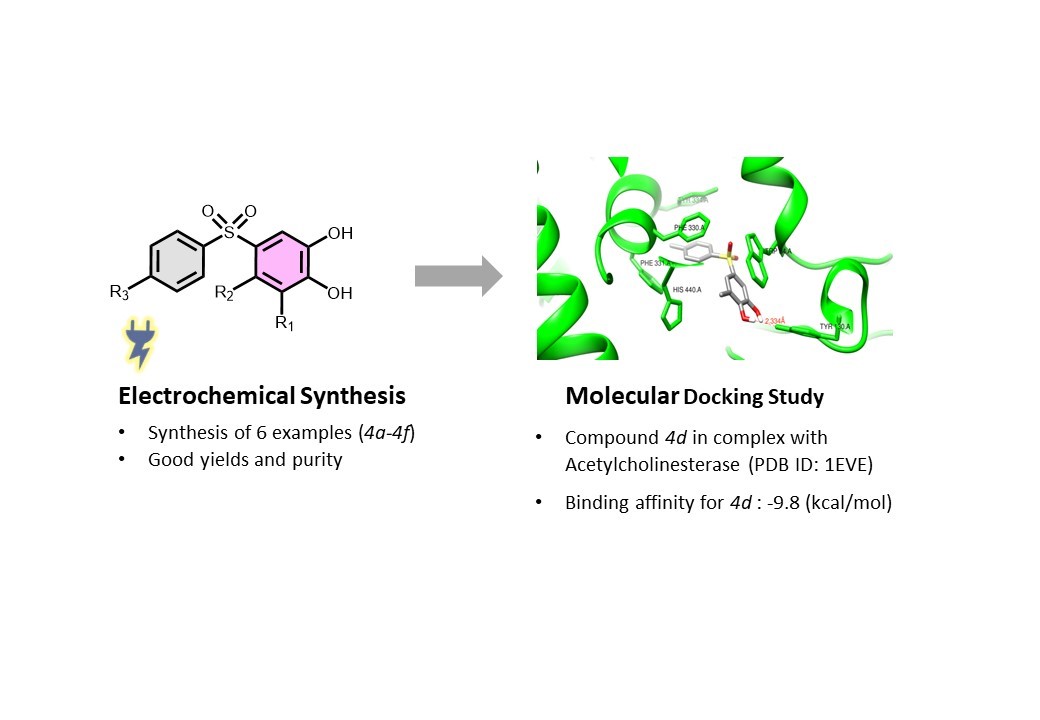
Acetylcholinesterase (AChE) is an enzyme that catalyzes the hydrolysis of acetylcholine. Acetylcholine plays an essential role in learning and memory. Since acetylcholine deficiency is related to the pathogenesis of Alzheimer's disease, obtaining acetylcholinesterase inhibitors is of great interest. Here, a group of aryl sulfone derivatives with a catechol ring was synthesized by the electrochemical method. The structure of compounds was confirmed by 1HNMR and ESI-MS. Molecular docking studies of the synthesized compounds with AChE were performed and the results showed that all of the compounds have good theoretical affinities for the target enzyme, AChE. Moreover, the physicochemical properties and ADME parameters of synthesized compounds were predicted, which revealed that they have acceptable features as drug candidates.
HIGHLIGHTS
- Aryl sulfone derivatives with catechol rings were synthesized by electrochemical method.
- Molecular docking studies of the compounds revealed good binding affinities against acetylcholinesterase.
- All of the synthesized compounds obey Lipinski’s rule of five which suggests them as good oral drug candidates.
- Acetylcholinesterase inhibitor
- Aryl sulfone derivatives
- Catechol
- Molecular docking
- Physicochemical properties
How to Cite
References
Akrami, H, Mirjalili B.F., Khoobi M., Nadri H., Moradi A., Sakhteman A,. Emami S., Foroumadi A. and A. Shafiee, (2014). ″Indolinone-based acetylcholinesterase inhibitors: Synthesis, biological activity and molecular modeling.″ European Journal of Medicinal Chemistry, 84, 375–381. DOI: https://doi.org/10.1016/j.ejmech.2014.01.017.
BIOVIA Dassault Systèmes. Discovery Studio Visulaizer, v4.5.0.15071, San Diego: Dassault Systèmes, CA, USA: 2016.
Boittier, E.D., Tang, Y.Y., Buckley, M.E., Schuurs, Z.P., Richard, D.J. and N.S. Gandhi, (2020). "Assessing molecular docking tools to guide targeted drug discovery of CD38 inhibitors." International Journal of Molecular Sciences, 21(15): 5183. DOI: https://doi.org/10.3390/ijms21155183.
Chen, C.C. and J. Waser, (2015). "One-Pot, three-component arylalkynyl sulfone synthesis." Organic Letters, 17(3): 736–739. DOI: https://doi.org/10.1021/acs.orglett.5b00015.
Chen, Y., Wu, B., Hao, Y., Liu, Y., Zhang, Z., Tian, C., Ning, X., Guo, Y., Liu, J. and X. Wang, (2019). "Structure-activity relationship studies of (E)-3,4-dihydroxystyryl alkyl sulfones as novel neuroprotective agents based on improved antioxidant, anti-inflammatory activities and BBB permeability." European Journal of Medicinal Chemistry, 171: 420–433. DOI: https://doi.org/10.1016/j.ejmech.2019.03.044.
Daina, A., Michielin, O. and V. Zoete, (2017). "SwissADME: a free web tool to evaluate pharmacokinetics, drug-likeness and medicinal chemistry friendliness of small molecules." Scientific Reports, 7(1): 42717. DOI: https://doi.org/10.1038/srep42717.
Du, X., Wang, X. and M. Geng, (2018). "Alzheimer’s disease hypothesis and related therapies." Translational Neurodegeneration, 7(1): 2. DOI: https://doi.org/10.1186/s40035-018-0107-y.
Habibi, D., Rahimi, A., Rostami, A. and S. Moradi, (2017). "Green and mild laccase-catalyzed aerobic oxidative coupling of benzenediol derivatives with various sodium benzenesulfinates." Tetrahedron Letters, 58(4): 289–293. DOI: https://doi.org/10.1016/j.tetlet.2016.11.119.
Ibrahim, M., Latif, A., Ahmad, M., Ahmad, S., Ali, A., Siddique, A.B., Saadiq, M., Akbar, N., Farooq, U., Khan, A., Al-Harrasi, A. and M. Ali, , (2022). "Sulfonylbis(acylhydrazones) as anticholinesterase inhibitors: Synthesis, in vitro biological evaluation and computational studies." Journal of Molecular Structure, 1252: 132215. DOI: https://doi.org/10.1016/j.molstruc.2021.132215.
Kärkäs, M.D. (2018). "Electrochemical strategies for C–H functionalization and C–N bond formation." Chemical Society Reviews, 47(15): 5786–5865. DOI: https://doi.org/10.1039/C7CS00619E.
Khan, H., Ullah, H., Aschner, M., Cheang, W.S. and E.K. Akkol, (2019). "Neuroprotective effects of quercetin in alzheimer’s disease." Biomolecules, 10(1): 59. DOI: https://doi.org/10.3390/biom10010059.
Kryger, G., Silman, I. and J.L. Sussman, (1999). "Structure of acetylcholinesterase complexed with E2020 (Aricept®): implications for the design of new anti-Alzheimer drugs." Structure, 7(3): 297–307. DOI: https://doi.org/10.1016/S0969-2126(99)80040-9.
Lamie P.F., Abdel-Fattah M.M. and J.N. Philoppes, (2022). ″Design and synthesis of new indole drug candidates to treat Alzheimer’s disease and targeting neuro-inflammation using a multi-target-directed ligand (MTDL) strategy.″ Journal of Enzyme Inhibition and Medicinal Chemistry, 37(1): 2660–78. DOI: https://doi.org/10.1080/14756366.2022.2126464.
Lipinski, C.A. (2004). "Lead- and drug-like compounds: the rule-of-five revolution." Drug Discovery Today: Technologies, 1(4): 337–341. DOI: https://doi.org/10.1016/j.ddtec.2004.11.007.
Liu, H., Wang, L., Lv, M., Pei, R., Li, P., Pei, Z., Wang, Y., Su, W. and Xie, X.-Q., (2014). "AlzPlatform: An alzheimer’s disease domain-specific chemogenomics knowledgebase for polypharmacology and target identification research." Journal of Chemical Information and Modeling, 54(4): 1050–1060. DOI: https://doi.org/10.1021/ci500004h.
Mahmoud Z., Sayed H.S., Mohamed L.W. and K.M. Mohamed, (2022). ″Development of new donepezil analogs: synthesis, biological screening and in silico study rational.″ Medicinal Chemistry Research, 31(10): 1754–1770. DOI: https://doi.org/10.1007/s00044-022-02941-8.
Möhle, S., Zirbes, M., Rodrigo, E., Gieshoff, T., Wiebe, A. and S.R. Waldvogel, (2018). "Modern electrochemical aspects for the synthesis of value-added organic products." Angewandte Chemie International Edition, 57(21): 6018–6041. DOI: https://doi.org/10.1002/anie.201712732.
Morris, G.M., Huey, R., Lindstrom, W., Sanner, M.F., Belew, R.K., Goodsell, D.S. and A.J. Olson, (2009)."AutoDock4 and AutoDockTools4: Automated docking with selective receptor flexibility." Journal of Computational Chemistry, 30(16): 2785–2791. DOI: https://doi.org/10.1002/jcc.21256.
Motin, M.A., Uddin, M.A., Dhar, P.K., Mia, M.A.H. and M.A. Hashem, (2017). "Study of electrochemical oxidation of catechol in the presence of sulfanilic acid at different pH." Portugaliae Electrochimica Acta, 35(2): 103–116. DOI: https://doi.org/10.4152/pea.201702103.
Nematollahi, D. and M. Rafiee, (2004). "Electrochemical oxidation of catechols in the presence of acetylacetone." Journal of Electroanalytical Chemistry, 566(1): 31–37. DOI: https://doi.org/10.1016/j.jelechem.2003.10.044.
Nematollahi, D. and R. Rahchamani, (2002a). "Electrochemical synthesis of p-tolylsulfonylbenzenediols." Tetrahedron Letters, 43(1): 147–150. DOI: https://doi.org/10.1016/S0040-4039(01)02050-0.
Nematollahi, D. and R. Rahchamani, (2002b). "Electro-oxidation of catechols in the presence of benzenesulfinic acid. Application to electro-organic synthesis of new sulfone derivatives." Journal of Electroanalytical Chemistry, 520(1–2): 145–149. DOI: https://doi.org/10.1016/S0022-0728(02)00654-X.
Pasieka, A., Panek, D. and B. Malawska, (2020). "Multifunctional Ligand Approach: Search for Effective Therapy Against Alzheimer’s Disease. In: X. Huang (Ed.), Alzheimer’s Disease: Drug Discovery. Exon Publications. pp.181–203. DOI: https://doi.org/10.36255/exonpublications.alzheimersdisease.2020.ch11.
Pettersen, E.F., Goddard, T.D., Huang, C.C., Couch, G.S., Greenblatt, D.M., Meng, E.C. and T.E. Ferrin, (2004). "UCSF Chimera--A visualization system for exploratory research and analysis." Journal of Computational Chemistry, 25(13): 1605–1612. DOI: https://doi.org/10.1002/jcc.20084.
Sander, T., Freyss, J., von Korff, M. and C. Rufener, (2015). "DataWarrior: An Open-source program for chemistry aware data visualization and analysis." Journal of Chemical Information and Modeling, 55(2): 460–473. DOI: https://doi.org/10.1021/ci500588j.
Soyer, Z., Uysal, S., Parlar, S., Tarikogullari Dogan, A.H. and V. Alptuzun, (2017). "Synthesis and molecular docking studies of some 4-phthalimidobenzenesulfonamide derivatives as acetylcholinesterase and butyrylcholinesterase inhibitors." Journal of Enzyme Inhibition and Medicinal Chemistry, 32(1): 13–19. DOI: https://doi.org/10.1080/14756366.2016.1226298.
Taha, M., Alshamrani, F.J., Rahim, F., Anouar, E.H., Uddin, N., Chigurupati, S., Almandil, N.B., Farooq, R.K., Iqbal, N., Aldubayan, M., Venugopal, V. and K.M. Khan, (2021). "Synthesis, characterization, biological evaluation, and kinetic study of indole base sulfonamide derivatives as acetylcholinesterase inhibitors in search of potent anti-Alzheimer agent". Journal of King Saud University - Science, 33(3): 101401. DOI: https://doi.org/10.1016/j.jksus.2021.101401.
Toghan, A., Abo-Bakr, A.M., Rageh, H.M. and M. Abd-Elsabour, (2019). "Green electrochemical strategy for one-step synthesis of new catechol derivatives." RSC Advances, 9(23): 13145–13152. DOI: https://doi.org/10.1039/C9RA01206K.
Veber, D.F., Johnson, S.R., Cheng, H.-Y., Smith, B.R., Ward, K.W. and K.D. Kopple, (2002). "Molecular properties that influence the oral bioavailability of drug candidates." Journal of Medicinal Chemistry, 45(12): 2615–2623. DOI: https://doi.org/10.1021/jm020017n.
Wang, Y., Chang, W., Qin, S., Ang, H., Ma, J., Lu, S. and Y. Liang, (2022). "Diversification of aryl sulfonyl compounds through ligand‐controlled meta ‐ and para ‐C−H borylation." Angewandte Chemie International Edition, 61(34): 1-10. DOI: https://doi.org/10.1002/anie.202206797.
World Health Organisation. (2017). "Global action plan on the public health response to dementia." 2017–2025. Retrieved form https://www.who.int/publications-detail-redirect/global-action-plan-on-the-public-health-response-to-dementia-2017---2025.
Yusufzai S.K, Khan M.S., Sulaiman O., Osman H. and D.N. Lamjin, (2018) "Molecular docking studies of coumarin hybrids as potential acetylcholinesterase, butyrylcholinesterase, monoamine oxidase A/B and β-amyloid inhibitors for Alzheimer’s disease." Chemistry Central Journal, 12(1): 128. DOI: https://doi.org/10.1186/s13065-018-0497-z.
- Abstract Viewed: 260 times
- PDF Downloaded: 171 times