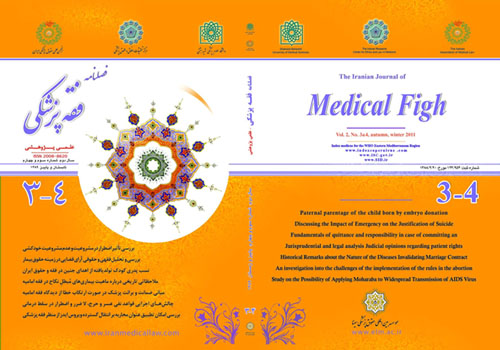
Jurisprudential and legal analysis Judicial opinions regarding patient rights
Medical Figh,
Vol. 2 No. 4-3 (1389),
3 Mehr 2010
,
Page 12-39
https://doi.org/10.22037/mfj.v2i4-3.3571
Abstract
A case which is observed in the judicial decisions on the patients’ rights is a physician who causes the patient’s death upon his treatment. In a case, the physician doing positional anesthesia observes that the patient is shocked and dies and considering what has been mentioned in the decisions issued by the Supreme Court, the accused is sentenced to the payment of one complete blood money to the heirs of the dead person for quasi intentional murder. From one perspective, the physician has caused the death and the title “principle” is applied to him; although if the physician is highly skilled and proficient according to the medical and technical rules and no fault is ascribed to him and also since the physician has not obtained discharge from the patient or his guardians before treatment and the patient has given permission for the treatment not wasting, the physician may be deemed liable. On the other part, the theory of some jurisprudents like Ibn Idris is observed to this effect that if we see that it is said that “one who engages in treatment should obtain discharge from the patient or his guardian, otherwise he will be liable” is applied to a situation where the patient is minor or mad and has not capacity for permission and the discharge should be obtained from his guardian; but if the patient is mature and wise and he has himself instructed the physician to treat him, there will be no liability against the physician, whether the guardian has given discharge to the physician or not and our reason for this is the principle of discharge.
How to Cite
- Abstract Viewed: 412 times
- PDF Downloaded: 173 times