Development and Characterization of Plasticized Films Made of Exopolysaccharides from Weissella confusa NH02
Applied Food Biotechnology,
Vol. 13 No 1 (2026),
7 âzar 2025
,
Page 1-9 (e8)
https://doi.org/10.22037/afb.v13i1.50906
Résumé
Background and Objective: Environmental concerns over petroleum-based packaging have increased interests in biodegradable edible films from renewable resources. Exopolysaccharides from lactic acid bacteria are promising due to their film-forming ability, safety and functionality. Weissella confusa NH02, isolated from Thai fermented pork (Nham), produces high-molecular-weight glucan exopolysaccharides appropriate for film formation. However, exopolysaccharides films alone are fragile and moisture-sensitive. Glycerol plasticization can improve flexibility and barrier characteristics by modifying intermolecular interactions. This study developed exopolysaccharides films from Weissella confusa NH02 and assessed the effect of glycerol content on film characteristics.
Material and Methods: Exopolysaccharides were produced by submerged fermentation and recovered by ethanol precipitation and drying. Film-forming solutions containing 2.5–10 g kg-1 exopolysaccharides were prepared with glycerol (6.25–50 grams per 100 gram exopolysaccharides). Dispersions were cast, dried at 40 °C and conditioned under controlled humidity. Rheological behavior was analyzed using rotational rheometer and fitted to Ostwald-de Waele model. Mechanical characteristics were assessed using American Society for Testing and Materials methods. Moisture content, water activity, thickness, transparency, solubility and water-vapor permeability were assessed using standard techniques. Dynamic mechanical thermal analysis investigated viscoelastic behavior and glass transition temperature. All assessments were carried out in triplicate.
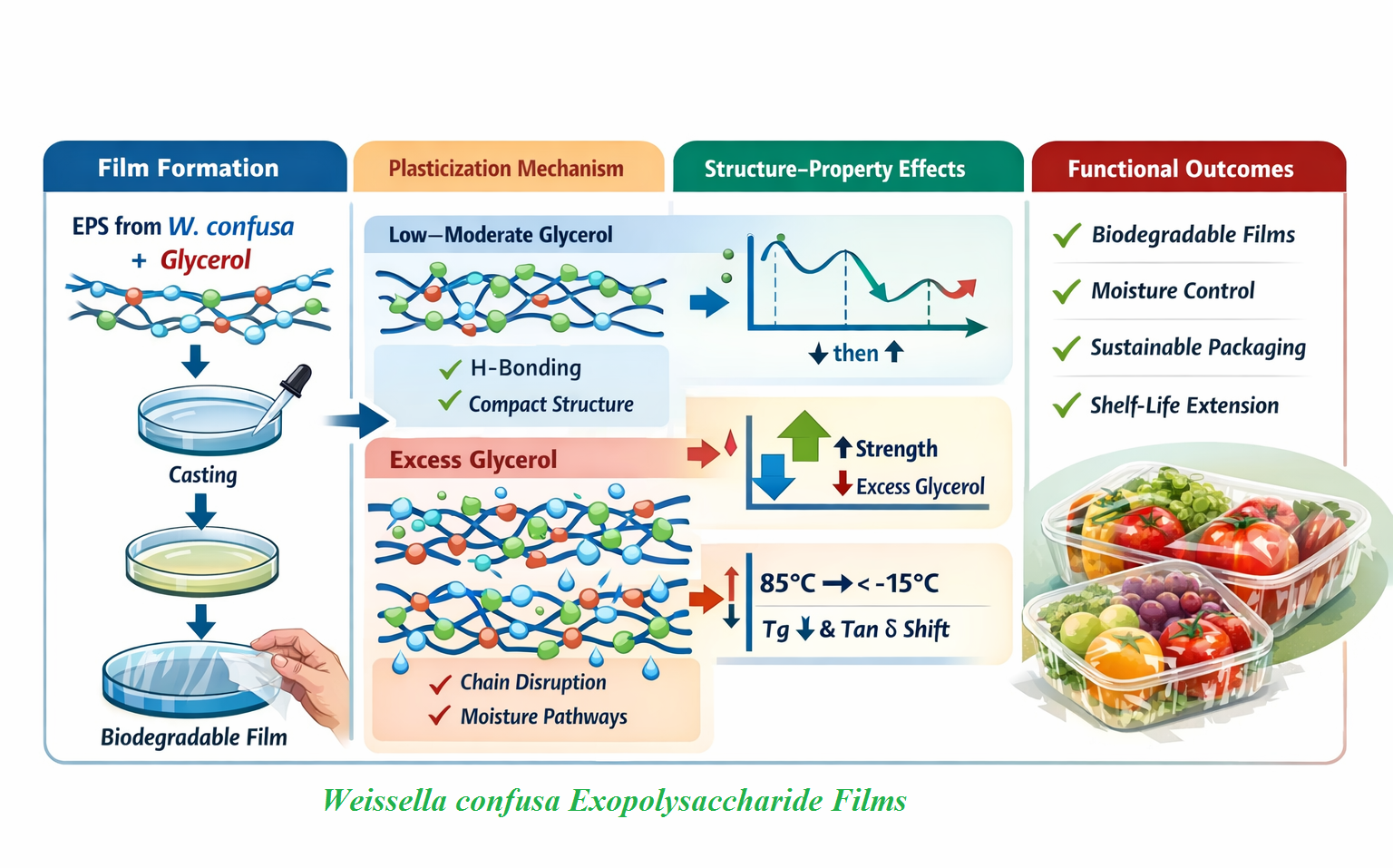
Results and Conclusion: Exopolysaccharides produced clear flexible films and dispersions showed shear-thinning behavior appropriate for casting. Glycerol strongly affected performance as water-vapor permeability decreased up to ~25% glycerol due to improved polymer packing then increased at higher levels due to increased hydrophilicity. Mechanical characteristics improved at moderate plasticizer levels, with optimal performance near an exopolysaccharide:glycerol ratio of 65:35 (TS ≈ 5.56 MPa; elongation ≈ 142%), while excess glycerol weakened the matrix. Dynamic mechanical thermal analysis revealed single transition temperature decreasing from ~85 to less than -15 °C as glycerol increased, indicating strong compatibility and efficient plasticization. Plasticized exopolysaccharides films from Weissella confusa NH02 show promise as biodegradable food-contact materials with tunable strength, flexibility and moisture barrier characteristics.
Keywords: Biopolymer materials; Microbial polysaccharides; Plasticizer effect; Barrier characteristics; Mechanical performance; Biodegradable packaging
- Introduction
Protective edible coating and optimized packaging are increasingly adopted to extend the shelf life of foods. Conventional packaging depends heavily on non‑renewable inputs and can impose environmental costs. Therefore, bio‑based alternatives and edible and biodegradable films derived from renewable resources have been interested as a route to maintain quality while decreasing wastes [1]. In addition to waste decrease, next-generation edible films are increasingly designed to act as active interfaces capable of regulating moisture transfer, limiting oxidation and serving as carriers for natural antimicrobials; thereby, aligning food preservation strategies with circular bioeconomy principles and sustainable material transitions [2,3].
Weissella confusa NH02, isolated from Thai fermented minced pork (Nham), produces exopolysaccharides (EPS) characterized by high viscosity, molecular mass of approximately 1.13 × 10⁶ Da and glucose as the sole monomer [4]. Based on these characteristics and the demand for multipurpose food‑contact films, EPS from W. confusa NH02 is a promising film‑forming substrate. Films assembled from lactic acid bacterial EPS alone can be achieved [5], but limited resistance to water and vapor often limits practical uses. Mixing EPS with compatible, lower‑cost polymers and plasticizers is a common strategy to develop mechanical strength and barrier behavior [6]. A study highlighted that the functional performance of EPS-based films depended not only on composition but also on supramolecular organization and intermolecular interactions formed during drying, which governed transport characteristics and structural integrity [7].
A report has demonstrated that EPS produced by lactic acid bacteria (LAB), including W. confusa, possess excellent rheological characteristics and potential for food, biomedical and biodegradable material uses [8]. The EPS from W. confusa NH02 has been reported as a high-molecular-weight (HMW) glucan with strong viscosity and thickening ability, making it interesting for film formation [4,9]. In addition, research on polysaccharide-based edible films has shown that plasticizers such as glycerol can improve flexibility and decrease fragility [10].
However, several important issues are still unresolved. First, although EPS from W. confusa NH02 has been characterized chemically and rheologically, its intrinsic film-forming capability and appropriateness as a standalone film matrix have not been systematically investigated. Second, EPS-based films are typically limited by poor moisture resistance and mechanical fragility, restricting practical uses in food packaging. Third, while glycerol is widely used as a plasticizer, the optimal concentration needed to balance mechanical strength, flexibility and water-vapor barrier performance in EPS films from this specific strain has not clearly been established. Moreover, limited information are available on the thermomechanical behavior and molecular compatibility of EPS-glycerol systems, particularly regarding glass transition behavior and structure-characteristics relationships.
Therefore, the present study addressed these gaps by developing films from EPS produced by W. confusa NH02 and systematically assessing the effects of glycerol content on rheological behavior, mechanical characteristics, water-vapor permeability (WVP) and thermal transitions. This study aimed to clarify structure-function relationships and provide guidance for optimizing EPS-based biodegradable films for food-contact uses.
- Materials and Methods
2.1. Microorganism and culture conditions
The W. confusa NH02 strain was recovered on modified MRS agar containing 2% sucrose at 4 °C and sub‑cultured every 3 w. Inoculum preparation followed the procedure of [4,9]. Production media were inoculated at 5% (v/v).
2.2. Exopolysaccharide production setup
The EPS production was carried out in shake flasks using synthetic fermentation media described by Wongsuphachat et al. [4].
2.3. Isolation of exopolysaccharides from fermentation broth
Culture supernatant collected on day 2 was clarified by centrifugation at 4,058× g for 15 min. The EPS was precipitated by adding two volumes of 96% chilled (v/v) ethanol and incubating the mixture at 4 °C for 1 h. The precipitate was recovered by centrifugation and dried under vacuum at 40 °C for 48 h. Materials from three fermentations were pooled and ground to a fine powder. Then, EPS content was quantified following Araujo-Rodrigues et al. [11] by assessing reducing sugars released by β‑glucanase (Sigma‑49101, USA) using DNS assay; β‑1,3‑glucan from Euglena gracilis (Sigma‑89862, USA) served as a positive control.
2.4. Preparation of film-forming solutions
Aqueous EPS solutions (2.5, 5.0, 7.5 and 10 g kg-1) were prepared under continuous stirring. Glycerol (Baker, Mexico) was added as the plasticizer at 6.25, 12.5, 25.0, 37.5 or 50.0 g per 100 g EPS to assess plasticizer level effects.
2.5. Rheology of filmogenic dispersions
Rheological behavior of the selected EPS concentration was characterized using Haake ReoStress 600, PP35 plate and plate geometry (1 mm gap) at 25 °C. Shear rate increased from 0 to 500 s⁻¹ (4.167 s⁻² acceleration) and then decreased with a similar magnitude. Data were fitted to Ostwald-de Waele model, t = k·Dⁿ, where D was shear rate (s⁻¹), t was shear stress (Pa), k was the consistency index (Pa·sⁿ) and n was the flow index (dimensionless). Apparent viscosity was reported at 300 s⁻¹.
2.6. Film casting and conditioning
Twenty‑five grams of each filmogenic solution were cast into 8.7‑cm Petri dishes and dried at 40 °C for ~6 h to constant mass using ventilated oven. Films were removed and equilibrated at 20 °C and 75% relative humidity (RH). Prior to mechanical and permeability assessments, specimens were conditioned based on ASTM D618‑61 at 25 °C ±2 and 51% RH over saturated magnesium nitrate for at least 48 h and then sealed using plastic bags and desiccators.
2.7. Dynamic mechanical thermal analysis
Glass‑transition temperature (Tg) of EPS/glycerol films was assessed using dynamic mechanical thermal analysis (DMTA) instrument (Triton Technology, UK) equipped with liquid nitrogen and film grips for uniaxial assessment. Samples (initial grip separation of 5.5 mm) were assessed using small sinusoidal strain (1 Hz, 0.02%), while heating from 69 to 159.6 °C at 5 °C min⁻¹. To minimize water loss, the exposed film surface was partially covered with aluminium foil, leaving the clamped ends uncovered [12]. Storage modulus (E′) and loss tangent (tan δ) were recorded versus temperature. The Tg was recorded at the midpoint between the tan δ peak and the onset of the sharp drop in E′. Assessments were carried out in triplicate.
2.8. Mechanical assessment
Tensile strength (TS) and elongation at break (E) were assessed at 25 °C using Testometric M350‑10CT (United Kingdom) based on ASTM D882 [13]. Strips (25 × 100 mm) were conditioned for 48 h at 51% RH (saturated magnesium nitrate), clamped with an initial grip separation of 50 mm and pulled at 50 mm min-¹. Stress-strain curves were recorded; TS was calculated from the maximum load divided by the initial cross-sectional area (MPa) and E was the percentage increase in length at rupture associated to the initial gauge length. For puncture assessment, discs (3 cm in diameter) were probed perpendicularly with a 3-mm cylindrical tip at 50 mm min-¹ to investigate puncture strength (PS) and puncture deformation (PD).
2.9. Physicochemical characteristics
Moisture content was achieved by drying films at 105 °C ±1 to constant mass and expressed as grams water per 100 g material. Water activity was assessed using quaLab meter (Decagon Devices, USA). Thickness was assessed using Check Line DCN‑900 (USA); fifteen random positions per specimen were averaged. Transparency was assessed from A600 assessed using Beckman DU650 (USA) and normalized by thickness (A600 mm-¹) according to [14,15]. Solubility of films with or without 25 g glycerol per 100 g polysaccharide was assessed by incubating samples in deionized water at 20, 37 or 100 °C for 2 h under agitation; then, supernatant polysaccharides were quantified using anthrone method [16].
2.10. Water-vapor permeability
The WVP was assessed based on ASTM E96 with minor modifications [17]. Each film sealed a 0.00181 m² aperture on a permeation cell held at 20 °C with 75% RH gradient (0% inside with anhydrous CaCl2; 75% outside with saturated NaCl). Mass gain under steady state after ~2 h was recorded at eight time points. The driving force included 1,753.55 Pa.
2.11. Statistical analysis
All experiments were carried out in triplicate and reported as means. Statistical analyses were carried out using SPSS v.10.0 for Windows (IBM, USA).
- Results and Discussion
3.1. Crude exopolysaccharides and films
Alcohol‑precipitated EPS achieved from W. confusa NH02 are sometimes labeled as dextran, when composition is not explicitly resolved. In practice, the precipitate can include multiple glucan-type and hetero-polysaccharide fractions depending on cell morphology during culture and the specific fermentation regime [18]. In the present study, pooled alcohol‑precipitated material from three independent fermentations comprised ~65% glucan and its average molecular mass exceeded 1.13 × 10⁶ Da using HPLC analysis [4]. Films cast from the melanin-deficient W. confusa NH02 EPS were optically clear and colorless (Fig. 1), water‑soluble and resisted cracking on folding. Introducing glycerol did not visibly alter color/clarity or qualitative solubility; however, high plasticizer loadings (> 50 g per 100 g EPS) yielded tacky films that adhered strongly to Petri dishes and were difficult to remove intact. The EPS level in the film‑forming dispersion was selected to balance transparency, flexibility and ease of plate release. As expected, film thickness increased with increasing polysaccharide concentration.
3.2. Rheology of filmogenic dispersions
The EPS film-forming dispersion showed non-Newtonian pseudoplastic behavior within the assessed shear range, as verified by fitting to Ostwald-de Waele model (Table 1). The flow behavior index (n = 0.42) indicated pronounced shear-thinning characteristics, while the consistency index (k = 3.18 Pa·sⁿ) reflected a structured polymer network with substantial intermolecular interactions. Apparent viscosity decreased with increasing shear rate, reaching 0.84 Pa·s at 300 s⁻¹ and suggesting appropriate flow characteristics for casting. This shear-thinning behavior was attributed to progressive alignment and disentanglement of dextran chains under shear, which decreased flow resistance while preserving structural integrity at rest. The relatively high k value indicated strong hydrogen bonding and chain entanglement within α (1→6) dextran backbone, promoting cohesive film formation. Such rheological characteristics facilitated uniform spreading and stabilization of the filmogenic matrix, while the presence of a structured network in dispersion form was consistent with the enhanced tensile strength and flexibility observed in the resulting films, as improved intermolecular interactions and chain packing enabled efficient stress distribution and mechanical resilience. Similar relationships between shear-thinning behavior, polymer network structure and improved mechanical performance have been reported for polysaccharide-based film systems [19–20].
3.3. Water‑vapor permeability
The WVP response showed a non‑monotonic trend with plasticizer content as WVP decreased as glycerol was increased from 0 to ~35% (w/w). However, this re-increased at higher fractions, with a maximum of approximately 3.36 observed at 50% glycerol (Table 2). At moderate loadings, extensive hydrogen bonding between EPS chains and glycerol likely restricted water‑transport pathways; thereby, decreasing WVP [21]. In addition to an EPS:glycerol ratio of 60:40, the permeability increased sharply, which could be rationalized by heterogeneous plasticizer distribution and the greater hydrophilicity of glycerol linked to EPS that together facilitated water diffusion through the matrix. In humid environments, minimizing WVP is a key performance target for practical packaging films [22]. In parallel, water contact angle decreased from 94.25 (0% glycerol) to 65.82° (50% glycerol), indicating increased surface hydrophilicity with plasticization (Table 2).
This behavior could be explained by plasticizer-polymer-water interactions and their effects on film microstructure. At moderate glycerol contents (up to ~35%), glycerol promoted intermolecular hydrogen bonding and closer chain packing, decreasing microvoids and limiting water-vapor diffusion. In contrast, excess glycerol disrupted polymer-polymer interactions, increased free volume and enhanced matrix hydrophilicity, promoting moisture sorption and transport. Similar non-monotonic WVP trends associated with plasticizer-induced structural rearrangements have been reported for polysaccharide films [23–24].
3.4. Mechanical characteristics
Literature reports show broad ranges for hydrocolloid‑film mechanics due to differences in biopolymer structure/composition and processing conditions [25–27]. For the EPS/glycerol plasticized films, tensile strength (TS) increased initially with glycerol addition, reached a maximum of 5.56 MPa and then decreased as plasticizer content increased (Table 2). The early strengthening could be attributed to favorable inter-polymer hydrogen bonding in EPS and glycerol that improves network integrity up to an optimal composition of EPS:glycerol of 65:35, whereas excessive plasticization over this point disrupted interchain interactions and introduced free volume that weakened the film [28].
As the available hydroxyl content in the filmogenic solution increased with higher polysaccharide/plasticizer proportions, hydrogen‑bond density and distribution changed as well [29]; similar to the observed turning point in TS. Decreased TS has been linked to phase‑separation‑like behavior in associated systems, when intra‑polymer interactions dominate over inter‑polymer ones [30–31]. Elongation at break (E) followed TS trends, with the an EPS:glycerol (65:35) formulation showing the largest extensibility (142.51%). At small to moderate plasticizer contents, glycerol enhanced ductility without a penalty in TS; similar behavior has been reported for kefiran‑based plasticized films [32].
The dextran-based film developed in this study demonstrated tensile strength (5.56 MPa) and elongation at break (142%), exceeding typical values reported for bacterial α-glucan films (TS < 3 MPa, E < 60%). This enhanced performance could be attributed to the structural characteristics of dextran produced by W. confusa, whose α(1→6) backbone with α(1→3) branches promoted chain entanglement and extensive hydrogen bonding; thereby, improving film cohesion. Moreover, the optimized glycerol content likely provided effective plasticization by increasing polymer chain mobility while preserving matrix integrity. Controlled drying conditions might promote dense polymer packing and decreased microstructural defects. Similar improvements in strength-flexibility balance due to plasticizer optimization and intermolecular interactions have been reported for polysaccharide-based films in recent studies [23, 33]. Collectively, these factors explain the superior mechanical performance.
3.5. Dynamic mechanical thermal analysis
The DMA/DMTA is widely used to probe viscoelastic transitions in glycerol‑containing biopolymer films [34–36]. For EPS/glycerol blends, the E′ and tan δ curves showed single relaxation associated to the glass transition; Tg decreased significantly with increasing glycerol content, shifting from approximately 85 °C in the unplasticized EPS film to less than -15 °C at 50% (w/w) glycerol, as evidenced by the progressive left shift of the tan δ peak and the storage modulus drop (Fig. 2). This pronounced depression of Tg demonstrated the high plasticizing efficiency of glycerol and the increased mobility of EPS chains. Changes in Tg reflected molecular‑level compatibility and the evolving polymer network; EPS functional groups could form interpenetrating networks with the companion phase, modulating chain mobility; similar to classical structure-characteristics relationships in amorphous polymers [37]. The presence of one tan δ peak and a single‑step drop in E′, without additional α‑relaxations or separate melting events, indicated no detectable phase separation; single Tg in DMTA commonly signifiesd strong component compatibility [38].
- Conclusion
This study provides the first evidence that EPS recovered from LAB W. confusa NH02 (from Nham) can be processed into continuous films and systematically maps how glycerol tuning governs physical, mechanical and barrier attributes. With increasing glycerol, WVP decreased from 0 to ~35% glycerol and then increased at higher fractions. Mechanical performance peaked nearly EPS:glycerol (65:35) (TS 5.56 MPa; E 142.51%), after which additional plasticizer decreased strength and extensibility. The DMTA revealed single glass transition in compositions, supporting good compatibility of the EPS and glycerol phases. Furthermore, Tg decreased dramatically with increasing glycerol content, shifting from approximately 85 °C in the unplasticized EPS film to les than -15 °C at 50% (w/w) glycerol, as indicated by the left shift of the tan δ peak and the corresponding drop in storage modulus. This strong depression of Tg verified the high plasticizing efficiency of glycerol and enhanced chain mobility within the EPS matrix. In conclusion, plasticized EPS films offer a promising platform for food-contact uses, where a balanced combination of strength, flexibility and moisture control is needed.
- Biopolymer materials
- Microbial polysaccharides
- Plasticizer effect
- Barrier characteristics
- Mechanical performance
- Biodegradable packaging
Comment citer
Références
Bremenkamp I, Sousa Gallagher MJ. Edible coatings for ready-to-eat products: critical review of recent studies, sustainable packaging perspectives, challenges and emerging trends. Polymer. 2025; 17(3): 376. https://doi.org/10.3390/polym17030376
2. Ramos ÓL, Pereira RN, Vicente AA. Edible films and coatings as active food packaging: recent advances and future trends. Trends Food Sci Technol. 2023; 137: 1-14. https://doi.org/10.1007/s11947-023-03178-y
3. Ncube B, Mhlanga N. Circular bioeconomy approaches in sustainable food packaging systems. J Clean Prod. 2024; 418: 140271. https://doi.org/10.3390/su13073896
4. Wongsuphachat W, Maneerat S. Optimization of exopolysaccharides production by Weissella confusa NH 02 isolated from Thai fermented sausages. Songklanakarin J Sci Technol. 2010; 32(1): 27-35. https://doi.org/10.5897/AJMR11.486
5. Garmasheva I, Tomila T, Kharkhota M, Oleschenko L. Exopolysaccharides of lactic acid bacteria as protective agents against bacterial and viral plant pathogens. Int J Biol Macromol. 2024; 276: 133851. https://doi: 10.1016/j.ijbiomac.2024.133851
6. Maitra J, Bhardwaj N. Development of bio-based polymeric blends–a comprehensive review. J Biomater Sci Polym Ed. 2025; 36(1): 102-136. https://doi.org/10.1080/09205063.2024.2394300
7. Li Q, Zhou Y, Chen H. Structure–function relationships in microbial polysaccharide films: Intermolecular interactions and barrier performance. Food Hydrocoll. 2022; 129: 107640. https://doi.org/10.1007/978-0-387-92824-1_3
8. Bibi A, Xiong Y, Rajoka MSR, Mehwish HM, Radicetti E, Umair M, Aadil RM. Recent advances in the production of exopolysaccharide (EPS) from Lactobacillus spp. and its application in the food industry: A review. Sustainability. 2021; 13(22): 12429. https://doi.org/10.3390/su132212429
9. Du R, Pei F, Kang J, Zhang W, Wang S, Ping W, Ling H, Ge J. Analysis of the structure and properties of dextran produced by Weissella confusa. Int J Biol Macromol. 2022; 204: 677-684. https://doi.org/10.1016/j.ijbiomac.2022.02.038
10. Xie C, Wang Y, Yang D, Zhong Y, Fan K. Polysaccharide-based edible film/coating incorporated with nano-antimicrobial agent for improving quality of fruits and vegetables: a review. Food Rev Int. 2025; 1-33. https://doi.org/10.1080/87559129.2025.2524401
11. Araujo-Rodrigues H, Amorim M, de Freitas V, Relvas JB, Tavaria FK, Pintado M. Comparative analysis of polysaccharide and nutritional composition of biological and industrial-scale cultivated Pleurotus ostreatus mushrooms for functional food and nutraceutical applications. Polysaccharides. 2025; 6(3): 62. https://doi.org/10.3390/polysaccharides6030062
12. Jing J, Chan SS, King H, Hung AP, Lau A, Ang AS. Enhanced thermal stability and antibacterial properties of biodegradable chitosan composite films reinforced with clove essential oil and graphene oxide. J Appl Polym Sci. 2025; 142(42): e57607. https://doi.org/10.1002/app.57607
13. Raj SS, Michailovich KA, Subramanian K, Sathiamoorthyi S, Kandasamy KT. Philosophy of selecting ASTM standards for mechanical characterization of polymers and polymer composites. Mater Plas. 2021; 58(3): 247-256. https://doi.org/10.37358/Mat.Plast.1964
14. Chandla NK, Kaur G, Singh S, Saxena DC, Khatkar SK, Wakchaure NS, Deshmukh GP. Analyzing the effect of drying temperature and storage conditions on properties of amaranth starch-based biodegradable (edible) films. Asian J Dairy Food Res. 2025; 1-8. https://doi.org/10.18805/ajdfr.DR-2225
15. Acuna-Pacheco LV, Moreno-Robles AL, Plascencia-Jatomea M, Del Toro-Sánchez CL, Ayala-Zavala JF, Tapia-Hernández JA, Graciano-Verdugo AZ. The preparation and characterization of an alginate-chitosan-active bilayer film incorporated with asparagus (Asparagus officinalis L.) residue extract. Coatings. 2024; 14(10): 1232. https://doi.org/10.3390/coatings14101232
16. Er-Rqaibi S, Lyamlouli K, El Yacoubi H, El Boukhari MEM. Effect of crude extract and polysaccharides derived from Fucus spiralis on radish plants Raphanus sativus L. agrophysiological traits under drought stress. BMC Plant Bio. 2025; 25(1): 46. https://doi.org/10.1186/s12870-024-06023-2
17. Shi X, Gong G. A novel method to determine the water vapour permeability of composite porous materials. Indoor Built Environ. 2025; 34(8): 1453-1471. https://doi.org/10.1177/1420326X251346106
18. Hao F, Zhong B, Shen F, Mao Y, Wu Z. Macroparticle-enhanced morphology engineering of Cordyceps sinensis for high glucose fermentation to optimize the production of bioactive exopolysaccharides. Biochem Eng J. 2024; 211: 109470. https://doi.org/10.1016/j.bej.2024.109470
19. Rahman Khan MM, Rumon MMH, Islam M. Synthesis, rheology, morphology and mechanical properties of biodegradable PVA-based composite films: a review on recent progress. Proc. 2024; 12(12): 2880. https://doi.org/10.3390/pr12122880
20. Huang H, Wen Y, Li Z, Wang B, Li S. Characterization and rheological properties of a new exopolysaccharide overproduced by Rhizobium sp. L01. Polymers. 2025; 17(5): 592. https://doi.org/10.3390/polym17050592
21. Zhang Y, Teng J, Huang J, Shen L, Lin H, Li R, Zhang M. Glycerol-driven optimization of algae-bacteria symbiosis systems for enhanced lipid production and self-flocculation. J Environ Chem Eng. 2025; 13(2): 115540. https://doi.org/10.1016/j.jece.2025.115540
22. Guo J, Ding K, Li S, Li S, Jin P, Zheng Y, Wu Z. Polysaccharide-based high barrier food packaging film: design and application. Crit Rev Food Sci Nutri. 2025; 65(31): 7651-7670. https://doi.org/10.1080/10408398.2025.2476118
23. Wang L, Chen C, Zhang R. Structure–property relationships of polysaccharide-based biodegradable films and coatings. Food Hydrocolloids. 2022; 124: 107250. https://doi.org/10.3390/polysaccharides3030029
24. Zhang Y, Liu W, Tang C. Hydrogen-bonding interactions and barrier performance of plasticized biopolymer films. Int J Biol Macromol. 2023; 233: 123-131. https://doi.org/10.1016/j.carbpol.2017.03.001
25. Pirsa S, Hafezi K. Hydrocolloids: Structure, preparation method and application in food industry. Food Chem. 2023; 399: 133967. https://doi.org/10.1016/j.foodchem.2022.133967
26. Romero-Rosales M, Romero-Luna HE, Cantu-Lozano D andrade-Gonzalez I, Luna-Solano G. Functionality and modifications of food hydrocolloids: an approach to starch. Starch‐Starke. 2025; 77(9): e70083. https://doi.org/10.1002/star.70083
27. Su CY, Xia T, Li D, Wang LJ, Wang Y. Hybrid biodegradable materials from starch and hydrocolloid: fabrication, properties and applications of starch-hydrocolloid film, gel and bead. Crit Rev Food Sci Nutr. 2024; 64(33): 12841-12859. https://doi:10.1080/10408398.2023.2257786
28. Huang S, Chao C, Yu J, Copeland L, Wang S. New insight into starch retrogradation: The effect of short-range molecular order in gelatinized starch. Food Hydrocoll. 2021; 120: 106921. https://doi.org/10.1016/j.foodhyd.2021.106921
29. Dong S, Gao A, Xu H, Chen Y. Effects of dielectric barrier discharges (DBD) cold plasma treatment on physicochemical and structural properties of zein powders. Food and Bioprocess Technol. 2017; 10(3): 434-444. https://doi.org/10.1007/s11947-016-1814-y
30. Montilla‐Buitrago CE, Gomez-Lopez RA, Solanilla‐Duque JF, Serna-Cock L, Villada-Castillo HS. Effect of plasticizers on properties, retrogradation and processing of extrusion-achieved thermoplastic starch: a review. Starch-Starke 2021; 73(9-10): 2100060. https://doi.org/10.1002/star.202100060
31. Tarique JSMS, Sapuan SM, Khalina A. Effect of glycerol plasticizer loading on the physical, mechanical, thermal and barrier properties of arrowroot (Maranta arundinacea) starch biopolymers. Sci Rep. 2021; 11(1): 13900. https://doi.org/10.1038/s41598-021-93094-y
32. Wu Y, Gao S, Zhao J, Kong S, Wang H, Wang W, Hou H. Sugar/sugar alcohol with glycerol as co-plasticizers for high-content starch/PBAT blown films: from fine structure to physicochemical properties. J Sci Food Agric. 2025; 105(2): 1105-1115. https://doi.org/10.1002/jsfa.13901
33. Shi J, Tang J, Zhang M, Zou Y, Pang J, Wu C. Recent advances in polysaccharide-based electrospun nanofibers for food safety detection. Sensors. 2025: 25(7): 2220. https://doi.org/10.3390/s25072220
34. Fakhri V, Jafari A, Zeraatkar A, Rahimi M, Hadian H, Nouranian S, Khonakdar HA. Introducing photo-crosslinked bio-nanocomposites based on polyvinylidene fluoride/poly (glycerol azelaic acid)-g-glycidyl methacrylate for bone tissue engineering. J Mater Chem B. 2023; 11(2): 452-470. https://doi.org/10.1039/D2TB01628A
35. Gazinska MA, Krokos A. Tunable structure and linear viscoelastic properties of poly (glycerol adipate urethane)-based elastomeric composites for tissue regeneration. J Mech Behav Biomed. 2024; 153: 106493. https://doi.org/10.1016/j.jmbbm.2024.106493
36. Shah YA, Bhatia S, Al-Harrasi A, Oz F, Khan MH, Roy S, Pratap-Singh A. Thermal properties of biopolymer films: Insights for sustainable food packaging applications. Food Eng Rev. 2024; 16(4): 497-512. https://doi.org/10.1007/s12393-024-09380-8
37. Ghiassinejad S, Mortensen K, Rostamitabar M, Malineni J, Fustin CA, Van Ruymbeke E. Dynamics and structure of metallo-supramolecular polymers based on short telechelic precursors. Macromolec. 2021; 54(13): 6400-6416. https://doi/10.1021/acs.macromol.1c00373
38. Wnuczek K, Puszka A, Klapiszewski L, Podkoscielna B. Preparation, thermal and thermo-mechanical characterization of polymeric blends based on di (meth) acrylate monomers. Polymers. 2021; 13(6): 878. https://doi.org/10.3390/polym13060878
- Résumé ##plugins.themes.ojsPlusA.frontend.article.viewed##: 127 ##plugins.themes.ojsPlusA.frontend.article.times##
- pdf (English) ##plugins.themes.ojsPlusA.frontend.article.downloaded##: 119 ##plugins.themes.ojsPlusA.frontend.article.times##