
A Novel Integrated Steam Distillation Method for Producing Rosa damascena Nanoemulsions to Improve Antibacterial Activity
Applied Food Biotechnology,
Vol. 12 No 1 (2025),
4 janvier 2025
,
Page 1-13 (e27)
https://doi.org/10.22037/afb.v12i1.50491
Résumé
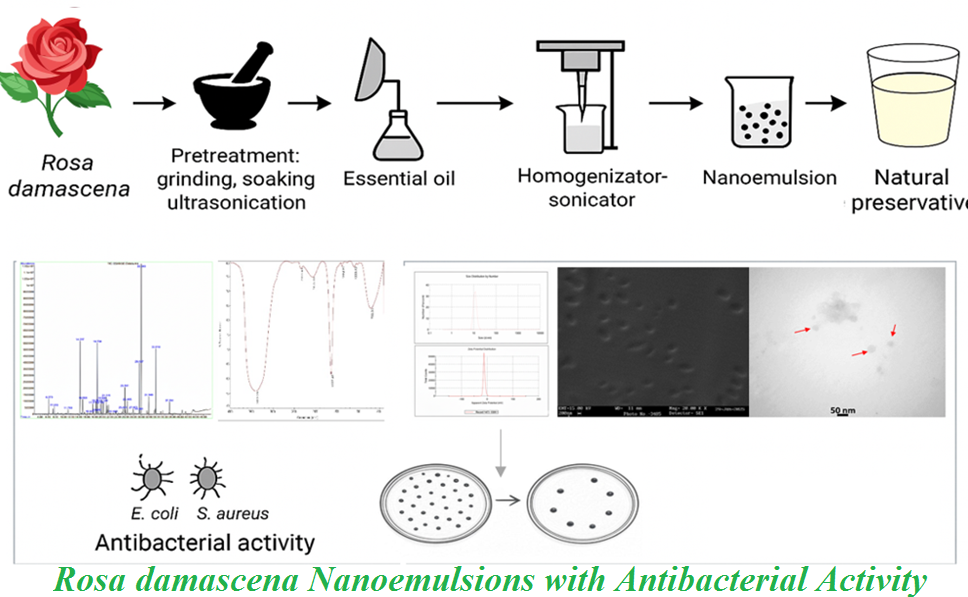
Background and Objective: The growing demand for natural preservatives in the food industry has driven research into plant-derived essential oils. This study focused on optimizing the extraction of essential oil from Damask rose (Rosa damascena Mill.) and developing a stable oil-in-water nanoemulsion for potential food applications.
Material and Methods: Essential oil was extracted from dried rose buds, with pretreatment methods including grinding, soaking, and ultrasonication evaluated to maximize yield. The optimal method involved using crushed, pre-soaked buds, which significantly improved extraction efficiency. The chemical profile of the essential oil was analyzed by Gas Chromatography-Mass Spectrometry (GC-MS), revealing a complex mixture of bioactive compounds, with heneicosane, citronellol, and other alkanes as major constituents. An oil-in-water nanoemulsion was then formulated using the extracted oil, deionized water, and Tween 80 as a surfactant, prepared via a high-energy ultrasonic homogenization method. The nanoemulsion was characterized using Dynamic Light Scattering (DLS), Zeta Potential analysis, SEM, TEM and Fourier-Transform Infrared Spectroscopy (FTIR).
Results and Conclusion: Characterization by DLS(11.49nm) revealed a highly polydisperse nanoemulsion (PDI = 0.724) with an intensity-weighted average diameter (Z-Average) of 505.6 nm and a zeta potential of -5.10 mV, indicating the presence of small nanoparticles alongside larger aggregates. FTIR analysis confirmed the successful encapsulation of the essential oil within the nanoemulsion structure. Furthermore, the essential oil demonstrated antimicrobial activity against E. coli and S. aureus, with a Minimum Inhibitory Concentration (MIC) of 15000 ppm. These findings suggest that R. damascena nanoemulsion is a promising natural antimicrobial agent for food preservation.
Keywords: Essential Oil, Natural Preservative, Nanoemulsion, Rosa damascene, Steam distillation
- Introduction
Rosa damascena Mill, commonly known as the Damask rose, is a fragrant species of the Rosaceae family, renowned for its use in the perfume, cosmetic, and food industries. The essential oil extracted from its petals is one of the most valuable essential oils in the global market due to its complex aroma and therapeutic properties. Iran is a leading producer of Damask rose, with a long history of cultivating this plant for rose water and essential oil production. The oil is rich in a variety of phytochemicals, including citronellol, geraniol, nonadecane, and heneicosane, which contribute to its characteristic fragrance and biological activities [1, 2]. These activities include antioxidant, antimicrobial, and anti-inflammatory effects, making it a valuable natural ingredient [3, 4].
Despite their benefits, the direct application of essential oils in food systems is often limited by their poor water solubility, high volatility, and susceptibility to degradation from environmental factors like light, oxygen, and heat. These limitations can reduce their efficacy and impact the sensory properties of the final product [5]. To overcome these challenges, nanoencapsulation technologies have emerged as a promising approach. Nanoemulsions, which are colloidal dispersions of oil droplets in an aqueous phase with droplet sizes typically below 200 nm, offer a solution by enhancing the stability, solubility, and bioavailability of lipophilic compounds [6].
Nanoemulsions provide several advantages for food applications, including optical transparency, high surface area for improved activity, and protection of the encapsulated active compounds from degradation. High-energy methods, such as ultrasonic homogenization, are widely used to produce nanoemulsions by applying intense disruptive forces to break down large oil droplets into nanoscale particles. This technique is efficient, scalable, and suitable for food-grade formulations [7-10].
A significant challenge in the production of high-quality nanoemulsions from plant materials is the efficiency and quality of the initial extraction process. Conventional methods like hydrodistillation, while effective, can be time-consuming and may lead to thermal degradation of sensitive bioactive compounds [11, 12]. Recognizing these limitations, there is a growing need for innovative extraction and formulation systems that can streamline production, improve yield, and better preserve the integrity of the essential oil. In response, our research team has developed a novel, integrated apparatus that combines a homogenization unit and a sonication unit, allowing for the continuous and repeated processing of an oil and aqueous phase dispersion. This patented system is designed not only to produce nanoemulsions with superior stability and smaller particle size but also to serve as a more efficient method for processing plant extracts, as demonstrated by its application in this study [9]. By circulating the mixture between the two units, our method ensures uniform energy distribution and minimizes processing time, overcoming key drawbacks of traditional batch methods. The potential application of R. damascena essential oil (RDEO) as a natural preservative in food products like dairy desserts is of great interest [13]. Although hydrodistillation and other conventional methods are commonly used to extract R. damascena essential oil, these techniques are often time-consuming and can lead to thermal degradation of heat-sensitive bioactive compounds. Subsequently, formulating the extracted oil into a nanoemulsion is treated as an entirely separate process [9]. This disconnection between extraction and nano-formulation represents a significant gap in the current research. There is a clear need for an innovative, integrated system that can streamline the entire workflow from plant material to a stable final product. An integrated approach could significantly reduce processing time, improve extraction yield, and better preserve the integrity of the essential oil, overcoming key drawbacks of traditional multi-step, batch-based methods.
Therefore, this study was designed not only to optimize the extraction of essential oil from R. damascena but also to address this technological gap by utilizing a novel, patented apparatus that combines homogenization and sonication in a continuous process. The objective was to efficiently formulate and characterize an oil-in-water nanoemulsion and evaluate its physicochemical and antimicrobial properties to assess its potential as a novel natural preservative for food systems. The potential application of R. damascena essential oil (RDEO) as a natural preservative is of great interest, especially in meeting consumer demand for "clean label" alternatives to synthetic additives. Therefore, the primary novelty of this work lies in addressing the limitations of conventional extraction and formulation through the application of a newly developed, patented integrated apparatus that combines homogenization and sonication in a continuous, recirculating system. This study is the first to utilize this streamlined technology for R. damascena to efficiently produce a stable oil-in-water nanoemulsion. The objective is to thoroughly characterize the physicochemical properties (particle size, stability, morphology) and antimicrobial activity of the resulting nanoemulsion to validate its potential as a novel and effective natural preservative for food systems.
- Materials and Methods
2.1 Plant Material and Chemicals
Dried Damask rose (Rosa damascena Mill.) buds were commercially sourced from a reputable local supplier (Tavazo, Iran). The Rosa damascena petals were sourced from the Layzangan valley in the Darab region of Fars province, a region renowned for its high-quality roses. The plant specimens were authenticated at the Herbarium of the Faculty of Pharmacy, Tehran University of Medical Sciences, Tehran. The quality of the buds was visually inspected to ensure they were free from foreign materials and contamination. Tween 80, used as a non-ionic surfactant, was purchased from Neutron (Iran). All other chemicals and solvents were of analytical grade.
2.2 Preparation of R. damascena Nanoemulsion Using an Integrated Apparatus
First, the essential oil of rosehip, which had previously been pretreated by soaking and ultrasonication, was prepared using steam distillation (U.S. Patent Application No. US 2024/0174419 A1) [9]. The system, depicted in the patent, consists of a homogenization unit fluidly connected to a sonication unit, allowing for continuous recirculation of the dispersion between the two tanks via a pump.
The procedure was conducted based on the methods detailed in the patent. To create a coarse pre-emulsion, 150 mL of the extracted R. damascena essential oil was added to 14.85 L of deionized water in a bioreactor under specific conditions (500 rpm, 60 psi, 45-50°C). This coarse mixture was then transferred to the homogenization tank of the integrated apparatus. The nanoemulsification process was initiated by activating the circulation pump to pass the liquid between the homogenization and sonication tanks. The system parameters were set as follows: the homogenizer's power was configured to 170 W at 2000 rpm, while the ultrasonic sonicator's power was also set to 170 W, operating in pulse mode with an on-time of 5 seconds and an off-time of 2 seconds. After 5 minutes of continuous circulation and processing, Tween 80 was added dropwise into the homogenization tank to act as a surfactant. The entire process was continued for a total processing time of 10 minutes to ensure the formation of a stable and uniform nanoemulsion with a small droplet size. The final product was then collected for characterization.
2.3 Preparation of R. damascena Nanoemulsion
An oil-in-water (O/W) nanoemulsion was prepared using a high-energy ultrasonic method. The oil phase consisted of the extracted RDEO. The aqueous phase was the rose hydrosol (rose water) collected during the distillation process. For the formulation, 1 mL of the essential oil was mixed with 0.5 mL of Tween 80 (surfactant). This mixture was then added to 20 mL of the rose hydrosol. The coarse emulsion was homogenized using an ultrasonic bath (Elmasonic P, 5L) operating at a frequency of 37 kHz. The process was carried out for 15 minutes in pulse mode at a controlled temperature of 45°C to prevent thermal degradation of the oil components. The resulting nanoemulsion appeared as a stable, milky liquid and was stored at 4°C.
2.4 Characterization of Essential Oil and Nanoemulsion
2.4.1 Gas Chromatography-Mass Spectrometry (GC-MS)
The chemical composition of the essential oil was determined using a Shimadzu TQ-8050 GC-MS system (Shimadzu, Japan). The device is a triple quadrupole GC-MS with femtogram-level detection sensitivity, offering up to 800 MRM transitions/second and advanced noise reduction for ultra-trace analysis. It features multiple ion sources (EI, BEIS, NCI), a contamination-resistant ion source, and a long-life detector with a robust vacuum system for stable, high-sensitivity performance.
The sample was diluted and injected into the GC system equipped with a capillary column (a 30 m × 0.25 mm ID×0.25 µm film thickness HP-5ms column, featuring 5% phenyl methylpolysiloxane stationary phase). The oven temperature was programmed to separate the volatile compounds. Mass spectra were obtained in electron ionization (EI) mode, and compounds were identified by comparing their mass spectra and retention indices with data from the NIST library.
2.4.2 Fourier-Transform Infrared Spectroscopy (FTIR)
The functional groups of the essential oil and the structural integrity of the nanoemulsion were analyzed using a PerkinElmer Spectrum Two FTIR spectrometer. A small amount of the liquid sample (essential oil or nanoemulsion) was placed on a KBr pellet. The spectra were recorded in the range of 4000–400 cm⁻¹ with a resolution of 4 cm⁻¹. The spectra of the essential oil and the nanoemulsion were compared to identify any shifts or changes in characteristic peaks, which would indicate successful encapsulation and interactions between the components [7].
2.4.3 Dynamic Light Scattering (DLS) and Zeta Potential
The mean particle size (hydrodynamic diameter), polydispersity index (PDI), and zeta potential of the nanoemulsion were measured using a Malvern Zetasizer Nano ZS instrument (Malvern Instruments, UK). The nanoemulsion was diluted with deionized water to avoid multiple scattering effects before analysis. DLS measures the fluctuations in scattered light intensity due to the Brownian motion of particles to determine their size distribution. Zeta potential, a measure of the magnitude of the electrostatic charge at the droplet surface, was determined to predict the long-term stability of the colloidal system. All measurements were performed in triplicate at 25°C [7].
2.4.4 Scanning Electron Microscopy (SEM)
The surface morphology and structure of the nanoemulsion were analyzed using a Scanning Electron Microscope (TESCAN VEGA3, USA). To prepare the samples, the nanoemulsion was first applied to an aluminum stub and allowed to air-dry. The stub was then coated with a thin layer of gold using a sputter coater to make the sample conductive. The imaging was performed at an accelerating voltage of 15.0 kV, with a working distance of 11-14 mm. Micrographs were captured at various magnifications (1.00 Kx, 3.00 Kx, 10.00 Kx, and 20.00 Kx) to observe the particle distribution and surface features [7].
2.4.5 Transmission Electron Microscopy (TEM)
The internal structure, size, and shape of the nanoemulsion droplets were visualized using a Transmission Electron Microscope (FEI Tecnai G20, USA). For sample preparation, a drop of the diluted nanoemulsion was placed onto a 200-mesh copper grid coated with a carbon film. The excess liquid was wicked away using filter paper, and the sample was negatively stained with a drop of 2% phosphotungstic acid. After air-drying, the grid was observed under the TEM at an accelerating voltage of 200 kV. This analysis provided direct visualization of the core-shell structure and confirmed the nanoscale dimensions of the droplets [7].
2.5 Antimicrobial Activity Assessment
The antimicrobial activity of the RDEO was evaluated against Gram-negative Escherichia coli and Gram-positive Staphylococcus aureus. The Minimum Inhibitory Concentration (MIC) and Minimum Bactericidal Concentration (MBC) were determined using a broth microdilution method. Serial dilutions of the essential oil were prepared in a 96-well microplate containing nutrient broth (HiMedia, India). Each well was then inoculated with a standardized bacterial suspension (~106 CFU.mL-1). The plates were incubated at 37°C for 24 hours. The MIC was defined as the lowest concentration of the essential oil that resulted in no visible microbial growth. To determine the MBC, aliquots from the wells with no visible growth were subcultured onto nutrient agar plates. The MBC was the lowest concentration that resulted in a 99.9% reduction in bacterial viability after incubation [10].
2.6 Statistical Analysis
All experiments were performed in triplicate (n=3) to ensure the reliability of the results.
- Results and Discussion
3.1 Performance of the Novel Nanoemulsion Apparatus
The integrated homogenization-sonication apparatus successfully produced a stable Rosa damascena oil-in-water nanoemulsion. A key advantage of this novel method was its efficiency; a stable nanoemulsion with fine droplets was prepared in approximately 10 to 15 minutes of processing time. The continuous circulation between the homogenization and sonication tanks ensured that the entire volume of the liquid was uniformly subjected to high-shear forces and ultrasonic waves, leading to the rapid formation of a homogenous product. Stability tests, including centrifugation, confirmed that the nanoemulsion produced by this method remained stable without phase separation.
A key innovation of this study is the application of a newly developed and patented integrated apparatus for the direct production of the Rosa damascena nanoemulsion. Unlike conventional multi-step processes that separate extraction and emulsification, our system combines homogenization and sonication in a continuous, recirculating loop. This design addresses several critical limitations of traditional methods. By repeatedly passing the dispersion between the two units, we achieve a more uniform energy distribution throughout the fluid, which is crucial for producing monodisperse nanoparticles and preventing over-processing in any single zone. As demonstrated in the results, this method significantly reduces the processing time to as little as 10-15 minutes while yielding a nanoemulsion with excellent stability. This efficiency represents a substantial improvement over standard batch sonication or homogenization techniques, which can be less scalable and often result in less stable emulsions. The ability to produce a stable nanoemulsion so rapidly highlights the apparatus's potential for industrial applications where both product quality and throughput are paramount [9, 15, 16].
The integrated homogenization–sonication method used in this work shows a marked improvement in both extraction efficiency and processing time compared with several well-documented R. damascena extraction studies. For example, Kara et al (2017) reported yields of ≈0.042–0.045% (w/w) from fresh rose petals using conventional hydrodistillation over ~1.5 hours, whether using distilled water or seawater as the distillation medium [17]. In another study of 35 Damask rose landraces across multiple locations, hydrodistillation for 1.5 hours yielded essential oil percentages typically in the range 0.030–0.040% under standard field-conditions [18]. By contrast, this patented continuous homogenization–sonication method achieves an oil recovery of ≈0.10% (≈eight-fold higher than ~0.02%) in only 10-15 minutes, demonstrating a substantially higher extraction coefficient and faster processing. The superiority of our method is also reinforced when comparing droplet size and stability of the produced nanoemulsions versus values from the literature. Many published essential oil nanoemulsions (for clove, lemon myrtle, etc.) report droplet sizes in the 90-200 nm range under optimized surfactant and processing conditions; for example, in clove oil nanoemulsions, one study achieved ~93.2 ± 3.9 nm using ~1.0% surfactant and ~2.5% oil phase [19]. Other work on lemon myrtle essential oil achieved minimum droplet sizes of ≈16 nm using ultrasonication under low energy methods, though often with high surfactant or co-surfactant burdens [20]. While TEM imaging confirmed the presence of numerous small droplets in the 10-50 nm range, corroborating the DLS number-weighted peak of 11.49 nm, the overall system had an intensity-weighted average size (Z-Average) of 505.6 nm, confirming the nanoemulsion is highly polydisperse. This is in line with previous reports [21-23]. Together, both the significantly higher oil yield in shorter time and the much smaller droplet size give our method a superior extraction coefficient in both quantity and quality compared with conventional hydrodistillation and commonly used nanoemulsification processes.
3.2 Chemical Composition of the Essential Oil
The chemical composition of the RDEO was analyzed by GC-MS. The analysis identified several major compounds responsible for its aroma and bioactivity. The results are summarized in Table 1. The most abundant compounds were long-chain alkanes, specifically a compound identified as a mix including Hexacosane/Tridecane/Eicosane (27.81%) and Heneicosane (20.74% and 6.37% at different retention times). Citronellol, a key monoterpene alcohol known for its rosy scent, was also a major component at 10.02%. Other notable compounds included Tetradecane (8.70%), Geraniol (1.52%), and α-Pinene (1.39%). The GC chromatogram, presented in Figure 1, shows the distinct peaks corresponding to these compounds. The GC-MS analysis revealed a chemical profile rich in alkanes (heneicosane, hexacosane) and monoterpene alcohols (citronellol, geraniol). While citronellol and geraniol are well-known for contributing to the characteristic rose aroma and antimicrobial properties, the high concentration of long-chain hydrocarbons is also typical for solvent-free distilled rose oil and contributes to its semi-solid consistency at low temperatures [24-27]. This composition is consistent with the findings of Nunes and Miguel (2017), who reported that Damask rose essential oils are complex mixtures primarily composed of monoterpenes, phenylpropanoids, and long-chain hydrocarbons [28]. However, our findings contrast significantly with those of Charoimek et al. (2023), who identified phenylethyl alcohol (57-61%) as the dominant component in the essential oil from Damask rose varieties cultivated in Thailand [29, 30]. This notable difference underscores the principle, also highlighted by other studies that the chemical profile of RDEO is highly dependent on factors such as plant genotype, geographical origin, cultivation conditions, and the specific extraction method employed [28, 31].
3.3 Characterization of the Nanoemulsion
3.3.1 FTIR Analysis
FTIR spectroscopy was used to confirm the encapsulation of the essential oil. Figure 2 displays the FTIR spectra for the pure RDEO and the formulated nanoemulsion.
The spectrum of the pure essential oil showed characteristic peaks corresponding to its chemical composition. A broad band around 3435 cm⁻¹ was attributed to the O–H stretching of alcohol groups like citronellol and geraniol. Peaks at 2920 cm⁻¹ and 2851 cm⁻¹ were assigned to the C–H stretching of alkane chains (e.g., heneicosane). A sharp peak at 1637 cm⁻¹ indicated the presence of C=C stretching from aromatic or unsaturated components.
In the nanoemulsion spectrum (Figure 2), the characteristic peaks of the essential oil were retained, confirming its presence. However, notable changes were observed. The broad O–H stretching band shifted and intensified around 3403.39 cm⁻¹, which is indicative of increased hydrogen bonding between the oil's hydroxyl groups, the water from the aqueous phase, and the hydrophilic head of the Tween 80 surfactant. The C-H stretching peaks remained visible, confirming the presence of the oil's lipid-soluble core within the nano-droplets. These spectral changes confirm the successful formation of the nanoemulsion structure, where the essential oil is encapsulated by the surfactant in the aqueous medium.
The FTIR analysis supported the successful encapsulation, with shifts in the hydroxyl band indicating strong interactions between the essential oil, water, and surfactant, which is crucial for the formation of a stable nano-droplet structure. Research on different essential oil nanoemulsions also identified a broad O-H stretching band, which is characteristic of the phenols and alcohols present in the oil and their interaction with the surrounding matrix. The formation of these extensive hydrogen networks is crucial for stabilizing the oil droplets within the aqueous medium. Therefore, the spectral changes observed in our study align with established interpretations, providing strong evidence that the essential oil was successfully encapsulated within a stable nano-droplet structure [31, 28].
3.3.2 Particle Size and Zeta Potential
The physical characteristics of the nanoemulsion were determined by DLS and zeta potential analysis. The results are visualized in Figure 3. The DLS analysis revealed that the nanoemulsion consisted of nanoparticles with a primary mean diameter of 11.49 nm, which represented 100% of the number distribution peak. This very small particle size confirms the effectiveness of the ultrasonic homogenization process in creating a nano-scale dispersion. However, the Polydispersity Index (PDI) was 0.724, indicating a broad size distribution, and the Z-Average of 505.6 nm, suggesting the presence of some larger aggregates or a multimodal distribution not fully captured by the primary peak analysis.
The zeta potential of the nanoemulsion was measured to be -5.10 mV. This value indicates a net negative surface charge on the droplets, which provides some electrostatic repulsion to prevent aggregation.
The successful formulation of the nanoemulsion was a key objective of this study. The DLS results confirmed the production of very small nanoparticles (11.49 nm), which is highly desirable for food applications as it can lead to optical transparency and increased surface area, potentially enhancing the oil's bioactivity [33]. However, the high PDI value (0.724) and the large Z-average size (505.6 nm) indicate a polydisperse system, which could be a concern for long-term stability. This polydispersity might be due to the complex nature of the essential oil or the presence of minor aggregates. Further optimization of the surfactant concentration or homogenization parameters could improve the uniformity of the droplet size distribution [34-36].
The zeta potential of -5.10 mV suggests that the nanoemulsion has limited electrostatic stability. Typically, zeta potential values greater than 30 mV are required for excellent long-term stability against aggregation. The formulation of the essential oil into a nanoemulsion via ultrasonic homogenization proved highly effective. The DLS results confirmed the production of nanoparticles with an exceptionally small mean diameter of 11.49 nm. This particle size is considerably smaller than those reported in similar studies on essential oil nanoemulsions, such as the ~130 nm rosehip oil nanoemulsion developed by Zilles et al. (2023) [37] or the ~32 nm clove oil nanoemulsion prepared by Shehabeldine et al. (2023) [38]. The smaller particle size achieved in our study is highly advantageous for food applications, as it promotes optical clarity and increases the surface-to-volume ratio, which can enhance the bioactivity of the encapsulated oil. However, the high PDI of 0.724 and the low zeta potential of -5.10 mV present potential concerns for long-term stability. A low zeta potential is often expected when using non-ionic surfactants like Tween 80, which provide stability through steric hindrance rather than electrostatic repulsion. While the system appeared stable in the short term, these values suggest a risk of droplet aggregation or Ostwald ripening over extended storage, indicating that further optimization of surfactant concentration or processing parameters may be necessary to enhance shelf life, a common challenge in nanoemulsion formulation.
3.3.3 Morphological and Structural Analysis (SEM and TEM)
SEM and TEM analyses were performed to visually characterize the morphology and structure of the formulated nanoemulsion. The SEM micrographs, shown in Figure 4, provide insights into the surface topography of the dried nanoemulsion. At lower magnifications (1.00 Kx and 3.19 Kx), the images reveal a relatively smooth, continuous film with embedded particle-like structures distributed across the surface. This suggests that as the aqueous phase evaporated, the nanoparticles coalesced to form a matrix. At higher magnifications (10.00 Kx and 20.00 Kx), individual spherical and slightly ovoid nanoparticles become visible, appearing as distinct, raised bumps on the surface. The particles appear to be in the sub-100 nm range, although some aggregation is evident, which is common during the drying process required for SEM preparation. The overall structure appears dense, confirming the successful formation of nanoparticles.
Furthermore, the SEM analysis provides valuable insight into the nanoemulsion's behavior upon drying, and the observed film formation is a commonly reported artifact of SEM sample preparation for liquid nanoemulsions. Studies on lemon and Algerian Origanum essential oil nanoemulsions have also reported that SEM imaging of dried samples reveals nanoparticle aggregation and the formation of a continuous matrix, similar to our findings. This occurs because as the water evaporates, the stabilizing forces are disrupted, causing the nanoparticles to coalesce. Therefore, while SEM is useful for visualizing surface topography, the TEM results provide a more accurate representation of the nanoemulsion's morphology in its dispersed, aqueous state. The clear contrast between the aggregated structures in SEM and the well-dispersed individual droplet in TEM underscores the importance of employing complementary imaging techniques for a comprehensive characterization of nanomaterials [7, 29].
The TEM images, presented in Figure 5, offer a clearer visualization of the individual nano-droplets in their near-native state. The micrographs confirm the presence of discrete, spherical nanoparticles that are well-dispersed. The droplet size, as observed in the images, is consistently below 50 nm, with many particles appearing to be in the 10-30 nm range. This observation strongly corroborates the primary peak of 11.49 nm identified by DLS analysis. The dark core and lighter surrounding halo visible in some particles are characteristic of a core-shell structure, where the essential oil (core) is encapsulated by the surfactant (shell). The particles do not show significant signs of coalescence, indicating the effectiveness of the emulsifier in stabilizing the droplets. The morphological characteristics of the nanoemulsion, as revealed by TEM, align well with observations from similar studies for example by Hasanian et al, confirming the formation of a well-defined nanostructure. The TEM micrographs clearly showed discrete, spherical nanoparticles with a distinct core-shell structure, which is the desired outcome for successful encapsulation. This morphology is consistent with research on nanoemulsions of thyme and oregano essential oils, where TEM analysis also revealed spherical droplets with the oil core encapsulated by a surfactant shell. The particle sizes observed in our study (10–30 nm) are notably small, corroborating the DLS number distribution data and suggesting a highly efficient emulsification process. This contrasts with some other studies where mean diameters were larger, further highlighting the effectiveness of the novel integrated apparatus used here. The excellent dispersion of particles seen in TEM confirms the stability provided by the surfactant layer, preventing immediate coalescence, which is a critical attribute for the formulation's shelf life and efficacy [7-29].
3.4 Antimicrobial Activity of the Essential Oil
The antimicrobial properties of the RDEO were tested against E. coli and S. aureus. The oil exhibited inhibitory and bactericidal effects against both strains, as shown in Table 2. The MIC was found to be 15000 ppm for both bacteria. The MBC was 30000 ppm for E. coli, indicating a complete killing effect at this concentration. For S. aureus, the oil reduced bacterial growth at 30000 ppm but did not achieve a full bactericidal effect under the test conditions.
The antimicrobial activity of the RDEO was confirmed against both S. aureus and E. coli with an MIC of 15000 ppm (1.5%). This result supports the traditional use of rose extracts as antimicrobial agents, as documented in various studies [31, 35, 39]. Interestingly, our findings are in direct contrast to those of Charoimek et al. (2023), who reported no antimicrobial activity in their rose by-product fractions against the same bacterial species [30]. This discrepancy is almost certainly due to the different chemical compositions; our oil's activity can be attributed to its content of citronellol and other antimicrobial terpenes, whereas the phenylethyl alcohol-dominant oil in the other study lacked these potent compounds. The mechanism of action for such essential oils likely involves the disruption of the bacterial cell membrane, leading to increased permeability and leakage of vital intracellular components, a process that is enhanced when the oil is delivered via a nanoemulsion carrier system [38]. The demonstrated preservative in this study, (based on U.S. Patent Application No. US 2025/12365525B2) potential aligns well with the findings of Akhavan & Mehrizi (2016), who showed that a Damask rose extract could effectively extend the shelf life of Sohan, an Iranian confection, by inhibiting both microbial growth and lipid oxidation [40, 41]. This parallel strongly supports the hypothesis that the R. damascena nanoemulsion developed in our study could serve as a valuable multifunctional natural additive in food systems like ice cream, contributing flavor, aroma, and preservative action.
- Conclusion
This study successfully optimized the extraction of essential oil from Rosa damascena and formulated a nanoemulsion with potential applications in food preservation. The choice of pre-soaking and crushing dried buds as a pretreatment step was critical for maximizing the extraction yield. This method likely enhances the hydrodistillation process by increasing the surface area and softening the plant tissue, thereby improving the diffusion of volatile oils into the steam, a finding consistent with other studies on essential oil extraction.
- Acknowledgements
This research was partially supported technically by Islamic Azad university.
- Declaration of competing interest
The authors report no conflicts of interest.
- Authors’ Contributions
Designate each author’s contribution using their initials. “Conceptualization, F.S and H.A; methodology, software, validation, and formal analysis, F.S.; investigation, M.M.; resources, A.A.; data curation, H.A; writing—original draft preparation, A.M.N; writing—review and editing, visualization, supervision, project administration, H.A.; funding acquisition, A.A”.
- Using Artificial Intelligent Chatbots
The authors declare no artificial intelligent chatbot use.
- Ethical Consideration
This study did not involve human participants or animals. The research complied with institutional guidelines for laboratory safety and good scientific practice.
- Essential Oil
- Natural Preservative
- Nanoemulsion
- Rosa damascene
- Steam distillation
Comment citer
Références
1. Venkatesha K, Gupta A, Rai AN, Jambhulkar SJ, Bisht R, Padalia RC. Recent developments, challenges, and opportunities in genetic improvement of essential oil-bearing rose (Rosa damascena): A review. Ind Crops Prod. 2022; 184: 114984. https://doi.org/10.1016/j.indcrop.2022.114984
2. Gerasimova T, Gateva S, Jovtchev G, Angelova T, Topashka-Ancheva M, Dobreva A, et al. Rosa damascena Mill essential oil: Analysis of in vitro and in vivo genotoxic and cytotoxic potentials by employing three cytogenetic endpoints. Molecules. 2024; 30(1): 78. https://doi.org/10.3390/molecules29010078
3. Yaghoobi M, Farimani MM, Sadeghi Z, Asghari S, Rezadoost H. Chemical analysis of Iranian Rosa damascena essential oil, concrete, and absolute oil under different bio-climatic conditions. Ind Crops Prod. 2022; 187: 115266. https://doi.org/10.1016/j.indcrop.2022.115266
4. Özsoy E, Barak TH, Yörük E, Servi H, Yli-Mattila T. Chemical composition, antifungal activity, and plant-protective potential of Rosa damascena Mill. Essential Oil against fusarium graminearum. Pathogens. 2025; 14(4): 383. https://doi.org/10.3390/pathogens14040383
5. Shams, N, Sahari M A. Nanoemulsions: Preparation, structure, functional properties and their antimicrobial effects. Appl Food Biotechnol. 2016; 3(3): 138-149. https://doi.org/10.22037/afb.v3i3.11773
6. Pandey VK, Srivastava S, Dash KK, Singh R, Dar AH, Singh T, et al. Bioactive properties of clove (Syzygium aromaticum) essential oil nanoemulsion: A comprehensive review. Heliyon. 2024; 10. https://doi.org/10.1016/j.heliyon.2023.e22437
7. Hasanin MS, Ayoob FA, Hashem AH, Emam M. Synthesis of chitosan based nanoemulsions and their characterization and antifungal activity toward fungi causing mucormycosis. Sci Rep. 2025; 15(1): 1-7. https://doi.org/10.1038/s41598-025-06577-7
8. Yousefi S, Rajaei P, Nateghi L, Rashidi L. Encapsulation of sesamol and retinol using alginate and chitosan-coated W/O/W multiple emulsions containing Tween 80 and Span 80. Int J Biol Macromol. 2023; 668: 131426. https://doi.org/10.1016/j.colsurfa.2023.131426
9. Anvar SA, Allahyaribeik S, Ataee M, Ahari H, Rahimian M, Golestan L, et al. Apparatus and method for producing nanoemulsions. US20240174419A1. 2025
10. Donsì F, Ferrari G. Essential oil nanoemulsions as antimicrobial agents in food. J Biotechnol. 2016; 233: 106-120. https://doi.org/10.1016/j.jbiotec.2016.07.005
11. Yousefi S, Nateghi L, Rashidi L. Improvement of margarine shelf-life using alginate-chitosan coated multiple W/O/W nanoemulsions containing sesamol and retinol. Food Chem. 2024; 445: 137776. https://doi.org/10.1016/j.foodchem.2024.137776
12. Niazi Tabar MTM, Nateghi L, Hashemi MRM. Encapsulation of walnut husk and pomegranate peel extracts by alginate and chitosan-coated nanoemulsions. Food Hydrocoll. 2023; 137: 108365. https://doi.org/10.1016/j.foodhyd.2022.108365
13. Androutsopoulou C, Christopoulou SD, Hahalis P, Kotsalou C, Lamari FN, Vantarakis A. Evaluation of essential oils and extracts of rose geranium and rose petals as natural preservatives in terms of toxicity, antimicrobial, and antiviral activity. Pathogens. 2021; 10(4): 494. https://doi.org/10.3390/pathogens10040494
14. Elyemni M, Louaste B, Nechad I, Elkamli T, Bouia A, Taleb M, et al. Extraction of essential oils of Rosmarinus officinalis L. by two different methods: Hydrodistillation and microwave assisted hydrodistillation. Sci World J. 2019; 2019(1): 3659432. https://doi.org/10.1155/2019/3659432
15. Hamed Ahari A, Beik S, Moradi S, Rahimian M. Formulation of Saffron and a Method of Preparation Thereof. US Patent. 2021. US17/086763).
16. Ahari H, Anvar A, Rahimian M, Beik SA, Moradi S. Water-in-oil nano-emulsion of saffron and a method of preparing thereof. 2021. US2021090303.
17. Kara N, Erbaş S, Baydar H. The effect of seawater used for hydrodistillation on essential oil yield and composition of oil-bearing Rose (Rosa damascena Mill.). Int J Second Metab. 2017; 4(3, Special Issue 2):423-428. https://doi.org/10.21448/ijsm.375120
18. Yousefi B, Aghdaei S. Essential oil yield and stability of various Rosa damascena Mill Landraces under different ecological conditions. Horticult Int J. 2018; 2(5):271-275. https://doi.org/10.15406/hij.2018.02.00063
19. Haro-González JF, Schlienger de Alba BN, Martínez-Velázquez M, Castillo-Herrera GA, Espinosa-Andrews H. Optimization of clove oil nanoemulsions: Evaluation of antioxidant, antimicrobial, and anticancer properties. Colloids Interfaces. 2023; 7(4): 64. https://doi.org/10.3390/colloids7040064
20. Liao W, Badri W, Dumas E, Ghnimi S, Elaissari A, Saurel R, et al. Nanoencapsulation of essential oils as natural food antimicrobial agents: An overview. Appl Sci. 2021; 11(13): 5778. https://doi.org/10.3390/app11135778
21. Benjemaa M, Neves MA, Falleh H, Isoda H, Ksouri R, Nakajima M. Nanoencapsulation of Thymus capitatus essential oil: Formulation process, physical stability characterization and antibacterial efficiency monitoring. Ind Crops and Prod. 2018; 113: 414-421. https://doi.org/10.1016/j.indcrop.2018.01.042
22. Hasani S, Ojagh SM, Ghorbani M. Nanoencapsulation of lemon essential oil in Chitosan-Hicap system. Part 1: Study on its physical and structural characteristics. Int J Biol Macromol. 2018; 115: 143-151. https://doi.org/10.1016/j.ijbiomac.2018.04.037
23. Ali H, Al-Khalifa AR, Aouf A, Boukhebti H, Farouk A. Effect of nanoencapsulation on volatile constituents, and antioxidant and anticancer activities of Algerian Origanum glandulosum Desf. essential oil. Sci Rep. 2020; 10(1): 2812. https://doi.org/10.1038/s41598-020-59686-w
24. Shohayeb M, Abdel-Hameed E-SS, Bazaid SA, Maghrabi I. Antibacterial and antifungal activity of Rosa damascena MILL. essential oil, different extracts of rose petals. Glob J Pharmacol. 2014; 8(1): 1-7. https://doi.org/10.5829/idosi.gjp.2014.8.1.81151
25. Halawani EM. Antimicrobial activity of Rosa damascena petals extracts and chemical composition by gas chromatography-mass spectrometry (GC/MS) analysis. Afr J Microbiol Res. 2014; 8(24): 2359-2367. https://doi.org/10.5897/AJMR2014.6829
26. Achuthan C, Babu B, Padikkala J. Antioxidant and hepatoprotective effects of Rosa damascena. Pharm Biol. 2003; 41(5): 357-361. https://doi.org/10.1076/phbi.41.5.357.15945
27. Odyntsova V, Denysenko O, Shkopinska T, Mozul V, Polishchuk N, Aksonova I, et al. Chemical composition and antimicrobial activity of Rosa Damascena mill.(variety rainbow) from clonal micropropagation. 2023.
28. Nunes H, Miguel MG. Rosa damascena essential oils: A brief review about chemical composition and biological properties. Trends in phytochemical research. 2017; 1(3): 111-128. https://doi.org/10.30485/tpr.2017.30673
29. Zakeri Z, Allafchian A, Vahabi MR, Jalali SA. Synthesis and characterization of antibacterial silver nanoparticles using essential oils of crown imperial leaves, bulbs and petals. Micro Nano Lett. 2021; 16(11): 533-539. https://doi.org/10.3390/plants12193428
30. Charoimek N, Sunanta P, Tangpao T, Suksathan R, Chanmahasathien W, Sirilun S, et al. Pharmaceutical potential evaluation of Damask rose by-products from volatile oil extraction. Plants. 2024; 13(12): 1605. https://doi.org/10.3390/plants13121605
31. Boutagayout A, Lahlali R, El Baghazaoui R, Bouiamrine EH, Radah A, Benabderrahmane A, et al. GC-MS, FTIR analysis and effects of thyme (Thymbra capitata L. Cav) and rosemary (Rosmarinus officinalis L.) essential oils on the growth and pathogenicity of Botrytis fabae. Int J Environ Stud. 2025; 82(1): 501-522. https://doi.org/10.1080/00207233.2024.2405448
32. Afrasiabi H, Jamali B, Ganje M. The evaluation of the impacts of Rosa damascena extract on the physiochemical, functional and sensory properties of soy milk-based yogurt. Life Sci Stud J. 2025; 3(2): 45-53. https://doi.org/10.22034/lssj.2025.2.45
33. Monfared BP, Ahari H, Moradi S, Sahraei F. Investigation of damask rose extract nanoemulsions as a shelf-life extender for refrigerated beluga sturgeon fillets. J Food Meas Charact. 2024; 18(8): 6433-6450. https://doi.org/10.1007/s11694-024-03198-0
34. Salvia-Trujillo L, Rojas-Graü MA, Soliva-Fortuny R, Martín-Belloso O. Impact of microfluidization or ultrasound processing on the antimicrobial activity against Escherichia coli of lemongrass oil-loaded nanoemulsions. Food Control. 2014; 37: 292-7. https://doi.org/10.1016/j.foodcont.2013.09.015
35. Verešová A, Vukic MD, Vukovic NL, Terentjeva M, Ban Z, Li L, et al. Chemical composition, biological activity, and application of Rosa damascena essential oil as an antimicrobial agent in minimally processed eggplant inoculated with salmonella enterica. Foods. 2024; 13(22): 3579. https://doi.org/10.3390/foods13223579
36. Tavakoli M, Barzegar M, Khorasany S. Encapsulation of Rosa damascena Mill. essential oil in nanoliposomes: Physicochemical and antioxidant activity features. J Agric Sci Technol. 2023; 25(6): 1371-1385. https://doi.org/10.22067/jast.2023.62619
37. Zilles JC, Duarte LP, Ruaro TC, Zimmer AR, Kulkamp-Guerreiro IC, Contri RV. Nanoemulsion containing kojic dipalmitate and rosehip oil: A promising formulation to treat melasma. Pharmaceutics. 2023; 15(2): 468. https://doi.org/10.3390/pharmaceutics15020468
38. Shehabeldine AM, Doghish AS, El-Dakroury WA, Hassanin MM, Al-Askar AA, AbdElgawad H, et al. Antimicrobial, antibiofilm, and anticancer activities of syzygium aromaticum essential oil nanoemulsion. Molecules. 2023; 28(15): 5812. https://doi.org/10.3390/molecules28155812
39. Trendafilova A, Staleva P, Petkova Z, Ivanova V, Evstatieva Y, Nikolova D, et al. Phytochemical profile, antioxidant potential, antimicrobial activity, and cytotoxicity of dry extract from Rosa damascena Mill. Molecules. 2023; 28(22): 7666. https://doi.org/10.3390/molecules28227666
40. Akhavan H, Mehrizi RZ. Effects of Damask Rose (Rosa damascena Mill.) extract on chemical, microbial, and sensory properties of Sohan (an Iranian Confection) during storage. J Food Qual Hazards Control. 2016; 3. https://doi.org/10.18869/acadpub.jfqhc.3.3.97
41. Anvar SA, Allahyaribeik S, Ataee M, Ahari H, Rahimian M, Golestan L, Sahraei F, Moradi S. Apparatus and method for producing nanoemulsions. US Patent. 2025; US 12,365,525 B2. Available from: https://www.freepatentsonline.com/12365525.pdf
- Résumé ##plugins.themes.ojsPlusA.frontend.article.viewed##: 383 ##plugins.themes.ojsPlusA.frontend.article.times##
- pdf (English) ##plugins.themes.ojsPlusA.frontend.article.downloaded##: 124 ##plugins.themes.ojsPlusA.frontend.article.times##