
Physicochemical, Rheological and Sensorial Changes of Lactobacillus bulgaricus fermented rice-base product: Influence of Processing Parameters
Applied Food Biotechnology ,
Vol. 12 Núm. 1 (2025),
4 dey 2025
,
Página 1-13 (e23)
https://doi.org/10.22037/afb.v12i1.49480
Resumen
Background and Objective: The global demand for plant-based dairy alternatives is steadily increasing. However, relatively little is known about the fermentation processes of plant-based beverages. The main objective of this study was to investigate the changes in chemical composition, as well as structural, rheological, and organoleptic properties of rice-based beverages, depending on the initial rice-to-water ratio and fermentation time.
Material and Methods: Hydromodules with rice-to-water ratios of 1:2 and 1:3 were prepared. Each hydromodule was subjected to enzymatic hydrolysis, followed by fermentation for 8 and 24 hours. The samples were evaluated for physicochemical, rheological, and sensory characteristics. Data analysis and correlation studies were performed using GraphPad Prism and Origin8 software at a significance level of p < 0.05.
Results and Conclusion: Fermented samples showed a decrease in pH (by up to 3.5 units) and an increase in titratable acidity (from baseline to 34.2°T and 90.1°T after 8 and 24 hours of fermentation, respectively), which indicates successful acidification due to microbial activity. Fermentation for 8 hours at a 1:2 rice-to-water ratio improved water-holding capacity (98%), as well as textural properties such as cohesiveness (89.2%) and gumminess (17.4%). These results suggest that combining enzymatic pre-hydrolysis with fermentation using L. bulgaricus can significantly enhance the technological and functional properties of rice-based beverages, offering a promising approach for developing high-quality fermented plant-based products.
Keywords: Fermentation, Plant Beverages, Sensory Evaluation, TPA, Viscosity
- Introduction
In recent years, people have been paying increasing attention to their health, which is reflected in their dietary choices. There has been a growing interest in foods with beneficial health properties. Among these, plant-based beverages that resemble cow’s milk in appearance and texture have become especially popular. These products are commonly referred to as plant-based beverages.
Plant-based beverages are preferred by consumers who follow a healthy diet, adhere to a vegan lifestyle, care about animal welfare, or simply wish to diversify their food intake. They also serve as a suitable alternative for individuals with lactose intolerance or milk protein allergies, who may have difficulty digesting or absorbing certain nutrients – such as lactose and specific proteins – found in animal milk [1].
These beverages are not only dairy alternatives but also sources of essential nutrients and various biologically active compounds that have been shown to promote human health [2,3].
Soy milk, being of vegetable origin and produced industrially, is one of the most common substitutes for animal milk. Its popularity is particularly strong in many Asian countries, where soybeans have long been part of traditional diets and are used in foods such as tofu and tempeh.
Research into the production of plant-based milks from alternative raw materials is currently expanding. Notable examples include cereals, nuts (such as almonds, cashews, and tiger nuts), legumes (e.g., peas, chickpeas, and lupin), and pseudocereals (e.g., chia, flaxseed, and quinoa) [4–11].
Among these raw materials, rice stands out as one of the most accessible and widely available sources for plant-based beverages production.
Rice (Oryza spp.) is one of the oldest cereal crops cultivated by humans and is widely consumed across the globe. Asia remains the primary region for rice cultivation, although it is also grown in Africa, the Americas, Europe, and Russia. Due to the presence of biologically active compounds rice exhibits several beneficial properties. These components contribute to anti-inflammatory and antioxidant effects, support the normalization of hematopoietic processes, and improve metabolic functions [4,12,13].
Rice and its derivatives are highly valued in nutrition due to their complex polysaccharides, which effectively satisfy hunger and promote prolonged satiety, while their hypoallergenic properties – stemming from the absence of gluten and lactose – make them an ideal dietary choice for individuals suffering from food allergies or intolerances.
Most cereals are traditionally processed into food and beverages through enzymatic conversion (e.g., starch, molasses, malt) or microbial fermentation (e.g., bread, beer, soy sauce, vinegar). These processes significantly alter the nutritional and functional properties of the raw materials [5,14–16].
Fermentation, in particular, is a cost-effective and energy-efficient method that enhances the digestibility of proteins and dietary fiber, increases the bioavailability of micronutrients, and reduces anti-nutritional factors. Furthermore, fermentation enriches the final product with beneficial metabolites – such as vitamins, amino acids, and others – and introduces live microorganisms, including probiotics. It also improves food safety by reducing levels of toxic compounds like mycotoxins and by producing antimicrobial substances such as lactic acid and bacteriocins [17]. In addition, fermentation enhances sensory qualities by diversifying flavors, textures, and aromas [18–21].
Consumer demand for plant-based alternatives to traditional dairy products – particularly those with high acceptability and functional benefits – is steadily increasing. Fermented cereal-based beverages show significant potential to meet this demand. Various types of such beverages and methods of biotransformation are being explored to enhance their probiotic and functional properties [22–25].
Despite its potential, the production of fermented rice beverages remains a challenging process. This is primarily due to the significant compositional differences between cow’s milk and rice «milk» – the latter being the substrate for lactic acid bacteria in plant-based fermentation. Moreover, rice requires specific preparation steps, including soaking, milling, optimization of the solid-to-liquid ratio, and pre-hydrolysis to increase sugar availability, among others. Furthermore, unlike dairy milk, rice-based substrates do not form a coagulated structure similar to that of fermented dairy gels after fermentation. This structural difference affects key sensory attributes – such as texture and mouthfeel – that are characteristic of traditional yogurt and contribute significantly to its consumer appeal [26]. As a result, research in this area is of considerable importance, as it can not only advance our understanding of plant-based fermentation but also support the development of novel functional foods aligned with modern trends in healthy and sustainable nutrition.
Therefore, the aim of this study was to evaluate the feasibility of using rice as a base for developing fermented plant-based beverage with enhanced functional and health-promoting properties.
- Materials and Methods
2.1. Preparation of rice base, starter culture and samples
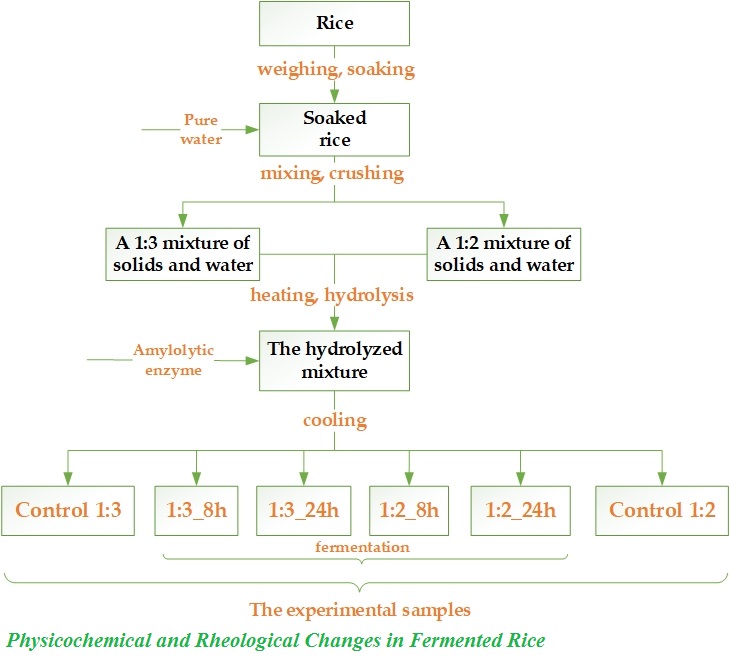
The preparation of rice began with washing and soaking to facilitate subsequent processing. Whole rice grains were thoroughly washed and soaked in excess water for 12 hours to ensure complete hydration. The water-to-rice ratio (hydromodule) was carefully optimized to achieve two key objectives:
– Provide a sufficient concentration of dry matter to support lactobacilli growth;
– Ensure the formation of a stable system with desired structural and rheological properties.
In this study, two ratios were tested: 1:2 and 1:3 (rice to water, w/v). After soaking, the hydrated rice was ground in water using a laboratory grinder («JustBuy», Qingdao, China) to obtain a homogeneous suspension.
The resulting rice slurry was subjected to amylolytic hydrolysis to increase the concentration of fermentable sugars – essential for microbial metabolism – and to generate intermediate products such as dextrins of varying molecular weights, which influence the viscosity of the final product. Hydrolysis was carried out using an amylolytic enzyme preparation α-amylase («Alfalad BN», Bio-Preparat, Moscow, Russia) at 40±2°C for 40 minutes, with continuous monitoring of key physicochemical parameters. The enzyme dosage was 50µL per 100g of substrate, as recommended by the manufacturer. The fermentation process was conducted in a 4-liter vessel.
To terminate the enzymatic reaction, the mixture was heated to 95–100°C for 1–2 minutes, then rapidly cooled on ice. Following inactivation, the physicochemical parameters of the hydrolysate were determined, and the temperature was adjusted to 37°C prior to inoculation with the starter culture.
Lactobacillus delbrueckii subsp. Bulgaricus (commercially available as «Lactosynthesis», Moscow, Russia), a strain commonly used in dairy fermentation, was employed in this study. The culture was stored in de Man, Rogosa, and Sharpe (MRS) broth (Himedia, India) supplemented with 50% glycerol at −80°C. For activation, a 100µL aliquot of the frozen culture was transferred into fresh MRS broth and incubated at 37°C for 24 hours under anaerobic conditions.
The preparation and composition of the experimental samples are summarized in Table 1 and illustrated in Fig. 1.
2.2. Preparing of starter and fermentation of rice base
Pre-cultures of Lactobacillus delbrueckii subsp. bulgaricus (L. bulgaricus) were prepared by inoculating MRS broth and incubating at 37°C for 8–12 hours. An overnight culture of L. bulgaricus was used as inoculum to achieve a final concentration of approximately 10⁸ colony-forming units (CFU)/mL in the rice base, with an inoculation volume of 3mL per 100mL of substrate.
The fermentation process was conducted according to a previously described method [27]. Two fermentation durations were evaluated: 0–8 hours and 0–24 hours. During fermentation, physicochemical and rheological parameters were monitored at regular intervals. Sensory evaluation of the final products was also performed.
2.3. Chemical assays
Titratable acidity was determined by titrating 10 mL of each sample with 0.1 N NaOH using phenolphthalein as an indicator, with results expressed in °T (degrees Thorner). The pH was measured using a HI 2211-02 pH meter (HANNA Instruments, Germany), following the manufacturer’s instructions.
Compositional analysis – including protein, fat, total solids, and total sugar content – was performed using near-infrared spectroscopy (NIRS) with an InfraLUM FT-12 spectrometer (Russia). The instrument was equipped with dedicated software and pre-established calibration models for cereal-based matrices.
2.4. Rheology, structural and textural parameters analysis
Viscosity measurements were taken using a rotational viscometer model RV-DVIII (China). Approximately 50 ml sample was placed in a beaker and the viscosity measurements were taken using spindle 2 of the viscometer at 30 rpm. The temperature of the samples was about 25 °C. The viscosity values were calculated automatically using a coefficient to convert the viscosity values into centipoise units (cP). Measurements were carried out in 3 replicates for each treatment and results were expressed in mPa·s.
The stability of the structure and thixotropic properties of the samples were evaluated by the coefficient of loss of viscosity (Lƞ, %) and coefficient mechanical stability (CMR), according to equations:
Lη = ((ηs-ηe))/ηs ∙100,
CMR = ηe/ηs,
where ηs is the initial viscosity of the undisturbed structure, cP; ηe is the viscosity of the maximally destroyed structure, cP.
Syneresis was measured after cooling samples weighing about 10 g to 4 °C after 24 hours of storage. The samples were centrifuged for 5 min at 1000 rpm and a temperature of 20 °C. The released serum was removed and weighed.
Syneresis (%) was calculated by equation:
Syn=S/М∙100, (%),
where M is the mass of the sample, g; S is the mass of the released serum, g.
The water-holding capacity (WHC) was measured after cooling the samples weighing about 20 g to 4 ° C after 24 hours of storage. The samples were centrifuged for 10 min at 3000 rpm and a temperature of 20 °C. The released serum was removed and weighed. WHC (%) of the product was calculated by equation:
WHC= (М-W)/М∙100,
where M is the sample weight, g; W is the released serum weight, g.
Texture profile analysis (TPA) was carried out using an ST-2 texture analyser (Quality Laboratory JSC, Moscow, Russia). The following factors were determined: hardness (g), cohesiveness, %, gumminess, g, adhesiveness, g·mm.
2.5. Sensory evaluation
A sensory evaluation was conducted by a panel of untrained (non-professional) and semi-trained assessors, comprising bachelors, masters, and professors involved in food production and biotechnology studies or work. This methodology is widely accepted and commonly used in similar research studies [29, 30]. The consumer panel comprised 65 participants, including 40 women and 25 men. The participants were predominantly young, with 74% aged between 18 and 39 years, and had a high level of education: 25% held PhD degrees, while 75% were undergraduates or graduates. Individuals with lactose intolerance, pregnancy, diabetes, or any allergies were excluded from participation.
The all panelists evaluated the organoleptic properties of each sample, identifying any sensory defects and rating their intensity on a 5-point hedonic scale: 5 – Full compliance (no defects), 4 – Single minor defect, 3 – Several minor defects, 2 – Significant defects, 1 – Severe (gross) defects.
All panelists provided informed consent, and ethical approval for the study was obtained prior to data collection and publication.
2.6. Statistical analysis
Each experimental trial was performed in five replicates for statistical validation. Data were analyzed for statistical significance using GraphPad Prism software (version X, GraphPad Software, USA) at a significance level of p < 0.05. Correlation analysis and data visualization were performed using Origin 8 software (OriginLab, USA), with significance set at p < 0.05.
- Results and Discussion
3.1. Preparation of rice base for lactic acid fermentation
After processing, the rice base exhibited a more homogeneous and viscous structure. The characteristic raw cereal taste was eliminated, and a distinct sweetness developed due to the release of simple sugars during hydrolysis. Changes in key physicochemical parameters are presented in Table 2.
3.2. Research on the properties of a hydromodule 1:2
3.2.1. Fermentation process at hydromodule 1:2
During the initial phase of fermentation (0–4 hours), titratable acidity increased to 17 °T (Fig. 2A), while pH decreased to 4.47 (Fig. 2B). Changes in viscosity exhibited a stepwise pattern (Fig. 2C), likely due to thermal equilibration of the rice base and the gradual activation of LAB. No noticeable changes in odor or taste were observed during this period.
Between 5 and 6 hours of fermentation, the development of sour aroma and acidic taste became perceptible, intensifying by the 8th hour. At this point, titratable acidity and pH reached 40 °T and 3.63, respectively. The sample also exhibited increased thickness, with viscosity rising to 1280–1300 cP. Based on sensory and physicochemical indicators, the primary fermentation of one sample (designated 1:2_8h) was terminated.
To rapidly reduce LAB metabolic activity, the sample was first placed in a freezer (−18°C) for 20–30 minutes, followed by transfer to a refrigerator (4°C) for 12 hours to allow structural stabilization.
The second sample (1:2_24h) was maintained under fermentation conditions for up to 24 hours to assess the upper limit of acceptable acidification. After 24 hours, the product developed a sharp sour taste and aroma. Titratable acidity and pH reached 90°T and 3.11, respectively. This sample was also subjected to the same post-fermentation stabilization protocol.
Following stabilization, viscosity increased further:
1:2_8h: from 1280–1300cP to 1347.5cP (+6.1%),
1:2_24h: to 1409.6Cp (+10.9%).
The increase in viscosity after cooling indicates ongoing structural development, likely due to protein network formation, water binding, or dextrin interactions, despite the cessation of active fermentation.
3.2.2. Physicochemical parameters after lactic acid fermentation at hydromodule 1:2
Following lactic acid fermentation, significant changes were observed in titratable acidity and pH compared to the unfermented control (Table 2). Titratable acidity increased progressively with fermentation time, reaching 40 °T after 8 hours and 90 °T after 24 hours, while pH decreased from an initial value of ~6.2 to 3.63 and 3.11, respectively.
In contrast, the overall chemical composition of the samples remained largely unchanged (Table 3), with the exception of total sugar content. A notable amount of residual total sugar was detected even after 24 hours of fermentation. This is likely attributable not only to the high initial concentration of fermentable sugars resulting from amylolytic hydrolysis but also to the presence of complex starch degradation products (e.g., dextrins) that may be only partially utilized by Lactobacillus delbrueckii subsp. bulgaricus under the applied fermentation conditions.
These findings suggest that while the fermentation process effectively acidifies the rice base, complete sugar utilization may be limited by the metabolic capabilities of the starter culture or the accessibility of certain carbohydrate fractions.
3.2.3. Structural and textural properties
Rheological characteristics play a crucial role in determining the quality of fermented products, both dairy and plant-based. Viscosity, texture, and structural stability are key parameters influencing consumer acceptability, particularly in beverages and yogurt-like products. Plant-based matrices are often prone to structural instability and phase separation (syneresis), necessitating careful process optimization to ensure product homogeneity and mouthfeel.
In this study, the apparent viscosity of fermented rice samples decreased compared to the unfermented control, with the most pronounced reduction observed in sample 1:2_24h (−22%). However, further analysis of structural and rheological parameters (Table 4) revealed distinct differences in recovery behavior and WHC, indicating that viscosity alone does not fully reflect structural integrity.
The unfermented control (1:2) exhibited high structural stability, with only a 2.4% viscosity loss and excellent recovery capacity (97.6%) and WHC (97.0%). In contrast, the 1:2_8h sample showed greater viscosity loss (−19.1%) and lower CSR (80.9%), despite maintaining a high WHC (98.0%). This suggests partial structural breakdown during fermentation, possibly due to insufficient network formation.
Surprisingly, sample 1:2_24h, despite the largest initial viscosity drop (−22%), demonstrated improved recovery (CSR: 92.7%) and the highest WHC (98.5%), along with the lowest syneresis (Syn: 0.5%). These results indicate that prolonged fermentation led to the development of a more resilient and cohesive structure, likely due to microbial metabolite production.
These changes are attributed to the metabolic activity of Lactobacillus delbrueckii subsp. bulgaricus during extended fermentation. Although initial acidification and substrate utilization may cause temporary thinning of the matrix (as observed at 8 h).
Thus, fermentation duration significantly influences the structural evolution of rice-based fermented beverages. While short fermentation (8 h) leads to acidification and viscosity reduction, extended fermentation (24 h) promotes the synthesis of functional metabolites that enhance structural recovery and water retention, ultimately improving physical stability.
Rheological characteristics represent a critical set of parameters for the evaluation of fermented products, providing objective quantification of textural attributes such as firmness, cohesiveness, and mouthfeel [19, 27, 28]. When integrated with sensory analysis, rheological data enable a comprehensive assessment of texture perception, bridging the gap between instrumental measurements and consumer experience. The results of TPA are presented in Table 5.
TPA revealed that hardness – defined as the force required to deform a material – was similar across all samples, indicating comparable resistance to initial compression. In contrast, parameters related to the internal structure and textural behavior exhibited significant variation.
Cohesiveness, which reflects the internal strength and resistance to deformation, was on average 5% higher in the fermented samples compared to the unfermented control. This suggests enhanced structural integrity and molecular interactions within the matrix, likely due to microbial metabolite production during fermentation.
Gumminess was highest in sample 1:2_24h, indicating a more resilient and chewable texture. An increase in gumminess is generally perceived positively in plant-based fermented products, as it prolongs oral residence time – enhancing interaction with taste and tactile receptors and contributing to a more satisfying, yogurt-like mouthfeel.
In contrast, adhesiveness was highest in sample 1:2_8h, but decreased in the 24-hour sample. Notably, the reduction in adhesiveness observed in 1:2_24h is advantageous from a technological standpoint, as lower stickiness reduces the force required for pumping, filling, and dosing viscous products, thereby improving processability and minimizing fouling in production equipment.
These results demonstrate that lactic acid fermentation significantly influences not only the rheological properties of the rice base but also its textural profile. Prolonged fermentation (24 h) promotes the development of a more cohesive and structured matrix with improved sensory and functional characteristics, while simultaneously reducing undesirable adhesive properties.
3.2.4. Sensory evaluation
Sensory evaluation plays a critical role in shaping consumer preferences, particularly when assessing novel or reformulated food products [31–35]. It provides essential insights into product acceptability by capturing perceptions related to key organoleptic attributes. The sensory profiles of the fermented rice beverages – including consistency, texture, color, taste, aftertaste, smell, flavor, and overall acceptability – were evaluated by a panel of assessors and are presented in Table 6.
3.3. Research on the properties of a hydromodule 1:3
3.3.1. Fermentation process at hydromodule 1:3
During the initial phase of fermentation (0–4 hours), titratable acidity increased to 11 °T (Fig. 2A), and pH decreased to 4.10 (Fig. 2B). Viscosity rose to 347.0 cP (Fig. 2C), likely due to thermal equilibration of the rice base and the onset of LAB metabolic activity. No noticeable changes in odor or taste were observed during this period.
Between 5 and 6 hours of fermentation, the development of sour aroma and acidic taste became perceptible, intensifying by the 8th hour. At this point, titratable acidity and pH reached 27 °T and 3.64, respectively. The samples also exhibited increased thickness, with viscosity rising to 390–395 cP. Based on these physicochemical and sensory changes, primary fermentation of one sample (designated 1:3_8h) was terminated.
The second sample (1:3_24h) was maintained under fermentation conditions for 24 hours to evaluate the upper limit of acceptable acidification. After 24 hours, the product developed a sharp, pronounced sour taste and aroma. Titratable acidity and pH reached 79 °T and 3.20, respectively. This sample was then subjected to the same post-fermentation stabilization protocol: rapid cooling (freezing at −18 °C for 20–30 min), followed by refrigeration at 4 °C for 12 h to ensure structural stabilization.
Following stabilization, viscosity increased further:
1:3_8h: from 390–395 cP to 410.8 cP (+23.4%),
1:3_24h: to 377.0 cP (+13.6%).
The greater relative increase in viscosity observed in the 1:3_8h sample suggests more effective structural development during cold storage, possibly due to better preservation of matrix integrity at lower acidity. In contrast, prolonged fermentation in 1:3_24h may have led to excessive acidification, partially disrupting the network and limiting post-fermentation structuring.
3.3.2. Physicochemical parameters after lactic acid fermentation at hydromodule 1:3
As a result of lactic acid fermentation, the indicators of titratable and active acidity changed significantly compared to the control (Table 3). The chemical composition changed only slightly (Table 7), which is associated with a more diluted environment of the hydro-module and a relatively low content of dry substances. At the same time, the fermentation process did occur, especially with a processing duration of 24 hours.
3.3.3. Structural and textural properties
The viscosity of fermented samples increased compared to the control, with the highest relative growth in 1:3_8h (+6.6%). However, structural stability varied significantly (Table 8).
Sample 1:3_24h showed the best performance: high recovery (96.1%), WHC (85.6%), and minimal syneresis (0.5%), indicating strong network formation. In contrast, 1:3_8h had greater viscosity loss (−11.3%) and lower recovery (88.7%), despite high WHC.
These differences are linked to fermentation duration. The low dry matter content in the 1:3 system limits early structuring, but 24-hour fermentation enables sufficient synthesis of metabolites by LAB, enhancing stability. At 8 hours resulting in a weaker, less recoverable structure.
Thus, prolonged fermentation compensates for dilution, promoting a stable, cohesive matrix.
TPA results for the 1:3 hydromodule are presented in Table 9. Hardness was similar across all samples. Cohesiveness – reflecting internal structural strength – was on average 6% higher in fermented samples compared to the control, indicating improved matrix integrity.
Gumminess was highest in 1:3_8h, suggesting a more chewable texture. In contrast, adhesiveness was greatest in 1:2_24h, though this parameter remained low in the 1:3 system overall.
Overall, fermentation enhanced key textural properties, particularly cohesiveness, confirming the formation of a more stable and structurally developed rice-based matrix.
3.3.4. Sensory evaluation
The results of the sensory evaluation of the fermented samples of hydromodule 1:3 are presented in Table 10.
The sample 1:3_8h was more acceptable for the sum of the scores. At the same time, the sections noted that both samples lacked consistency. Sample 1:2_24h received a low rating mainly due to the liquid, «watery» consistency, as well as lack of aftertaste and sharp acidity in taste and odour.
Rice and its derivatives are widely consumed globally due to their digestibility, hypoallergenic nature, and neutral sensory profile. These qualities make rice an excellent base for developing novel functional foods, particularly plant-based fermented products. In this study, a two-stage processing approach – enzymatic hydrolysis followed by lactic acid fermentation (LAF) – was applied to enhance the sensory, textural, and functional properties of rice-based systems.
Enzymatic pretreatment played a pivotal role in modifying the raw rice matrix. It effectively eliminated the characteristic cereal aftertaste and introduced a mild sweetness due to the release of simple sugars and dextrins from starch hydrolysis. Concurrently, the viscosity of the rice suspension increased significantly, transforming it from a phase-separated dispersion into a stable, homogeneous system. This improvement is attributed to the breakdown of starch granules and the formation of soluble high-molecular-weight fragments, which contribute to colloidal stability – a finding consistent with studies on other plant matrices [36, 37].
The resulting simple sugars concentration provided sufficient fermentable substrate for the growth of Lactobacillus delbrueckii subsp.bulgaricus, enabling rapid acidification during fermentation. Titratable acidity increased significantly, with pH decreasing to 3.1–3.7 depending on hydromodule and fermentation duration. The 1:2 hydromodule demonstrated higher acidification potential than 1:3, likely due to its greater dry matter content and higher nutrient availability.
Fermentation time was a critical factor. An 8-hour process proved optimal, achieving balanced acidity and high sensory acceptability in both systems. In contrast, 24-hour fermentation led to over-acidification (up to 79–90 °T), resulting in a sharp, unpleasant taste and reduced consumer preference – especially in the more diluted 1:3 system.
The obtained data is preliminary. Of course, further research will be continued and will focus on several key aspects: optimizing the amount of starter culture applied, studying the fermentation kinetics through glucose modifications, and determining the product’s shelf life. Additionally, the research will investigate the survival and persistence of bacteria within the product.
Beyond acidification, LAF significantly improved the structural and textural properties of the product. The increase in viscosity and CSR is likely driven by multiple mechanisms: particle size reduction, increased surface area for interaction. This is particularly important in plant-based systems, which naturally lack the casein network found in dairy.
These instrumental findings were confirmed by sensory evaluation. Sample 1:2_8h received the highest scores across all attributes – particularly for consistency, taste, and overall acceptability. Panelists described its texture as «dense», «coating», and «pleasant», correlating with its high viscosity (1026 cP), WHC (98%), and low syneresis (1.0%). In contrast, samples with a 1:3 ratio were perceived as «watery» and «lacking body», reflecting their lower dry matter content and weaker structural development.
The stability and texture of the fermented product improved. Analysis of the texture profile (TPA) and viscosity properties showed a high potential of the fermented samples. Especially sample 1:2_8h. It combines high viscosity (1026 cP), WHC (98%), stability of the internal structure (89.1%), as well as minimal syneresis (1.0%). It also received the highest sensory rating among all the samples studied.
The assessment of organoleptic indicators of food product quality, especially for new products, is highly sought after. It provides statistically reliable results and does not require specialized equipment; the analyzers are the human senses. Let us examine the results in more detail.
Appearance. Overall, no significant differences were found in participants' perceptions of the appearance of all samples. All samples had an acceptable appearance, as expected for this type of product.
Color. Overall, no significant differences were found in participants' perceptions of the color of all samples. All samples had an acceptable appearance characteristic of rice.
Consistency and texture. There was a significant difference in the perception of consistency and texture among the participants for the fermented samples. A comparison of the samples showed that there was a substantial difference between the hydro-gel samples 1:2 and 1:3. Participants expectedly noted a more viscous and dense consistency for samples 1:2_8h and 1:2_24h. The texture was also more enveloping, providing pleasant sensations on the tongue and in the mouth. The average score for the consistency (texture) of 1:2_8h was the highest at 4, while the lowest score was given to the samples with hydromodule 1:3. Participants noted the watery consistency of these samples. Taste and Aftertaste. In general, there was a significant difference in the participants' perception of the taste and aftertaste of all samples. The most balanced taste and aftertaste were found in sample 1:2_8h (distinct and pleasant), while the least pronounced were in sample 1:3_24h (indistinct and weak, with no aftertaste).
Aroma and Taste. Overall, participants noted significant differences in the perception of aroma and taste among all samples. The most pronounced taste and aftertaste were observed in sample 1:2_8h (distinct and pleasant), while the least pronounced were in sample 1:3_24h (indistinct and weak, with no aftertaste).
Overall Acceptability. Participants reported good sensory perception of the fermented samples 1:2_8h and 1:3_8h. However, a comparison between the samples indicated that there is a difference in the assessment of their consistency, texture, and aftertaste.
The average score for overall acceptability among the fermented samples was highest for sample 1:2_8h (29 points), while sample 1:3_24h received the lowest score (19 points). It is important to note that participants generally indicated a deficiency in the consistency of the fermented samples. Participants expressed the opinion that the product lacks «density» or «body». This must be taken into consideration in future developments. The integration of sensory and rheological data is essential for product development. As shown by Castro et al. [32] and Rodrigues et al. al. [33], consumer preferences are closely linked to texture and fermentation dynamics. The positive impact of homogenization and microbial metabolism on product stability and quality has also been demonstrated in other plant-based systems [37, 38].
Principal component analysis (PCA, Fig. 4A) plot clearly shows a distinct separation of data into two main groups represented by differently colored points: blue points correspond to the 1:2 hydro module, while red points correspond to the 1:3 hydro module. This distribution indicates significant differences between the groups primarily due to hydro module parameters.
The first principal component (PC1), explaining 65.84% of the data variation, serves as the key factor determining the separation of the 1:2 and 1:3 groups. This allows us to conclude that this component reflects the main differences between the studied samples. The second principal component (PC2), associated with fermentation duration, explains 29.42% of the data variation and helps identify additional differences, particularly within the 1:2 group, which includes samples with time stamps of 24 hours and 8 hours. This distribution of samples across components indicates a significant influence of both the hydro module and fermentation duration on the formation of observed differences between the groups. The results suggest the need for additional statistical analysis to assess the significance of the identified differences and determine specific variables contributing most to the formation of principal components.
Further research should investigate the nature of the relationship between components and initial parameters for a deeper understanding of the mechanisms underlying the observed sample separation.
Correlation analysis by the heat map method (Fig. 4B) revealed strong positive relationships between sensory perception and instrumental parameters such as viscosity, cohesiveness, gumminess, and WHC. Conversely, excessive acidity and prolonged fermentation showed negative correlations with taste and aftertaste, highlighting the need for precise process control.
This relationship is crucial because it enhances our comprehension of how elements affect the sensory experience of a product. The interdependence between subjective assessment (including the enveloping qualities, the duration of contact with the mouth and tongue, and the velvety texture) and the results of objective measurements is demonstrated. Additionally, correlation analysis has shown that there is a strong correlation between the sensory profile, texture, and processing parameters, with more than 10 controlled variables.
The investigation demonstrates that the textural and functional properties of the rice-based system developed in this study are crucial for its technological and nutritional value. Our findings indicate that viscosity plays a key role in determining both flavor and mouthfeel characteristics.
Glucan not only contributes to flavor formation but also undergoes beneficial structural changes during fermentation. The positive effects of β-glucan and other metabolites, which are well-known for their rheological and physiological functions [39-41], are significantly enhanced by microbial activity. Among these microorganisms, Lactobacillus bulgaricus plays a particularly important role.
The activity of L. bulgaricus on rice substrates is essential for improving the texture and stability of the final product. This has been previously demonstrated in milk systems [27, 28].
As a result of a comprehensive analysis and sensory evaluation, sample hydromodule 1:2_8h can be identified as the most promising for further research.
- Conclusion
This study demonstrates that the combination of enzymatic hydrolysis and lactic acid fermentation using Lactobacillus delbrueckii subsp. bulgaricus significantly improves the physicochemical, rheological, and sensory properties of rice-based fermented products. The rice-to-water ratio (hydromodule) was identified as a key factor influencing product quality, with a 1:2 ratio proving optimal for structural development and sensory acceptability.
Fermentation for 8 hours yielded the best balance of acidity, viscosity, and texture, particularly in the 1:2 system. Sample 1:2_8h exhibited high water-holding capacity (98%), low syneresis (1.0%), and superior sensory scores, confirming its potential as a stable, palatable plant-based functional product.
The findings indicate significant potential for rice as an eco-friendly and hypoallergenic foundation for developing cereal-based beverages and fermented food products. Research priorities include understanding matrix formation during fermentation, enhancing storage stability, and expanding applications into new food categories. These categories encompass plant-based yogurts, innovative desserts, functional sauces, and specialty dressings.
Furthermore, studies will examine fermentation’s effect on antioxidant properties and transformations in rice-derived exopolysaccharides. These components are vital for creating innovative health products. Ultimately, these efforts aim to advance the development of novel, health-focused food solutions using fermented rice substrates.
- Acknowledgements
The author acknowledges to Dr. Nikitina E.V. for her helpful advices.
- Declaration of competing interest
The author reports no conflicts of interest with anybody.
- Authors’ Contributions
The entire manuscript is an independent work of the author.
- Using Artificial Intelligent Chatbots
Artificial Intelligent chatbots has not been used in any section of work.
- Ethical Consideration
This study does not require approval from an ethics committee.
- Fermentation
- Plant Beverages
- Sensory Evaluation
- TPA
- Viscosity
Cómo citar
Citas
Weerathilake WADV, Rasika DMD, Ruwanmali JKU, Munasinghe MADD. The evolution, processing, varieties and health benefits of yogurt. International journal of recent scientific research Publication. 2014; 4. https://doi.org/10.9734/JSRP/2014/4/101378
Kesika P, Thangaleela S, Sivamaruthi BS, Bharathi M, Chaiyasut C. Fermented foods and their role in respiratory health: A Mini-review. Fermentation. 2022; 8(4): 162. https://doi.org/10.3390/fermentation8040162
Vashisht P, Singh L. Comparative review of nutri-functional and sensorial properties, health benefits and environmental impact of dairy (bovine milk) and plant-based milk (soy, almond, and oat milk). Food and Humanity. 2024; 2: 100301. https://doi.org/10.1016/j.foohum.2024.100301
Aydar E.F., Tutuncu S., Ozcelik B. Plant-Based milk substitutes: bioactive compounds, conventional and novel processes, bioavailability studies, and health effects. J Funct Foods. 2020; 70: 103975. https://doi.org/10.1016/j.jff.2020.103975
Bernat N, Cháfer M, Chiralt A, Gonzalez-Martinez C. Vegetable milks and their fermented derivative products. Int J Food Stud. 2014; 3(1). https://doi.org/10.7455/ijfs.v3i1.201
Canon F, Maillard M-B, Famelart M-H, Thierry A, Gagnaire V. Mixed dairy and plant-based yogurt alternatives: Improving their physical and sensorial properties through formulation and lactic acid bacteria cocultures. Curr Res Food Sci. 2022; 5: 665-676. https://doi.org/10.1016/j.crfs.2022.03.011
Deziderio MA, Souza HFd, Kamimura ES, Petrus RR. Plant-based fermented beverages: Development and characterization. Foods. 2023; 12(22): 4128. https://doi.org/10.3390/foods12224128
Giugliano R, Musolino N, Ciccotelli V, Ferraris C, Savio V, Vivaldi B, Ercolini C, Bianchi DM, Decastelli L. Soy, rice and oat drinks: Investigating chemical and biological safety in plant-based milk alternatives. Nutrients. 2023; 15(10): 2258. https://doi.org/10.3390/nu15102258
Łopusiewicz Ł. Comparison of homemade and commercial plant-based drinks (Almond, Oat, Soy) fermented with yogurt starter culture for fresh consumption. Fermentation. 2024; 1(1): 35. https://doi.org/10.3390/fermentation10010035
Sethi S, Tyagi SK, Anurag RK. Plant-based milk alternatives an emerging segment of functional beverages: A Review. J Food Sci Technol. 2016; 53: 3408-3423. https://doi.org/10.1007/s13197-016-2328-3
Sungatullina A, Petrova T, Nikitina E. Potential use of flaxseed mucilage in dairy product technology. E3S Web Conf. 2023; 392: 01029. https://doi.org/10.1051/e3sconf/202339201029
Ramsing R, Santo RE, Kim BF, Altema-Johnson D, Wooden A, Chang KB, Semba RD, Love DC. Dairy and plant-based milks: Implications for nutrition and planetary health. Curr Environ Health Rep. 2023; 10: 291-302. https://doi.org/10.1007/s40572-023-00400-z
Wijaya C, Romulo A. Proximate analysis and antioxidant activity of red rice (Oryza Sativa L.) milk. J Phys Conf Ser. 2049(1): 012012. https://doi.org/10.1088/1742-6596/2049/1/012012
Yu Q, Qian J, Guo Y, Qian H, Yao W, Cheng Y. Applicable strains, processing techniques and health benefits of fermented oat beverages: A Review. Foods. 2023; 12: 1708. https://doi.org/10.3390/foods12081708
Kitaevskaya SV, Ponomarev VY, Yunusov ES. Research of fermentation processes of protein substrates by consortiums of lactic acid bacteria. IOP Conf Ser: Earth Environ Sci. 2022; 978(1): 012052. https://doi.org/10.1088/1755-1315/978/1/012052
Karimov AZ, Ponomarev VY, Yunusov ES, Khrundin D, Egkova GO. The prospects for the use of proteinase from Bacillus Pumilus for processing raw meat. IOP Conf Ser: Earth Environ Sci. 2020; 548(6): 062029. https://doi.org/10.1088/1755-1315/548/6/062029
Luana N., Rossana C., Curiel J.A., Poutanen K., Gobbetti M., Rizzello C.G. Manufacture and Characterization of a Yogurt-like Beverage Made with Oat Flakes Fermented by Selected Lactic Acid Bacteria. Int J Food Microbiol. 2014; 185: 17-26. https://doi.org/10.1016/j.ijfoodmicro.2014.05.004
Singh V, Guizani N, Shah H, et al. Correlation between sensory and instrumental textural attributes of date palm (Phoenix Dactylifera L.) fruits: Technical note. J Agric Mar Sci. 2021; 26(1): 57-61. https://doi.org/10.24200/jams.vol26iss1pp57-61
Haas R, Schnepps A, Pichler A, Meixner O. Cow milk versus plant-based milk substitutes: A comparison of product image and motivational structure of consumption. Sustainability. 2019; 11(18): 5046. https://doi.org/10.3390/su11185046
Cabello-Olmo M, Krishnan PG, Araña M, Oneca M, Díaz JV, Barajas M, Rovai M. Development, analysis, and sensory evaluation of improved bread fortified with a plant-based fermented food product. Foods. 2023; 12: 2817. https://doi.org/10.3390/foods12152817
Silva A, Silva M, Ribeiro BD. Health issues and technological aspects of plant-based alternative milk. Food Res Int. 2020; 131(1): 108972. https://doi.org/10.1016/j.foodres.2019.108972
Gupta S, Cox S, Abu-Ghannam N. Process optimization for the development of a functional beverage based on lactic acid fermentation of oats. Biochem Eng J. 2010; 52(2-3): 199-204. https://doi.org/10.1016/j.bej.2010.08.008
Nionelli L, Coda R, Curiel JA, Poutanen K, Gobbetti M, Rizzello CG. Manufacture and characterization of a yogurt-like beverage made with oat flakes fermented by selected lactic acid bacteria. Int J Food Microbiol. 2014; 17-26. https://doi.org/10.1016/j.ijfoodmicro.2014.05.004
Rathore S, Salmeron I, Pandiella SS. Production of potentially probiotic beverages using single and mixed cereal substrates fermented with lactic acid bacteria cultures. Food Microbiol. 2012; 30(1): 239-244. https://doi.org/10.1016/j.fm.2011.09.001
Magala M, Kohajdová Z, Karovičová J, Greifová M, Hojerová J. Application of lactic acid bacteria for production of fermented beverages based on rice flour. Czech J Food Sci. 2015; 33(5): 458-463. https://doi.org/10.17221/74/2015-CJFS
Walsh H, Ross J, Hendricks G, Guo M. Physico-Chemical properties, probiotic survivability, microstructure, and acceptability of a yogurt-like symbiotic oats-based product using pre-polymerized whey protein as a gelation agent. J Food Sci. 2010; 75(5): M327-M337. https://doi.org/10.1111/j.1750-3841.2010.01637.x
Alshevskaya M, Anistratova O, Kochina A, Ustich V, Alshevskiy D. Rheological structure assessment of the plant alternative to yoghurt. BIO Web Conf. 2023.
Nikitina E, Petrova T, Vafina A, Ezhkova A, Yahia MN, Kayumov AR. Textural and functional properties of skimmed and whole milk fermented by novel Lactiplantibacillus Plantarum AG10 strain isolated from silage. Fermentation. 2022; 8(6): 290. https://doi.org/10.3390/fermentation8060290
Terhaag MM, Sakai OA, Ruiz F, Garcia S, Bertusso FR, Prudencio S. The Probiotication of a lychee beverage with Saccharomyces boulardii: An alternative to dairy-based probiotic products. Foods. 2025; 14 (2) (2):156. https://doi.org/10.3390/foods14020156
Shilin H, Sharareh H. Sensory evaluation of non-dairy probiotic beverages. J Food Res. 2014; 4 (1) (1):186–92. https:// doi.org/10.5539/jfr.v4n1p186
Khule GD, Ranvare AR, Singh A, C S Babu. Texture profile analysis: A comprehensive insight into food texture evaluation. J Dyn Control. 2024; 8(9): 30-45. https://doi.org/10.71058/jodac.v8i9003
Castro WF, Cruz AG, Bisinotto MS, Guerreiro LMR, Faria JAF, Bolini HMA, Cunha RL, Deliza R. Development of probiotic dairy beverages: rheological properties and application of mathematical models in sensory evaluation. J Dairy Sci. 2012; 96: 16-25. http://dx.doi.org/10.3168/jds.2012-5590
Rodrigues SSQ, Dias LG, Teixeira A. Emerging methods for the evaluation of sensory quality of food: technology at service. Curr Food Sci Technol Rep. 2024; 2(2): 77-90.
Nishinari K, Fang Y, Rosenthal AJ. Human oral processing and texture profile analysis parameters – bridging the gap between the sensory evaluation and the instrumental measurements. J Texture Stud. 2019; 50(1): 12404.
Grujić S, Odžaković B, Ciganović M. Sensory Analysis as a Tool in the New Food Product Development. 2014; pp. 325–330.
Sharonov AN, Tyts VV, Zharikov MV. Taste sensations: The role of sensory analysis in controlling the quality of food products. Pharmacy Formulas 2022; 4(4): 48-55. https://doi.org/10.17816/phf321836
Kaur G, Singh A, Orsat V. An overview of different homogenizers, their working mechanisms and impact on processing of fruits and vegetables. Crit RevFood Sci Nutr. 2021; 63(14): 1-14. https://doi.org/10.1080/10408398.2021.1969890
Salehi F. Physico-chemical and rheological properties of fruit and vegetable juices as affected by high pressure homogenization: A review. Int J Food Prop. 2020; 23(1): 1136-1149. https://doi.org/10.1080/10942912.2020.1781167
Ibrahim SA, Yeboah PJ, Ayivi RD, Eddin AS, Wijemanna ND, Paidari S, Bakhshayesh RV. A review and comparative perspective on health benefits of probiotic and fermented foods. Int J Food Sci Technol. 2023; 58: 448-4964. https://doi.org/10.1111/ijfs.16619
He A, Xu B. High-pressure homogenisation improves food quality of plant-based milk alternatives. Int J Food Sci Technol. 2024; 59(1): 399-407. https://doi.org/10.1111/ijfs.16822
Ahmad A, Anjum FM, Zahoor T, Nawaz H, Dilshad SMR. β-Glucan: A valuable functional ingredient in foods. Crit Rev Food Sci Nutr. 2012; 52(3): 201-212. https://doi.org/10.1080/10408398.2010.499806
- Resumen ##plugins.themes.ojsPlusA.frontend.article.viewed##: 316 ##plugins.themes.ojsPlusA.frontend.article.times##
- pdf (English) ##plugins.themes.ojsPlusA.frontend.article.downloaded##: 99 ##plugins.themes.ojsPlusA.frontend.article.times##