Bacteriophage-based Biocontrol of Escherichia coli O157:H7 in Beef: Investigating Sprayed Wraps for Enhanced Food Safety
بیوتکنولوژی غذایی کاربردی,
دوره 13 شماره 1 (2026),
7 آذر 2025
,
صفحه 1-10 (e3)
https://doi.org/10.22037/afb.v13i1.50662
چکیده
Background and Objective: Escherichia coli O157:H7, a major foodborne bacterial pathogen, is commonly detected in the intestines of healthy cattle, deer, goats and sheep. It can readily contaminate veal, ground beef and hamburgers, causing a range of human diseases, including mild diarrhea, hemorrhagic colitis, hemolytic-uremic syndrome and thrombotic thrombocytopenic purpura. Various treatment strategies are used to reduce E. coli O157:H7 contamination, ranging from washing to chemical and physical food decontamination. The increase of antibiotic-resistant bacteria has hence increased interest in lytic bacteriophages as biocontrol agents. This study investigated the use of bacteriophages to control E. coli O157:H7 growth in experimentally contaminated meat.
Material and Methods: Six E. coli O157:H7 specific bacteriophages were isolated from sewage, purified via plaque assay and assessed individually and in cocktails for lytic activity at various multiplicity of infection rates. Temperature-dependent effects on adhesion and lytic efficiency were assessed at refrigeration and ambient conditions. Phages were further used in commercial polyethylene food wraps to assess realistic surface delivery performance on inoculated meat samples and long-term phage stability was monitored during storage at 4 °C.
Results and Conclusion: Single-phage treatments achieved up to 100% bacterial elimination at higher multiplicities of infection, while optimized phage cocktails completely eradicated bacteria. Temperature affected bacterial recovery, with refrigeration decreasing bacterial adhesion and slightly slowing phage-mediated lysis. Importantly, this study has introduced an innovative practical approach using phages onto commonly used commercial polyethylene plastic wraps, demonstrating 99 and 93% reductions when phage‑treated wraps were used after 20 min and 24 h storages, respectively. Long-term storage of phage tf1 at 4 °C for seven months demonstrated stable plaque-forming ability, verifying durability for practical uses. These results highlight bacteriophages as effective, safe and scalable interventions to control E. coli O157:H7 in meat products, providing a practical strategy to enhance food safety, particularly for pathogens with extremely low infectious doses.
Keywords: Bacteriophage biocontrol, Escherichia coli O157:H7, Food safety intervention, Meat contamination, Phage cocktail therapy, Polyethylene wrap application
- Introduction
Escherichia coli O157:H7 was identified in 1983 and has since been addressed as a major foodborne bacterial pathogen affecting humans [1, 2]. It is commonly detected in the intestines of healthy cattle, deer, goats and sheep and can therefore readily contaminate veal, ground beef and hamburgers [3]. The E. coli O157:H7 produces Shiga toxins and is classified as an enteric bacterium responsible for diarrhea and dysentery, also known as enterohemorrhagic E. coli (EHEC) [4]. It causes a range of human diseases, including mild diarrhea, hemorrhagic colitis (HC), hemolytic-uremic syndrome (HUS) and thrombotic thrombocytopenic purpura (TTP) [5]. Although other foodborne pathogens such as Listeria, Salmonella enterica Serovar Enteritidis and Shigella species have been isolated from meats, E. coli O157:H7 is particularly concerning due to its extremely low infectious dose, as few as 10 cells, and its ease of transmission during slaughter and meat processing [6]. The microorganism can spread directly from person to person, especially in child day-care settings and from animals to humans [7].
Globally, E. coli infections are estimated to cause 2.8 million cases annually, with approximately 63,000 cases of HC reported each year in the United States alone. Children are particularly susceptible to severe complications such as HUS, a leading cause of acute renal failure (ARF) [8]. Numerous studies have investigated the prevalence of E. coli O157:H7 in food products and the bacterium has been isolated from a variety of plant and animal-derived foods within several countries. Contamination is frequently associated with meat products due to exposure to intestinal contents during slaughter and processing. However, contamination has been reported in raw fruits and vegetables, often linked to the use of untreated animal waste or contaminated irrigation water. Reported prevalence rates vary by country and food type, but the detection of the pathogen in ready-to-eat foods highlights the risk of foodborne illness outbreaks [9]. From 2003 to 2012, 390 outbreaks of Shiga toxin-producing E. coli O157 in the United States led to 4,928 diseases, 1,272 hospitalizations and 33 deaths, with cattle serving as the primary reservoir and ground beef as the most common route of transmission. Undercooked ground beef and other non-intact cuts pose a high risk, making it critical to decrease contamination during beef production, processing and storage and to protect consumers through appropriate handling and cooking of raw beef products [10].
Despite the urgent need to control E. coli O157:H7 contamination, current treatment methods vary in effectiveness and present challenges. To effectively decrease or eradicate E. coli O157:H7 contamination, a variety of treatment methods are currently used, ranging from simple washing of foods to chemical (peroxyacetic acid, chlorine dioxide, sodium hypochlorite and organic acids) or physical (irradiation, pasteurization, high-pressure processing and pulsed electric fields) decontamination techniques. These methods vary in their efficacy, costs and effects on the sensory quality and visual appeal of foods. However, their practical use is limited because several of these treatments can modify texture, flavor and nutritional attributes and some also increase concerns associated to residue safety and toxicity. Furthermore, they are not universally usable within all food types, which limits their feasibility and consistency in real processing environments [11]. Although antibiotics are used as effective chemical agents for removing these bacteria, increasing reports of antibiotic-resistant bacteria suggest that an alternative effective method is needed [12]. The growing threat of multidrug-resistant bacterial pathogens necessitates urgent investigation of alternatives to traditional antibiotics [13].
Regarding the limitations of current treatments, bacteriophage therapy, first developed by Felix d’Herelle and historically overshadowed by antibiotics, has re-emerged as a promising alternative to traditional antibiotics. This is due to its specificity, ability to target biofilms, minimal side effects and potentials to decrease antibiotic resistance development [14]. In food safety, bacteriophages offer unique advantages because of their narrow host range, which enables them to eliminate pathogenic E. coli strains without harming beneficial microbiota [15]. Coliphages, in particular, are abundant in environments such as sewages, animal wastes and water sources, making them accessible for isolation and use against foodborne pathogens [16]. One challenge to their use is the possible emergence of phage-resistant bacteria; however, this can be addressed through the use of phage cocktails composed of multiple phages with complementary host specificities. Such formulations not only broaden the range of susceptible bacterial targets but also decrease the likelihood of resistance development. Moreover, phages include the ability to evolve in bacteria, allowing them to overcome resistance mechanisms that limit the effectiveness of antibiotics. These characteristics have provided a way for regulatory acceptance of several phage-based products in the food industry, particularly for the control of E. coli O157:H7 in beef and fresh products, highlighting their potential as sustainable and innovative tools to enhance food safety [17].
Bacteriophages have been recognized as safe for use in food production and are classified as generally recognized as safe (GRAS) by the U.S. Food and Drug Administration (FDA). While phages targeting E. coli O157:H7 such as EcoShield and SecureShield E1 have received GRAS approval for use in beef and other food products, similar approvals exist for phages against other foodborne pathogens. The GRAS phages are valued for their specificity, safety for human consumption, minimal effects on the food sensory characteristics and ability to decrease pathogen levels without contributing to antimicrobial resistance [18]. This research investigated the use of bacteriophages as biocontrol agents to control the propagation of artificially contaminated E. coli O157:H7 in meat samples.
- Materials and Methods
2.1. Bacteria cultivation
Lyophilized E. coli O157:H7 PTCC 1860 was provided by the Persian Type Culture Collection (PTCC), Iran. The strain was cultured on tryptic soy agar plates at 37 °C for 16–18 h. For storage, bacterial cultures were suspended in tryptic soy broth (TSB) with 15% glycerol and stored at -80 °C. Bacterial counts were determined as colony-forming units (CFU) defined as viable bacterial cell capable of forming a visible colony on solid media.
2.2. Isolation and purification of bacteriophages
Bacteriophages were isolated from environmental water, sewage and slaughterhouse sewage samples. Briefly, 100 mL of sewage samples were collected in sterile bottles and transported to the laboratory. To enrich bacteriophages, samples were mixed with 200 mL of TSB media and inoculated with the E. coli host and then incubated overnight at 37 °C. Chloroform was added to the mixture for 10 min to lyse the bacterial cells, followed by centrifugation to remove debris. The resulting supernatants, containing potential bacteriophages, were assessed against host bacteria using double-layer agar method [19]. After overnight incubation at 37 °C, plates were investigated for plaques. Single plaques were isolated and subjected to repeated culture using double-layer agar technique to purify individual bacteriophages. Isolated bacteriophages were stored in SM buffer at 4 °C. Phage titers were expressed as plaque-forming units (PFU), where one PFU corresponded to an infectious phage particle that produced a visible plaque on a bacterial lawn.
2.3. Contaminated-meat experiments
Fresh beef was purchased from a local butchery and cut into similar pieces. Their sterility was assessed before use. For experimental contamination, E. coli O157:H7 was cultured overnight and a bacterial suspension was prepared at a concentration of 10⁷ CFU.mL-1. Meat samples were immersed in the suspension and agitated for 10 min to allow bacterial adhesion. The multiplicity of infection (MOI) was reported as the ratio of phage particles (PFU) to bacterial cells (CFU).
2.3.1. Single Phage Treatment
Meat samples were divided into three groups and suspended in sterile water, including untreated meat (control), meat treated with E. coli O157:H7 at 10⁷ CFU.mL-1 (bacteria only), meat contaminated with E. coli O157:H7 (10⁷ CFU.mL-1) and subsequently treated with a specific bacteriophage at 10⁸ PFU.mL-1 (phage-treated). All samples were agitated for 20 min; after which, aliquots were serially diluted (10-¹, 10-² and 10-³) for plating on eosin methylene blue (EMB) agar. Sampling and culturing were repeated after 60 min to assess bacterial decrease over time. The entire procedure was carried out at room temperature (RT) and 4 °C to assess the effect of temperature on phage efficacy.
2.3.2. Phage Cocktail Treatment
A mixture of three bacteriophages (TF1, TF2 and SC) was used in meat samples inoculated with E. coli O157:H7 (10⁷ CFU.mL-1) at a total phage concentration of 10⁸ PFU.mL-1. To further assess the cocktail performance, an additional trial was carried out; in which, each phage was used individually at 10⁸ PFU.mL-1.
2.4. Contaminated ground beef experiments
Ground beef was prepared from the meat under sterile laboratory conditions and divided into three portions of equal weight. One portion was untreated as a control. The second portion was inoculated with E. coli O157:H7 at a concentration of 5 × 10⁸ CFU.mL-1 without further treatment. The third portion was similarly contaminated with the bacteria, agitated for 20 min to ensure homogenized distribution and then treated with a bacteriophage suspension at 10⁸ PFU.mL-1. These experiments were carried out at RT and 4 °C.
2.5. Plastic wrap treatment with bacteriophages
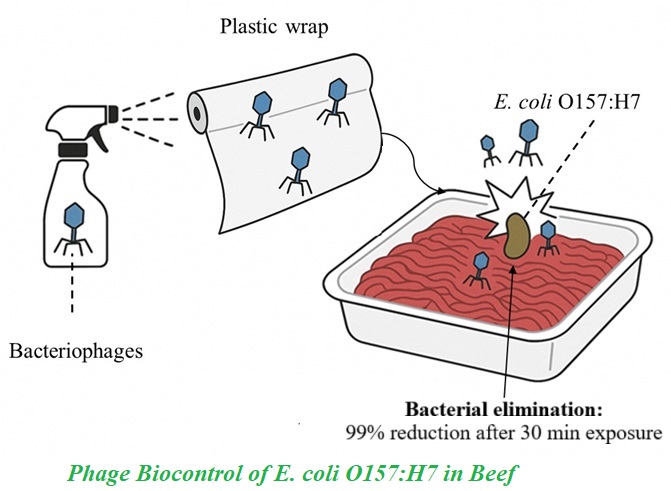
Beef samples were covered with plastic wrap under various conditions. The wrap included commercial food-grade low-density polyethylene available in the market. In the control setup, uncontaminated beef was wrapped with untreated plastic. A second setup involved contaminated beef wrapped with plastic that did not contain bacteriophages. In the phage-treatment setup, plastic wrap was pretreated with a suspension containing 10⁹ PFU.mL-1 bacteriophages by spraying and storing at 4 °C for 20 min and then used in contaminated beef for 30 min at 4 °C. To further assess the protective effect of wraps over time, additional plastic sheets were incubated at 4 °C for 24 h after sprayed with the phage suspension followed by covering beef samples for 30 min.
2.6. Statistical analysis
All experiments were carried out in three replicates (n = 3). Quantitative data were presented as mean ± SD (standard deviation). Error bars in figures represented SD of the replicates.
- Results and Discussion
Four bacteriophages were isolated from municipal sewage and two others from slaughterhouse wastewater. These were designated as tf1-tf4 and sc-sg, respectively. Of the six bacteriophages isolated, tf1 was chosen for further individual assessments based on its distinct plaque morphology. This produced large, clear and well-defined plaques, suggesting high lytic efficiency and strong bactericidal potential against E. coli O157:H7. In contaminated beef experiments, when 106 PFU.mL-1 of tf1 bacteriophage was used at RT against 107 CFU.mL-1 of E. coli O157:H7, 65% ±0.5 of bacteria were removed after 20 min (MOI = 0.1) at RT. Increasing phage dose up to 109 PFU.mL-1 led to 99% ±0.4 bacterial elimination (MOI = 100), as shown in Figure 1.
Exposure with phage for 60 min at RT, addition of 107 PFU.mL-1 of phage to 106 CFU.mL-1 of bacteria resulted in nearly 93.5% ±0.4 elimination (MOI = 10). However, bacteria were more effectively removed, when treated by 108 PFU.mL-1 phage even up to 99% ±0.2 (MOI = 100). Elimination rate was 100%, when 109 PFU.mL-1 of phage was added to 107 CFU.mL-1 of bacteria (MOI = 1000), as shown in Figure 2. Bacterial decreases are shown at the second y axis (right y axis).
For assessing the effect of phage cocktail, including tf1, tf2 and sc, cocktails with two various formulas were assessed. Meat containing 107 CFU.mL-1 bacteria was exposed to a dose of 108 PFU.mL-1 cocktail phages and showed nearly 99% ±0.1 of bacteria being lysed after 20 min and 99.5% ±0.1 after 60 min. When a cocktail included 108 PFU.mL-1 separately, bacterial removal was 100%; as shown in Figure 3. Comparison of performance between single-phage (Figure 1-2) and cocktail treatments (Figure 3) indicated that while tf1 alone achieved strong bacterial decrease at higher MOIs, the cocktails demonstrated enhanced efficacy and reliability in reaching levels below infectious (< 100 CFU) and ingestion (< 10 CFU) thresholds. The optimized cocktail not only maintained 99% bacterial elimination but achieved complete eradication when used at equivalent individual phage titers, demonstrating superior robustness in ensuring bacterial counts fall below clinically relevant exposure limits.
In ground beef experiments, meat samples were inoculated with E. coli O157:H7 at an initial concentration of 107 CFU.mL-1 and then treated with 108 PFU.mL-1 of bacteriophages for either 20 or 60 min at 25 and 4 °C. Bacterial recovery from the meat was affected by temperature, as adhesion decreased at refrigeration temperature, compared to ambient conditions, consistent with the lower metabolic activity and decreased surface interactions of bacteria at colder environments. After 20 min of phage exposure, bacterial counts decreased by 96.4% ±0.1 at 25 °C and 82.0% ±0.4 at 4 °C (Figure 4). When exposure time was extended to 60 min, decrease rates increased to 99.95% ±0.05 and 87.0% ±0.5 at 25 and 4 °C, respectively, indicating that phage-host interactions were kinetically dependent, with higher temperatures favoring further efficient adsorption and subsequent lysis. These findings suggested that rapid refrigeration of meat could decrease infection risk by limiting bacterial attachment, even though phage-mediated lysis occurred further slowly at lower temperatures
Contaminated meat samples were covered for 30 min with plastic wraps coated with 109 PFU.mL-1 phage for 20 min and 24 h. significant viable cell decreases, at the two conditions were observed with the greatest decrease in the 20 min-treated plastic wrap, compared to controls without phages. This included 99.0% ±0.9, compared to 93% ±2 in 24 h-treated group; as shown in Figure 5.
To assess the long-term stability of phage tf1, its plaque-forming ability was assessed over a 7 m storage at 4 °C. At a 10⁻⁷ dilution, plaque counts were consistent within all measured time points, showing no appreciable decreases in infectivity (Figure 6). The average plaque count calculated from all sampling intervals was stable, further verifying the persistence of active phage particles during prolonged storage. Minor deviations observed between the months were included within the expected range of experimental variability, which might be seen due to the counting precision or inherent assay fluctuations. Overall, these results indicated that phage tf1 preserved its infective capacity and structural integrity for at least 7 m under refrigerated conditions, highlighting its strong potential for use in long-term biocontrol uses.
The EHEC are pathogenic E. coli strains that produce Shiga toxins and cause HC and its life-threatening sequelae of HUS [20]. Since identification of serotype O157:H7 in 1983, many outbreaks associated with EHEC have been reported in the United States and E. coli O157:H7 has become one of the most important foodborne pathogens [21]. It causes severe human disease worldwide. It seems important to eliminate this pathogen in appropriate way [5]. Antibiotics were always an option; however, with increasing antibiotic-resistant strains due to use of antibiotics in cow feed, an alternative treatment is needed [22].
In a study, the overall prevalence of Shiga toxin-producing E. coli in raw beef samples collected from an industrial slaughterhouse in Hamadan, Iran, was 10.4%, with one isolate (12.5%) belonged to the O157 serogroup and the rest isolates of 87.5% classified as non-O157. The prevalence of O157 (1.3%) was similar to that reported in Iran (e.g., 1.35% in Mashhad), greater than those reported from the EU (0.3%), the U.S. (0.8%) and Brazil (1%) and less than those reported in Nigeria (2.2%) and Australia (1.7%). The study verified cattle as a reservoir for Shiga toxin-producing E. coli and highlighted seasonal and animal-associated factors such as spring sampling and the use of feeder cattle, which might contribute to the prevalence [23]. Additionally, they reported that 5.3% of raw poultry meat samples were contaminated with E. coli O157 strains. Out of 257 samples, 36% of the samples contained E. coli isolates, with 38.7% of the isolates identified as Shiga toxin-producing E. coli carrying virulence genes such as stx1, stx2 and eae. The isolates showed significant genetic diversity and high resistance to antibiotics, including nalidixic acid, tetracycline, ampicillin and trimethoprim-sulfamethoxazole [24].
Since discovery of bacteriophages, they included therapeutic potential as natural enemies of bacteria and phase-based elimination of bacteria in agriculture and food industry was started [25]. Therefore, bacteriophages have been reported as good antibiotic alternatives. They provide a highly specific, environmental-friendly effective means of controlling bacterial pathogens in agriculture; thereby, contributing to efforts against the increase of antibiotic resistance in the food sector [26].
This study aimed isolation of effective bacteriophages for biocontrol of E. coli O157:H7 in beef and ground beef. Six phages were isolated and assessed in suspension and spray methods on beef and beef ground samples at RT and 4 °C. The use of the submersion method to assess bacterial attachment to meat showed less bacterial recovery at 4 °C, compared to 25 °C, verifying that adhesion and phage inactivation efficiency were modulated by temperature, likely due to differences in bacterial physiology and phage adsorption kinetics. These findings highlighted the importance of environmental conditions and exposure time in optimizing phage-based biocontrol strategies in meat systems. Furthermore, the effect of various MOIs were assessed after incubation times of 20 and 60 min. The results showed that the phage treatment eliminated 82 to 100% of E. coli O157:H7. Phage cocktails included a better elimination rate. In a similar study, a cocktail of all three phages was assessed for their ability to lyse the bacterium in vivo and in vitro. The phage cocktail totally eradicated E. coli O157:H7 from beef surfaces in seven out of nine experiments. They have isolated phages from bovine farmyard slurry samples. The study achieved superior results when using phage cocktails similar to those used in this study, suggesting that a combination of multiple phages could enhance the effectiveness against the target bacteria. Another bacteriophage cocktail of three lytic phages for E. coli O157:H7 was investigated for its ability to decrease experimental contamination of hard surfaces, tomato, spinach, broccoli and ground beef by three bacteria. The observed decreases ranged from 94 to 100%. This suggested that naturally occurring bacteriophages might be useful for decreasing contamination of various hard surfaces, fruits, vegetables and ground beef by E. coli O157:H7 [10]. The E. coli O157:H7 is addressed for its extremely low ingestion (number of viable microorganisms that must be consumed via contaminated food or water orally to establish infection in a susceptible host) and infectious dose (the smallest number of viable microorganisms needed to cause infection in a host). Epidemiological evidence indicates that ingestion of fewer than nine viable cells can cause infection, with most reports estimating an infectious dose of fewer than 100 CFU [27]. This exceptionally low threshold highlights the importance of complete bacterial elimination in any antimicrobial intervention [28]. In the present study, the initial bacteriophage cocktail achieved a 99.95% decrease in E. coli O157:H7 counts, creating approximately 730 CFU. In contrast, the optimized cocktail achieved complete eradication (no detectable CFU). Regarding that single-digit cell numbers can lead to infection, the ability to decrease bacterial levels to less than the detection limit represents a critical improvement in ensuring microbiological safety.
Extending previous research on phage-based biocontrol strategies, the current study introduced a novel approach by spraying bacteriophage preparations onto plastic wrap used in cover meat containers, demonstrating that phage could effectively decrease E. coli O157:H7 contamination. This study assessed the stability of bacteriophage-coated plastic wrap under refrigeration. Wraps stored for 20 min or 24 h before contact with E. coli O157:H7 significantly decreased bacterial counts, with 99 and 93% decreases, respectively. These results indicated that phages were active on the wrap for at least 24 h, though shorter storage preserved slightly higher lytic activity. While phage uses in food safety such as sprays, edible films and integration into packaging have been reported in the literature [29, 30], the use of phage-coated plastic wrap directly covering meat surfaces is novel. This method offers a practical potentially-scalable strategy for controlling pathogenic contamination, particularly for pathogens such as E. coli O157:H7 with very low infectious doses, using a simple, economic readily available packaging material. The results showed that brief exposure to phage-coated surfaces could substantially decrease bacterial load, highlighting its relevance for enhancing food safety in processing and retail settings.
Previous studies have investigated the use of bacteriophages as natural antimicrobial agents in active or edible packaging by incorporating phages into biopolymer films or coatings [31]. Several studies have used phages within chitosan and PVA matrices for suppressing E. coli on food surfaces, demonstrating decreases in bacterial load on beef, poultry and other substrates [32-34]. These film or coating-based approaches, while effective, often need specialized formulation and fabrication and may face challenges such as controlled phage release, stability during storage and ensured sufficient contact with the food surface. In contrast, the present approach, spraying phage preparations directly onto standard commercial plastic wrap covering meat containers, eliminates the need for film casting or coating, enabling immediate phage contact with contaminated surfaces. This method can be rapidly implemented within existing packaging workflows without modifying materials or supply chains and the large decreases observed in these experiments suggest that sprayed phages may achieve antimicrobial effects on phage-embedded films while offering greater operational simplicity and flexibility.
Monitoring the viability of the tf1 phage over 7 m demonstrated long-term stability, with plaque numbers showing a slight increase during storage. This modest increase might reflect the gradual disaggregation of phage particles over time and further verifies that the phage preserves its stability and plaque-forming ability under standard storage conditions.
Bacteriophages can be limited by their narrow host range, complexity of formulating effective cocktails and decreased diffusion and activity within dense food matrices such as meats. Their stability is affected by environmental conditions and bacterial resistance may increase through receptor modifications. Additionally, regulatory restrictions and consumer perception challenges are difficulties to widespread adoption in food systems. In contrast to FDA, the European Food Safety Authority (EFSA) provides a further restrictive stance and bacteriophages are not currently approved as food additives or antimicrobials within the EU due to unresolved concerns regarding genetic stability, host-range specificity and safety classification [35]. This regulatory disparity highlights the need of continued investigation into phage safety, efficacy under practical food-processing conditions and standardized assessment frameworks to support future approval.
- Conclusion
Use of bacteriophages is an effective strategy for controlling pathogenic E. coli O157:H7 in the beef and ground beef industry. Suspension and spraying methods demonstrated promising results in decreasing bacterial contamination. The ability to target dangerous pathogens with phages that are relatively easy to isolate highlights their potential as a practical and safe biocontrol tool. Widespread use of bacteriophages could enhance food safety by decreasing pathogenic E. coli contamination and should further be investigated for integration into standard food processing protocols, including their incorporation into sanitation procedures, formulation optimization and development of practical delivery methods appropriate for industrial use. The findings of this study represent an early-stage investigation of phage use in beef packaging systems. While the decreases are highly encouraging, continued research under diverse storage conditions, product types and scaling environments is needed before full industrial adoption. These preliminary results support further development of phage-based interventions as a promising addition to meat safety strategies.
- Acknowledgements
The authors gratefully acknowledge the Microbiology Laboratory staff at Tabriz University, Ms. Fatemeh Khodayi and laboratory colleagues for their technical support and assistance throughout this study.
- Declaration of competing interest
The authors declare no conflict of interest associated to this study.
- Authors’ Contributions
Investigation, methodology, data curation, HMG; original draft preparation, editing and review, analysis, visualization, RR; supervision, conceptualization, FSH, supervision, conceptualization, methodology, formal analysis, review, resources, GZ.
- Using Artificial Intelligent Chatbots
No AI assistance was used.
- Ethical Consideration
No ethical approval was required for the conduct of this study
- Bacteriophage biocontrol
- Escherichia coli O157:H7
- Food safety intervention
- Meat contamination
- Phage cocktail therapy
- Polyethylene wrap application
ارجاع به مقاله
مراجع
1. Mead PS, Griffin PM. Escherichia coli O157: H7. Lancet. 1998; 352(9135): 1207-1212. https://doi.org/10.1016/S0140-6736(98)01267-7
2. Torso LM, Voorhees RE, Forest SA, Gordon AZ, Silvestri SA, Kissler B, et al. Escherichia coli O157: H7 outbreak associated with restaurant beef grinding. J Food Prot. 2015; 78(7): 1272-1279. https://doi.org/10.4315/0362-028X.JFP-14-545
3. Persad AK, Lejeune JT. Animal reservoirs of Shiga toxin‐producing Escherichia coli. In: Enterohemorrhagic Escherichia coli and other Shiga toxin‐producing E coli. 2015:211-230. https://doi.org/10.1128/9781555818791.ch11
4. Gebisa ES, Gerasu MA, Leggese DT. A review on virulence factors of Escherichia coli. Anim Vet Sci. 2019; 7(3): 83-93. https://doi.org/10.11648/j.avs.20190703.13
5. Yang S-C, Lin C-H, Aljuffali IA, Fang J-Y. Current pathogenic Escherichia coli foodborne outbreak cases and therapy development. Arch Microbiol. 2017; 199(6): 811-825. https://doi.org/10.1007/s00203-017-1393-y
6. Goswami K, Chen C, Xiaoli L, Eaton KA, Dudley EG. Coculture of Escherichia coli O157: H7 with a nonpathogenic E. coli strain increases toxin production and virulence in a germfree mouse model. Infect Immun. 2015; 83(11): 4185-4193. https://doi.org/10.1128/iai.00663-15
7. Mesele F, Abunna F. Escherichia coli O157: H7 in foods of animal origin and its food safety implications. Adv Biol Res. 2019; 13(4): 134-145. https://doi.org/10.5829/idosi.abr.2019.134.145
8. Ameer MA, Wasey A, Salen P. Escherichia coli (e Coli 0157 H7). 2018. PMID: 29939622. https://europepmc.org/article/NBK/nbk507845
9. Jaradat ZW, Abulaila S, Al-Rousan E, Ababneh QO. Prevalence of Escherichia coli O157: H7 in foods in the MENA region between years 2000 and 2022: A review. Arab J Basic Appl Sci. 2024; 31(1): 104-120. https://doi.org/10.1080/25765299.2024.2309793
10. Heiman KE, Mody RK, Johnson SD, Griffin PM, Gould LH. Escherichia coli O157 outbreaks in the United States, 2003-2012. Emerg Infect Dis. 2015; 21(8):1293. https://doi.org/10.3201/eid2108.141364
11. Puligundla P, Lim S. Biocontrol approaches against Escherichia coli O157: H7 in foods. Foods. 2022; 11(5): 756. https://doi.org/10.3390/foods11050756
12. Gambushe SM, Zishiri OT, El Zowalaty ME. Review of Escherichia coli O157: H7 prevalence, pathogenicity, heavy metal and antimicrobial resistance, African perspective. Infect Drug Resist. 2022: 4645-4673. https://doi.org/10.2147/IDR.S365269
13. Vinayamohan PG, Pellissery AJ, Venkitanarayanan K. Role of horizontal gene transfer in the dissemination of antimicrobial resistance in food animal production. Curr Opin Food Sci. 2022; 47: 100882. https://doi.org/10.1016/j.cofs.2022.100882
14. Jamil T, Mehmood A, Farhan M, Kalim F, Hadi F, Younas K, et al. Bacteriophage therapy: Effective antibiotic replacer against emerging ghost of antimicrobial resistant bacteria. In: One Health Triad. Faisalabad, Pakistan: Unique Scientific Publishers; 2023: 158-167. https://doi.org/10.47278/book.oht/2023.24
15. Holzer K, Marongiu L, Detert K, Venturelli S, Schmidt H, Hoelzle L. Phage applications for biocontrol of enterohemorrhagic E. coli O157:H7 and other Shiga toxin-producing Escherichia coli. Int J Food Microbiol. 2025; 111267. https://doi.org/10.1016/j.ijfoodmicro.2025.111267
16. Zhou Y, Wan Q, Bao H, Guo Y, Zhu S, Zhang H, et al. Application of a novel lytic phage vB_EcoM_SQ17 for the biocontrol of Enterohemorrhagic Escherichia coli O157:H7 and Enterotoxigenic E. coli in food matrices. Front Microbiol. 2022; 13: 929005. https://doi.org/10.3389/fmicb.2022.929005
17. Bolocan AS, Callanan J, Forde A, Ross P, Hill C. Phage therapy targeting Escherichia coli—a story with no end? FEMS Microbiol Lett. 2016; 363(22): fnw256. https://doi.org/10.1093/femsle/fnw256
18. Oluwarinde BO, Ajose DJ, Abolarinwa TO, Montso PK, Du Preez I, Njom HA, et al. Safety characteristics of Escherichia coli O157: H7 specific bacteriophages: recent advances for Food Safety. Foods. 2023; 12(21): 3989. https://doi.org/10.3390/foods12213989
19. Rahmani R, Zarrini G, Sheikhzadeh F, Aghamohammadzadeh N. Effective phages as green antimicrobial agents against antibiotic-resistant hospital Escherichia coli. Jundishapur J Microbiology. 2015; 8(2): e17744. https://doi.org/10.5812/jjm.17744
20. Rivas M, Chinen I, Guth BE. Enterohemorrhagic (Shiga toxin-producing) Escherichia coli. In: Escherichia coli in the Americas. Springer; 2016. p. 97-123. https://doi.org/10.1007/978-3-319-45092-6_5
21. Laury A, Echeverry A, Brashears M. Fate of Escherichia coli O157:H7 in Meat. In: Safety of Meat and Processed Meat. Springer; 2009. p. 31-53. https://doi.org/10.1007/978-0-387-89026-5_2
22. Tabaran A, Soulageon V, Chirila F, Reget OL, Mihaiu M, Borzan M, et al. Pathogenic E. coli from cattle as a reservoir of resistance genes to various groups of antibiotics. Antibiotics. 2022; 11(3): 404. https://doi.org/10.3390/antibiotics11030404
23. Babolhavaeji K, Shokoohizadeh L, Yavari M, Moradi A, Alikhani MY. Prevalence of shiga toxin‐producing Escherichia coli O157 and non‐O157 Serogroups isolated from fresh raw beef meat samples in an industrial slaughterhouse. Int J Microbiol. 2021; 2021(1): 1978952. https://doi.org/10.1155/2021/1978952
24. Zarei O, Shokoohizadeh L, Hossainpour H, Alikhani MY. The prevalence of shiga toxin‐producing Escherichia coli and enteropathogenic Escherichia coli isolated from raw chicken meat samples. Int Journal Microbiol. 2021; 2021(1): 3333240. https://doi.org/10.1155/2021/3333240
25. Cristobal-Cueto P, García-Quintanilla A, Esteban J, García-Quintanilla M. Phages in food industry biocontrol and bioremediation. Antibiotics. 2021; 10(7): 786. https://doi.org/10.3390/antibiotics10070786
26. Sieiro C, Areal-Hermida L, Pichardo-Gallardo Á, Almuiña-González R, De Miguel T, Sánchez S, et al. A hundred years of bacteriophages: Can phages replace antibiotics in agriculture and aquaculture? Antibiotics. 2020; 9(8): 493. https://doi.org/10.3390/antibiotics9080493
27. Hara-Kudo Y, Takatori K. Contamination level and ingestion dose of foodborne pathogens associated with infections. Epidemiol Infect. 2011; 139(10): 1505-1510. https://doi.org/10.1017/S095026881000292X
28. Rahal EA, Kazzi N, Nassar FJ, Matar GM. Escherichia coli O157: H7—Clinical aspects and novel treatment approaches. Front Cell Infect Microbiol. 2012; 2: 138. https://doi.org/10.3389/fcimb.2012.00138
29. García-Anaya MC, Sepulveda DR, Zamudio-Flores PB, Acosta-Muñiz CH. Bacteriophages as additives in edible films and coatings. Trends in Food Sci Technol. 2023; 132: 150-161. https://doi.org/10.1016/j.tifs.2023.01.008
30. Wagh RV, Priyadarshi R, Rhim J-W. Novel bacteriophage-based food packaging: an innovative food safety approach. Coatings. 2023; 13(3): 609. https://doi.org/10.3390/coatings13030609
31. Abdollahzadeh E, Nematollahi A, Hosseini H. Composition of antimicrobial edible films and methods for assessing their antimicrobial activity: A review. Trends Food Sci Technol. 2021; 110: 291-303. https://doi.org/10.1016/j.tifs.2021.01.084
32. Cui H, Yuan L, Lin L. Novel chitosan film embedded with liposome-encapsulated phage for biocontrol of Escherichia coli O157: H7 in beef. Carbohydr Polym. 2017; 177: 156-164. https://doi.org/10.1016/j.carbpol.2017.08.137
33. Tomat D, Soazo M, Verdini R, Casabonne C, Aquili V, Balagué C, et al. Evaluation of an WPC edible film added with a cocktail of six lytic phages against foodborne pathogens such as enteropathogenic and Shigatoxigenic Escherichia coli. Lwt. 2019; 113: 108316. https://doi.org/10.1016/j.lwt.2019.108316
34. Vimala K, Yallapu MM, Varaprasad K, Reddy NN, Ravindra S, Naidu NS, et al. Fabrication of curcumin encapsulated chitosan-PVA silver nanocomposite films for improved antimicrobial activity. J Biomater Nanobiotechnol. 2011; 2(1): 55-64. https://doi.org/10.4236/JBNB.2011.21008
35. Efenberger-Szmechtyk M, Nowak A. Bacteriophage Power: Next-gen biocontrol strategies for safer meat. Molecules. 2025; 30(17): 3641. https://doi.org/10.3390/molecules30173641
- چکیده مشاهده شده: 248 بار
- pdf (English) دانلود شده: 126 بار