
Optimization of Culture Media Parameters of Saccharomyces Cerevisiae PTCC 5209 for Maximized Invertase Enzyme Production
Applied Food Biotechnology ,
Vol. 12 Núm. 1 (2025),
4 enero 2025
,
Página 1-10 (e29)
https://doi.org/10.22037/afb.v12i1.50414
Resumen
Background and Objective: Invertase enzyme or D-fructofuranosidfructohydrolase EC (3.2.1.26) is a member of the hydrolase family and responsible for the decomposition of sucrose into fructose and glucose. In recent years, extensive research has been carried out to increase the industrial production of invertase enzyme.
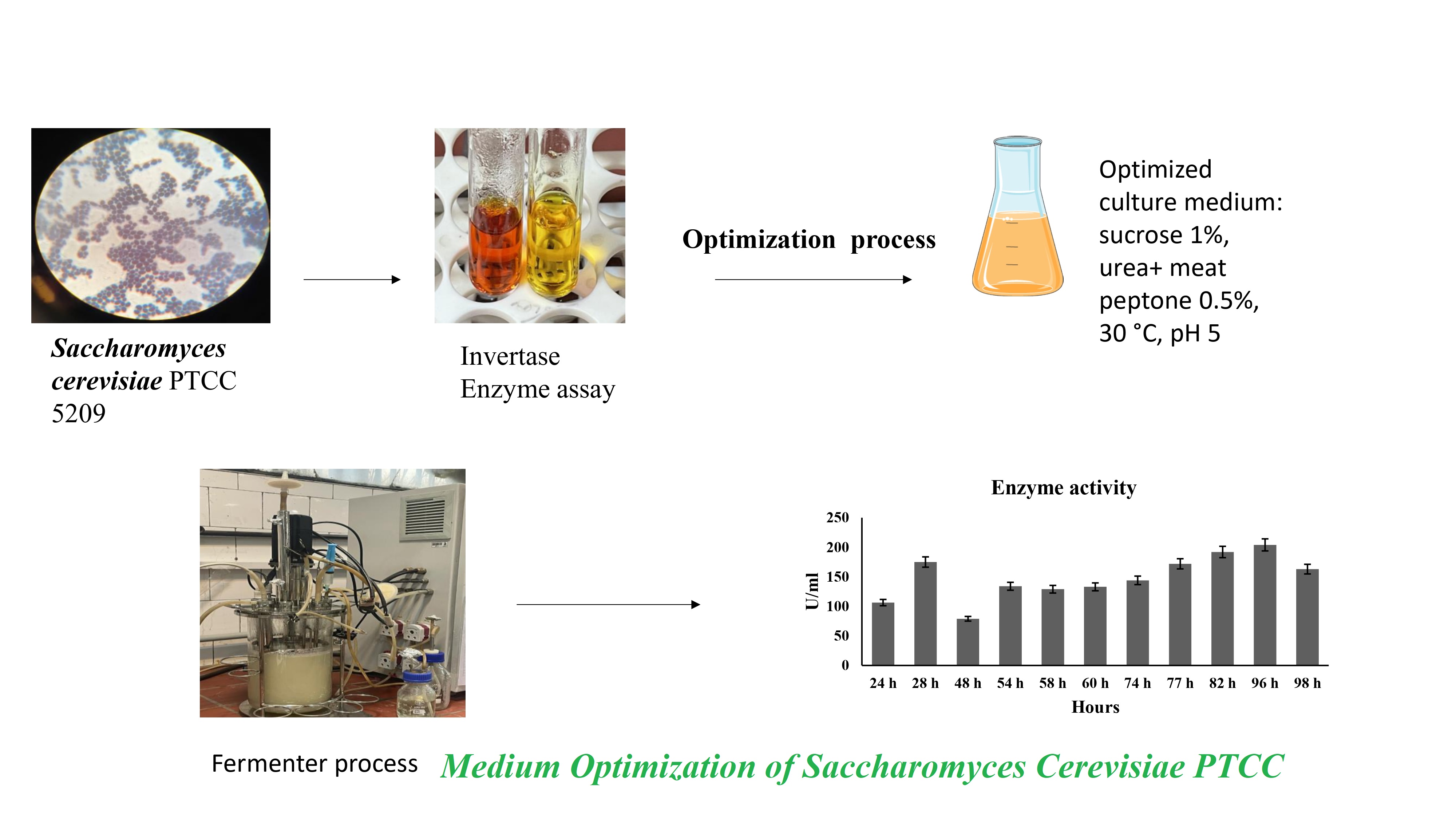
Material and Methods: This study focused on maximizing invertase production in Saccharomyces cerevisiae by optimizing culture media conditions. Elements of the culture media were investigated using monofunctional optimization method. Moreover, basic salt culture media, containing compounds such as Na₂HPO₄, K₂HPO₄, MgSO₄ and CaCl₂, were used. Then, growth curve of the yeast was plotted and results showed that the highest growth rate occurred within 38 h and the strongest enzyme activity occurred within 18 h. Optimizing the culture conditions showed that yeast provided the most activity with 1% sucrose as a carbon source, urea and 0.5% meat peptone as nitrogen sources, pH 5, 30 °C and shaking speed of 150 rpm. In this research, 3-l fermentor was used to assess yeast growth and enzyme activity at a larger scale.
Results and Conclusion: Results of this study showed that the highest OD value was included at 48 h and the highest enzyme activity was recorded at 28 and 96 h. The difference between the time of maximum growth and peak enzyme activity indicated the need of careful control of fermentation time to prevent unnecessary biomass accumulation. Therefore, further research in the field of advanced fermentation and optimization of yeast strains can help researchers achieve the highest secretion and enzyme activity.
Keywords: Invertase, Optimization, Saccharomyces cerevisiae PTCC 5209, Yeast fermentation
- Introduction
Enzymes are macromolecules that play a critical role in enabling the chemical transformations needed for sustaining biological processes. Enzymes are classified based on the types of reactions they catalyze, reflecting their diverse catalytic activities [1]. Enzymes are used in several industrial processes, including baking, brewing, detergents, fermented products, pharmaceuticals, textiles and leather processing and include a crucial role in the pharmaceutical and diagnostic industries [2]. One of the enzymes that has been most discussed in recent years is the invertase enzyme. Invertase (D-fructofuranosid fructohydrolase, EC 3.2.1.26) catalyzes the hydrolysis of the α-1,4-glycosidic bonds between D-glucose and D-fructose in sucrose and transfers the αβ-D-O-fructofuranoside residue to an acceptor substrate [3]. Thus, invertase functions under high sucrose concentrations showing transferase activity. This dual characteristic classifies it within the group of transferases, referred to as fructosyltransferases (EC 2.4.1.9) [4]. In addition, invertase can hydrolyze other oligosaccharides, including kestose, raffinose and stachyose [5]. Nowadays, invertase is widely used for commercial purposes in various industries such as foods, beverages, pharmaceuticals and biosensors. It facilitates the conversion of sucrose and linked glycosides into simple commercial carbohydrates. Saccharomyces sp. invertase is the most common commercial source, compared to others. Yeast invertase is a β-fructosidase, whereas the fungus produces an α-glucosidase type of invertase. These two types of invertase include various catalytic mechanisms. The β-fructosidase hydrolyzes the sucrose from the fructose end, while the α-glucosidase hydrolyzes sucrose from the glucose end. The two reactions yield a mixture named invert syrup, which consists of glucose and fructose. Due to the high sweetness of fructose, the invert syrup is much sweeter than sucrose. Fructose is more appropriate than glucose for diabetic patients and enhances iron absorption in children [6]. The generally recognized as safe (GRAS) S. cerevisiae is a preferred protein-production host due to its well-understood genetics, collection of molecular biology tools that enable precise strain engineering and significant tolerance to industrial and chemical stresses [7]. First, invert sugar was produced using chemical method by the hydrolysis of sucrose with acid. Before identification of the invertase enzyme this method was highly used; however, acid hydrolysis of sucrose includes several disadvantages such as byproduct generation and low efficiency, limiting its industrial uses [8]. Invertase is a glycoprotein rich in mannose residues that belongs to the glycoside hydrolase (GH) family and consists of 370 enzymes [9]. Various isoforms with distinct characteristics of invertase are located in various parts of the cell and produced in intracellular and extracellular forms [10]. The major strain for the production of the invertase enzyme for the industries is S. cerevisiae [11]. In addition to its ability to catalyze and hydrolyze several sugars, invertase is capable of degrading numerous chemical compounds such as rhamnose and stachyose. As the first known protein in the role of biological catalysts, this enzyme has formed one of the most fundamental principles in enzymology. This characteristic has led to suggest invertase as a basis for the development of various models used in the study of enzyme reaction kinetics [12]. Previous studies' major focus was on conventional yeast strains and standard fermentation conditions, focusing primarily on basic production and biochemical characterization [3, 4]. Optimization of culture conditions, particularly nitrogen sources, has been verified as effective in enhancing enzyme yield [13]. The goal of this research was to enhance invertase activity. Invertase production and activity highly depend on the microbial strain, culture media and environmental conditions. However, systematic assessment of S. cerevisiae PTCC 5209 with optimized nitrogen sources is limited. This study demonstrated that combining this strain with two nitrogen sources enhanced the enzyme yield, while Amicon ultrafiltration efficiently concentrated the enzyme. The novelty of this study was linked to the combined approach of strain selection and nutritional optimization, including use of a combination of nitrogen sources, to maximize invertase production under controlled culture conditions.
- Materials and Methods
2.1. Materials
Chemicals and mineral salts in this study included carbon sources of molasses (Brix 80, Jahan Alcohol, Iran) and sucrose (Merck, Germany); nitrogen sources of yeast extract (Leiber, Germany), meat peptone (Sigma-Aldrich, Germany), urea (pharmaceutical grade; Behansar, Iran) and diammonium phosphate (Merck, Germany); mineral salts of calcium chloride (Merck, Germany), magnesium sulfate (Merck, Germany), disodium hydrogen phosphate (Merck-DNA Biotech, Germany), dipotassium hydrogen phosphate (Merck, Germany), sodium potassium tartrate (Merck, Germany) and sodium acetate trihydrate (Merck, Germany); agar (Ibresco, Germany); sodium hydroxide (Merck, Germany); and glucose ( Merck, Germany).
2.2. Microorganism
The yeast strain of S. cerevisiae PTCC 5209 was provided by the Persian Type Culture Collection (PTCC, Iran). The strain was cultivated in yeast peptone dextrose adenine (YPDA) media (pH 5). For further experiments, glycerol stocks and slants were prepared.
2.3. Media
For enzyme production, the optimized culture media contained Na₂HPO₄ (2.5 g l-1), K₂HPO₄ (2.5 g l-1), meat peptone (10 g l-1), MgSO₄ (0.05 M) and CaCl₂ (0.01 M). The primary pH of the media was adjusted to 5.0 before sterilization.
2.4. Invertase assay
The culture media were centrifuged at 9,000 rpm for 20 min at 4 °C and the supernatant was collected as the crude enzyme source for the invertase assay. Invertase activity was investigated by measuring the quantity of reducing sugars released from sucrose using DNS method according to Miller [14]. The reaction mixture contained 0.4 ml of 1% (w/v) sucrose as substrate, 1.2 ml of 0.1 M acetate buffer (pH 5.0) and 0.4 ml of the crude enzyme supernatant. The mixture was incubated at room temperature (RM) for 30 min. After incubation, 0.25 ml of the reaction mixture was added to 1 ml of DNS reagent to terminate the reaction and the tubes were boiled for 10 min using water bath. After cooling to RM, the absorbance was measured at 540 nm using UV-vis spectrophotometer. One unit of invertase activity was reported as the quantity of enzyme needed to release 1 µmol of glucose per minute under the assay conditions.
2.5. Invertase activity calculation
Enzyme activity (mol min-1 ml-1) or (U ml-1) =
2.6. Carbon source optimization
Two carbon sources were assessed to investigate the optimal substrate for invertase production, including molasses with a Brix of 80 and sucrose. The culture media were supplemented with either 1% (v/v) molasses or 1% (w/v) sucrose and the pH was adjusted to 5.0. Each 250-ml flask containing 100 ml of the media was inoculated with S. cerevisiae and incubated at 30 °C for 24 h at 150 rpm using shaker incubator.
2.7. Sucrose concentration optimization
The culture media were prepared with various concentrations of sucrose ranging from 1 to 4% (w/v) to optimize invertase production [15]. With pH 5 in 250-ml flasks, culture media were inoculated with S. cerevisiae and incubated at 30 °C for 24 h at 150 rpm using shaker incubator.
2.8. Nitrogen source optimization
Four nitrogen sources were selected to investigate the best nitrogen source for invertase activity. These nitrogen sources were urea, yeast extract, meat peptone [16] and diammonium phosphate (DAP). The culture media were supplemented with 1% (w/v) of each nitrogen source and pH was adjusted to 5.0. Each 250-ml flask containing 100 ml of the media was inoculated with S. cerevisiae and incubated at 30 °C for 24 h at 150 rpm using shaker incubator.
2.9. Combination nitrogen source optimization
To enhance invertase production, various combinations of nitrogen sources were assessed, including 0.5% yeast extract and 0.5% meat peptone, 0.5% urea and 0.5% meat peptone, 0.5% urea and 0.5% yeast extract, and 0.5% yeast extract and 0.5% diammonium phosphate. Each combination was prepared in 100 ml of the culture media (pH adjusted to 5.0) using 250-ml flasks, inoculated with S. cerevisiae and incubated at 30 °C for 24 h at 150 rpm using shaker.
2.10. Optimization pH
Briefly, 100 ml of the production media were distributed into each 250-ml flask and pH was adjusted to 3, 4, 5, 6, 7 and 8 [17]. These were inoculated with S. cerevisiae and incubated at 30 °C for 24 h at 150 rpm using shaker incubator. Then, the supernatant was used for enzyme assay and investigation of invertase activity.
2.11. Acetate buffer pH optimization
To investigate that at what pH the enzyme was most active, acetate buffer was prepared at various pH levels between 4 and 7 and enzyme activity was assessed using enzyme assay with the acetate buffer at various pH levels.
2.12. Shaker incubator rpm optimization
To investigate the effect of the rpm of the shaker incubator on enzyme activity, the culture media containing microorganisms were incubated at 30 °C for 24 h at 150 and 160 rpm after inoculation, and enzyme activity was assessed, as described in the previous steps.
2.13. Shaker incubator temperature optimization
To investigate the Optimal shaker temperature to achieve higher enzyme activity, the culture media containing microorganisms were transferred into shakers at 25, 30 and 32 °C and 150 rpm after inoculation. After 24 h, enzyme assay was used as previously described.
2.14. Growth curve and enzyme activity
Yeast growth and invertase activity were monitored over 48 h. Cell growth was assessed spectrophotometrically at 600 nm every 2 h and the growth curve was plotted. Enzyme activity was investigated approximately every 4 h using standard invertase assay with each measurement carried out in duplicate (n = 2). Results were reported as mean ±SD (standard deviation).
2.15. Effects of temperature on enzyme activity
The crude enzyme from the supernatant was incubated at 30 to 90 °C for 30 min using water bath [18]. Enzyme activity was then assessed using standard invertase assay and absorbance of the samples was read at 540 nm.
2.16. Effects of substrate concentration and kinetic parameters (Michaelis-Menten equation)
The effect of substrate concentration on invertase activity was assessed using sucrose at final concentrations ranging from 0 to 300 mM under standard assay conditions. The reactions were carried out at constant temperatures of 30 and 50 °C. Kinetic parameters, including the Michaelis-Menten constant (Km) and the maximum reaction rate (Vmax), were calculated using non-linear regression analysis and Michaelis-Menten model.
2.17. The SMF fermentor
To assess enzyme production at a larger scale, fermentation was carried out using 3-l laboratory-scale bioreactor (working volume of 2.0 l; Zist Fan Sanat Iranian, Iran). The bioreactor was equipped with a Rushton-type impeller, an air sparger and automatic control systems for temperature, pH and dissolved oxygen (DO). Fermentation was carried out at 30 °C with pH 5.0. The culture was agitated at 150 rpm and continuously aerated with sterile air, while DO was set at approximately 5 mg l-1 throughout the process to ensure adequate oxygen transfer and homogeneous mixing. To minimize the risk of contamination, no sampling was carried out during the first 24 h after inoculation. Then, samples were collected at regular intervals to investigate yeast growth (OD₆₀₀) and invertase activity and growth and enzyme activity profiles were recorded. For each sample, OD₆₀₀ was measured in duplicate (technical replicates) to monitor cell growth and invertase activity was assessed in duplicate. Data were present as mean ±SD and error bars in figures represented SD.
2.18. Amicon (ultra centrifugal filter of 10 kDa)
Briefly, 10-kDa Amicon ultrafiltration was used to concentrate the crude invertase enzyme and simultaneously remove low-molecular-weight (LMW) salts and other solutes in the supernatant. The enzyme solution was processed according to the manufacturer’s instructions and the concentrated enzyme was collected for activity assays.
2.19. Statistical analysis
All experiments, except fermentation studies, were carried out in duplicate as independent biological replicates (n = 2). Enzyme activity for each replicate was calculated individually and results were present as mean ±SD. For fermentation samples, only one fermentor was used; each sample was assessed in duplicate (technical replicates) and OD₆₀₀ and enzyme activity were reported as mean ±SD. Michaelis-Menten plots were generated using GraphPad Prism 8 (GraphPad, USA) and the mean values of duplicate measurements. Standard deviations were not included in the fitting analysis since averaged values were used for each substrate concentration.
- Results and Discussion
3.1. Carbon source optimization
After 24 h of yeast incubation in culture media containing 1% molasses or 1% sucrose as carbon sources, enzyme activity was assessed to investigate the most suitable substrate. Sucrose was selected as the optimal carbon source since molasses interfered with the DNS assay due to its strong reaction with the reagent, making accurate quantification of enzyme activity unreliable.
3.2. Sucrose concentration optimization
After selecting sucrose as the preferred carbon source for enzyme production, various concentrations of sucrose (1–4% w/v) were assessed to investigate the optimal level for maximum enzyme activity. The results showed that the highest enzyme activity was achieved at 1% sucrose.
3.3. Nitrogen source optimization
Culture media containing yeast extract, meat peptone, urea and diammonium phosphate (DAP) were assessed as nitrogen sources. After 24 h of incubation, the enzyme assay results showed that the media containing pharmaceutical-grade urea as the nitrogen source included the highest invertase activity.
3.4. Combination of nitrogen sources
To enhance enzyme production, various combinations of nitrogen sources were assessed. After 24 h of incubation, the results indicated that the media containing a combination of meat peptone and pharmaceutical-grade urea included the highest invertase activity.
3.5. Media pH optimization
Media of various pH levels between 3 and 8 were prepared. After 24 h of yeast inoculation and enzyme assay, the culture media with pH of 5 included the highest enzyme activity. At pH 7 and pH 8, enzyme activity could not be assessed due to the precipitation in the culture media.
3.6. The pH acetate buffer
The buffer used in the assay included acetate buffer. To achieve and ensure the appropriate pH for the invertase enzyme, buffers with various pH levels between 3 and 7 were prepared. Then, the enzyme assay was carried out. The invertase enzyme showed the highest activity at pH 5.
3.7. The rpm optimization
To assess the effects of agitation speed on enzyme activity, shaking rates of 150 and 160 rpm were assessed. The results showed that the culture agitated at 150 rpm included the highest invertase activity.
3.8. Shaker incubator temperature optimization
After inoculation, the culture flasks were incubated at 25, 30 and 35 °C for 24 h. Enzyme assay results showed that the highest invertase activity was achieved at 30 °C.
3.9. Growth curve and enzyme activity curve
The growth and enzyme activity curves were monitored over 48 h by measuring cell growth (OD₆₀₀) every 2 h and invertase activity approximately every 4 h, except during the early stage of inoculation, when enzyme secretion did not begin. The growth curve showed two distinct logarithmic phases, likely due to the presence of dual nitrogen sources in the media. The highest enzyme activity was observed at 18 and 48 h, while the maximum optical density (OD₆₀₀) occurred at 38 h. These results indicate that the peak enzyme secretion did not coincide with the time of maximum yeast growth (biomass accumulation).
3.10. Fermentor
During the first 24 h of fermentation, no sampling was carried out to minimize the risk of contamination. After this time, samples were collected at regular intervals to monitor cell growth and enzyme activity. The highest optical density (OD₆₀₀) was recorded at 48 h, while the maximum invertase activity occurred at 28 and 96 h. Similar to the shake-flask experiments, the peak of enzyme activity did not match with the maximum cell growth, indicating that invertase secretion was not directly correlated with the biomass accumulation.
3.11. Effects of temperature
The crude enzyme was incubated at 30, 40, 60, 70 and 90 °C for 30 min, followed by activity measurement using standard assay. The highest invertase activity was observed within the temperature range of 40–60 °C, with similar activity levels at 40 and 60 °C, indicating that the enzyme preserved its substantial stability and catalytic efficiency across this range.
3.12. Michaelis-Menten equation
The Michaelis–Menten parameters of invertase were investigated through non-linear regression at 30 and 50 °C, as summarized in Table 1. At 30 °C, the Km and Vmax values were 63.35 mM and 0.8557 µmol min-1, respectively. At 50 °C, Km increased to 124.2 mM and Vmax to 2.283 µmol min-1. The higher Km at 50 °C indicated decreased affinity of invertase for sucrose at increased temperatures, suggesting that structural changes or increased flexibility of the enzyme at higher temperatures might affect substrate binding. The increase in Vmax at 50 °C showed that the catalytic rate could increase at higher temperatures; however, the overall efficiency was moderated by the decreased substrate affinity.
3.13. Amicon ultra centrifugal filter
In this study, Amicon 10-kDa filter was used to concentrate the enzyme. Before centrifugation, the volume in the tube was 3.5 ml and after centrifugation, the rest of volume in the Amicon filter was 1.4 ml; hence, this was 2.5 times further concentrated.
The results of this study showed that the yeast reached its highest growth rate within 38 h, while the best enzyme activity was seen within 18 h, highlighting the fact that enzyme secretion was not strictly coupled to growth, a phenomenon reported for S. cerevisiae MK, where the maximum invertase production occurred at 48 h while biomass increased up to 96 h [19]. These observations highlighted the importance of optimizing harvest time to achieve maximal enzyme yield. Such differences highlighted the importance of selecting the optimal harvest time to maximize enzyme activity. The present results, including that the invertase enzyme pH optimization was 5, were similar to those of Al-Saady’s study [16] but differed from Shankar's study [18], where maximum activity was observed at pH 6 for invertase from S. cerevisiae MTCC 170, suggesting that strain-specific variations in invertase isoforms or differences in post-translational modifications and culture conditions such as media composition, temperature and aeration might further affect the pH profile. In 2024, Dokuzparmak investigated the effect of pulp on the activity of the invertase enzyme in S. cerevisiae and the results showed that the invertase enzyme activity increased by 2.5 times. In the current study, a combination of 1% sucrose, 0.5% urea and meat peptone at pH 5 and 30 °C and 150 rpm yielded the highest enzyme activity, aligning with Dokuzparmak’s findings under comparable conditions [20]. However, it is noteworthy that the optimization was carried out using one-factor-at-a-time (OFAT) approach, which did not account for potential interactions between the factors. For example, the optimal sucrose concentration investigated by one nitrogen source may shift, when a various nitrogen source is used. Future studies can use factorial design or response surface methodology (RSM) to investigate such interactions and achieve further precise optimization.
In this investigation, the invertase from S. cerevisiae PTCC 5209 showed high activity over a broad temperature range (40–60 °C), which was similar to that of Du's study [21], who reported the maximum activity of the enzyme at 45 °C. This suggested that the enzyme preserved substantial activity within a wide range of temperatures. In this study, 3-l fermentor was used to investigate the growth and activity of yeast at a large scale, which showed the highest OD value within 48 h. In general, the achieved results showed that use of S. cerevisiae bacteria with the optimization of culture media parameters included a positive effect on increasing the production of invertase enzyme, similar to previous studies [22–24]. In addition, analysis of the fermentor growth curve revealed differences between the maximum biomass growth and the maximum enzyme activity. This highlighted the necessity of careful monitoring of fermentation time to avoid unnecessary accumulation of biomass in conditions, where enzyme efficiency reached its optimal level. Therefore, further research can focus on developing advanced fermentation methods or optimizing strains to achieve further optimal enzyme secretion and activity.
- Conclusion
Invertase is found in nature in various isoforms. This enzyme is widely distributed in plants and microorganisms. In plants, three isoforms of invertase differ in biochemical characteristics and subcellular locations. The role of invertase in plants extends beyond metabolism, as it is effective in osmotic regulation, growth and immune system strengthening. In the human body, invertase is addressed as an immune system booster, antioxidant and disinfectant agent and is useful in certain cases of patients with bone and stomach cancers. The importance of this enzyme in these reactions led the current authors to investigate the structure of the enzyme and optimize conditions for its maximum production. Regarding that S. cerevisiae, commonly known as baker's yeast, is the major strain used for the production and purification of invertase, S. cerevisiae was used under optimal conditions to maximize the production and activity of this enzyme. In yeasts, this enzyme can be detected extracellularly or intracellularly. In this study, invertase production by S. cerevisiae PTCC 5209 was maximized under optimized nutritional and culture conditions. The study detected that invertase production peaked at 18 h under 1% sucrose, 0.5% urea and meat peptone, pH 5, 30 °C and 150 rpm conditions. Combination of urea and meat peptone resulted in the highest invertase activity, likely due to the complementary nature of these nitrogen sources as urea provided a rapidly metabolizable form of nitrogen and meat peptone supplied complex peptides and amino acids that supported enzyme synthesis. Moreover, urea represented an economically advantageous nitrogen source, being an inexpensive petrochemical product that is readily available in Iran, which made this combination particularly appropriate for industrial-scale enzyme production. The process was successfully scaled up in 3-l fermentor, demonstrating its potential for industrial enzyme production. Although experiments were carried out under specific laboratory conditions, findings included broader uses for the global biotechnology and food industries, where invertase plays a vital role in processes such as sucrose hydrolysis, prebiotic synthesis and fermentation. Further studies could focus on optimizing fermentation techniques or improving the yeast strain to increase enzyme production.
- Acknowledgements
The authors would like to thank [Alzahra University/Department of Biotechnology/Industrial Biotechnology Laboratory] for providing technical support and laboratory facilities for this study.
- Declaration of competing interest
The authors report no conflict of interest.
- Authors’ Contributions
All authors participated in project administration and writing of the primary draft of the manuscript, providing critical revision and editing.
- Using Artificial Intelligent Chatbots
This manuscript was written entirely by the authors. Artificial intelligence tools were used only to improve the English language and enhance readability.
- Ethical Consideration
The authors confirm that this research involved only microbial (yeast) experiments and did not include human or animal subjects. Accordingly, ethical approval was not applicable for this study.
- Invertase
- Optimization
- Saccharomyces cerevisiae PTCC 5209
- Yeast fermentation
Cómo citar
Citas
1. Gurung N, Ray S, Bose S, Rai V. A broader view: Microbial enzymes and their relevance in industries, medicine, and beyond. BioMed Res Int. 2013; 2013(1): 329121. https://doi.org/10.1155/2013/329121
2. Singh R, Kumar M, Mittal A, Mehta PK. Microbial enzymes: Industrial progress in 21st century. 3 Biotech. 2016; 6(2):174. https://doi.org/10.1007/s13205-016-0485-8
3. Toledo LET, García DM, Cruz EP, Intriago LMR, Pérez JN, Chanfrau JMP. Fructosyltransferases and invertases: Useful enzymes in the food and feed industries. Enzymes Food Biotechnol. Elsevier. 2019: 451-469. https://doi.org/10.1016/B978-0-12-813280-7.00026-8
4. Awad GE, Amer H, El-Gammal EW, Helmy WA, Esawy MA, Elnashar MM. Production optimization of invertase by lactobacillus brevis mm-6 and its immobilization on alginate beads. Carbohydrate polymers. 2013; 93(2): 740-746. https://doi.org/10.1016/j.carbpol.2012.12.039
5. Andjelkovic U, Lah J. Thermodynamics and structural features of the yeast saccharomyces cerevisiae external invertase isoforms in guanidinium-chloride solutions. J Agric Food Chem. 2011; 59(2): 727-732. https://doi.org/10.1021/jf103441p
6. Linde D, Rodríguez-Colinas B, Estévez M, Poveda A, Plou FJ, Lobato MF. Analysis of neofructooligosaccharides production mediated by the extracellular β-fructofuranosidase from xanthophyllomyces dendrorhous. Bioresour Technol. 2012; 109: 123-130. https://doi.org/10.1016/j.biortech.2011.12.077
7. Love KR, Dalvie NC, Love JC. The yeast stands alone: The future of protein biologic production. Curr Opin Biotechnol. 2018; 53: 50-58. https://doi.org/10.1016/j.copbio.2017.12.010
8. Antošová M, Polakovič M. Fructosyltransferases: The enzymes catalyzing production of fructooligosaccharides. Chem Pap. 2001; 55(6): 350-358. https://doi.org/10.2478/s11696-014-0563-5
9. Lombard V, Golaconda Ramulu H, Drula E, Coutinho PM, Henrissat B. The carbohydrate-active enzymes database (cazy) in 2013. Nucleic acids res. 2014; 42(D1): D490-D495. https://doi.org/10.1093/nar/gkt1178
10. Barbosa PMG, de Morais TP, de Andrade Silva CA, da Silva Santos FR, Garcia NFL, Fonseca GG, Leite RSR, da Paz MF. Biochemical characterization and evaluation of invertases produced from saccharomyces cerevisiae cat-1 and rhodotorula mucilaginosa for the production of fructooligosaccharides. Prep Biochem Biotechnol. 2018; 48(6):506-513. https://doi.org/10.1080/10826068.2018.1466155
11. Romero-Gómez S, Augur C, Viniegra-González G. Invertase production by aspergillus niger in submerged and solid-state fermentation. Biotechnol Lett. 2000; 22: 1255-1258. https://doi.org/10.1023/A:1005659217932
12. Gracida-Rodríguez J, Favela-Torres E, Prado-Barragán A, Huerta-Ochoa S, Saucedo-Castañeda G. Invertases. In: Enzyme Technology.
13. Batista RD, Carvalho do Nascimento G, Carvalho NB, Leite PC, Basso RC, Morales SAV, Xavier MdCA, Perna RF, Almeida AFd. Cost-effective optimization of the transfructosylation activity of an invertase produced from aspergillus carbonarius pc-4 using pineapple crown and determination of its biochemical properties. Processes. 2024; 12(10): 2255. https://doi.org/10.3390/pr12102255
14. Miller GL. Use of dinitrosalicylic acid reagent for determination of reducing sugar. Anal Chem. 1959; 31(3): 426-428. https://doi.org/10.1021/ac60147a030
15. Kamble SP, Borate JC. Effect of nitrogen sources on the production of invertase by yeast saccharomyces cerevisiae 3090. 2012.
16. Al-Sa'ady AJ. Optimization of invertase production from saccharomyces cerevisiae by solid state fermentation. 2014.
17. Osiebe O, Adewale IO, Omafuvbe BO. Production and characterization of intracellular invertase from saccharomyces cerevisiae (ol629078. 1), using cassava-soybean as a cost-effective substrate. Sci Rep. 2023; 13(1):16295. https://doi.org/10.1038/s41598-023-43502-2
18. Shankar T, Thangamathi P, Rama R, Sivakumar T. Characterization of invertase from saccharomyces cerevisiae mtcc 170. Afr J Microbiol Res. 2014; 8(13): 1385-1393. https://doi.org/10.5897/AJMR2014.6612
19. Shankar T, Thangamathi P, Rama R, Sivakumar T. Optimization of invertase production using saccharomyces cerevisiae mk under varying cultural conditions. Int J Biochem Biophys. 2013; 1(3): 47-56. https://doi.org/10.13189/ijbb.2013.010301
20. Dokuzparmak E. Industrial approach to invertase production from fruit waste for enhanced efficiency and conservation. ACS Omega. 2024; 9(24): 26183-26194. https://doi.org/10.1021/acsomega.4c01732
21. Du L, Pang H, Wang Z, Lu J, Wei Y, Huang R. Characterization of an invertase with ph tolerance and truncation of its n-terminal to shift optimum activity toward neutral ph. PLoS One. 2013; 8(4): e62306. https://doi.org/10.1371/journal.pone.0062306
22. Topcu H, Degirmenci I, Sonmez DA, Paizila A, Karci H, Kafkas S, Kafkas E, Ercisli S, Alatawi A. Sugar, invertase enzyme activities and invertase gene expression in different developmental stages of strawberry fruits. Plants. 2022; 11(4): 509. https://doi.org/10.3390/plants11040509
23. Liu J, Cheng J, Huang M, Shen C, Xu K, Xiao Y, Pan W, Fang Z. Identification of an invertase with high specific activity for raffinose hydrolysis and its application in soymilk treatment. Front Microbiol. 2021; 12: 646801. https://doi.org/10.3389/fmicb.2021.646801
24. Mahendran S, Sankaralingam S, Tamilarasi S, Maheswari P, Kathiresan D, Ramya SS, Seethapathy P, Kousalya L, Harinathan B, Palpperumal S. Bioactive potential of invertase by yeast saccharomyces cerevisiae from the honey bee gut: Isolation and characterization. Biomass Convers Biorefin. 2024; 14(4): 4897-4906. https://doi.org/10.1007/s13399-022-02499-w
- Resumen ##plugins.themes.ojsPlusA.frontend.article.viewed##: 292 ##plugins.themes.ojsPlusA.frontend.article.times##
- pdf (English) ##plugins.themes.ojsPlusA.frontend.article.downloaded##: 95 ##plugins.themes.ojsPlusA.frontend.article.times##