
Enhancing the Survival Rate and Population Growth of Heyndrickxia Coagulans Spores for Use in Functional Foods
Applied Food Biotechnology ,
Vol. 12 Núm. 1 (2025),
4 enero 2025
,
Página 1-13 (e24)
https://doi.org/10.22037/afb.v12i1.49837
Resumen
Background and Objective: The delivery of probiotics using functional foods or supplements (e.g., capsules, tablets, or sachets) as carriers is an important strategy to provide health benefits, as it is necessary to maintain 10⁶-10⁹ colony-forming units (CFU) per gram of the probiotic strain alive and active at the time of consumption for effectiveness. This study investigated the effects of batch and fed-batch fermentation methods on increasing the cell and spore populations of Heyndrickxia coagulans MTCC 5856 (formerly Bacillus coagulans MTCC 5856).
Material and Methods: Batch and fed-batch fermentation strategies were applied to evaluate their effects on vegetative growth and sporulation. The protective effects of various cryoprotectants (sorbitol, sucrose, inulin, calcium lactate, manganese chloride, and skim milk) were assessed during freeze-drying. Spore resistance under simulated gastrointestinal conditions and stability in two functional food matrices (pastille and coffee mix) were also evaluated.
Results and Conclusion: Skim milk increased sporulation from 63% to 88%, with >80% spore viability in GI conditions and 85–98% stability in food matrices after 6 months. This study provides the first comparative analysis of batch versus fed-batch fermentation on H. coagulans MTCC 5856 sporulation in industrial food matrices, revealing glucose’s inhibitory effect and skim milk’s superior cryoprotective efficacy. These findings highlight the importance of optimizing fermentation conditions and applying suitable cryoprotectants to enhance the long-term viability and application of H. coagulans in functional food formulations.
Keywords: Batch fermentation, Freeze-drying, Functional foods, Gastrointestinal resistance, Heyndrickxia coagulans, Probiotics, Sporulation, Spore stability
- Introduction
Efforts to improve nutrition to promote health and prevent chronic diseases have led to the exploration of various food components and the production of functional foods [1]. Probiotics are live microorganisms that positively impact the host's health by balancing the natural microbes in the intestine, provided they are consumed in adequate amounts. Common probiotics, such as those from the Lactobacillus and Bifidobacterium genera, exhibit effective probiotic activity; however, their survival rates are generally low, making them quite vulnerable. Conditions of fermentation, freezing, thawing, drying, and additives for cell protection are among the factors that affect the survival of these microorganisms during the production of probiotic food [2]. Also, the digestive conditions of the body and stressful factors can cause the loss of a significant number of probiotic cells in the digestive system [3].
Bacillus spores are highly resilient, allowing them to endure the demanding conditions of product production and storage, as well as the challenges posed by digestive system, such as exposure to stomach acid and bile [4). Among the numerous Bacillus species, only a select few strains are available for use as human probiotic. One such strain is H. coagulans, which has recently garnered attention from researchers and food manufacturers due to its unique characteristics that combine traits of both the Bacillus and Lactobacillus genera [3]. This non-GMO probiotic is generally recognized as safe (GRAS), can tolerate high temperatures, and exhibits genetic stability over several years of commercial production. H. coagulans can survive for decades in harsh environments without cell division by forming spores [5].
In recent research, its clinical effectiveness has been confirmed to control hypercholesterolemia, lactose intolerance, digestive disorders, and diarrhea [6, 7]. Compared to other probiotic bacterial strains, the spore nature of H. coagulans has ensured its stability and vitality in functional foods and has not shown an adverse effect on the sensory and nutritional characteristics of the products [6, 8]. Table 1 presents a summary of the limited research regarding how various factors, such as the type of drying method and the application of protectants during the cell drying process, affect cell viability, sporulation, and the persistence of bacteria under simulated conditions of the digestive system, as well as during production and storage process.
Despite the growing interest in H. coagulans, several gaps remain in the current literature. Comparative studies investigating the influence of batch versus fed-batch fermentation on its vegetative growth and sporulation are limited. Additionally, systematic evaluations of various cryoprotectants in preserving spore viability during freeze-drying are lacking. Furthermore, few studies have explored its resilience under simulated gastrointestinal conditions or assessed its long-term viability in real food matrices such as pastille and coffee mix under ambient storage. Pastille and coffee mix were selected in this study based on a direct request from Master Foodeh Food Industries (Tehran, Iran), which aims to develop probiotic-enriched versions of their commercial products. These food matrices represent two distinct formulation challenges, one being a gelatin-based, thermally processed confectionery product and the other a dry beverage powder intended for reconstitution with boiling water. Both products were evaluated under factory-scale conditions, confirming their feasibility for industrial application. The aim of this study was to evaluate the impact of fermentation strategy and cryoprotectants on the viability of H. coagulans, assess its resistance to simulated gastrointestinal conditions, and determine its shelf stability when incorporated into functional food products. Assessing the viability of H. coagulans in these real food systems aligns with the overall objective of this study and allows evaluation of its functional stability and potential use in commercially viable probiotic foods.
Notably, this study provides the first comparative analysis of batch versus fed-batch fermentation on H. coagulans MTCC 5856 sporulation in industrial food matrices, showing that glucose inhibits sporulation and skim milk provides superior cryoprotective efficacy.
- Materials and Methods
2.1. Chemicals, solvents and other compounds
Casein peptone, D(+)-Glucose, yeast extract, tryptone, agar, sodium chloride, sorbitol, sucrose, inulin, calcium lactate, magnesium sulfate heptahydrate (MgSO₄·7H₂O), manganese sulfate monohydrate (MnSO₄·H₂O), ferrous sulfate heptahydrate (FeSO₄·7H₂O), calcium carbonate (CaCO₃), sodium acetate (CH₃COONa), and skim milk were obtained from Merck (Darmstadt, Germany). Phosphate buffer was purchased from Bio Idea (Tehran, Iran). Pepsin and trypsin were acquired from Sigma-Aldrich (St. Louis, MO, USA), and bile oxalate was obtained from Ibresco (Iran). Industrial pastille and coffee mix were produced by Master Foodeh Food Industries Company (MFFIC, Tehran, Iran) using standard commercial procedures.
2.2. Microorganism and Culture Conditions
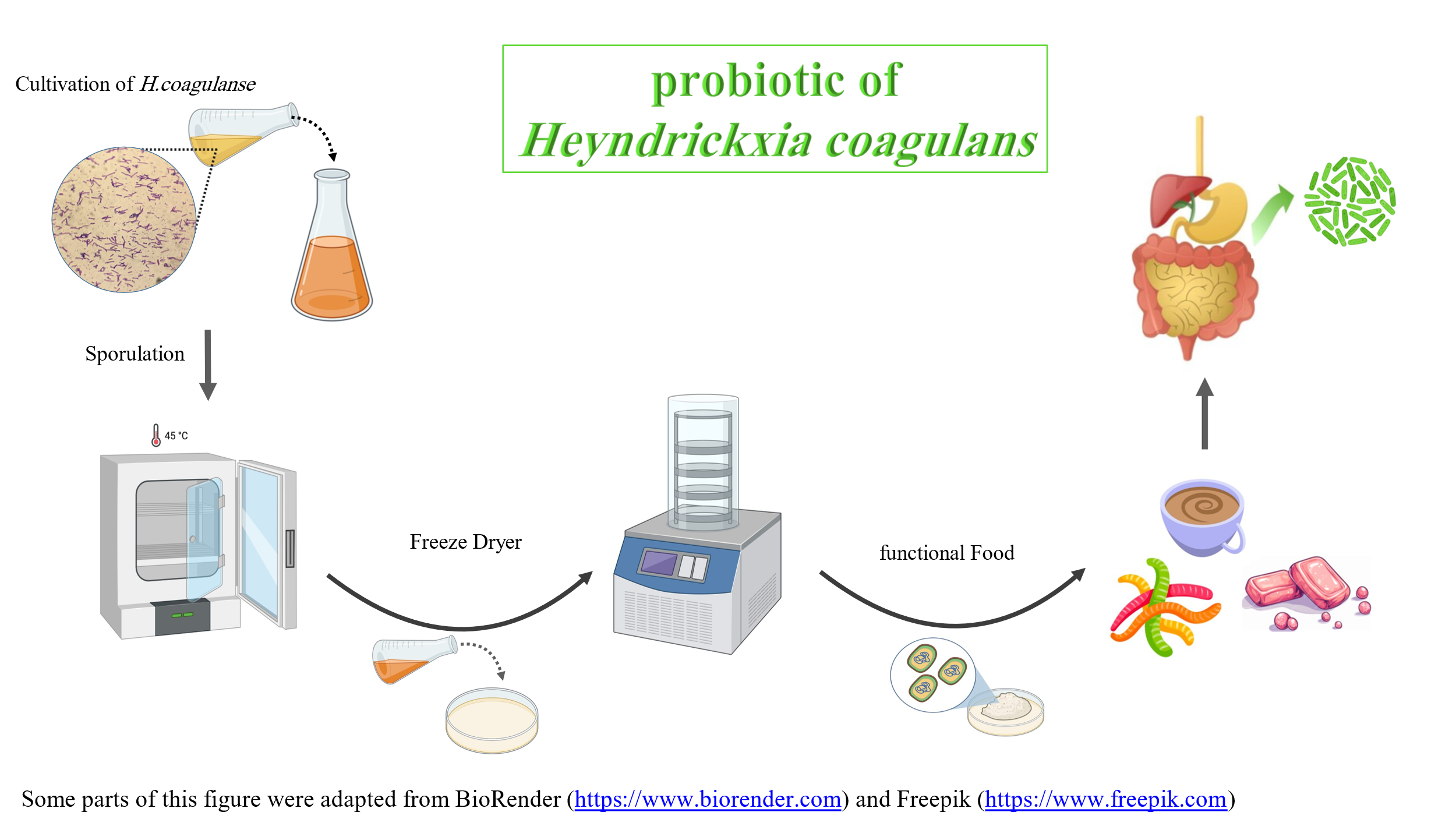
Heyndrickxia coagulans MTCC 5856 was obtained from Maya Zist Farayand Company (Tehran, Iran). The strain was cultured in a modified medium containing (g/L): glucose 40, yeast extract 13.33, tryptone 13.33, MgSO₄·7H₂O 0.027, CaCO₃ 20, MnSO₄·H₂O 0.015, FeSO₄·7H₂O 0.024, NaCl 0.013, and sodium acetate (CH₃COONa) 0.67, based on formulation [15]. Stock cultures were preserved in 20% (v/v) glycerol at –80 °C. For inoculum preparation, a single colony was transferred into 10 mL of the same medium and incubated at 37 °C with shaking at 200 rpm for 16 h. This culture was then used to inoculate 100 mL of fresh medium at 5% (v/v), followed by incubation at 37 °C and 200 rpm for 24 h to obtain vegetative cells. For sporulation, the culture was subsequently incubated at 45 °C under static conditions for an additional 24 h. The selected temperature and incubation period were based on prior validation to balance sporulation efficiency and vegetative cell viability, considering both the nutrient composition and typical pH dynamics of medium. Although minor pH shifts occurred during this period, the primary driver for optimizing sporulation was the availability and balance of nutrients, which promoted maximal spore formation. The fermentation and sporulation conditions applied in this study were determined based on previously optimized parameters, as described in a separate manuscript currently under peer review.
2.3. Analysis Methods
2.3.1. Viable counts of H. coagulans
The viable cell count of H. coagulans in each sample was determined by enumerating colony-forming units (CFU). Samples were serially diluted in sterile peptone water, and appropriate dilutions were plated using the pour plate method. Plates were incubated at 37 °C for 24 h, after which colonies were counted and expressed as CFU per gram of sample [16].
2.3.2. H. coagulans Spore resistance
To evaluate the thermal resistance of H. coagulans, the culture medium was subjected to heat treatment at 90 °C for 10 min and then rapidly cooled to 30 °C. This procedure was applied to eliminate vegetative cells while preserving heat-resistant spores. The treated samples were plated using the plate counting, and the plates were incubated at 37 °C for 48 h. Germinated spores formed visible colonies, which were counted and reported as CFU per gram [17].
2.3.3. Statistical methodology
All data were analyzed using Minitab software (version 21.4.2, Minitab LLC, USA), SPSS Statistics (version 26.0, IBM Corp., USA) and Microsoft Excel 2016 (Microsoft Corporation, USA). Results are presented as the mean ± standard deviation of triplicate measurements conducted in two independent experiments. Microbial counts were expressed as log₁₀ CFU/mL or log₁₀ CFU/g. Statistical significance was considered at P < 0.05.
2.4. Kinetics of bacterial growth, investigating pH changes and glucose consumption during bacterial growth
To evaluate the growth kinetics of H. coagulans, the bacterial culture was incubated at 37 °C for 24 h. At 3-hour intervals, samples were taken to determine viable cell counts using the colony enumeration. Simultaneously, pH measurements of the culture medium were recorded using a digital pH meter. Glucose consumption was also monitored during the growth period. To quantify the residual glucose in the culture medium, a standard calibration curve was prepared using a glucose oxidase colorimetric kit (Pars Azmoon, Tehran, Iran) with concentrations of 0.1, 0.2, 0.4, 0.6, 1.0, 1.2, 1.4, 1.6, and 2.0 mg/mL, following the manufacturer’s protocol. Absorbance was measured at 540 nm using a spectrophotometer, and the glucose concentration in culture samples was calculated based on the standard curve at 3-hour intervals [18].
2.5. Investigating the effect of feeding on cell growth and sporulation
To investigate the effect of glucose supplementation on the growth and sporulation of H. coagulans, 250 µL of a 60% (w/v) glucose stock solution was added to 50 mL of culture medium at 3-hour intervals during incubation. Glucose feeding was performed based on the re-measured glucose concentration in the medium at each interval. The populations of vegetative cells and spores were determined at each sampling point using the pour plate method, as previously described.
Glucose was chosen as the feeding substrate since it was already present in the base culture medium, and the aim was to examine how its continued availability might influence bacterial growth and sporulation dynamics.
2.6. Investigating the effect of different protectants on reducing damage to cells before transfer to freeze dryer
The production of probiotic powder typically involves a freezing and drying process, during which dehydration can damage bacterial cell structures such as surface proteins, membranes, and cell walls. To mitigate these effects and enhance cell viability during freeze-drying, various protective agents were tested, including sorbitol, sucrose, inulin, calcium lactate, skim milk, and manganese chloride. Each protectant was added in equal concentration to identical volumes of bacterial suspension, and all samples were treated under the same conditions throughout cultivation and freeze-drying. Samples were initially frozen at –40 °C, then transferred to a freeze dryer and subjected to lyophilization for 18 h. The resulting powders were sealed in airtight polyethylene bags and stored at –4 °C to prevent moisture absorption. To assess the effectiveness of each protectant in preserving spore viability, pour plate culturing was performed on treated samples both before and after heat treatment (90 °C for 10 min). Plates were incubated at 37 °C for 48 h, and colony counts were compared between the different protectants and the control sample without any added protectant. Spore viability was assessed before and after freeze-drying by performing plate counting following heat treatment at 90 °C for 10 minutes to eliminate vegetative cells. Spore viability (%) was calculated by dividing the number of surviving spores after heat treatment by the total initial bacterial population (including vegetative cells and spores) before freeze-drying, and multiplying the result by 100.
2.7. Assessment of bacterial persistence under simulated gastrointestinal conditions
Probiotic microorganisms must survive the harsh conditions of the gastrointestinal tract to exert their beneficial effects. Therefore, the tolerance of H. coagulans to acidic pH, simulated gastric juice, and bile salts was evaluated under laboratory conditions.
2.7.1. Acid resistance:
A fresh culture of H. coagulans was prepared, and 100 µL of microbial suspension was inoculated into 10 mL of culture medium adjusted to pH 2.5 and 4.0. The tubes were incubated at 37 °C, and after 3 h and 4 h, 1 mL of each sample was taken and analyzed using the colony enumeration. Viable cell counts were determined and expressed as CFU/mL. A minimum survival threshold of 10⁶ CFU/mL was considered acceptable [19, 20].
2.7.2. Gastric juice resistance
Simulated gastric juice was prepared using two separate media, each containing 2.3 g of pepsin and trypsin, and 2 g of sodium chloride per liter of distilled water, adjusted to pH 2.0. Control media were prepared with the same composition but adjusted to pH 7.0. Each medium was inoculated with 2% (v/v) of the H. coagulans suspension and incubated at 37 °C. Samples were taken at 0, 1, 2, 3, 4, and 24 h for viable cell count using the plate counting Survival above 10⁶ CFU/mL was considered indicative of resistance.[21]
2.7.3. Bile salt resistance
To assess the tolerance of H. coagulans spores to bile salts, two culture media were prepared containing 0.3% and 0.5% bile oxalate, along with a control medium without bile. Each tube was inoculated with 100 µL of microbial suspension and incubated at 37 °C. Viable cell counts were determined at 0 h and 8 h using the colony enumeration.
The inhibition coefficient (Cinh) was calculated using equation .1 to quantify the inhibitory effect of bile salts on bacterial growth:
Where T₀ and T₈ refer to the log CFU/mL values at time 0 and 8 hours, respectively. A Cinh value ≤ 0.4 indicates acceptable resistance to bile salts [12, 22].
2.8. Evaluation of spore stability in food products
The stability of H. coagulans spores was assessed in two functional food matrices: pastille and coffee mix, during both production and storage processes.
2.8.1. Pastille formulation
The base syrup was prepared by mixing glucose, sugar, and water at 100 °C. This mixture was combined with hydrated gelatin (prepared by dissolving gelatin in boiling water), food-grade coloring, citric acid, and essential oil. After cooling to an appropriate temperature, probiotic powder was added and the mixture was homogenized. The final mixture was poured into molds using a funnel and allowed to set for 24 h at room temperature. For microbiological analysis, randomly selected pastilles were dissolved in sterile peptone water and agitated in a shaker incubator for 1 h. Serial dilutions were then plated using the plate counting and incubated at 37 °C for 48 h. According to standard guidelines, a minimum viability of 10⁶ CFU per 100 g of pastille was considered acceptable.
2.8.2. Coffee mix formulation
Coffee mix powder was prepared from processed coffee beans using either spray drying or freeze drying. To simulate beverage preparation, a known quantity of probiotic powder was mixed with a single-serving coffee sachet (approximately 18 g), dissolved in 150 mL of boiling water, and stirred thoroughly.
To evaluate the stability of H. coagulans spores, samples were plated using the colony enumerationand incubated at 37 °C for 48 h. Colony counts were recorded and used to assess spore survival after exposure to product processing and heat.
- Results and Discussion
3.1. Kinetics of bacterial growth, pH variation, and glucose consumption
To assess the growth behavior of H. coagulans, a batch fermentation was conducted, and key parameters including viable cell count, pH, and glucose concentration were monitored at 3-hour intervals for 24 h. Viable counts were determined by the plate counting, pH was measured using a digital pH meter, and residual glucose levels were quantified via spectrophotometric analysis.
As shown in Figure 1, bacterial growth increased steadily until reaching its peak at 24 h, after which it declined, indicating entry into the death phase. These observations are consistent with the growth kinetics reported [23]. Glucose concentration in the medium decreased rapidly and was nearly depleted by 12 h, suggesting a high metabolic activity during the exponential phase. Following glucose exhaustion, the cells likely shifted to alternative nutrient sources. The pH of the culture medium showed a marked decline during the initial hours of growth, reaching its minimum around 18 h. This decrease corresponds to the accumulation of organic acids, primarily lactic acid, produced during active metabolism. After 18 h, pH levels began to rise slightly, which may be attributed to ammonium production from protein degradation or the consumption of lactate as a secondary substrate. After heat treatment, the final spore concentration was measured at 7.11 log CFU/mL, indicating successful sporulation under the tested conditions.
3.2. Investigation of the Effect of Feeding on Cell Growth and Sporulation
In batch culture, due to the reduction of the initial concentration of food compounds in the culture medium and the lack of control of their concentration, formation and accumulation of the growth inhibitory compounds in the culture medium, bacterial growth quickly leaves the exponential growth phase and enters the stationary phase. Research has shown that employing a fed-batch culture method, which involves controlling nutrient concentrations, especially the limiting substrate, can significantly reduce the buildup of growth-inhibitory compounds. This strategy extends the exponential growth phase, ultimately improving the efficiency of the fermentation process.
Therefore, in this research, to increase the number of vegetative cells and subsequently increase sporulation, the effect of the fed-batch process with pulse feeding was investigated on the growth of vegetative cells. Feeding was done according to the amount of glucose in the culture medium.
According to the results illustrated in Figure 1, glucose was nearly completely consumed at 12 hours of fermentation. So, the first pulse feeding of glucose was initiated at this time. The glucose concentration in the culture medium was measured hourly, and approximately every three hours, when glucose was nearly depleted, an additional pulse of glucose was added to the culture. At that point, 250 μl of 60% glucose solution was added to 50 mL of the culture medium, after which the cell population was examined. Figure 2 shows the effect of feeding on pH changes and bacterial growth.
A comparison of the results in Figures 1 and 2 indicates that although the bacterial growth rate has increased, the difference in vegetative cell populations between batch and fed-batch cultures when feeding at 12, 15, 18, 21 h of growth is not significant. This suggests that this kind of feeding had a slight effect on vegetative cell population growth. The pH continued to decline until hour of 24 and, in contrast to the batch process, the culture medium remained acidic throughout.
At hour of 25 of cell growth, the culture medium was subjected to sporulation conditions for 24 h. After this period, pour plate cultures were performed both before and after heat treatment. However, the sporulation results in the fed-batch fermentation process were unsatisfactory; after 48 h, no spores were detected on the plates. While the total cell population before heat treatment was approximately 8.18 log CFU/ml, the vegetative cells did not convert to spores. A carbon source is essential for vegetative cell growth because it helps create an acidic environment. However, increasing its concentration has little effect on enhancing vegetative cell population and can inhibit spore production. This inhibition may be due to the negative effects of the carbon source on the synthesis of compounds necessary for spore formation. A study was conducted on the effect of glucose on the growth and sporulation of Bacillus subtilis. The results indicated that the population of vegetative cells increased with rising glucose concentrations, reaching a peak at 5g/l, after which it remained constant at higher glucose levels. However, the efficiency of spore formation decreased as glucose concentration increased. This is attributed to the fact that up to approximately 5g/l, all the glucose in the culture medium is used by the bacteria until the end of the logarithmic growth phase. Continued glucose consumption leads to reduced spore formation [24]. To directly compare sporulation outcomes between the two cultivation strategies, spore counts were measured after 48 h in both batch and fed-batch systems. Sporulation was observed only under batch conditions, yielding 7.11 log CFU/mL after heat treatment. In contrast, spore formation was entirely absent in the fed-batch culture, as post-heat treatment counts consistently yielded zero colony-forming units. This finding clearly demonstrates that while glucose feeding supported vegetative growth, it completely inhibited the transition to spore formation. As a matter of fact, unlike fed-batch fermentation, where nutrient feeding increases bacterial growth as active vegetative cells, sporulation is induced by starvation and nutrient limitation. Since all fed-batch results were uniformly zero, no comparative figure was included; instead, the outcomes are described textually to avoid redundancy and to ensure clarity of data presentation.
3.3. Effect of cryoprotectants on spore survival during freeze-drying
Various cryoprotectants were tested to improve the survival of H. coagulans spores during freeze-drying by minimizing cellular damage. The protective compounds function by reducing osmotic pressure differences between the intracellular and extracellular environments, thereby preserving cell integrity. In this study, six commonly used cryoprotectants were applied at equal concentrations (w/v), and their effects were compared to a control sample without protectant.
As shown in Table 2 and Figure 3, the presence of cryoprotectants significantly enhanced spore viability post freeze-drying. The sporulation rate increased from 63% in the control group to a maximum of 88% with skim milk. Among all protectants tested, skim milk resulted in the highest survival rate, followed closely by sorbitol. One-way ANOVA followed by Tukey’s post-hoc test was performed to compare survival percentages among the tested cryoprotectants. The results showed that skim milk (88.23%) and sorbitol (84.57%) provided the highest protection, with no statistically significant difference between them (P > 0.05). Both were significantly more effective than inulin (76.14%), sucrose (77.05%), calcium lactate (72.15%), MgCl (71.09%), or the no-protectant control (63.04%) (P < 0.05).
.The superior performance of skim milk in enhancing survival of H. coagulans (88%) can be attributed to its rich content of calcium and proteins. Calcium ions stabilize spore coat structures and maintain cell wall integrity, protecting against mechanical and thermal stresses during freeze-dryingProteins in skim milk form a protective matrix around the spores, mitigating osmotic shock caused by rapid water removal. Together, these components preserve the functionality of spore coat proteins and cell membranes, preventing structural damage and maintaining viability post-lyophilisation. Similar findings were observed in studies on lactic acid bacteria, where mechanistic evaluations demonstrated that protective compounds such as sugars and proteins reduce osmotic stress and stabilize cell structures during freeze- or spray-drying. These components mitigate membrane damage and protein denaturation, thereby improving post-drying survival [10].
The results suggest that skim milk is an effective cryoprotectant for preserving H. coagulans spores during freeze-drying and may be suitable for developing stable formulations.
3.4. Spore stability under simulated gastrointestinal conditions
3.4.1. Acid resistance
To evaluate acid tolerance, H. coagulans spores were exposed to acidic media at pH 2.5 and 4. Samples were collected at 3 and 4hours post-inoculation, and viable spore counts were determined using the plate counting following heat treatment. The initial spore population was 7.5 ± 0.18 log CFU/mL.
As shown in Table 3 and Figure 4, spore viability was higher at pH 4 compared to pH 2.5. This suggests that lower pH increases cellular stress and reduces viability. The observed reduction may be attributed to spore germination followed by inactivation of vegetative cells under harsh acidic conditions. Despite this, more than 90% of spores survived under both pH conditions, and the difference in survival between 3 and 4 hours was not statistically significant.
3.4.2. Simulated gastric juice resistance
The ability of probiotics to survive in gastric juice is a key factor in their functionality. To simulate stomach conditions (pH 2.3), H. coagulans spores were incubated in artificial gastric fluid, and samples were collected at 1, 2, 3, 4, and 24 hours. Viable spore counts were determined using the colony enumeration, and the initial population was 7.5 ± 0.18 log CFU/mL. As illustrated in Table 4 and Figure 5, spore viability remained above 85% even after 24 hours of exposure. The spores did not germinate during the incubation, likely due to the absence of specific germination triggers. This high level of resistance highlights the robustness of H. coagulans spores in simulated gastric conditions.
3.4.3. Bile salt tolerance
To assess bile tolerance, H. coagulans spores were incubated in media containing 0.3% and 0.5% bile salts. Samples were collected at 0 and 8 hours, and viable counts were measured by the plate counting. The initial population was 7.5 ± 0.18 log CFU/mL. Results are shown in Table 5.
The bile salt inhibition coefficient (Cinh) was calculated based on the method described by Mojgani et al. and Sui et al. using the following equation (12, 22):
Cinh = [(T₈ – T₀)control – (T₈ – T₀)treatment] / (T₈ – T₀)control
The calculated values were:
Cinh (0.5%) = [(6.45 – 6.38) – (6.53 – 6.48)] / (6.45 – 6.38) = 0.28
Cinh (0.3%) = [(6.34 – 6.28) – (6.42 – 6.35)] / (6.34 – 6.28) = 0.16
The inhibition coefficients (Cinh) were 0.28 for 0.5% bile and 0.16 for 0.3% bile. Statistical analysis using a paired t-test showed no significant difference between these values (P > 0.05), indicating that H. coagulans MTCC 5856 maintains high viability under both bile concentrations. To assess this, the increase in viable counts over 8 hours was compared between bile-treated and control samples, confirming that the differences were not statistically significant. These results support our conclusion that the spores maintain high viability under gastrointestinal-like bile stress conditions.
Both values were below the threshold of 0.4, indicating acceptable bile salt resistance. Moreover, viable counts slightly increased over time, suggesting that spores not only survived but may have germinated and proliferated under bile salt exposure.
These findings are consistent with previous reports, which demonstrated high survival and germination of H. coagulans spores under simulated gastrointestinal conditions. While our study focused on spore viability under bile salt stress, both studies emphasize that maintaining high spore viability is essential for subsequent germination and functional activity in the gut. The slight increase in viable counts observed over 8 hours in bile-containing media suggests that spores may germinate and proliferate, complementing the high germination rates reported previously [4].
3.5. Stability of H. coagulans spores during production and storage of functional food products
3.5.1. Pastille
To assess probiotic viability in pastille, five samples (each ~2 g) were randomly selected and individually diluted in sterile peptone water. Samples were incubated at 37 °C for 30 minutes with gentle shaking, followed by enumeration of viable spores using the colony enumeration. Plates were incubated at 37 °C for 48 hours. The viable counts are shown in Figure 6. After 6 months of ambient storage, the average survival rate of spores in pastille samples was 85.06%. This high level of survival suggests that H. coagulans spores remained dormant but viable during storage, highlighting their potential for use in heat-processed confectionery products.
3.5.2. Coffee mix
To simulate consumer preparation, one sachet (18 g) of coffee mix was reconstituted in 150 mL of boiling water and stirred thoroughly. The suspension was plated using the pour plate method, and incubated at 37 °C for 48 hours. Results are shown in Figure 7. After 6 months of storage, spore viability remained high at 97.98%, with no significant reduction in count compared to initial levels. The persistence of H. coagulans spores is attributed to their ability to remain dormant under harsh conditions and germinate when conditions become favorable. These results demonstrate the success and applicability of H. coagulans MTCC 5856 in pastille and coffee, highlighting its stability during production and shelf storage and supporting the overarching goal of this study to evaluate its viability in real-world functional food applications. These findings are consistent with previous work, which reported 94% and 99% survival of H. coagulans in brewed coffee and tea, respectively, and over 99% stability in powder form stored at room temperature for up to 24 months [13]. In contrast, a study by Adibpour et al. demonstrated that candies made with non-spore-forming probiotics such as L. plantarum A7 and UBLP-40 failed to retain viable bacteria after production. This comparison emphasizes the superior stability conferred by the spore form and underscores the practical advantage of H. coagulans MTCC 5856 for functional food applications. Slight differences in survival rates between studies may be due to variations in product formulation, storage conditions, or strain-specific characteristics, providing a mechanistic rationale for the observed outcomes [14].
Overall, the findings confirm that H. coagulans MTCC 5856 is a robust probiotic candidate capable of surviving harsh industrial and gastrointestinal environments, making it suitable for incorporation into a variety of functional food formulations.
- Industrial Aspects
From an industrial perspective, the scalability and cost-effectiveness of probiotic production are critical considerations. Although freeze-drying is widely used to preserve spore viability, it represents a cost-intensive process. Alternative drying methods such as spray-drying or fluidized bed drying may provide more economical options for large-scale manufacturing, though their effects on spore survival require further evaluation. In addition, the spores exhibited high resistance to simulated gastrointestinal conditions, including acidic pH, gastric juice, and bile salts, with survival rates above 85%. This intrinsic resilience ensures that probiotics remain viable after consumption, reducing the need for additional protective formulations or complex delivery systems. Maintaining high spore viability during industrial-scale pastille molding and storage is another challenge, as exposure to heat or shear stress can reduce survival. Nevertheless, the present study demons-trated that H. coagulans spores maintained 85% viability in pastille and 98% viability in coffee mix after six months, highlighting their robustness under processing and storage conditions. Importantly, the inherent stability of spores also reduces the need for cold-chain logistics, thereby lowering distribution costs. Taken together, these features underscore the potential of H. coagulans MTCC 5856 as a cost-effective, scalable, and robust probiotic solution for functional food applications, with reliable performance from production to consumer use.
- Conclusion
Functional probiotic products are increasingly favored by consumers due to their role in promoting gut health and overall well-being. However, the effectiveness of such products depends on the viability and stability of the probiotic strains during production, storage, and consumption. This study investigated strategies to enhance the survival and performance of H. coagulans MTCC 5856, a spore-forming probiotic with strong industrial potential. Comparative evaluation of batch and fed-batch fermentation revealed that while glucose supplementation improved vegetative growth, it adversely affected sporulation efficiency. Furthermore, the use of cryoprotectants during freeze-drying significantly influenced spore viability, with skim milk yielding the highest survival rate. The spores demonstrated high tolerance to simulated gastrointestinal conditions, including acidic pH, gastric juice, and bile salts, ensuring functionality after consumption. Incorporation into real food matrices, such as pastille and coffee mix, confirmed long-term stability during product processing and ambient storage, with survival rates of 85% and 98%, respectively. From an industrial perspective, these features (robust spore survival, resistance to gastrointestinal conditions, and stability in functional foods) underscore the strain’s scalability, cost-effectiveness, and suitability for commercial applications. Overall, H. coagulans MTCC 5856 is a robust and viable probiotic candidate capable of maintaining performance from production to consumer use, making it highly suitable for heat-processed and shelf-stable functional food formulations.
Limitations and Future Directions
One limitation of the study is that sporulation optimization conditions could not be disclosed due to overlap with a separate manuscript under review. However, the applied conditions were based on previously validated methods and industry collaboration, ensuring relevance to real-world applications. Additionally, while in vitro resistance to gastric and bile conditions was confirmed, further investigations are needed to fully characterize the probiotic functionality of this strain, including adhesion to intestinal epithelial cells (e.g., Caco-2) and colonization ability in animal models. Future studies could also examine the long-term effects of various cryoprotectants and storage conditions on H. coagulans spore viability across a wider range of food matrices. Moreover, exploring new functional food formulations and optimizing fermentation and processing parameters for industrial-scale production would help translate these findings into commercially viable products. Collectively, these efforts would provide a comprehensive understanding of the strain’s probiotic functionality and support its effective application in functional food development.
- Acknowledgements
The authors thanks to Maya Zist Farayand Company for the strain and providing Master Foodeh Company for help in some analysis. Also, we appreciate Mr Rouzbeh Almasi Ghale, Ms. Maryam Hamidi and Ms. Elham Yavari for their great assistance in collecting data.
- Declaration of competing interest
The authors report no conflicts of interest.
- Authors’ Contributions
Conceptualization, Valiollah Babaeipour and fatemeh tabandeh; Data curation, Nasrin Alizadeh, Valiollah Babaeipour and fatemeh tabandeh; Formal analysis, Nasrin Alizadeh, Valiollah Babaeipour and fatemeh tabandeh; Funding acquisition, Valiollah Babaeipour; Investigation, Nasrin Alizadeh, Valiollah Babaeipour and fatemeh tabandeh; Methodology, Nasrin Alizadeh, Valiollah Babaeipour and fatemeh tabandeh; Project administration, fatemeh tabandeh; Resources, fatemeh tabandeh; Software, Nasrin Alizadeh and fatemeh tabandeh; Supervision, Valiollah Babaeipour and fatemeh tabandeh; Validation, Nasrin Alizadeh, Valiollah Babaeipour and fatemeh tabandeh; Visualization, Nasrin Alizadeh and fatemeh tabandeh; Writing – original draft, Nasrin Alizadeh and fatemeh tabandeh; Writing – review & editing, Valiollah Babaeipour and fatemeh tabandeh.
- Using Artificial Intelligent Chatbots
This manuscript was entirely written and developed by the authors based on original experimental data. During its preparation, the authors used ChatGPT (OpenAI) solely to enhance the grammar and language clarity of certain sentences. All AI-assisted outputs were carefully reviewed and edited by the authors, who take full responsibility for the content of this manuscript.
- Ethical Consideration
This study did not involve human or animal subjects; therefore, ethical approval was not required.
- Batch fermentation
- Freeze-drying
- Functional foods
- Gastrointestinal resistance
- Heyndrickxia coagulans
- Probiotics
- Sporulation
- Spore stability
Cómo citar
Citas
Ma Z F, Fu C, Lee Y Y. The modulatory role of bioactive compounds in functional foods on inflammation and metabolic pathways in chronic diseases. Foods. 2025; 14(5): 821. https://doi.org/10.3390/foods14050821
Liu X, Mao B, Tang X, Zhang Q, Zhao J, Chen W, Zhang W. Bacterial viability retention in probiotic foods: A review. Crit Rev Food Sci Nutr. 2025; 1-23. https://doi.org/10.1080/10408398.2025.2488228
Konuray G, Erginkaya Z. Potential use of Bacillus coagulans in the food industry. Foods. 2018; 7(6): 92. https://doi.org/10.3390/foods7060092
Keller D, Verbruggen S, Cash H, Farmer S, Venema K. Spores of Bacillus coagulans GBI-30, 6086 show high germination, survival and enzyme activity in a dynamic, computer-controlled in vitro model of the gastrointestinal tract. Benef Microbes. 2019; 10(1): 77-87. https://doi.org/10.3920/BM2018.0037
Majeed M, Majeed S, Nagabhushanam K, Punnapuzha A, Philip S, Mundkur L. Rapid assessment of viable but non-culturable Bacillus coagulans MTCC 5856 in commercial formulations using flow cytometry. PLoS One. 2018; 13(2): e0192836. https://doi.org/10.1371/journal.pone.0192836
Majeed M, Majeed S, Nagabhushanam K, Natarajan S, Sivakumar A, Ali F. Evaluation of the stability of Bacillus coagulans MTCC 5856 during processing and storage of functional foods. Int J Food Sci Technol. 2016; 51(4): 894-901. https://doi.org/10.1111/ijfs.13044
Majeed M, Nagabhushanam K, Paulose S, Arumugam S, Mundkur L. The effects of Bacillus coagulans MTCC 5856 on functional gas and bloating in adults: A randomized, double-blind, placebo-controlled study. Medicine. 2023; 102(9): e33109-e33109. https://doi.org/10.1097/md.0000000000033109
Almada -Érix C N, Almada C N, Pedrosa G T S, Biachi J P, Bonatto M S, Schmiele M, Bonatto S. Bread as probiotic carriers: Resistance of Bacillus coagulans GBI-30 6086 spores through processing steps. Food Res Int. 2022; 155: 111040. https://doi.org/10.1016/j.foodres.2022.111040
Madhu A N, Awasthi S P, Bhasker K, Praveen Kumar R, Prapulla S. Impact of freeze and spray drying on the retention of probiotic properties of Lactobacillus fermentum: An in vitro evaluation model. Int J Microbiol Res. 2011; 2(3): 243-251.
Gagneten M, Passot S, Cenard S, Ghorbal S, Schebor C, Fonseca F. Mechanistic study of the differences in lactic acid bacteria resistance to freeze- or spray-drying and storage. Appl Microbiol Biotechnol. 2024; 108(1): 361. https://doi.org/10.1007/s00253-024-13186-3
Zamora L, Carretero C, Parés D. Comparative survival rates of lactic acid bacteria isolated from blood, following spray-drying and freeze-drying. Food Sci Technol Int. 2006; 12(1): 77-84. https://doi.org/10.1177/1082013206062443
Sui L, Zhu X, Wu D, Ma T, Tuo Y, Jiang S, Zhang Z. In vitro assessment of probiotic and functional properties of Bacillus coagulans T242. Food Biosci. 2020; 36: 100675. https://doi.org/10.1016/j.fbio.2020.100675
Majeed M, Majeed S, Nagabhushanam K, Arumugam S, Beede K, Ali F. Evaluation of probiotic Bacillus coagulans MTCC 5856 viability after tea and coffee brewing and its growth in GIT hostile environment. Food Res Int. 2019; 121: 497-505. https://doi.org/10.1016/j.foodres.2018.12.003
Adibpour N, Hosseininezhad M, Pahlevanlo A. Application of spore-forming probiotic Bacillus in the production of Nabat–a new functional sweetener. LWT. 2019; 113: 108277. https://doi.org/10.1016/j.lwt.2019.108277
Chen Y, Dong F, Wang Y. Systematic development and optimization of chemically defined medium supporting high cell density growth of Bacillus coagulans. Appl Microbiol Biotechnol. 2016; 100(18): 8121-8134. https://doi.org/10.1007/s00253-016-7644-z
Bagkar P, Dixit Y, Tiwari A, Gupta AK, Maity C. Process and storage stability of Bacillus coagulans LBSC in food matrices and appraisal of calorific restriction. Appl Food Biotechnol. 2021; 8(1):57-69. https://doi.org/10.22037/afb.v8i1.31212
Majeed M, Majeed S, Nagabhushanam K, Arumugam S, Beede K, Ali F. Comparative evaluation for thermostability and gastrointestinal survival of probiotic Bacillus coagulans MTCC 5856. J Biosci Bioeng. 2020; 130(6): 650-657. https://doi.org/10.1016/j.jbiosc.2020.04.012
Dabaro M D, Demsash H D. Valorization of agro-industrial waste into bioethanol: A case of brewers spent grain. Int J Renew Energy Commercial. 2020; 6(1): 1-20.
de Valdez G F, Taranto M P. Probiotic properties of Lactobacilli: Cholesterol reduction and bile salt hydrolase activity. Food Microbiol Protoc. 2001: 173-181.
Altun G K, Erginkaya Z. Identification and characterization of Bacillus coagulans strains for probiotic activity and safety. LWT. 2021; 151: 112233.
(ISIRI) IoSaIRoI. Microorganisms-probiotics-specifications and test methods (in vitro). Tehran, Iran: ISIRI 19459; 2013.
Mojgani N, Hussaini F, Vaseji N. Characterization of indigenous Lactobacillus strains for probiotic properties. Jundishapur J Microbiol. 2015; 8(2). https://doi.org/10.5812/jjm.17523
Pandey K R, Joshi C, Vakil B V. Statistical optimization for enhanced yields of probiotic Bacillus coagulans and its phage resistant mutants followed by kinetic modelling of the process. SpringerPlus. 2016; 5: 1-12. https://doi.org/10.1186/s40064-016-3325-8
Monteiro S M, Clemente J J, Henriques A O, Gomes R J, Carrondo M J, Cunha A E. A procedure for high-yield spore production by Bacillus subtilis. Biotechnol Prog. 2005; 21(4): 1026-1031. https://doi.org/10.1021/bp050062z
- Resumen ##plugins.themes.ojsPlusA.frontend.article.viewed##: 373 ##plugins.themes.ojsPlusA.frontend.article.times##
- Pdf (English) ##plugins.themes.ojsPlusA.frontend.article.downloaded##: 15 ##plugins.themes.ojsPlusA.frontend.article.times##