Effects of Commercial and Natural Starter Cultures on Physicochemical, Microbiological and Sensory Characteristics of Algerian Edam-type Cheese
Applied Food Biotechnology,
Vol. 13 No. 1 (2026),
7 December 2025
,
Page 1-8 (e12)
https://doi.org/10.22037/afb.v13i1.51819
Abstract
Background and Objective: Traditional cheese-making practices often rely on locally adapted fermentation strategies that contribute to product identity and sensory typicity. This study investigated the effects of commercial and natural starter cultures on the physicochemical, microbiological and sensory characteristics of a locally adapted Edam-type cheese produced under semi-traditional conditions in Algeria.
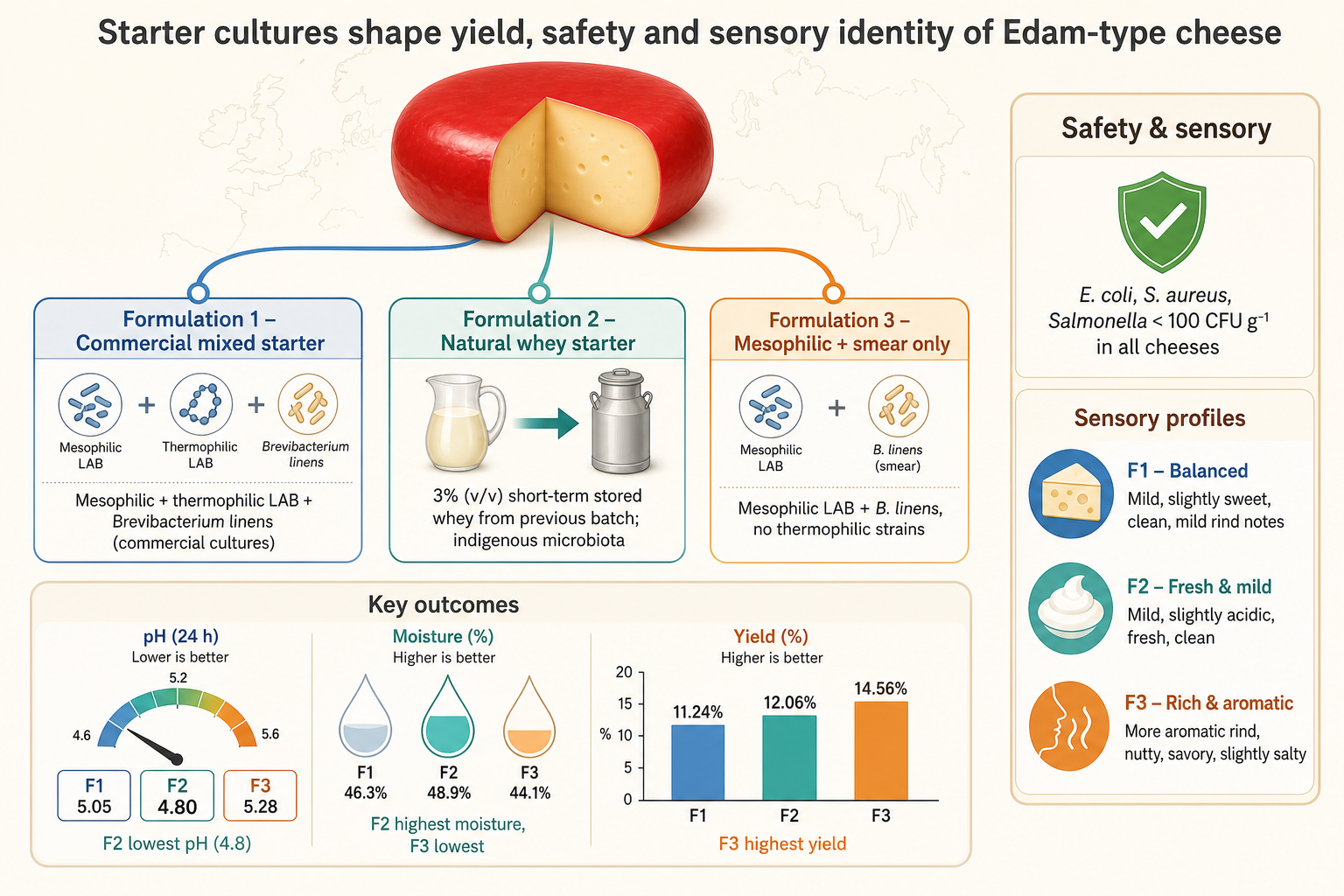
Material and Methods: Three cheese formulations were prepared, using (i) a combination of mesophilic and thermophilic lactic acid bacteria with red smear cultures, (ii) whey from a previous batch used as a natural starter and (iii) mesophilic bacteria with red smear cultures without thermophilic strains. Pasteurized cow milk used for cheese-making met standard physicochemical and microbiological quality requirements.
Results and Conclusion: The resulting cheeses showed significant differences (p < 0.05) in pH (4.8–5.7), moisture content (33.82–38.1%) and yield, depending on the starter culture used. From the three formulations, cheeses produced without thermophilic bacteria showed the highest yield (14.56%). Microbiological analyses verified the absence of Escherichia coli, Staphylococcus aureus and Salmonella in all samples, ensuring product safety. Sensory evaluation showed that cheeses produced with combined mesophilic, thermophilic and red smear cultures included the most balanced texture and flavor, whereas whey-inoculated cheese included characteristics associated with traditional fermented dairy products. These results highlight how starter culture selection and whey reuse shape the sensory identity and technological performance of ethnic Edam-type cheeses, supporting the sustainable valorization of whey within Algerian traditional dairy systems.
Keywords: Edam-type cheese, lactic acid bacteria, natural whey starter, sensory quality, traditional cheese.
- Introduction
Cheese production is one of the most important pathways for milk valorization, providing a wide range of products with distinct technological and sensory characteristics. Cheese is a complex food matrix produced through the coagulation of milk proteins, by either enzymatic action (rennet) or acidification, followed by whey drainage and maturation. The diversity of cheese varieties is originated from variations in milk composition, coagulation processes, microbial communities and aging conditions [1]. The cheese industry aims to transform milk into a long‑lasting, flavorful product through microbial and enzymatic activities, which contribute to its distinctive texture and sensory characteristics.
Traditional cheese production is deeply rooted in agricultural heritage. In Algeria, traditional cheeses are an integral part of the country's dairy culture, reflecting local knowledge and unique processing techniques [2,3]. From these, Edam cheese (a semi-hard-pressed variety) is widely recognized for its characteristic texture and flavor, aligning with international cheese production standards [1].
The popularity of cheese within consumers stems from its desirable sensory attributes, high nutritional value and versatile uses in the food industry [4]. Regarding the critical role of microbial communities in defining cheese quality, it is essential to assess the physicochemical, microbiological and sensory characteristics of cheese to ensure optimal production and consumer satisfaction [5]. Sensory analysis is still an important tool for assessing cheese acceptability and quality [6]. Joudu et al. [6] demonstrated that ripening time leads to important changes in the texture and structure of Edam-type cheese. Mesophilic lactococci are mainly associated to early acidification and flavor development. Thermophilic starters such as Streptococcus thermophilus support rapid lactose fermentation and smear bacteria such as Brevibacterium linens contribute to surface-ripening aroma development [7-9]. In traditional Algerian dairy systems, whey reused as a natural starter introduces an indigenous mixed microbiota that may reinforce local sensory typicity while increasing process variability [2,7]. Despite the widespread production of Edam-type cheese, there is still limited research on how various starter cultures affect the quality of traditional pressed Edam-type cheese under locally adapted processing conditions. Therefore, this study aimed to assess how commercial and traditional starter cultures, including whey as a natural starter, affect the physicochemical, microbiological and sensory qualities of a locally adapted Edam-type cheese produced under semi-traditional conditions.
- Materials and Methods
2.1. Cheese manufacture
The cheese‑making process was inspired by locally adapted artisanal practices commonly used in traditional dairy production, while maintaining controlled hygienic and technological conditions.
2.2. Starter cultures and formulations
Edam-type cheeses were prepared from whole cow milk standardized to 3.5% fat and pasteurized using LTLT, 63 °C for 30 min, then cooled to 32 °C before inoculation. Three Edam-type cheese formulations were assessed in triplicate.
2.2.1. Formulation 1: Commercial mixed starter and smear
Milk was inoculated with a mesophilic starter (Flora Danica; Lactococcus lactis ssp. cremoris, L. lactis ssp. lactis, L. lactis ssp. diacetylactis and Leuconostoc mesenteroides spp. cremoris; Chr. Hansen, Denmark), a thermophilic starter containing S. thermophilus (TA 40 Lyo 50 DCU, Yo-mix Danisco, France) and a red smear culture of B. linens (Chr. Hansen, Denmark), used as freeze-dried commercial cultures based on the manufacturers' recommendations.
2.2.2. Formulation 2: Natural whey starter (short-term storage)
Whey used as a natural starter was collected at the end of the previous batch immediately after whey drainage. The whey was filtered through sterile gauze to remove curd particles, then cooled and stored at 4 °C for 2–4 h (time needed to carry out quality control analyses on the milk). Prior to inoculation, whey physicochemical parameters were assessed as pH = 5.6 ±0.1 and titratable acidity = 18 °D ±2 (approximately 0.18% lactic acid). No preinoculation microbiological enumeration or species-level identification of the whey starter was carry out in the original experiment; accordingly, the natural starter was characterized by its short-term handling conditions and physicochemical screening only. The whey starter was added to pasteurized milk at a rate of 3% (v/v), corresponding to 30 ml per liter of milk. After whey addition, the milk entered the common 20 min activation step at 32 °C before rennet addition.
2.2.3. Formulation 3: Mesophilic starter and smear (without thermophilic strains)
Milk was inoculated with the mesophilic starter (Flora Danica, Chr. Hansen, Denmark) and the red smear culture (B. linens, Chr. Hansen, Denmark) without thermophilic strains, using freeze-dried commercial cultures based on the manufacturers’ recommendations.
2.2.4. Common processing steps
For all three formulations, after starter inoculation the milk was held at 32 °C for 20 min to allow starter activation. Calcium chloride (0.25 ml l-1) and rennet (CHY-MAX, Chr. Hansen, Denmark) were then added to the formula and coagulation proceeded for 30 min at 32 °C. The curd was cut into approximately 1 cm cubes and primary whey was drained for 10 min. Scalding was carry out by gradually increasing the temperature to 38–40 °C over 30 min with gentle stirring. The curd was pressed at room temperature (RT) for 2 h (first pressing), followed by moulding and final pressing overnight (12–16 h) under progressively increasing weight to achieve appropriate consolidation and moisture removal. Cheese blocks were brined in 20% (w/w) brine at 13 °C for 24 h, coated with red wax, ripened for 6 w at 10–13 °C (80–85% RH), then stored at 4–6 °C. A 6-w ripening time was selected as a common early-ripening endpoint for comparing formulations under identical conditions and did not represent full Edam maturation. The cheese-making workflow followed standard semi-hard cheese practice while was consistent with locally adapted artisanal processing conditions [2,10].
2.3. Physicochemical analysis of milk
Milk physicochemical quality was assessed using routine dairy analytical methods [10]. Milk pH was assessed using pH meter. Titratable acidity was investigated using Dornic method and 0.111 N sodium hydroxide and expressed as degrees Dornic. Density was assessed using pycnometer, refractive index was assessed using refractometer, ash content after incineration at 500 °C and total solids were assessed using oven drying at 105 °C to constant mass.
2.4. Microbiological analysis of milk
Microbiological analyses were carried out on milk samples after preparing decimal dilutions in sterile physiological saline (0.85% NaCl). Aerobic mesophilic microorganisms at 30 °C were enumerated on plate count agar based on ISO 4833-1:2013. Thermotolerant coliforms were enumerated on violet red bile lactose agar based on ISO 4832:2006. Staphylococcus aureus was detected on Baird-Parker agar supplemented with egg yolk and potassium tellurite based on ISO 6888-1:2021. Salmonella detection followed ISO 6579-1:2017 after pre-enrichment, selective enrichment and isolation on Hektoen agar. When no colonies were observed on plates, milk results were reported as < 10 CFU ml-1, based on the plated volume and dilution factor.
2.5. Physicochemical analysis of cheese
The pH, dry matter content, ash content, titratable acidity, density, refractive index and fat content of cheese were investigated in triplicate using standard dairy analytical methods [10]. Instrumental texture, objective color, porosity, protein content and shelf-life assessments were not included in the present study and were acknowledged as limitations.
2.6. Microbiological analysis of cheese
The methods for detecting Escherichia coli, S. aureus and Salmonella in cheese were similar to those used for milk after homogenization of 10 g of cheese in 90 ml of sterile physiological saline (0.85% NaCl). For cheese samples, results were reported as < 100 CFU g-1 when no colonies were observed under the analytical conditions.
2.7. Organoleptic analysis
Sensory evaluation was carried out by a panel of 20 trained evaluators (ten males and ten females, aged 25–55 y) familiar with dairy product assessment and experienced in cheese sensory analysis. Cheese samples from each formulation were coded with random three-digit numbers and presented to panelists in a randomized order to minimize order effects. Samples (10–15 g cubes) were served at 10–12 °C under white light in individual booths and unsalted crackers and RT water were provided for palate cleansing between samples [11]. The sensory assessment was handled as a descriptive profile rather than numerical hedonic test. Panelists recorded predefined descriptors covering color, appearance, texture, odor and taste/overall appreciation for each formulation [11]. Because the available sensory dataset consisted of descriptive frequencies rather than numerical hedonic scores, sensory differences were interpreted comparatively and qualitatively.
2.8. Statistical analysis
Each formulation was produced in triplicate. One-way ANOVA was used to assess differences between the three cheese formulations, followed by Tukey's honestly significant difference (HSD) post-hoc test when ANOVA indicated a statistically significant result. P-values less than 0.05 were considered statistically significant. Statistical analyses were carry out using R software.
- Results and Discussion
3.1. Physicochemical analysis of milk
The physicochemical parameters of the pasteurized milk used in this study are summarized in Table 1. The pH value (6.4) verified that the milk complied with the standard pH range of fresh milk (6.0–7.0) as recommended by [12]. The titratable acidity of the milk was recorded as 17 °D, which falls within the standard range (14–18 °D) and the milk density (1.030) was within the acceptable range (1.028–1.035), verifying a good balance between fat and solid contents [13]. The ash content (0.735%) was within the standard range (0.7–0.8%), reflecting the mineral composition of the milk. The total solid extract assessed as 12.9% was within the normal range (10.2–13%) [11], indicating good milk quality. The refractive index of the milk was investigated as 1.348, a value affected by the fat and protein compositions [10].
3.2. Microbiological analysis of milk
Microbiological analysis results (Table 2) indicated that aerobic mesophilic microorganisms, thermotolerant coliforms, S. aureus and Salmonella were all less than 10 CFU ml-1 or absent in 25 ml in the pasteurized milk sample. These findings indicated good hygienic quality, in compliance with [2] and verified that pasteurization was effective in limiting potential contaminants [7].
3.4. Brining time and cheese yields
The brining time varied depending on the type of starter. The cheeses fermented with Formulation 1 including a brining time of 5 h and 37 min (±3 min), while the cheeses prepared with Formulation 2 needed 6 h (±5 min) and the cheeses made with Formulation 3 needed 7 h and 30 min (±6 min) (Table 3). Statistical analysis revealed a significant difference in yield between the various formulations (p < 0.05) (Fig. 1). The highest yield (14.56% ±0.06) was recorded for Formulation 3, followed by Formulation 2 (12.06% ±0.04) and Formulation 1 (11.24% ±0.06), verifying that bacterial composition affects cheese yield [14,15]. Mayo et al. [16] demonstrated that milk coagulation characteristics significantly affected cheese-making efficiency. In this study, since a similar milk was used for all formulations, the observed variations in yield could be attributed mainly to the effect of the bacterial starter cultures.
3.5. Physicochemical characteristics of cheeses
Table 4 presents the physicochemical parameters of the three cheese formulations. The pH values ranged from 4.8 ±0.04 (Formulation 2) to 5.7 ±0.06 (Formulation 1), with a significant decrease in Formulation 2, due to higher lactic acid production. Lower pH was associated to enhanced bacterial metabolism during ripening [17]. This was consistent with the ripening-linked physicochemical changes reported by Joudu et al. [6] for Edam-type cheeses. Titratable acidity ranged between 18 °D ±0.02 and 20.7 °D ±0.03, which was appropriate for cheese maturation [8]. The dry matter content varied from 61.90% ±0.5 (Formulation 2) to 66.18% ±0.4 (Formulation 3), affecting cheese texture and firmness. The moisture content was inversely correlated to the dry matter percentage, with Formulation 2 including the highest moisture (38.1% ±0.03) and Formulation 3 including the lowest moisture (33.82% ±0.05). The variations in rheological characteristics observed in Edam-type cheeses during ripening were consistent with those of Joudu et al. [6], who analyzed changes in these characteristics during the maturation of Edam-type cheeses. The present differences should therefore be interpreted as 6-w ripening outcomes rather than full Edam maturation characteristics. The fat content was highest in Formulation 1 (20% ±0.7) and lowest in Formulation 3 (15.9% ±0.3), indicating that the type of starter affects lipid retention during cheese formation [18,19]. The ash content was highest in Formulation 1 (2.40% ±0.04) and lowest in Formulation 3 (1.60% ±0.01), suggesting variations in mineral retention. The refractive index was consistent in all cheese samples (1.335 ±0.001 to 1.336 ±0.002), indicating similar compositional characteristics [20]. In addition to their technological effects, the observed differences in cheese formulations revealed the effects of fermentation strategy on the typicity of the final product. Cheeses produced using whey as a natural starter showed characteristics commonly associated with traditional fermented dairy products, including enhanced acidity and softer texture. Such attributes were often perceived as markers of authenticity in ethnic and artisanal foods. In contrast, the use of commercial starter cultures resulted in greater standardization and consistency, highlighting the balance between technological control and traditional identity in locally adapted cheese production.
3.6. Microbiological quality of cheese
Microbiological analysis results verified that E. coli, S. aureus and Salmonella were less than the limit of detection (< 100 CFU g-1) in all cheese samples from the three formulations, meeting microbiological safety standards [10]. No colonies characteristic of these pathogens were detected on selective media under the conditions specified in the Methods section. The absence of pathogenic bacteria was attributed to good manufacturing practices, effective pasteurization and the antimicrobial activity of lactic acid bacteria (LAB), which produce organic acids and bacteriocins that inhibit microbial growth [11,21].
3.7. Organoleptic assessment
The sensory evaluation (Fig. 2) showed that cheese made with Formulation 1 included the highest organoleptic quality. The panelists associated this formulation most often with light-yellow color, further hydrating appearance, smooth texture, cheesy odor and the most favorable overall taste profile, compared with Formulations 2 and 3. Formulation 2, produced with the natural whey starter, included hydrating appearance and soft texture but was further frequently associated with higher perceived acidity and less balanced odor profile. Formulation 3, which lacked thermophilic bacteria, showed the driest appearance and lower overall sensory appreciation, with a less pronounced aroma. The results suggested that the combination of mesophilic, thermophilic and red smear bacteria contributed to superior cheese quality, a pattern that was broadly consistent with the sensory differentiation reported by Ercan et al. [5] and technological interpretation frameworks discussed by Possas et al. [18] as well as Thomareis and Dimitreli [19]. The use of a natural whey starter therefore was a feasible traditional alternative, but its sensory expression appeared less standardized than that achieved with the mixed commercial cultures.
- Conclusion
This study investigated the effects of various bacterial starters on the production of semi-cooked pressed Edam-type cheeses and verified that starter culture composition significantly affected cheese yield, physicochemical characteristics and sensory attributes. Physicochemical and microbiological analyses verified the high quality of raw material and final product, as all assessed parameters were within acceptable standards. Sensory evaluation revealed significant differences between the three cheese types, with the best organoleptic quality observed in Edam-types 1, which contained mesophilic, thermophilic and red smear bacteria.
The findings suggested that bacterial starter composition played a critical role in assessing cheese texture, taste and overall quality. The use of whey as a natural starter (Formulation 2) provided an alternative with acceptable characteristics, while the absence of thermophilic bacteria (Formulation 3) negatively affected sensory characteristics. For local producers, these results illustrated the balance between process standardization and preservation of traditional sensory identity.
Future research should investigate the effects of aging duration, temperature variations, various bacterial cultures, proteolysis, lipolysis, whey microbial profiling and objective color, texture, porosity, protein-content and shelf-life assessments to further optimize cheese production techniques and improve product consistency. Because ripening in the present study was limited to 6 w, longer maturation times should be assessed.
From a broader perspective, this study demonstrates that the integration of traditional fermentation practices into the production of locally adapted Edam-type cheese can enhance sensory identity while maintaining microbiological safety and acceptable physicochemical quality. The valorization of whey as a natural starter contributes to the traditional knowledge and supports sustainable dairy production systems. These findings highlight the potential of combining traditional practices with controlled processing to promote culturally significant dairy products within modern food systems.
- Declaration
5.1. Acknowledgements
This report was the result of an applied research project on traditional and industrial cheese productions carried out at University of Science and Technology of Oran - Mohamed Boudiaf. The authors thank the Laboratory of Applied Microbiology, Faculty of Natural and Life Sciences, University of Oran1 Ahmed Ben Bella, for providing laboratory and pilot-scale cheese-making facilities.
5.2. Data availability
The datasets generated during and/or analysed during the current study are available from the corresponding author on reasonable requests.
5.3. Funding
This research received no specific grant from any funding agency in the public, commercial or not‑for‑profit sector.
5.4. Financial interests
The authors declare no financial interests.
5.5. Declaration of competing interest
The authors have no competing interests to declare that are relevant to the content of this article.
5.6. Authors’ Contributions
Nebia Zebboudj: conceptualization, methodology, cheese production, data curation, writing – original draft. Hanane Fatma Chentouf: supervision, methodology, validation, writing – review and editing. Wassim Yezli: formal analysis, visualization, statistical analysis, writing – review and editing; corresponding author. Abdelatif Boudra: supervision, resources, project administration, writing – review and editing.
5.7. Using Artificial Intelligent Chatbots
AI language models were used only for language editing and proofreading. The authors carefully checked all AI-assisted text and remain fully responsible for the scientific content and conclusions.
5.8. Ethical Consideration
This article did not contain any studies with human participants or animals carry out by any of the authors. Therefore, formal ethics committee approval was not needed.
- Edam-type cheese
- lactic acid bacteria
- natural whey starter
- sensory quality
- traditional cheese
How to Cite
References
1. Fox PF, McSweeney PL, Cogan TM, Guinee TP. Cheese: chemistry, physics and microbiology. Vol. 1: General aspects. Elsevier, London, 2004: 1-617. https://doi.org/10.1007/978-1-4615-2650-6
2. Leksir C, Boudalia S, Moujahed N, Chemmam M. Traditional dairy products in Algeria: case of Klila cheese. J Ethn Foods. 2019; 6(7): 1-14. https://doi.org/10.1186/s42779-019-0008-4
3. El-Aidie S, Elzeini H, Norizzah AR, El-Garhi HEM. Effect of starter culture types on textural, rheological and melting properties of spreadable processed cheese made from UF milk retentate. Egypt J Food Sci. 2021; 49(1): 141-156. https://doi.org/10.21608/ejfs.2021.44323.1080
4. El-Bakry M, Sheehan J. Analysing cheese microstructure: a review of recent developments. J Food Eng. 2014; 125: 84-96. https://doi.org/10.1016/j.jfoodeng.2013.10.030
5. Ercan D, Korel F, Yüceer YK, Kınık Ö. Physicochemical, textural, volatile and sensory profiles of traditional Sepet cheese. J Dairy Sci. 2011; 94(9): 4300-4312. https://doi.org/10.3168/jds.2010-3941
6. Jõudu I, Henno M, Kaart T, Veskioja A, Ots M. Changes in rheological properties of Edam-type cheese during ripening. Agric Food Sci. 2017; 26(4): 198-206. https://doi.org/10.23986/afsci.63132
7. Leroy F, De Vuyst L. Lactic acid bacteria as functional starter cultures for the food fermentation industry. Trends Food Sci Technol. 2004; 15(2): 67-78. https://doi.org/10.1016/j.tifs.2003.09.004
8. Nugroho ADW, Kleerebezem M, Bachmann H. Growth, dormancy and lysis: the complex relation of starter culture physiology and cheese flavour formation. Curr Opin Food Sci. 2021; 39: 22-30. https://doi.org/10.1016/j.cofs.2020.12.005
9. Ritschard JS, Schuppler M. The microbial diversity on the surface of smear-ripened cheeses and its impact on cheese quality and safety. Foods. 2024; 13(2): 214. https://doi.org/10.3390/foods13020214
10. Lapointe-Vignola C. Science et technologie du lait: transformation du lait. Presses Inter Polytech, Montréal, 2002: 1-620.
11. Watts BM, Ylimaki GL, Jeffery LE, Elias LG. Méthodes de base pour l'évaluation sensorielle des aliments. CRDI, Ottawa, 1991: 1-155.
12. Ikonen T, Ruottinen O, Syväoja EL. Effect of milk coagulation properties of herd bulk milks on yield and composition of Emmental cheese. Agric Food Sci. 1999; 8(4-5):411-422. https://doi.org/10.23986/afsci.5638
13. Journal Officiel de la République Algérienne. Critères microbiologiques relatifs à certaines denrées alimentaires: légumes, fruits, végétaux et produits à base de végétaux. J Off Repub Algérienne. 2017; 39: 3-15. Available from: https://www.joradp.dz/FTP/JO-FRANCAIS/2017/F2017039.pdf
14. Liang Q, Zhou W, Peng S, Liang Z, Liu Z, Zhu C, Mou H. Current status and potential of bacteriocin-producing lactic acid bacteria applied in the food industry. Curr Res Food Sci. 2025; 100997. https://doi.org/10.1016/j.crfs.2025.100997
15. Lortal S, Boudier JF. La valorisation de la matière première lait, évolution passée et perspectives. Innov Agron. 2011; 13:1-12. https://doi.org/10.17180/8q6r-2d11
16. Mayo B, Rodríguez J, Vázquez L, Flórez AB. Microbial interactions within the cheese ecosystem and their application to improve quality and safety. Foods. 2021; 10(3):602. https://doi.org/10.3390/foods10030602
17. Medjahdi K, Didouh N, Araujo R. Pasteurized milk: a highlight on potential sources of contamination by aerobic spore-forming bacteria. Food Control. 2025; 111134. https://doi.org/10.1016/j.foodcont.2025.111134
18. Possas A, Bonilla-Luque OM, Valero A. From cheese-making to consumption: exploring the microbial safety of cheeses through predictive microbiology models. Foods. 2021; 10(2):355. https://doi.org/10.3390/foods10020355
19. Thomareis AS, Dimitreli G. Techniques used for processed cheese characterization. In: Processed cheese science and technology. Woodhead Publishing, Cambridge, 2022:295-349. https://doi.org/10.1016/B978-0-12-821445-9.00007-8
20. Vuillemard JC. Science et technologie du lait. Québec: Presses de l’Université Laval; 2018. https://doi.org/10.1515/9782763736341 [French].
21. Yap PC, MatRahim NA, AbuBakar S, Lee HY. Antilisterial potential of lactic acid bacteria in eliminating Listeria monocytogenes in host and ready-to-eat food application. Microbiol Res. 2021; 12(1):234-257. https://doi.org/10.3390/microbiolres12010017
- Abstract Viewed: 123 times
- Pdf Downloaded: 26 times