Effect of Different Types of Herbal Infusions on Functional Properties of Kombucha Fermented Beverages: Antibacterial, Antifungal and Antioxidant Characteristics
Applied Food Biotechnology,
Vol. 13 No. 1 (2026),
7 Azar 2025
,
Page 1-13 (e7)
https://doi.org/10.22037/afb.v13i1.51579
Abstract
Background and Objective: The type of substrate, fermentation conditions and microbial flora can affect the functional properties of fermented beverages. Therefore, this study aimed to compare the microbiological, chemical, antioxidant and antimicrobial properties of kombucha beverages produced from four herbal infusions (Green tea, Black tea, Lemon verbena and Shirazi thyme) and investigate the effects of fermentation on altering herbal infusions characteristics.
Material and Methods: Various herbal teas were fermented for 12 days after inoculation with the kombucha starter culture at 28°C. Total phenolic compounds and antioxidant activity were measured by Folin–Ciocalteu assay and DPPH free radical scavenging activity before and after fermentation of herbal infusions, respectively. Also, antibacterial activity against pathogenic gram-positive and gram-negative bacteria was evaluated by the well-diffusion method. Antifungal activity of various herbal infusions and Kombucha beverages against Aspergillus niger and Aspergillus flavus was analyzed by agar dilution and well-diffusion methods.
Results and Conclusion: The pH of different herbal infusions decreased significantly after fermentation. Total phenolic compounds increased markedly during fermentation, reaching 65.82–153.38 mg GAE.L-1 in the Kombucha samples, and green tea Kombucha indicated the highest value. Microbial analysis revealed that the highest microbial population in all Kombucha samples belonged to acetic acid bacteria (10⁶–10⁷ CFU.mL-1), followed by lactic acid bacteria (10⁴–10⁵ CFU.mL-1), and yeasts (10⁵ CFU.mL-1). Green tea infusion and its Kombucha beverage showed the strongest DPPH scavenging capacity. Unlike herbal infusions, all Kombucha beverages revealed antifungal and antibacterial activity. According to these findings, fermentation significantly enhanced the functional, antioxidant, and antimicrobial properties of herbal infusions and green tea Kombucha was introduced as a considerably promising functional food preservative.
Keywords: Herbal infusion, Functional beverage, Fermentation, Antioxidant, Antimicrobial activity
- Introduction
Kombucha is a traditional fermented, acidic drink with a relatively sweet taste, which has been popular in countries such as China, Russia, Japan, and Germany in the past due to its health-promoting properties. Today, the desire to consume this functional drink has increased in many countries, due to its antioxidant, antimicrobial, anticancer, antidiabetic, liver detoxification, cholesterol and blood pressure-lowering properties, and in the treatment of many heart diseases and insufficiency. Kombucha is the result of the fermentation of sweetened herbal tea for 7-14 days at 28-30 °C by acetic acid bacteria (AAB) (Acetobacter, Gluconobacter), lactic acid bacteria (LAB) and yeasts (Candida, Pichia, Saccharomyces, Schizosaccharomyces, Zygosaccharomyces, Brettaniomyces, and Torula) that exist symbiotically in the SCOBY (symbiotic culture of bacteria and yeast). The type of tea, sweetener, microorganisms, and fermentation conditions can affect Kombucha drink characteristics, including its chemical composition, color, flavor, and microbial flora [1]. In a recent study, Li et al. comprehensively compared microbial community and quality of kombucha from four different regions of China. This study identified 197 indigenous yeast and bacterial strains and demonstrated that fermentation time strongly influenced color, phenolic composition, volatile profiles, and antioxidant activity [2].
Although black tea (Camellia sinensis) is the most common substrate, interest in using alternative herbal infusions is growing, driven by the potential to improve bioactivity and diversify sensory profiles [3]. In a study, the antibacterial and antioxidant activities, as well as the chemical composition of kombucha beverages prepared from linden (lime tree), chamomile, nettle, St. John’s wort, rockrose (Cistus spp.), and green tea were comparatively evaluated [4]. SCOBY mediated fermentation significantly alters the chemical composition of herbal Kombucha, leading to notable changes in sugars, organic acids, and an increase in essential minerals such as iron, magnesium, and calcium. However, the type of herbal or plant waste infusion, such as mint, nettle, blackcurrant leaf, and banana peel, was identified as a key factor influencing the antioxidant potential and sensory attributes of the resulting beverages [5, 6].
Plant infusions such as green tea (Camellia sinensis), lemon verbena (Aloysia citrodora), and thyme (Thymus vulgaris) contain high levels of polyphenolic compounds and essential oils with well-documented antibacterial, antifungal, and antioxidant effects [7, 8]. The integration of these herbal extracts into Kombucha fermentation may influence both the microbial dynamics of SCOBY and the biochemical composition of the final product [9]. Several studies have investigated the antimicrobial and antioxidant potential of Kombucha brewed from black and green tea [10, 11], and some have examined chemical and biological characteristics of Kombucha derived from herbal infusions such as peppermint, oregano, sage, winter savory, stinging nettle, elderberry, quince and yarrow [12-14]. All of these studies have emphasized the effect of substrate type on the formation of beneficial and health-promoting compounds during Kombucha fermentation. Also, various antimicrobial activities of Kombucha beverages were reported in some studies due to the presence of organic acids, phenolic compounds, microbial protein and enzymes [15, 16].
Kombucha fermentation is a combination of three processes: lactic, alcoholic, and acetic acid fermentation. During tea fermentation, yeasts in the medium first convert sucrose, which can be consumed as a sweetener, into glucose and fructose, and then, by consuming glucose, ethanol and carbon dioxide are produced in the drink. The concentration of ethanol produced is usually less than 1%, which is oxidized by acetobacteria and leads to the production of acetic acid and acetaldehyde. In addition, glucose is also converted to gluconic acid by acetobacteria. Gluconic acid has been of interest in various studies in recent years due to its detoxification properties. This acid can remove various types of toxic substances, such as pollutants, chemicals, excess steroid hormones, and bilirubin from the human body through the urinary system. Gluconic acid is considered a precursor to vitamin C. In addition, gluconic acid can be converted into glucosamine, which is a useful substance related to the synthesis of cartilage, collagen, and interarticular fluids that are effective in the treatment of osteoarthritis. Lactic acid is another metabolite produced by LAB during the fermentation of glucose and sucrose [17]. As mentioned before, Kombucha contains a variety of compounds, including organic acids, amino acids, simple sugars, caffeine, tannins, phenolic compounds, folic acid, minerals, and vitamins C and B. Therefore, despite the active and health-promoting compounds mentioned in Kombucha, the use of this fermented beverage and its starters in the formulation of various foods can have a positive effect on their nutritional, quality, and shelf life as a novel biopreservation [18-22].
To produce Kombucha traditionally, black or green tea waste is usually used. Recently, Kombucha drinks based on various medicinal plants such as Thyme, Peppermint, and Lemon verbena, etc., are also been produced and marketed in Iran. However, there is limited information about functional properties such as phenolic components, antioxidants, antibacterial, and antifungal activities of various types of Iranian Kombucha beverages. Shirazi thyme (Zataria multiflora Boiss.) is one of the best-known medicinal plants in Iran from the mint family; most of its therapeutic, antimicrobial, and antioxidant properties are attributed to the presence of phenolic compounds such as thymol and carvacrol in it [23]. Lemon verbena (Aloysia citrodora) is also an aromatic plant from the Verbenaceae family that can be cultivated in different regions of Iran. The leaves and flowering tops of this plant have medicinal properties, and its essential oils are rich in flavonoid compounds [24].
According to our current knowledge, there is limited information to compare the microbiology, antioxidant, and antimicrobial activity of herbal infusions before and after fermentation with Kombucha starters. Given the importance of the type of herbal tea on the properties of Kombucha, research in this area is necessary and continues. Therefore, this study aims to compare the microbiology, antioxidant, antibacterial, and antifungal properties of different types of Kombucha fermented beverage produced from four herbal infusions (green tea, black tea, lemon verbena, and Shirazi thyme). In addition, the total phenolic content, antioxidant, and antimicrobial activity of four unfermented herbal infusions are compared before the production of kombucha beverages.
- Materials and Methods
2.1. Materials
Black Tea, green tea, lemon verbena, and thyme were purchased from Mashhad local market. Chemical material and microbial culture medium were obtained from Merck company.
2.2.Various herbal infusions and Kombucha production
In this study, four different types of Kombucha were prepared based on the formulation proposed by Cardoso et al., with slight modifications [25]. First, 80 g of sugar was dissolved in 1 L of water (95 °C) and 5 g of each dried herbal leaf, including black tea, green tea, Lemon verbena, or Shirazi thyme, was added, and the infusion was filtered through a strainer filter after 10 min. After cooling the infusion to 25 °C, the SCOBY Kombucha (4% w.v-1) and 40 mL of previously produced Kombucha drink as a starter were inoculated and placed in a dark place at ambient temperature (28°C) for 12 days to ferment. Finally, a newly formed scoby was removed from the surface, and all Kombucha beverages were stored at 4 °C after passing through a strainer until the tests were performed. It should be noted that unfermented herbal infusions without sugar were used as controls in various tests in this study.
2.3. Microbiological characterization
To determine the microbial flora of the produced Kombucha samples, after preparing serial dilutions, enumeration of LAB, AAB, and yeasts were performed on MRS agar (Man Rogosa Sharpe, Liofilchem, Italy) (37°C for 48 h), glucose yeast extract agar (glucose 50 g.L-1, yeast extract 10 g.L-1, and agar 20 g.L-1) (30°C for 48 h), and yeast glucose chloramphenicol agar (YGC agar)(Condalab, Spain) (25°C for 72 h), respectively. The population of each group of microorganisms in the Kombucha beverage was reported as Log CFU.mL-1.
2.4. pH and total acidity
The total acidity of each Kombucha beverage was determined by titration with standardized 0.01N NaOH and phenolphthalein as an indicator. The titrant was added dropwise until the pH reached 8.0, which was selected as the endpoint. The total acidity was calculated and expressed as g of acid / per L of sample (g.L-1). All titrations were performed at room temperature (~25 °C). The pH was determined by a previously calibrated pH meter and in triplicate to ensure reproducibility.
2.5. Total phenolic content
The Folin-Ciocalteu method was used to measure the total phenolic content of the produced Kombucha and herbal infusions samples. For this purpose, 0.5 mL of each sample was added to 2.5 mL of Folin-Ciocalteu reaction solution (0.2 N) in a test tube. After 5 min at room temperature, 2 mL of sodium carbonate (7.5% w.v-1) was mixed with the previous solution. After incubation for 30 min and the color change of the solution, the absorbance was measured at 760 nm. Total phenolic content was determined in terms of gallic acid equivalents using a gallic acid standard curve. The results were expressed as mg of gallic acid equivalents per mL of each Kombucha beverage (mg GAE.mL-1) [25].
2.6. Antioxidant activity
First, 0.2 ml of filtered Kombucha sample or each herbal infusion was added to 2.8 ml of 0.1 mM ethanolic DPPH solution and after mixing with a shaker at room temperature, it was kept in a dark place for 30 minutes. Distilled water was used as a control in this test. Then, the absorbance of each of the tested solutions was measured at 517 nm and the percentage of DPPH radical scavenging activity was calculated with Eq. 1 [26].
DPPH scavenging activity (%) = [A control- A sample/ A control] ×100 Eq. 1
2.7. Antimicrobial activity
2.7.1. Antifungal activity
The antifungal properties of the Kombucha samples and herbal infusions against two common spoilage molds, Aspergillus niger (PTCC 5010( and Aspergillus flavus (PTCC 5004(, were investigated by well diffusion and agar dilution methods. In the well diffusion method, after inoculating the spore suspension (100 μL) of each of the molds (104 spores.mL-1) on the surface of the YGC agar medium, wells were created on its surface with a sterile cork borer and 100 μL of each sample was inoculated into them. After the plates were incubated for 72 h at 25 °C, the diameter of the inhibition zone was measured with a ruler and reported in mm [27].
Also, in the agar dilution method, various concentrations of Kombucha or herbal infusion samples (10 – 40 % (v.v-1)) were added to molten YGC agar and poured in plates to solidify. Then, a blank disk was placed in the center of the plate and 10 μl of spore suspension of each mold (104 spores.mL-1) was inoculated into it. In this test, a YGC agar plate without Kombucha was used as a control. After 96 h of incubation at 25°C, the diameter of mold growth in the plates was measured and the percentage of growth inhibition in the presence of Kombucha or herbal infusion samples was calculated with Eq. 2 [28].
Inhibition of mold growth (%) = 1- (mold growth diameter in treatment plate /mold growth diameter in control plate) ×1 Eq. 2
2.7.2. Antibacterial activity
The antibacterial activity of various Kombucha and herbal infusion samples against gram-negative (Escherichia coli (PTCC 1399), Salmonella entritidis (PTCC 1709)) and gram-positive (Listeria monocytogenes (PTCC 1298), Staphylococcus aureus (PTCC 1431)) foodborne pathogenic bacteria was evaluated by the well diffusion method. First, each stock culture of the pathogenic indicator bacteria was activated in Muller-Hinton broth (MHB) medium for 24 h at 37 °C. Then, 100 μL of overnight bacterial culture at a concentration 1.5 × 10⁸ CFU.mL-1 (0.5 McFarland) was inoculated onto the surface of Muller-Hinton agar (MHA) medium and spread well using a sterile swab. Then, wells with a diameter of 6 mm were created in the culture medium using a cork borer and 100 μL of filtered Kombucha was injected into them. All plates were transferred to an incubator at 37 °C. After 24 h, the inhibition zone around the wells was measured using a ruler and reported in mm [16].
2.8. Statistical analysis
In the present study, all tests were performed with three replications. Data analysis was performed using a completely randomized design using SPSS version 23. Analysis of variance (ANOVA) was used to determine significant differences at a 95% confidence level, and Duncan's test was used to compare means. Graphs and tables were drawn using Microsoft Excel version 2020. Moreover, Pearson’s correlation coefficients (r) were calculated to assess the relationships among chemical parameters, bioactive compounds, functional properties, and microbial populations in herbal infusions before fermentation and kombucha beverages after fermentation. Two-tailed tests were applied, and statistical significance was set at p < 0.05 and p < 0.01.
- Results and Discussion
3.1. Microbiological characterization
The microbial evaluation of four types of Kombucha demonstrated that the population of LABs varied between approximately 104-105 CFU.mL-1, and the highest number of LABs was observed in BTK (4.89 ± 0.24 Log CFU.mL-1) and GTK (4.85 ± 0.31 Log CFU.mL-1), with no significant difference (P > 0.05), respectively. Moreover, there was no significant difference among the yeast population (5.29 ± 0.36 – 5.43 ± 0.35 Log CFU.mL-1) in the four types of Kombucha (P > 0.05). The highest frequency belonged to the AAB and varied between 6.59 ± 0.47-7.35 ± 0.35 Log CFU.mL-1 in the different studied Kombucha samples (Fig. 1). In the study by Cardoso et al., the population of LAB, AAB, and yeasts in two types of Kombucha (black tea and green tea) after 10 days of fermentation at 25 °C was reported to be about 105-106 CFU.mL-1 [25]. Also, Zhao et al. calculated the number of mesophilic bacteria as 106 CFU.mL-1 and yeasts as 105 CFU.mL-1 in Kombucha after 10 days of fermentation [29]. This is while higher populations of AAB and LABs, as well as yeasts (107 CFU.mL-1) were obtained in the study by Neffe-Skocińska et al. [30] under similar fermentation conditions. This difference observed in different studies is likely due to differences in the amount of sweetener, type of herbal infusion, initial inoculum (amount of SCOBY and previously produced Kombucha as starter), and fermentation conditions and time. The study of Jafari et al. confirmed the presence of 3 species of yeasts, 2 species of AABs and 3 species of LABs in black tea kombucha after 14 days of fermentation [31].
3.2. pH and acidity
According to Table 1, the herbal tea infusion samples exhibited pH values ranging from 6.54 to 7.60. As shown in Table 2, the pH of the Kombucha samples varied between 2.63-2.82, and there was no significant difference in this regard among the different treatments (P > 0.05). The lowest and highest pH belonged to the GTK and STK Kombucha samples, respectively. Also, the pH of all Kombucha samples was suitable for human consumption of fermented beverages (pH > 2.5). At pH values < 2.5, the health of consumers will be at risk due to the high concentration of acetic acid. Similarly, at pH > 4.4, the microbiological safety of the beverage will be at risk [32]. The highest and lowest acidity were also related to GTK and STK Kombucha, respectively. Overall, there was a significant difference between the acidity of GTK and other Kombucha samples (P < 0.05). One of the factors that determines the end of the fermentation time of a fermented Kombucha beverage is the titratable acid level reaching about 4 to 6 g.L-1 [33]. During the preparation of Kombucha, sugars are consumed by microorganisms such as AAB and LAB as well as yeasts and are converted into organic acids such as acetic acid, lactic acid, gluconic acid, etc. Therefore, following the fermentation of sweet tea, a decrease in pH and an increase in acidity occur. Instead of the yeast population, the largest population of AAB and LABs was observed in GTK and BTK samples, which could be the reason for producing more acid. Similarly, in the study by Cardoso et al. [25], green tea Kombucha had a lower pH and higher acidity compared to black tea Kombucha. They attributed the difference in the acidity of the Kombuchas to the difference in the abundance of AAB and LAB populations in these two types of beverages and their ability to produce organic acids. According to their report, the populations of AAB, LAB, and yeasts in green tea Kombucha were higher than those of black tea, but no significant difference was observed between them. In fact, the microbial population of the Kombucha sample at the end of fermentation depends on the type and content of sugar, herbal tea, and the amount of inoculation of SCOBY and abundance of various strains of AAB, LAB, and yeasts in it, as well as the fermentation conditions (time and temperature).
3.3. Total phenol content
Chemical compounds consisting of at least one aromatic ring with at least one hydroxyl group constitute phenolic compounds. They belong to secondary metabolites synthesized in plants and can be divided into different subgroups, including simple phenols, phenolic acids, flavonoids, coumarins, lignins, and tannins. The total phenol content (TPC) of herbal tea infusions and the four Kombucha samples was determined by the Folin-Ciocalteu method and a gallic acid standard curve. There was a significant difference between the TPC of herbal infusion samples and also Kombucha samples (P < 0.05). The TPC of herbal tea infusion samples varied considerably, with the lowest value observed in LV (27.71 ± 0.53 mg GAE. L-1) and the highest in GT (70.53 ± 1.07 mg GAE. L-1) (Table 1). Following fermentation and Kombucha production, TPC increased markedly. The TPC results revealed a significant difference among Kombucha beverages that varied between 65.82±0.93 to 153.38±1.07 mg GAE. L-1 (Table 2). The highest and lowest TPC were assigned to GTK and LVK, respectively. The TPC of GTK was 18, 57.8, and 32.87 % higher than that of BTK, LVK, and STK, respectively (Table 2). In addition to increasing acidity, the fermentation led to an increase in the TPC of herbal tea infusions. In this study, TPC of GTK, BTK, LVK, and STK was 2.47, 2.17, 2.37, and 2.14 higher than GT, BT, LV and ZM infusions, respectively. Similarly, Kim et al. stated that the TPC of Kombucha samples (70.87- 250.52 µg GAE. mL-1) prepared by inoculation of various AAB and yeasts was 1.27‒3.53-fold higher compared with black tea infusion [33]. The TPC of studied herbal infusions is related to the inherent presence of phenolic and flavonoid compounds in these medicinal plants.
The increase in TPC during Kombucha fermentation could be attributed to several microbial activities. Microbial enzymes hydrolyze complex polyphenols into simpler and more soluble phenolic components, while microbial metabolism generates additional phenolic compounds such as gallic and caffeic acids. The results of all these changes during fermentation are an enhancement in TPC [35-37].
3.4.Antioxidant activity
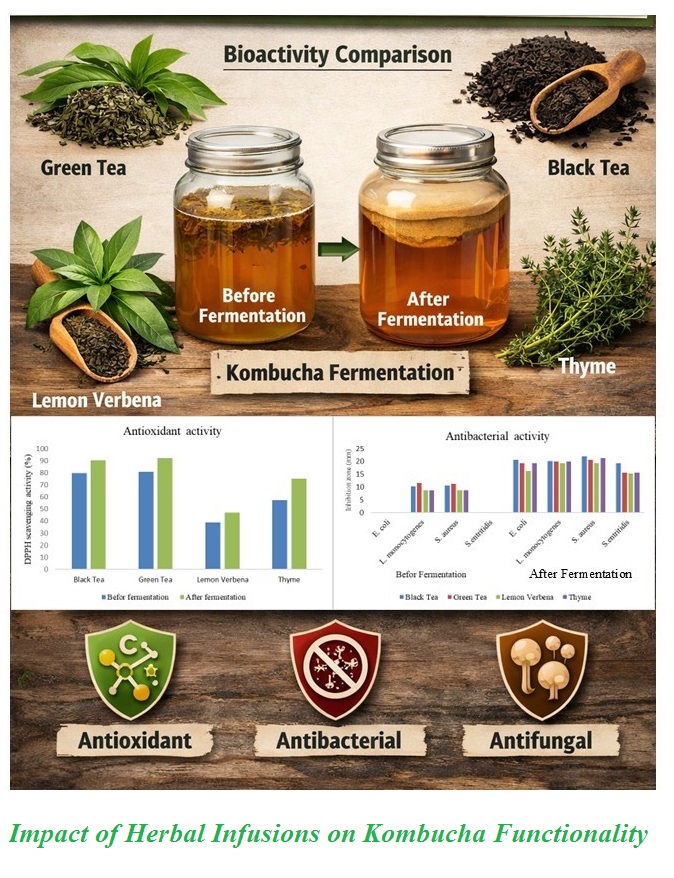
According to Fig. 2, the antioxidant activity of the four types of Kombucha samples was varied (47.13 – 92.11 %). The GTK had the highest DPPH free radical scavenging capacity (92.11%). This feature can be attributed to the presence of more phenolic compounds in green tea compared to other herbal teas, as confirmed in the previous section. There was no significant difference between the antioxidant properties of BTK and GTK, unlike LVK and STK. Similar results were observed for herbal diffusions (Fig. 3). The highest and lowest DPPH scavenging activity belonged to GT (81.01 %) and LV (38.91 %), respectively. Due to the fermentation of sweetened herbal infusions during Kombucha preparation by fermenting microorganisms such as AABs, LABs and yeasts, production of various organic acids and phenolic compounds had occurred, which could increase the antioxidant capacity of the beverage. Generally, these components are active as electron donors and could scavenge the DPPH free radicals. In this regard, Jakubczyk et al. also reported various DPPH radical scavenging capacity of different Kombuchas, including green tea (88.23%), black tea (61.04%), white tea (70.42%), and red tea (74.78%) after 14 days of fermentation [38]. Malbaša et al. observed that green tea and black tea Kombucha may have different antioxidant activity depending on the type of initial culture of yeast and AABs used in Kombucha production at 28°C for 10 days [39]. The highest DPPH radical scavenging capacity of black tea and green tea Kombucha in the presence of different starter cultures was determined to be about 50 %. In addition to the concentration of phenolic compounds in Kombucha, other metabolites produced during fermentation, such as ascorbic acid and other organic acids, may also modify the antioxidant capacity of Kombucha. In addition to starter cultures and herbal infusion types, the antioxidant capacity of Kombucha is also affected by the temperature and fermentation time. In Jafari et al. research, the invertase activity was enhanced in black tea kombucha by increasing time, then the content of polyphenolic compounds and subsequently the antioxidant capacity rose to 285.44 mg GAE. L-1 and 89.32%, respectively [40].
3.5. Antimicrobial properties
3.5.1. Antifungal activity
In this study, the antifungal activity of Kombucha samples against two spoilage molds was evaluated by the well diffusion method. According to Fig. 4, A. flavus was more sensitive to the compounds of fermented Kombucha beverages compared to A. niger. The largest inhibition zone against A. flavus (20.33 mm) and A. niger (10.33 mm) belonged to GTK sample. Also, no significant difference was observed among other Kombucha samples against A. niger (P>0.05). Moreover, no inhibition zone was observed for herbal infusions against both studied molds in the well diffusion test. These results are likely due to the low concentrations of phenolic compounds in the herbal infusions, indicating the need to use a greater amount of dry leaves when preparing these infusions in order to enhance their antifungal activity. In another antifungal activity evaluation method, unfermented herbal tea infusions also showed no antifungal activity. A. niger exhibited greater resistance to Kombucha compounds in the agar dilution method (Fig. 5).
By increasing the content of the four types of Kombucha in the solid medium from 10% to 40%, the percentage of growth inhibition was enhanced. The highest growth inhibition of A. niger (10.63%) occurred in the presence of 40% BTK or GTK, which is probably related to the higher organic acids and phenolic content of these types of Kombucha, as confirmed in the previous tests. In contrast, the highest growth inhibition (%) of A. flavus (57.14 %) occurred in the presence of 40 % GTK in the solid medium. Studies on the antifungal properties of Kombucha beverages against food-spoilage molds are limited. For example, black tea Kombucha produced in the study of Cetojevic-Simin et al. did not show any antifungal activity against A. niger and A. Flavus [41]. While in another study, the growth of A. flavus was inhibited in the presence of 5696 μg/mL black tea Kombucha [42]. Also, Kombucha produced from supercritical water and yarrow extract in the microdilution method demonstrated a minimum inhibitory concentration of 1.39 μg/mL against A. niger [13]. According to the report of Al-Mohammadi et al., fermented infusion, unfermented infusion, neutralized Kombucha, and heat-denatured Kombucha of black tea illustrated various antifungal activities. Black tea Kombucha showed higher antifungal activity against A. flavus and A.niger than heat-denatured Kombucha and neutralized Kombucha. While unfermented tea had no antifungal activity [43]. Generally, the antifungal mechanism of fermented Kombucha beverage is primarily attributed to its bioactive compounds, including organic acids (such as acetic acid), polyphenols, and enzymes produced during fermentation. These components collectively lower the pH, disrupt fungal cell membranes, and inhibit fungal growth through oxidative stress and metabolic interference. The synergistic effect of these metabolites creates an inhospitable environment for fungal proliferation, thereby conferring antifungal properties to Kombucha [1].
3.5.2. Antibacterial activity
According to Fig 6, in contrast to Gram-negative bacteria, no significant differences were observed in the antibacterial activity of the Kombucha samples against pathogenic Gram-positive bacteria (p>0.05). The highest and lowest antibacterial activities against E. coli and S. entritidis in the well diffusion assay were associated with the GTK and LVK Kombucha samples, respectively. The Gram-positive S. aureus, as the most sensitive bacterium, exhibited an inhibition zone of around 22 mm in the presence of GKT components. This observation is related to the highest total phenolic content and acidity and the lowest pH of GTK sample. Moreover, no antimicrobial activity was observed against Gram-negative bacteria for non-fermented herbal tea infusions (Fig. 7).
The highest antibacterial activity of non-fermented herbal tea infusions against both Gram-positive bacteria (L. monocytogenes and S. aureus) was obtained in the presence of GT and BT, with an inhibition zone ranging from 10.33 to 11.66 mm. According to these findings, fermentation of herbal infusions with Kombucha starters could improve antimicrobial characteristics. Similarly, Kombucha based on Black and green tea, lemon verbena (Lippia citriodora), and peppermint (Mentha piperita), demonstrated different antibacterial activity against Gram-positive and Gram-negative food-borne bacteria [16]. In another study, Green tea Kombucha showed higher antibacterial activity than black tea Kombucha in a microdilution assay due to the various contents of phenolic compounds and organic acids [25]. In contrast, no antibacterial activity was observed for Kombucha beverages prepared using banana peel, nettles, and black tea infusions in Ebrahimi Pure research [6]. The comparison of antimicrobial activity of fermented and non-fermented varieties of various herbal infusions (thyme, lemon verbena, rosemary, fennel, and peppermint) using the well-diffusion method against different bacterial pathogens, as well as the neutralization effect of Kombucha samples, revealed that the antibacterial activity varied depending on the type of Kombucha, and thyme Kombucha exhibited the strongest activity. Furthermore, neutralization resulted in a significant reduction in antimicrobial activity of the samples, indicating the role of organic acids in the antimicrobial properties. Also, a smaller inhibition zone was reported for unfermented herbal infusions compared to fermented Kombucha [44]. In this regard, unfermented tea and neutralized fermented tea derived from black, green, oolong, and mulberry teas showed no antibacterial activity [45]. In general, during the fermentation process of Kombucha, the levels of chemical components change rapidly, resulting in a rich concentration of organic acids, polyphenols, microbial enzymes, and bacteriocins, all of which contribute to its antimicrobial properties. Since an aqueous extract of medicinal plants was used in the present study, the comparatively weaker antioxidant and antimicrobial performance of ST and LV infusions may be primarily attributed to the limited extraction efficiency of their key bioactive constituents under water-based conditions and also the short extraction time. Several studies have established that the major antimicrobial compounds of Thyme, particularly thymol and carvacrol, are lipophilic phenolic terpenoids that are poorly soluble in water but are extracted more effectively with organic or alcoholic solvents [46]. Similarly, for Lemon verbena, although water infusions contain some phenolic compounds, the extraction of key polyphenols such as verbascoside and more hydrophobic constituents like citral is enhanced with moderate polarity solvents (e.g., ethanol-water mixtures), yielding significantly higher total phenolic content and antioxidant capacity than water alone [47].
3.6. Correlation Analysis
Pearson’s correlation analysis (N = 4) (Fig. 8) revealed distinct but complementary relationships among chemical, microbiological, and functional parameters in herbal infusions before fermentation and in the corresponding kombucha beverages. In herbal infusions, pH exhibited a very strong and statistically significant negative correlation with antioxidant activity (r = −0.993, p = 0.007). Strong negative correlations were also observed between pH and total phenolic content (TPC) (r = −0.932) as well as antibacterial activity (r = −0.903). These findings indicated that lower pH values were associated with higher antioxidant and antimicrobial capacity. In this regard, TPC showed positive correlation with both antioxidant (r = 0.885) and antibacterial activities (r = 0.869), suggesting that phenolic compounds are major contributors to the bioactive properties of the infusions. Following fermentation, the correlation structure became more complex due to microbial activity. In kombucha samples, TPC showed a strong and statistically significant positive correlation with antioxidant activity (r = 0.953, p < 0.05) and an exceptionally strong correlation with AAB counts (r = 0.991, p < 0.01), indicating a close link between microbial metabolism and phenolic compound availability. Total acidity was negatively correlated with pH (r = −0.813) and positively associated with both AAB (r = 0.800) and LAB (r = 0.633), highlighting the role of fermentation-driven acid production. Although several correlations involving antioxidant, antibacterial activity, and microbial populations were not statistically significant, their high correlation coefficients suggest biologically meaningful trends, likely constrained by the limited sample size. Overall, these results demonstrate that while the bioactivity of herbal infusions is primarily governed by inherent chemical composition, fermentation introduces microbial-driven transformations that strengthen and diversify the relationships among chemical composition, acidity, and functional properties in kombucha beverages.
- Conclusion
The findings of this study demonstrate that the type of herbal infusion used in Kombucha production plays a decisive role in determining its microbiological profile as well as its functional and antimicrobial properties. Across all formulations, AAB constituted the dominant microbial population, followed by LAB and yeasts, reflecting a stable and well-balanced fermentation ecosystem. The fermentation process markedly enhanced the biochemical characteristics of the beverages, resulting in increased total phenolic content, antioxidant activity, and acidity compared to the corresponding non-fermented herbal infusions. Among the evaluated samples, green tea Kombucha exhibited the most pronounced functional performance, particularly with respect to antioxidant capacity and antimicrobial activity against pathogenic bacteria and spoilage molds. In contrast, lemon verbena and thyme Kombuchas displayed relatively lower bioactive potential, although fermentation still led to notable improvements over their original infusions. These findings highlight Kombucha fermentation as an effective strategy for enhancing the nutritional and antimicrobial properties of herbal beverages. However, further studies are required to support their safe consumption and commercial development. Future research should prioritize cytotoxicity and safety evaluations, and minimum inhibition concentration (MIC) and minimum bactericidal concentration (MBC), as well as chemical and sensory analysis studies to determine palatability and market potential of these functional beverages.
- Herbal infusion
- Functional beverage
- Fermentation
- Antioxidant
- Antimicrobial activity
How to Cite
References
1. Jayabalan R, Malbaša R V, Lončar E S, Vitas J S, Sathishkumar M. A review on kombucha tea—microbiology, composition, fermentation, beneficial effects, toxicity, and tea fungus. Compr Rev Food Sci Food Saf. 2014; 13(4). https://doi.org/10.1111/1541-4337.12073
2. Li S, Wang R, Liu R, Wang L, Wang X, Wei J, Wang Z. Exploring the dynamic characteristic of typical kombucha induced by symbiotic microbiota succession from four Chinese regions: A comprehensive analytical framework. Food Res Int. 2024; 198: 115335. https://doi.org/10.1016/j.foodres.2024.115335
3. Villarreal Soto SA, Beaufort S, Bouajila J, Souchard J P, Taillandier P. Understanding Kombucha tea fermentation: A review. J Food Sci. 2018; 83(3):580-588. https://doi.org/10.1111/1750-3841.14068
4. Drozdz-Afelt J, Koim-Puchowska B, Malecka-Adamowicz M, Mikulski D. Herbal kombucha--composition, antioxidant and antibiotic properties. Authorea Prepr. 2024.
5. Czarnowska-Kujawska M, Klepacka J, Starowicz M, Lesińska P. Functional properties and sensory quality of kombucha analogs based on herbal infusions. Antioxidants. 2024; 13(10): 1191. https://doi.org/10.3390/antiox13101191
6. Ebrahimi Pure A, Ebrahimi Pure M. Antioxidant and antibacterial activity of Kombucha beverages prepared using banana peel, common nettles and black tea infusions. Appl Food Biotechnol. 2016; 3(2): 125-130. https://doi.org/10.22037/afb.v3i2.11138
7. Pereira E, Barros L, Dueñas M, Carvalho A M, Santos-Buelga C, Ferreira I C F R. Infusions of Thymus vulgaris L. as sources of antioxidant phenolic compounds: Variation in composition and activity during storage. Food Funct. 2018; 9(1): 1-10.
8. Almajano MP, Carbo R, Jiménez J A L, Gordon M H. Antioxidant and antimicrobial activities of tea infusions. Food Chem. 2008; 108(1): 55-63. https://doi.org/10.1016/j.foodchem.2007.10.040
9. Ayed L, Hamdi, M. Manufacture of a beverage from cactus pear juice using “tea fungus” fermentation. Ann Microbiol. 2015; 65: 2293–2299. https://doi.org/10.1007/s13213-015-1071-8
10. Sreeramulu G, Zhu Y, Knol W. Kombucha fermentation and its antimicrobial activity. J Agric Food Chem. 2000; 48(6): 2589-2594.
11. Watawana MI, Jayawardena N, Gunawardhana C B, Waisundara V Y. Health, wellness, and safety aspects of the consumption of Kombucha. J Chem. 2015 (2015):1-11. https://doi.org/10.1155/2015/591869
12. Chakravorty S, Bhattacharya S, Chatzinotas A, Chakraborty W, Bhattacharya D, Gachhui R. Kombucha tea fermentation: Microbial and biochemical dynamics. Int J Food Microbiol. 2016; 220: 63-72. https://doi.org/10.1016/j.ijfoodmicro.2015.12.015
13. Vitas JS, Cvetanović A D, Mašković P Z, Švarc-Gajić J V, Malbaša R V. Chemical composition and biological activity of novel types of Kombucha beverages with yarrow. J Funct Foods. 2018; 44: 95-102. https://doi.org/10.1016/j.jff.2018.02.019
14. Vitas J, Vukmanović S, Čakarević J, Popović L, Malbaša R. Kombucha fermentation of six medicinal herbs: Chemical profile and biological activity. Chem Ind Chem Eng. 2020; 26(2): 157-170. https://doi.org/10.2298/CICEQ190708034V
15. Içen H, Corbo M R, Sinigaglia M, Korkmaz B I O, Bevilacqua A. Microbiology and antimicrobial effects of Kombucha, a short overview. Food Biosci. 2023; 56: 103270. https://doi.org/10.1016/j.fbio.2023.103270
16. Valiyan F, Koohsari H, Fadavi A. Investigation of antibacterial activity of heated Kombucha beverages prepared with several herbal teas using response surface methodology. Iran Food Sci Technol Res J. 2022; 17.
17. da Silva Júnior JC, Mafaldo Í M, de Lima Brito I, de Magalhães Cordeiro a M T. Kombucha: Formulation, chemical composition, and therapeutic potentialities. Curr Res Food Sci. 2022; 5: 360-365. https://doi.org/10.1016/j.crfs.2022.01.023
18. Kaya Z, Asir Y. Assessment of instrumental and sensory quality characteristics of the bread products enriched with Kombucha tea. Int J Gastronomy Food Sci. 2022; 29: 100562. https://doi.org/10.1016/j.ijgfs.2022.100562
19. Khosravi S, Safari M, Emam-Djomeh Z, Golmakani M T. Development of fermented date syrup using Kombucha starter culture. J Food Process Preserv. 2019; 43(2). https://doi.org/10.1111/jfpp.13872
20. Vukić D, Pavlić B, Vukić V, Iličić M, Kanurić K, Bjekić M, Zeković Z. Antioxidative capacity of fresh Kombucha cheese fortified with sage herbal dust and its preparations. J Food Sci Technol. 2022; 59(6): 2274-2283.
21. Vukic VR, Hrnjez D V, Kanurić K G, Milanović S D, Iličić M D, Torbica A M, Tomić J M. The effect of Kombucha starter culture on the gelation process, microstructure and rheological properties during milk fermentation. J Texture Stud. 2014; 45(4): 261-273. https://doi.org/10.1111/jtxs.12071
22. Hrnjez D, Vaštag Ž, Milanović S, Vukić V, Iličić M, Popović L, Kanurić K. The biological activity of fermented dairy products obtained by Kombucha and conventional starter cultures during storage. J Funct Foods. 2014; 10: 336-345. https://doi.org/10.1016/j.jff.2014.06.016
23. Zafarmand KF, Khademi S D. Antioxidant and antimicrobial effects of Zataria multiflora Boiss. and Cuminum cyminum L. alcoholic extracts in bioactive coatings on chicken meat shelf life. Iran J Med and Aroma Plant Res. 2021.
24. Shahhoseini R, Beyraghdar A, Karimi S R, Ebadi M T. Essential oil content and composition of lemon verbena (Lippia citriodora Kunth.) during different phenological stages. J Med Plants By-Prod. 2013; 2(2): 205-208.
25. Cardoso RR, Neto R O, dos Santos D’Almeida C T, do Nascimento T P, Pressete C G, Azevedo L, de Barros F A R. Kombuchas from green and black teas have different phenolic profile, which impacts their antioxidant capacities, antibacterial and antiproliferative activities. Food Res Int. 2020; 128. https://doi.org/10.1016/j.foodres.2019.108782
26. Ahmed RF, Hikal M S, Abou Taleb K A. Biological, chemical and antioxidant activities of different types Kombucha. Ann Agric Sci. 2020; 65(1): 35-41. https://doi.org/10.1016/j.aoas.2020.04.001
27. Battikh H, Chaieb K, Bakhrouf A, Ammar E. Antibacterial and antifungal activities of black and green Kombucha teas. J Food Biochem. 2013; 37(2): 231-236. https://doi.org/10.1111/j.1745-4514.2011.00629.x
28. Ebrahimi M, Khomeiri M, Masoudi Nejad A, Sadeghi A, Sadeghi B, Kashaninejad M. Inhibitory effects of lactic acid bacteria isolated from traditional fermented foods against aflatoxigenic Aspergillus spp. Compar Clin Pathol. 2017; 26(5): 1083-1092. https://doi.org/10.1007/s00580-017-2489-0
29. Zhao ZJ, Sui YC, Wu HW, Zhou CB, Hu, XC, Zhang J. Flavour chemical dynamics during fermentation of kombucha tea. Emir J Food Agric. 2018; 30(9): 732-741. https://doi.org/10.9755/ejfa.2018.v30.i9.1794
30. Neffe Skocińska K, Sionek B, Ścibisz I, Kołożyn-Krajewska D. Acid contents and the effect of fermentation condition of Kombucha tea beverages on physicochemical, microbiological and sensory properties. CyTA J Food. 2017; 15(4): 601-607. https://doi.org/10.1080/19476337.2017.1321588
31. Jafari R, Naghavi NS, Khosravi-Darani K, Doudi M, Shahanipour K. Isolation, molecular and phylogenetic identification of microorganisms from Kombucha solution and evaluation of their viability using flow cytometery. Food Sci Technol. 2021; 42: 63220. https://doi.org/10.1590/FST.63220
32. Nummer BA. SPECIAL REPORT: Kombucha brewing under the Food and Drug Administration Model Food Code: Risk analysis and processing guidance. J Environ Health. 2013; 76(4): 8-11.
33. Bishop P, Pitts E R, Budner D, Thompson-Witrick K A. Kombucha: Biochemical and microbiological impacts on the chemical and flavor profile. Food Chem Adv. 2022; 1: 100025. https://doi.org/10.1016/j.focha.2022.100025
34. Kim H, Hur S, Lim J, Jin K, Yang T H, Keehm I S, Kim D. Enhancement of the phenolic compounds and antioxidant activities of Kombucha prepared using specific bacterial and yeast. Food Biosci. 2023; 56. https://doi.org/10.1016/j.fbio.2023.103431
35. Mihai RA, Cubi-Insuaste N S, Catana R D. Biological activity and phenolic content of Kombucha beverages under the influence of different tea extract substrates. Fermentation. 2024; 10(7): 338. https://doi.org/10.3390/fermentation10070338
36. Ayed L, Ben Abid S, Hamdi M. Development of a beverage from red grape juice fermented with the Kombucha consortium. Ann Microbiol. 2017; 67(1): 111-121. https://doi.org/10.1007/s13213-016-1242-2
37. Jayabalan R, Subathradevi P, Marimuthu S, Sathishkumar M, Swaminathan K. Changes in free-radical scavenging ability of kombucha tea during fermentation. Food Chem. 2008; 109(1): 227-234. https://doi.org/10.3390/polym18060764
38. Jakubczyk K, Kałduńska J, Kochman J, Janda K. Chemical profile and antioxidant activity of the kombucha beverage derived from white, green, black and red tea. Antioxidants. 2020; 9(5). https://doi.org/10.3390/antiox9050447
39. Malbaša RV, Lončar E S, Vitas J S, Čanadanović-Brunet J M. Influence of starter cultures on the antioxidant activity of Kombucha beverage. Food Chem. 2011; 127(4): 1727-1731. https://doi.org/10.1016/j.foodchem.2011.02.048
40. Jafari R, Naghavi NS, Khosravi-Darani K, Doudi M, Shahanipour K. Kombucha microbial starter with enhanced production of antioxidant compounds and invertase. Biocatal Agric Biotechnol. 2020; 1; 29: 101789. https://doi.org/10.1016/j.bcab.2020.101789
41. Cetojevic Simin DD, Bogdanovic G M, Cvetkovic D D, Velicanski A S J. Antiproliferative and antimicrobial activity of traditional Kombucha and Satureja montana L. Kombucha. 2008; 13(3): 395-401.
42. Yuniarto A, Anggadiredja K, Aqidah R A N. Antifungal activity of Kombucha tea against human pathogenic fungi. Organ. 2016; 2(4): 22159.
43. Al-Mohammadi A R, Ismaiel A A, Ibrahim R A, Moustafa A H, Abou Zeid A, Enan G. Chemical constitution and antimicrobial activity of kombucha fermented beverage. Molecules. 2021;26(16). https://doi.org/10.3390/molecules26165026
44. Battikh H, Bakhrouf A, Ammar E. Antimicrobial effect of Kombucha analogues. LWT-Food Sci. Technol. 2012; 47(1): 71-77. https://doi.org/10.1016/j.lwt.2011.12.033
45. Talawat S, Ahantharik P, Laohawiwattanakul S, Premsuk A, Ratanapo S. Efficacy of fermented teas in antibacterial activity. Agric Nat Resour. 2006; 40(4): 925–933.
46. Noveiri PB, Rezvaninejad R, Azarm A, Rezvaninejad R. Antibacterial effects of aqueous and alcoholic extracts of Zataria multiflora in comparison with chlorhexidine mouthwash on some pathogenic oral streptococci: An in vitro study. Dent Res J. 2023; 20(1): 48. https://doi.org/10.4103/1735-3327.374805
47. Athanasiadis V, Chatzimitakos T, Makrygiannis I, Kalompatsios D, Bozinou E, Lalas S I. Antioxidant-rich extracts from lemon verbena (Aloysia citrodora L.) leaves through response surface methodology. Oxygen. 2024; 4(1): 1-19. https://doi.org/10.3390/oxygen4010001
- Abstract Viewed: 321 times
- pdf Downloaded: 70 times