
Cytotoxicity activity of peptides derived from enzymatic hydrolysis of Chlorella vulgaris proteins
Applied Food Biotechnology,
Vol. 12 No. 1 (2025),
4 January 2025
,
Page 1-9 (e1)
https://doi.org/10.22037/afb.v12i1.46685
Abstract
Background and Objective: Microalgae are rich sources of bioactive metabolites and one of the major focuses of the pharmaceutical industry is the use of secondary metabolites from plant sources. Chlorella vulgaris, a microalga with high economic values, includes a high protein content and significant bioactive compounds and polysaccharides. Therefore, this microalga can be used as a dietary supplement and medicinal product. In this study, inhibition of the growth of colon cancer cells was investigated.
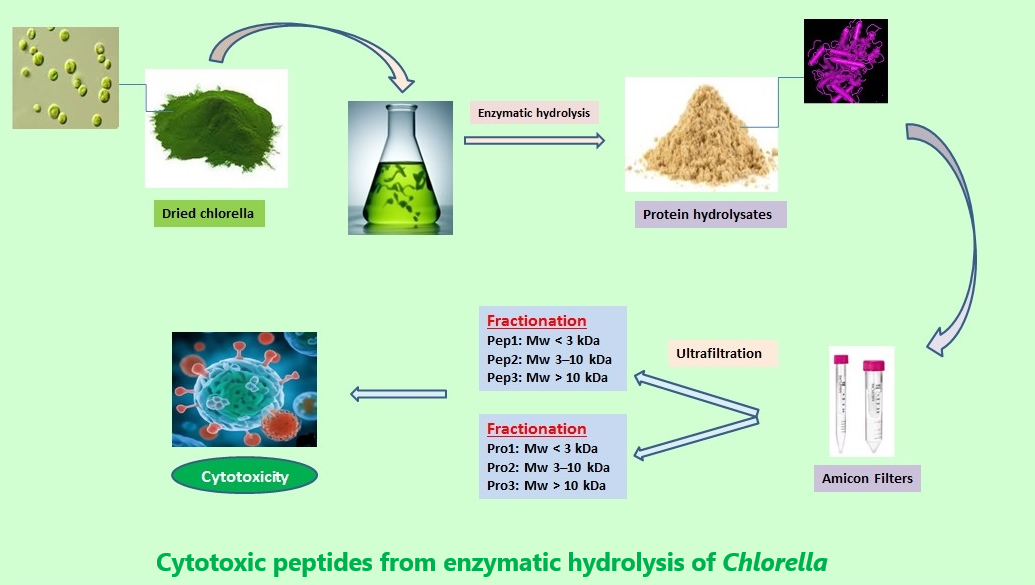
Material and Methods: Proteins of Chlorella vulgaris were extracted using enzymatic hydrolysis using proteolytic enzymes of pepsin and Promod (Bacillus subtilis protease). Separation of the peptides was carried out using ultrafiltration techniques. Cytotoxic effects of the extracted peptides were assessed using MTT assay on mouse colon tumor cell lines (CT-26).
Results and Conclusion: Results indicated that the pepsin protein hydrolysates (Pep1, Pep2 and Pep3) at a concentration of 1000 mg.ml-1 decreased the viability of the CT-26 colon cancer cell line by 24.34%, 36.00% and 40.08%, respectively, while the Promod protein hydrolysates (Pro1, Pro2 and Pro3) decreased the viability by 26.26, 35.91 and 37.13%, respectively. The Pep1 and Pro1 showed the highest cytotoxicity effects (P < 0.05). Findings of this study suggest that the bioactive peptides present in C. vulgaris may include beneficial functional compounds for cancer prevention.
How to Cite
References
Skjanes K, Aesoy R, Herfindal L, Skomedal H. Bioactive peptides from microalgae: Focus on anticancer and immunomodulating activity. Physiol Plant. 2021; 173(2): 612-623. https://doi.org/10.1111/ppl.13472
Jayshree A, Jayashree S, Thangaraju N. Chlorella vulgaris and Chlamydomonas reinhardtii: Effective antioxidant, antibacterial and anticancer mediators. Indian J Pharm Sci. 2016; 78(5): 575-581. https://doi.org/10.4172/pharmaceutical-sciences.1000155
Liu J, Bai X, Fu P. In silico and in vitro assessment of bioactive peptides from Arthrospira platensis phycobiliproteins for DPP-IV inhibitory activity, ACE inhibitory activity, and antioxidant activity. J Appl Phycol. 2022; 34(3): 1497-1511. https://doi.org/10.1007/s10811-022-02732-z
Leong YK, Chang JS. Proteins and bioactive peptides from algae: Insights into antioxidant, anti-hypertensive, anti-diabetic and anti-cancer activities. Trends Food Sci Technol. 2024; 104352. https://doi.org/10.1016/j.tifs.2024.104352
Santa M. Brazil RS. Handbook of Microalgae-Based Processes and Products, In: Acquah C, Tibbetts SM, Pan S, Udenigwe C. Nutritional Quality and Bioactive Properties of Proteins and Peptides from Microalgae. Academic Press. 2020: pp. 493-531. https://doi.org/10.1016/B978-0-12-818536-0.00019-1
Brodin P. Davis M.M. Human Immune System, In: Ghosh S, Bhattacherjee R, Banerjee D. Cell Death and Nanoparticles. 2022: pp. 71. https://doi.org/10.1515/9783110655858-005
Yao W, Qiu HM, Cheong KL, Zhong S. Advances in anti-cancer effects and underlying mechanisms of marine algae polysaccharides. Int J Biol Macromol. 2022; 221: 472-485. https://doi.org/10.1016/j.ijbiomac.2022.09.055
Darvish M, Jalili H, Ranaei-Siadat SO, Sedighi M. Potential cytotoxic effects of peptide fractions from Dunaliella salina protein hydrolyzed by gastric proteases. J Aquat Food Prod. 2018; 27(2): 165-175. https://doi.org/10.1080/10498850.2017.1414095
Sarvaysh Y, Rajasulochana P. A novel potent drug molecule from Chlorella vulgaris for the control of cancer cells. Eur Chem Bull. 2023; 12(4): 3098-3109.
Sedighi M, Jalili H, Ranaei, SSO, Amrane A. Potential health effects of enzymatic protein hydrolysates from Chlorella vulgaris. Appl Food Biotechnol. 2016; 3 (3):160-169. https://doi.org/10.22037/afb.v3i3.11306
Munir N, Imtiaz A, Sharif N, Naz S. Optimization of growth conditions of different algal strains and determination of their lipid contents. J Anim Plant Sci. 2015; 25(2): 546-553.
Razi N, Shamsaie Mehrgan M, Hosseini Shekarabi S.p. A comparative study of different drying methods on some proximate composition and pigments of marine microalgae (Isochrysis galbana). Aqua Sci. 2019; 7(2): 12-20.
Association of Official Analytical Chemists – AOAC. Official Methods of Analysis of AOAC International (18th ed.). Washington: AOAC. 2005.
Islam MS, Hongxin W, Admassu H, Noman A, Ma C, Wei F. Degree of hydrolysis, functional and antioxidant properties of protein hydrolysates from Grass Turtle (Chinemys reevesii) as influenced by enzymatic hydrolysis conditions. Food Sci Nutr. 2021; 9: 4031-4047. https://doi.org/10.1002/fsn3.1903
Hussain J, Wang X, Sousa L, Ali R, Rittmann BE, Liao W. Using non-metric multi-dimensional scaling analysis and multi-objective optimization to evaluate green algae for production of proteins, carbohydrates, lipids, and simultaneously fix carbon dioxide. Biomass Bioenergy. 2020; 141:p.105711. https://doi.org/10.1016/j.biombioe.2020.105711
Liu Y, Qi Y, Wang Q, Yin F, Zhan H, Wang H, Liu B, Nakamura Y, Wang J. Antioxidative effect of Chlorella pyrenoidosa protein hydrolysates and their application in Krill oil-in-water emulsions. Mar Drugs. 2022; 20(6): 345. https://doi.org/10.3390/md20060345
Moaveni S, Salami M, Khodadadi M, McDougall M, Emam-Djomeh Z. Investigation of S. limacinum microalgae digestibility and production of antioxidant bioactive peptides. Lwt. 2022; 154: 112468. https://doi.org/10.1016/j.lwt.2021.112468
Lu K, Zhao X, Ho SH, Ma R, Xie Y, Chen J. Biorefining and the functional properties of proteins from lipid and pigment extract residue of Chlorella pyrenoidosa. Mar drugs. 2019; 17(8): 454. https://doi.org/10.3390/md17080454
Shafay SE, El-Sheekh M, Bases E, El-Shenody R. Antioxidant, antidiabetic, anti-inflammatory and anticancer potential of some seaweed extracts. Food Sci Technol. 2021; 42: 20521. https://doi.org/10.1590/fst.20521
Xiao F, Xu T, Lu B, Liu R. Guidelines for antioxidant assays for food components. Food Front. 2020; 1(1): 60-69. https://doi.org/10.1002/fft2.10
Lemieszek MK, Rzeski W. Enhancement of chemopreventive properties of young green barley and Chlorella extracts used together against colon cancer cells. Ann Agric Environ Med. 2020; 27(4): 591. https://doi: 10.26444/aaem/130555
Derbel H, Elleuch J, Mahfoudh W, Michaud P, Fendri I, Abdelkafi S. In Vitro Antioxidant and Anti-Inflammatory Activities of Bioactive Proteins and Peptides from Rhodomonas sp. Appl Sci. 2023; 13(5): 3202. https://doi.org/10.3390/app13053202
Xie M, Liu D, Yang Y. Anti-cancer peptides: Classification, mechanism of action, reconstruction and modification. Open biology. 2020; 10(7): 200004.
Sedighi M, Jalili H, Darvish M, Sadeghi S, Ranaei-Siadat SO. Enzymatic hydrolysis of microalgae proteins using serine proteases: A study to characterize kinetic parameters. Food Chem. 2019; 284: 334-339. https://doi.org/10.1016/j.foodchem.2019.01.111
Oroojalian F, Beygi M, Baradaran B, Mokhtarzadeh A, Shahbazi MA. Immune cell Membrane Coated biomimetic nanoparticles for targeted cancer therapy. Small. 2021; 17(12): 2006484. https://doi.org/10.1002/smll.202006484
Kunte M, Desai K. The protein extract of Chlorella minutissima inhibits the expression of MMP-1, MMP-2 and MMP-9 in cancer cells through upregulation of TIMP-3 and down regulation of c-Jun. Cell J. 2018; 20(2): 211-19. https://doi.org/10.22074/cellj.2018.5277
Sheih IC, Fang TJ, Wu TK, Lin PH. Anticancer and antioxidant activities of the peptide fraction from algae protein waste. J Agric Food Chem. 2010; 58(2):1202-7. https://doi:10.1021/jf903089m
Adzahar NS, Basri DF, Latif ES, Sallehudin NJ. In vitro and in vivo cytotoxic effects of Chlorella against various types of cancer. IIUM Medical Journal Malaysia. 2021; 20(1). https://doi.org/10.31436/imjm.v20i1.1765
- Abstract Viewed: 506 times
- pdf Downloaded: 433 times