Biomass Productivity, Amino Acid and Vitamin Composition of Novel Euryhaline Microalga Ava limnothalassea And-Uz-76
التكنولوجيا الحيوية الغذائية التطبيقية,
مجلد 13 عدد 1 (2026),
7 كانون الأول 2025
,
الصفحة 1-14 (e17)
https://doi.org/10.22037/afb.v13i1.52501
الملخص
Background and Objective: Ava limnothalassea And-Uz-76 is a newly identified indigenous euryhaline microalgal strain isolated from aquatic ecosystems in Uzbekistan. Although its taxonomic identity has recently been established, information regarding the algal biomass productivity and nutritional composition relevant to food biotechnology are still limited.
Material and Methods: The strain was cultivated in BG-11, C, CSi, Chu-10, MAV, MDM and MW media. Biomass productivity, crude protein and lipid contents were assessed using standard analytical methods. Free amino acids and water-soluble vitamins were analyzed using high-performance liquid chromatography with diode array detector. All biochemical data were expressed on a dry-weight basis.
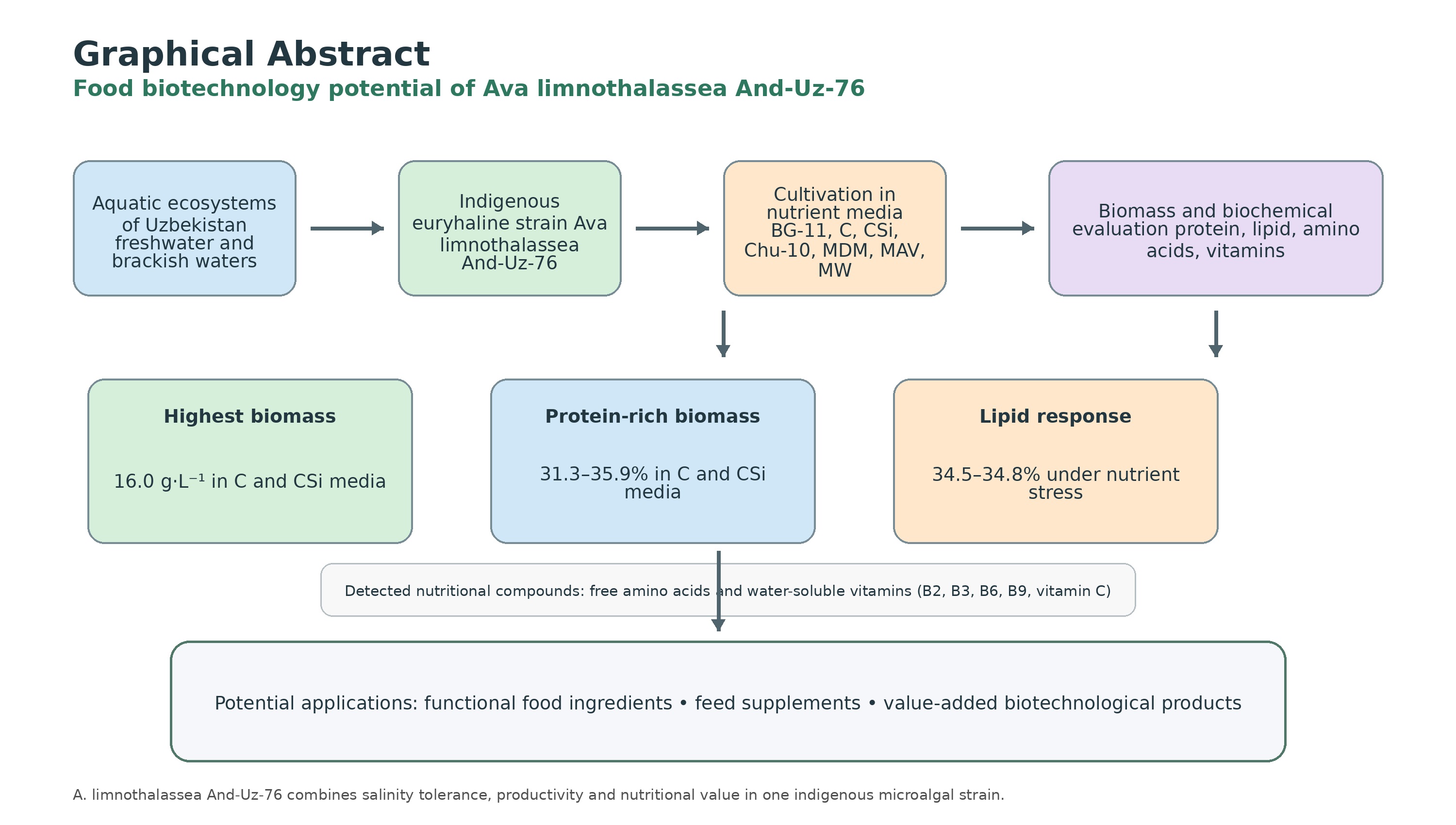
Results and Conclusion: Biomass production varied depending on nutrient composition. The highest biomass yield (16.0 g l⁻¹) was achieved in C and CSi media, whereas BG-11 media produced 14.6 g l⁻¹ of biomass. Crude protein content reached 31.3–35.9% of dry biomass in C and CSi media. Lipid accumulation increased under nutrient-limited conditions, with the highest value observed in Chu-10 media. Analysis using high-performance liquid chromatography with diode array detector detected nutritionally relevant free amino acids, including glycine, cysteine, proline and asparagine, as well as water-soluble vitamins B2, B3, B6, B9 and C. The indigenous strain Ava limnothalassea And-Uz-76 demonstrated stable biomass production under various cultivation conditions and accumulated proteins with nutritionally important amino acids and vitamins. These findings suggest that Ava limnothalassea And-Uz-76 may represent a promising candidate for further investigation as a sustainable source of protein-rich microalgal biomass and bioactive compounds for further food and feed uses.
Keywords: Ava limnothalassea; microalgae; food biotechnology; biomass productivity; crude protein; amino acids; vitamins; euryhaline strain.
- Introduction
Microalgae are valuable sources of proteins, lipids, pigments, vitamins and other bioactive compounds for food industries [1]. The euryhaline microalga of Ava limno-thalassea And-UZ-76, isolated from freshwater and brackish water ecosystems in Uzbekistan, is of particular interest. The A. limnothalassea has been described as a recently identified member of the Chlorellales order and its classification has been verified through molecular and morphological analyses [2]. Microscopic examinations revealed that the vegetative cells of this microalga demonstrated green pigmentation and occur singularly, displaying spherical or elliptical shapes with sizes varying within the microscopic range. The internal cellular structure is characterized by the presence of a single nucleus and a cup-shaped chloroplast, ultrastructural characteristics that are fully consistent with the defining characteristics of the Chlorellales order [3].
In phycology, a coenobium is defined as a non-repeating unit consisting of a fixed number of cells arranged in a constant and interconnected pattern. Unlike general colonies, the cell count and configuration in coenobia are genetically stable. This morphological plasticity highlights the species adaptability to environmental fluctuations. Reproduction occurs primarily through asexual means via autospores (non-motile spores). Within the vegetative cell, protoplast division results in the formation of several daughter cells, which are passive due to the absence of flagella. Following the lysis of the parent cell wall, the autospores are released into the external environment, where they differentiate into independent vegetative cells under favorable trophic and physicochemical conditions (light, temperature and salinity). Within the framework of this study, the effects of hydrophysical factors-specifically water depth, temperature regimes and salinity levels on the biomass productivity and physiological stability of A. limnothalassea were systematically assessed. Previous studies have shown that the growth dynamics and bio-chemical composition of A. limnothalassea are strongly affected by the composition of the nutrient media. Exper-imental results demonstrate that optimizing the physicochemical parameters of the cultivation media allows for the targeted direction of the microalgal metabolic flux. In particular, significant activation of intracellular protein synthesis and maximum biomass yield were observed in the standard BG-11 nutrient media .While BG-11 media served as the control, the growth dynamics of the study object were additionally assessed in seven alternative nutrient media ("C", "Csi", "Chu-10", "MAV", "MDM" and "MW") under laboratory conditions. Clear differences in biomass yield, crude protein content and lipid accumulation were observed in the nutrient media. These results indicate that the biochemical profile of A. limnothalassea And-Uz-76 may be affected by nutrient media composition, with media favoring protein-rich biomass formation and others pro-moting lipid accumulation. Therefore, media optimization can be considered as an important factor for directing the biotechnological use of this strain [4,5].
In particular, the growth performance of indigenous A. limnothalassea strains in various nutrient media, their capacity to produce high biomass and protein-rich biomass and their accumulation of nutritionally valuable metabolites have not been comprehensively investigated. Moreover, data on the amino acid and water-soluble vitamin com-position of this species are still limited [6].
Therefore, the present study aimed to assess the food biotechnology potential of a newly isolated euryhaline microalga A. limnothalassea And-Uz-76 collected from aquatic ecosystems of Uzbekistan. The novelty of this study was linked to the first comprehensive investigation of an indigenous Uzbek strain cultivated in various nutrient media, including assessment of biomass productivity, protein and lipid accumulation and characterization of free amino acids and water-soluble vitamins. The findings provide new insights into the nutritional value and bio-technological applicability of A. limnothalassea as a potential source of functional food ingredients and value-added biomass.
- Materials and Methods
2.1. Research object and strain origin
The unicellular green microalgal strain A. limnothalassea And-Uz-76 (Chlorellales) was used in this study. The strain was isolated in 2023 from artificial freshwater reservoirs in Ulugnor District of Andijan Region, Uzbekistan. The isolation and maintenance of the culture were carried out by researchers from the Tashkent Institute of Chemical Technology, the Institute of Microbiology of the Academy of Sciences of the Republic of Uzbekistan and Tashkent State Technical University named after Islam Karimov. The strain is deposited under the collection number UzRSMMT-432 in the Collection of Rare Microorganisms, Tashkent Institute of Chemical Technology, and in the Collection of Industrially Important Microorganisms, Institute of Microbiology of the Academy of Sciences of the Republic of Uzbekistan. Based on the collection records, A. limnothalassea And-Uz-76 is the first documented isolate of this species collected in Uzbekistan. Taxonomic identification was based on molecular analysis of the ribosomal DNA internal transcribed spacer region, including ITS1, the complete 5.8S rRNA gene and ITS2. A 519-bp sequence was used as a molecular barcode. The sequence analysis assigned the isolate to A. limnothalassea. The sequence was deposited in NCBI GenBank and the European Nucleotide Archive (ENA) under accession number of PZ035442.1. In this study, no 18S rDNA or *rbcL* sequences were used for taxonomic identification.
2.2. Isolation and culture purification conditions
Water samples were collected in 2023 from an artificial freshwater reservoir located in Ulugnor District of Andijan Region, Uzbekistan. Because the taxonomic identity of the target organism was unknown at the time of sampling, the initial isolation was carried out based on morphological and physiological characteristics. After transportation to the laboratory, samples were investigated using light microscope and green, chlorophyll-containing unicellular microalgae with spherical to slightly ellipsoidal cell morphology were selected for further purification. To separate the target microalga from the mixed microbial community, serial dilution and streak-plating techniques were used using solid mineral agar media. The inoculated cultures were incubated at 25 °C ±1 under a 16:8 h light:dark photoperiod and a photon flux density of approximately 45 μmol photons m⁻² s⁻¹. Individual colonies and visually homogeneous algal growth were aseptically transferred to fresh sterile liquid mineral media. The purification procedure was repeated sequentially 5–7 times. At each subcultivation stage, culture morphology was monitored using light and inverted microscopies. Cultures showing the presence of additional algal morphotypes, cyanobacterial cells, or other structures were excluded from further experiments. Only cultures demonstrating uniform cell morphology throughout the purification process were used. As a result, a morphologically homogeneous unialgal culture of A. limnothalassea And-Uz-76 was established and used for further cultivations and biochemical analyses. Taxonomic assignment of the purified isolate was verified using molecular characterization of the ITS1-5.8S-ITS2 ribosomal DNA region, as described in Section 2.1.
2.3. Biomass harvesting and assessment of biomass productivity
Biomass was harvested on Day 14 of cultivation, corresponding to the end of the experimental time. The microalgal suspension was concentrated using vacuum filtration and sterile membrane filtration system. The biomass was carefully collected from the filter surface and immediately subjected to freeze-drying to collect dry biomass for further biochemical analyses. To minimize the thermal degradation of heat-sensitive cellular constituents, including proteins, pigments and vitamins, the harvested biomass was lyophilized in a laboratory freeze-dryer (CHRIST, Germany). The wet biomass was evenly distributed in sterile Petri dishes, frozen and then dried under decreased pressure (3.1 Pa) at condenser temperatures ranging from -65.3 to -31 °C until a constant weight was achieved. The freeze-dried biomass was weighed and stored in sterile airtight containers at 4 °C until further analyses. Biomass concentration was expressed on a dry-weight basis (g l⁻¹). Biomass productivity was calculated based on the Eq. 1:
Eq. 1
Where, P was biomass productivity (g l⁻¹ d⁻¹), Xf was the final dry biomass concentration (g l⁻¹), Xi was the initial biomass concentration (g l⁻¹) and t was the cultivation time (d). All biomass assessments were carried out using independent biological replicates and the results were presented as mean ±SD (standard deviation).
2.4. Culture conditions and experimental design
The effects of nutrient composition on biomass productivity and biochemical characteristics of A. limnothalassea And-Uz-76 were assessed using seven mineral media of BG-11 (control), C, CSi, Chu-10, MAV, MDM and MW. All experiments were carried out in 250-ml Erlenmeyer flasks containing 200 ml of sterile culture media. Each flask was inoculated with 1 ml of actively growing algal suspension achieved from exponentially growing stock cultures. The initial pH of the media was adjusted to 6.0–8.0. Cultures were incubated at 23–24 °C under continuous illumination of approximately 4000 lux with a 14:10 h light:dark photoperiod. Aeration was supplied with sterile atmospheric air, whereas no additional CO₂ supplementation was provided. Cultures were set under static conditions without shaking. The cultivation period lasted for 14 d and samples were collected daily to monitor growth dynamics and biomass accumulation. All experiments were carried out using independent biological replicates and biomass values were expressed on a dry-weight basis (g l⁻¹).
2.5. Assessment of total protein content
Total protein content of the lyophilized biomass of A. limnothalassea And-Uz-76 was assessed using Kjeldahl method based on the quantification of total nitrogen and its conversion to crude protein. The method involved digestion of organic nitrogen-containing compounds in concentrated sulfuric acid, conversion of ammonium salts into ammonia under alkaline conditions, distillation of the released ammonia into an acidic receiving solution and quantitative assessment of nitrogen by titration. For analysis, a representative homogenized sample of freeze-dried biomass was accurately weighed and transferred into a Kjeldahl digestion flask. The samples were digested with concentrated sulfuric acid until complete mineralization and a clear solution were achieved. Following digestion, the solution was alkalized and the liberated ammonia was distilled and collected in a sulfuric acid solution. The absorbed ammonia was then quantified using titration with a standardized sodium hydroxide solution. The nitrogen content (%) was calculated based on the standard Kjeldahl procedure using the volume difference between the blank and sample titrations and expressed on a dry-weight basis. Crude protein content (%) was then calculated by multiplying the nitrogen content by a nitrogen-to-protein conversion factor of 6.38 (Eq. 2):
Eq. 2
Where, X was the nitrogen content in the test sample (%), V₀ was the volume of 0.1 mol l⁻¹ sodium hydroxide solution used for titration of 0.05 mol l⁻¹ sulfuric acid in the blank test (ml), V₁ was the volume of 0.1 mol l⁻¹ sodium hydroxide solution used for titration of sulfuric acid in the sample solution (ml), K was the correction factor for the titer of 0.1 mol l⁻¹ sodium hydroxide, 0.0014 was the amount of nitrogen equivalent to 1 ml of 0.05 mol l⁻¹ sulfuric acid and M was the sample mass (g). The nitrogen content was recalculated on a dry matter basis using the Eq. 3:
Eq. 3
Where, X₃ was the nitrogen content recalculated to dry matter (%), X₁ was the nitrogen content in the test sample (%) and W was the moisture content of the sample (%). The crude protein content was calculated using the Eq. 4:
Eq. 4
Where, Y was the crude protein content (%), K was the nitrogen-to-protein conversion factor and X was the nitrogen content (%). In this study, a conversion factor of 6.38 was used for biomass with moderate lipid content. The final result was accepted as the arithmetic mean of five parallel assessments. The calculated values were reported as crude protein content on a dry-weight basis (% DW) and the results were expressed as mean ±SD (standard deviation) [7].
2.6. Analysis of free amino acids using high-performance liquid chromatography with diode array detector
The composition of free amino acids in the biomass of A. limnothalassea And-Uz-76 was assessed using high-performance liquid chromatography with diode-array detection (HPLC-DAD) after pre-column derivatization with phenylisothiocyanate (PITC) based on a method of Cohen and Strydom [7]. This procedure enabled the formation of stable phenylthiocarbamyl (PTC) derivatives appropriate for chromatographic separation and quantitative assessment. For sample preparation, proteins and peptides were precipitated from the aqueous biomass extract by adding 1.0 ml of 20% trichloroacetic acid (TCA) to 1.0 ml of the sample extract. After incubation for 10 min, the precipitate was separated by centrifugation at 8000 rpm for 15 min. An aliquot (0.1 ml) of the supernatant was collected and lyophilized. The dried residue was dissolved in a triethylamine-acetonitrile-water mixture (1:7:1, v/v/v) and evaporated to dryness. This neutralization step was repeated twice to completely remove residual acid. The resulting amino acids were derivatized with phenylisothiocyanate to achieve phenylthiocarbamyl derivatives prior to chroma-tographic analysis. Chromatographic analyses were carried out using Agilent Technologies 1200 HPLC system (Agilent, USA) equipped with a diode-array detector and a Discovery HS C18 column (75 × 4.6 mm). The mobile phase consisted of solvent A (0.14 M sodium acetate buffer containing 0.05% triethylamine, pH 6.4) and solvent B (acetonitrile). The flow rate was set at 1.2 ml min⁻¹, the injection volume was 5 μl and chromatograms were recorded at 269 nm. Separation was carried out using the following gradient program of 1–6% B for 0–2.5 min, 6–30% B for 2.51–40.0 min, 30–60% B for 40.1–45.0 min, 60% B for 45.1–50.0 min and 60–0% B for 50.1–55.0 min. Identification of individual amino acids was carried out by comparing the retention times of sample peaks with those of amino acid standard mixtures analyzed under identical chromatographic conditions. Quantification was carried out using the external standard approach based on calibration curves constructed from the corresponding amino acid standards. Peak integration and data processing were carried out using ChemStation software package of the Agilent Technologies 1200 system (Agilent, USA). The concentrations of free amino acids were calculated from the calibration equations and expressed as milligrams per gram of dry biomass (mg g⁻¹ DW). A representative HPLC-DAD chromatogram showing the separation and identification of the detected free amino acids is present in Figure 1, whereas quantitative composition of the identified free amino acids is summarized in Table 1. All analyses were carried out using independent biological replicates and the results were present as mean ±SD (standard deviation). The assessed compounds were interpreted as free amino acid fractions and were not considered to represent the total amino acid composition of the microalgal biomass [8, 9].
2.7. Water-soluble vitamin composition of Ava limnothalassea And-Uz-76 biomass
The water-soluble vitamin composition of A. limnothalassea And-Uz-76 biomass was assessed using HPLC-DAD. Chromatographic analyses were carried out using Agilent Technologies 1200 HPLC system (Agilent, USA) equipped with a diode-array detector. Separation was achieved using Eclipse XDB C18 reversed-phase column (3.5-µm particle size, 4.6 × 150 mm dimensions). Detection wavelengths were set at 254 and 290 nm to ensure comprehensive identification of various water-soluble vitamins. The mobile phase consisted of solvent A (0.5% acetic acid solution, pH 1.7) and solvent B (acetonitrile). The flow rate was set at 1.0 ml min-1 and the column temperature was set at 25 °C throughout the analysis. Gradient elution was used as follows of 0–5 min, 4% B; 6–8 min, 30% B; 9–15 min, 20% B and 15–17 min, 4% B for column re-equilibration. A representative HPLC-DAD chromatogram showing the separation and detection of water-soluble vitamins in A. limnothalassea And-Uz-76 biomass is present in Figure 2 and quantitative composition of the identified vitamins is summarized in Table 2. The analysis revealed the presence of riboflavin (B₂), niacin (B₃/PP), pyridoxine (B₆), folate (B₉) and ascorbic acid (C) in the microalgal biomass. All assessments were carried out using independent biological replicates and results were expressed as mean ±SD (standard deviation) on a dry-weight basis.
2.8. Lipid content of Ava limnothalassea And-Uz-76 biomass
Total lipid content in the biomass of A. limnothalassea And-Uz-76 was assessed using Soxhlet extraction based on the AOAC gravimetric procedure. Freeze-dried biomass achieved from each nutrient media was used for analysis. A quantity of dry biomass was transferred into a filter paper thimble and extracted using petroleum ether and Soxhlet apparatus for 8 h. After extraction, the solvent was evaporated and the extraction flask containing the lipid residue was dried at 105 °C ±5 to constant weight. The flask was then cooled in a desiccator and weighed. Lipid content was calculated gravimetrically and expressed as a percentage of dry biomass (% DW) using the following equation:
× 100 (5)
Where, W₁ was the weight of the empty extraction flask (g), W₂ was the weight of the flask after solvent evaporation and drying (g) and Ws was the weight of the dry biomass sample used for extraction (g). Lipid content was assessed for biomass samples cultivated in all seven nutrient media of BG-11, C, CSi, Chu-10, MAV, MDM and MW. Results were reported on a dry-weight basis (% DW) [10].
2.9. Statistical analysis
Descriptive statistical processing of the experimental data was carried out using Microsoft Excel 2021 (Microsoft, USA). The achieved values were summarized as mean ±SD (standard deviation); where, replicate measurements were available. Since complete raw replicate datasets were not available for all experimental groups and analytical parameters, inferential statistical tests, including one-way analysis of variance (ANOVA), were not used. Accordingly, differences in nutrient media and biochemical parameters were interpreted descriptively, based on the observed trends and comparative changes in the mean values.
- Results and Discussion
3.1. Effect of nutrient media on biomass productivity and biochemical composition
The cultivation media significantly affected biomass formation and the biochemical composition of A. limnothalassea And-Uz-76. The observed responses indicated that nutrient composition could be used to modulate the balance in biomass production, protein accumulation and lipid storage in this strain. The BG-11 (control media) supported stable growth throughout a 14-d cultivation time, yielding a final biomass concentration of 14.6 g l⁻¹, as shown in Figure. 3. During cultivation, the protein content gradually decreased from Day 4, whereas lipid accumulation increased. This pattern might reflect a progressive redistribution of cellular carbon from growth-related metabolism to storage-lipid formation as the culture approached the later growth stages. Similar media and growth-stage-dependent changes in cellular composition have been reported for other microalgae under nutrient limitation or physiological stress [11].
The highest biomass yield, 16.0 g l⁻¹, was observed in C and CSi media. These values were approximately 9.6% higher than that observed in BG-11 media. In addition to supporting high biomass production, C and CSi media included relatively high protein contents of 31.3–35.9% DW, while lipid accumulation was comparatively low. As shown in Figure 4, these results suggested that C and CSi media primarily favored vegetative growth and protein-rich biomass formation rather than stress-induced lipid storage. Therefore, these media might be further appropriate when the principal cultivation objective was the production of protein-enriched microalgal biomass. In contrast, Chu-10 and MDM media supported substantially lower biomass accumulation. Final biomass concentrations reached approximately 0.6 g l¹ in Chu-10 and 1.0 g l⁻¹ in MDM. Despite the limited biomass production, lipid contents increased to 34.8 and 34.5% DW, respectively. This inverse relationship between biomass formation and lipid accumulation, as shown in Figure 4, suggested that nutrient limitation restricted cell division while promoting the storage of neutral lipids. Comparable metabolic shifts have been observed in several microalgal taxa exposed to nitrogen or mineral limitation [12]. Because inferential statistical analysis was not carried out, these differences should be interpreted as descriptive trends rather than statistically verified effects. As shown in Figure 5, MAV supported relatively high biomass formation (16.0 g l⁻¹) with protein contents of 28.5–37.2% DW and comparatively low lipid accumulation (12.4% DW), whereas MW produced moderate biomass yield (12.7 g l⁻¹) with increased lipid accumulation (32.5% DW), indicating that these media induced various metabolic responses in A. limnothalassea And-Uz-76. These findings indicated that MAV might support biomass and protein formations, whereas MW might induce a stronger shift to lipid storage. Overall, the results demonstrated that the growth and biochemical profile of A. limnothalassea And-Uz-76 could be directed through appropriate selection of the cultivation media. The C and CSi media were the most favorable for high biomass and protein productions, whereas Chu-10 and MDM media promoted lipid accumulation under conditions associated with restricted growth. This media-dependent metabolic flexibility may be useful for developing cultivation strategies targeted either toward protein-rich biomass or lipid-enriched biomass (Figure 6).
3.2. Comparison with Other Microalgal Biomass Sources
Previous investigations of A. limnothalassea have mainly focused on its taxonomic characterization and the lipid accumulation potential of the Greek strain TAU-MAC 2217. In comparison, the indigenous Uzbek strain And-Uz-76 demonstrated a broader biochemical profile, including high biomass productivity, substantial protein accumulation and increased lipid formation under nutrient-limited conditions. The protein content recorded in C and CSi media, as shown in Figure 4, ranged 31.3–35.9% DW, indicating that these media favored protein-rich biomass formation. Species of Chlorella and Arthrospira are widely reported as protein-rich microorganisms, although their protein concentration and productivity depend strongly on nutrient availability and cultivation conditions [13]. The ability of A. limnothalassea And-Uz-76 to combine biomass concentrations of up to 16.0 g l⁻¹ with moderate-to-high protein levels supports its potential as a source of protein-rich biomass for further food-biotechnology investigation. The nutritional significance of protein-rich microalgal biomass has been highlighted for food uses because bioactive protein hydrolysates may provide additional functional benefits [14].
The strain showed a pronounced media-dependent increase in lipid accumulation. Under Chu-10 (Figure 4) and MDM (Figure 5) cultivation, decreased biomass production coincided with lipid contents of 34.5–34.8% DW. This response was similar to the general tendency of microalgae to redirect carbon to storage compounds when exposed to nutrient stress [15,16]. Nevertheless, the present findings should be regarded as preliminary because complete raw replicate datasets were not available for all experimental groups and no inferential statistical comparisons were carried out. Several established microalgae are commercially cultivated for one dominant high-value product. For example, Haematococcus pluvialis is used for astaxanthin production, Dunaliella salina for β-carotene and Nannochloropsis spp. and Isochrysis galbana for polyunsaturated fatty acids [17]. In contrast, A. limnothalassea And-Uz-76 included several potentially useful characteristics within a single strain, including high biomass production, protein accumulation, stress-associated lipid formation and presence of free amino acids and water-soluble vitamins [18,19]. Nutrient availability and media composition are key determinants of biomass formation and protein accumulation in food-relevant microalgae. Similar media-dependent responses have been reported for A. maxima; in which, cultivation conditions strongly affected biomass and protein productions [20].
3.3. Nutritional and food-biotechnology relevance
The nutritional relevance of A. limnothalassea And-Uz-76 biomass was further supported by the detection of free amino acids (Table 1) and water-soluble vitamins (Table 2). The free amino acid fraction included nutritionally relevant compounds such as aspartic acid, glutamic acid, histidine, alanine, glycine, leucine, cysteine and proline. In addition, riboflavin, niacin, pyridoxine, folate and ascorbic acid were detected in the biomass. These compounds contribute to the potential nutritional value of the strain and justify further investigation of its use as a source of value-added microalgal biomass. However, the presence of proteins, amino acids, vitamins and lipids alone is not sufficient to establish suitability for direct food or feed use. Additional studies are needed to assess toxicological safety, contaminant levels, digestibility, nutrient bioavailability, sensory properties and techno-functional behavior in food or feed matrices. Therefore, A. limnothalassea And-Uz-76 should presently be reported as a promising indigenous strain for further food-biotechnology research rather than as an immediately usable commercial ingredient.
- Conclusion
The present study demonstrated that the biomass productivity and biochemical composition of A. limnothalassea And-Uz-76 were strongly affected by the composition of the cultivation media. The highest biomass yield was achieved in C and CSi media, reaching 16.0 g l⁻¹, while BG-11 media supported biomass accumulation of 14.6 g l⁻¹. In C and CSi media, protein content was within the range of 31.3–35.9%, indicating that these media were particularly appropriate for the production of protein-rich biomass. In contrast, cultivation under nutrient-limited conditions such as Chu-10 and MDM media altered the metabolic profile of the strain, verifying that biomass composition could be directed through appropriate manipulation of culture conditions.
The nutritional value of the biomass was further verified using HPLC-DAD analysis. The total concentration of free amino acids reached 70.747 mg g⁻¹ DW, with aspartic acid, glutamic acid, histidine, alanine, glycine and leucine as the predominant components. Water-soluble vitamin analysis revealed the presence of niacin (B3, 4.95 mg g-1), riboflavin (B2, 2.31 mg g-1), ascorbic acid (1.56 mg g-1), folate (B9, 0.83 mg g-1) and pyridoxine (B6, 0.29 mg g-1) (Table 2). In addition, Soxhlet extraction showed that lipid content varied in the nutrient media, ranging from 12.2% DW in C/CSi media to 34.8% DW in Chu-10 media. This indicated that nutrient-limited media might favor lipid accumulation, whereas C and CSi media were further appropriate for protein-rich biomass formation. An important outcome of this study was the characterization of A. limnothalassea And-Uz-76 as an indigenous microalgal isolate achieved from aquatic ecosystems of Uzbekistan. The use of a locally isolated strain may be advantageous for further cultivation studies under regional environmental conditions. However, the practical use for food or feed-associated purposes needs additional assessments, including safety assessment, contaminant analysis, digestibility, bioavailability and performance in associated food and feed matrices.
Compared with microalgal species that are currently further studied in Uzbekistan, including Chlorella, Scenedesmus and Spirulina, A. limnothalassea And-Uz-76 includes several desirable characteristics within a single bio-logical system. The strain demonstrated high biomass pro-ductivity, the capacity to accumulate substantial quantities of protein, the ability to shift metabolism to lipid synthesis under nutrient stress and the presence of nutritionally valu-able amino acids and vitamins. Its stable growth in various salinity conditions further enhances its potential for large-scale cultivation using diverse water resources. Overall, the findings show that A. limnothalassea And-Uz-76 includes biomass productivity and selected nutritional characteristics under laboratory cultivation conditions. The media-depen-dent changes in biomass, protein, lipid, free amino acid and vitamin profiles suggest that this indigenous isolate may be useful for further food-biotechnology studies. However, its practical use as a food or feed ingredient needs additional investigations.
- Declaration
5.1. Acknowledgements
The authors gratefully acknowledge the technical assistance provided by the staff of the Joint China-Uzbekistan Lab-oratory of 'Soil Ecobiotechnology' at the Tashkent Institute of Chemical Technology (Uzbekistan) during microalgal cultivation, biomass processing, and biochemical analyses, as well as investigations into safety, digestibility, bioavai-lability, contaminant profile, and techno-functional perfor-mance.
Funding: This research received no specific grant from any funding agency in the public, commercial or not-for-profit sectors.
Data Availability: The data generated and analyzed during the present study are available from the corresponding author upon reasonable requests.
5.2. Declaration of competing interest
The authors declare no known financial or personal relationship that could affect the study reported in this manuscript.
5.3. Authors’ Contributions
- R. Bakhranova contributed to the conception and design of the study, carried out the experiments, processed and interpreted the data and prepared the original draft of the manuscript; N. A. Khujamshukurov supervised the research, contributed to the methodological development and critically revised the manuscript. Other authors contributed to data interpretation, technical support and manuscript review. All authors read and approved the final version of the manuscript and agreed to be responsible for the accuracy and integrity of the study.
5.4. Using Artificial Intelligent Chatbots
Artificial intelligence-assisted tools were used only for language editing and improvement of English expression. These were not used to generate experimental data, perform scientific analyses, interpret the results or formulate the conclusions. All scientific content was reviewed, verified and approved by the authors, who take full responsibility for the accuracy and integrity of the manuscript.
5.5. Ethical Consideration
This study involved cultivation and biochemical analysis of a microalgal strain and did not include human participants or experimental animals. Therefore, approval from a human or animal ethics committee was not necessary.
- Ava limnothalassea
- microalgae
- food biotechnology
- biomass productivity
- crude protein
- amino acids
- vitamins
- euryhaline strain
كيفية الاقتباس
المراجع
1. Lortou U, Panteris E, Gkelis S. Uncovering new diversity of photosynthetic microorganisms from the Mediterranean region. Microorganisms. 2022; 10(8): 1571. https://doi.org/10.3390/microorganisms10081571
2. Bakhranova DR, Abdullaev KO, Khujamshukurov NA. Microalgae as a source of valuable biological compounds for the food, cosmeceutical and biofuel industries. J Food Sci. 2025; 3(7): 99-109.
3. Bakhranova DR, Khujamshukurov NA. Comparative analysis of growth dynamics and biochemical composition of the strain Ava limnothalassea cultivated in BG-11 and MDM media. In: Proceedings of the XXII International Scientific and Practical Conference “Scientific Review: Current Issues of Theory and Practice”; 2026; Penza, Russia. Penza: Nauka i Prosveshchenie; 2026. p. 15-18.
4. Borowitzka MA. High-value products from microalgae-their development and commercialisation. J Appl Phycol. 2013; 25(3): 743-756. https://doi.org/10.1007/s10811-013-9983-9
5. Spolaore P, Joannis-Cassan C, Duran E, Isambert A. Commercial applications of microalgae. J Biosci Bioeng. 2006; 101(2): 87-96. https://doi.org/10.1263/jbb.101.87
6. Becker EW. Micro-algae as a source of protein. Biotechnol Adv. 2007; 25(2): 207-210. https://doi.org/10.1016/j.biotechadv.2006.11.002
7. Cohen SA, Strydom DJ. Amino acid analysis utilizing phenylisothiocyanate derivatives. Anal Biochem. 1988; 174(1): 1-16. https://doi.org/10.1016/0003-2697(88)90512-X
8. Chew KW, Khoo KS, Foo HT, Chia SR, Walvekar R, Lim SS. Algae utilization and its role in the development of green cities. Chemosphere. 2021; 268: 129322. https://doi.org/10.1016/j.chemosphere.2020.129322
9. Chu SP. The influence of the mineral composition of the medium on the growth of planktonic algae. I. Methods and culture media. J Ecol. 1942; 30(2): 284-325.
10. Das BD, Bhattarai A. The versatility of algae in addressing global sustainability challenges. Front Bioeng Biotechnol. 2025; 13: 1621817. https://doi.org/10.3389/fbioe.2025.1621817
11. Zhang LX, Jiang YN, Buzdar JA, Ahmed S, Sun XY, Li FH, et al. Microalgae: an exciting alternative protein source and nutraceutical for the poultry sector. Food Sci Anim Resour. 2025; 45(1): 243-265. https://doi.org/10.5851/kosfa.2024.e130
12. Garcia-Encinas JP, Ruiz-Cruz S, Avena-Bustillos RJ, Islas-Rubio AR, Del-Toro-Sanchez CL, Marquez-Rios E. Proteins from microalgae: nutritional, functional and bioactive properties. Foods. 2025; 14(6): 921. https://doi.org/10.3390/foods14060921
13. Prates JAM. Unlocking the functional and nutritional potential of microalgae proteins in food systems: a narrative review. Foods. 2025; 14(9): 1524. https://doi.org/10.3390/foods14091524
14. Li J, Ma Y, Lin X, Yuan C. Editorial: microalgae as sustainable food resources: Prospects, novel species, bioactive compounds, cultivation process and food processing. Front Nutr. 2025; 11: 1543087. https://doi.org/10.3389/fnut.2024.1543087
15. Roleda MY, Slocombe SP, Leakey RJ, Day JG, Bell EM, Stanley MS. Simultaneous quantification of cellular components in microalgae using Fourier transform infrared spectroscopy. Bioresour Technol. 2013; 133: 59-65. https://doi.org/10.1016/j.biortech.2013.01.001
16. AOAC International. Official Methods of Analysis of AOAC International. 20th ed. Gaithersburg (MD): AOAC International; 2016.
17. Lauritano C, De Luca D, Ferrarini A, Avanzato C, Minio A, Delledonne M, et al. New molecular insights on the response of the green alga Tetraselmis suecica to nitrogen starvation. Sci Rep. 2019; 9: 3337. https://doi.org/10.1038/s41598-019-39860-5
18. Mularczyk M, Michalak I, Marycz K. Astaxanthin and other nutrients from Haematococcus pluvialis-multifunctional applications. Mar Drugs. 2020; 18(9): 459. https://doi.org/10.3390/md18090459
19. Sedighi M, Jalili H, Ranaei-Siadat SO, Amrane A. Potential health effects of enzymatic protein hydrolysates from Chlorella vulgaris. Appl Food Biotechnol. 2016; 3(3): 160-169. https://doi.org/10.22037/afb.v3i3.11306
20. Pan-utai W, Poopat N, Parakulsuksatid P. Photoautotrophic cultivation of Arthrospira maxima for protein accumulation under minimum nutrient availability. Appl Food Biotechnol. 2020; 7(4): 225-234. https://doi.org/10.22037/afb.v7i4.30353
- الملخص المشاهدات: 81 الأوقات
- pdf (English) التنزيلات: 18 الأوقات