Enhanced Sorbitol Production under Submerged Fermentation using Lactobacillus plantarum
التكنولوجيا الحيوية الغذائية التطبيقية,
مجلد 4 عدد 2 (2017),
5 نيسان 2017
,
الصفحة pp. 85-92
https://doi.org/10.22037/afb.v4i2.13514
الملخص
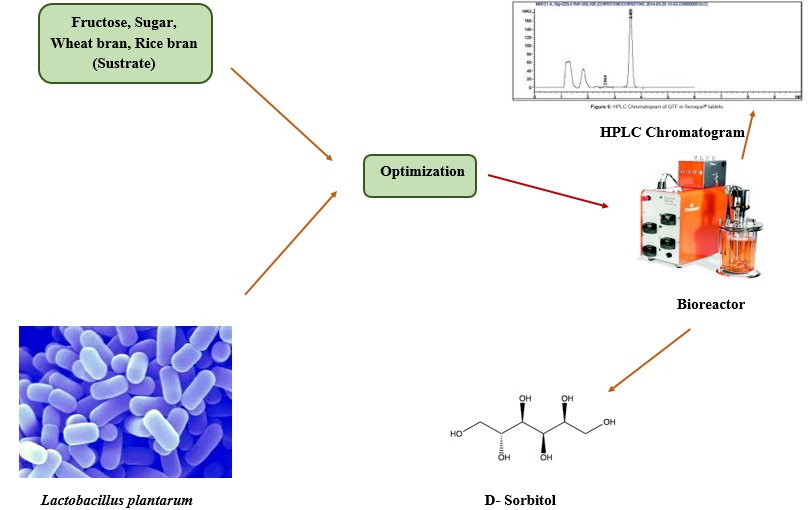
Background and Objective: Sorbitol is a non-toxic and slightly hygroscopic compound with different applications. Zymomonas mobiles produces sorbitol from sucrose or mixtures of glucose and fructose (formation is coupled with the dehydrogenation of glucose to glucono-δ- lactone). Recombinant Zymomonas mobilis may produce sorbitol and gluconic acid from glucose and fructose using different divalent metal ions with reduced the ethanol yield and
significantly increased yield of sorbitol. Current study envisaged to alter the media components, physical process parameters and supplementation of amino acids for enhanced sorbitol production.
Material and Methods: Several process variables were evaluated on sorbitol production including carbon sources (glucose, fructose, maltose, sucrose), carbon concentrations (5, 10, 20 and 25 g l-1), nitrogen sources (peptone, tryptone, yeast extract, beef extract and organic nitrogen mix), temperatures (25, 29, 33, 37, 41°C), pH (6, 6.5, 7 , 7.5 ,8), agitation rate (50, 100, 150, 200 rpm) and amino acids (cysteine, cystine, tryptophan)in batch cultivation of
Lactobacillus plantarum NCIM 2912. Shake flask cultivation performed under optimum conditions like temperature 37°C, pH 7.0 and agitation rate of 150 rpm, resulted in enhanced sorbitol production. Comparative study of sorbitol production in solid state fermentation and submerged fermentation was also evaluated.
Results and Conclusion: Batch cultivation under submerged conditions further performed in 7.5-l lab scale bioreactor (working volume 3.0-l) under optimized conditions resulted in maximum cell biomass of 8.95±0.03 g g-1 and a sorbitol content of 9.78±0.04 g l-1 after 42.0 h of fermentation. Scale up study on bioreactor resulted in maximum sorbitol yield (Yp/x) and productivity of 1.11 g g-1 and 0.50 g l-1 h under submerged fermentation, respectively.
Conflict of interest: The authors declare no conflict of interest.
- ▪ Characterization ▪ HPLC ▪ Lactobacillus plantarum NCIM 2912 ▪ Media components ▪ Physical parameters ▪ Sorbitol
كيفية الاقتباس
المراجع
Wrolstad R E and Shallenberger R S, Free sugars and sorbitol in fruits—a complication from the literature, J. Assoc. Off. Anal. Chem,. 64 (1981) 91–103.
Ladero V, Ramos A, Wiersma A, Goffin, P, Schank A, Kleerebezem M, Hugenholtz J, Smid E J and Hols P, High level production of the low-calorie sugar sorbitol by Lactobacillus plantarum through metabolic engineering, Appl Environ Microbiol 63 (2007) 2117-2123.
Leigh D A, Scopes R K and Rogers P L, A proposed pathway for sorbitol production by Zymomonas mobilis, Appl. Microbiol. Biotechnol, 20 (1984) 413–415.
Liu C, Dong H, Zhong J, Ryu D D Y, Bao J, Sorbitol production using recombinant Zymomonas mobilis strain, J. Biotechnol.148 (2010) 105–112
Pedruzzi I, Silva,B D, Eduardo A and Rodrigues, A ESimulated moving bed technology to improve the yield of the biotechnological production of lactobionic acid and sorbitol. Adsorption;17 (2011)145–158.
Boeck R D, Sarmeinto-Rubiano L A, Nadal I, Monedero V., Pérez-Martínez, G and Yebra J M, Sorbitol production from lactose by engineered Lactobacillu casei deficient in sorbitol transport system and mannitol-1-phosphate dehydrogenase, Appl Microbiol Biotechnol, 85 (2010) 1915-1922
Nissen L, Pérez-Martínez G, Yebra M J, Sorbitol synthesis by an engineered Lactobacillus casei strain expressing a sorbitol-6- phosphate dehydrogenase gene within the lactose operon. FEMS Microbiol Lett 249 (2005) 177–183
Vongsuvanlert V and Tani Y, L-Iditol production from L-Sorbose by a methanol yeast, candida boidinii (Kloeckera sp.), J. Ferment. Technol, 66 (1988) 517–523.
Duvnjak Z, Turcotte G and Duan Z D, Production of sorbitol and ethanol from jerusalem artichokes by saccharomyces cerevisiae ATCC 36859, Appl. Microbiol. Biotechnol, 35 (1991) 711–715.
Sasahara, H. and Izumori, K.: Reduction of L-sorbose by halotolerant yeast, Candida famata 234 B. Seibutsu-kogaku, 72, (1994) 299–304.
Sasahara H and Izumori K , Production of L-Sorbitol from L-Fructose by Aureobasidium pullulans LP23 Isolated from soy sauce Mash J Biosci Bioeng 100 (2005) 223-226
Vogel R, in Ullmann’s Encyclopedia of Industrial Chemistry, 6th ed., vol. 34, Wiley-VCH, Weinheim, Germany, pp. (2003) 492–498.
Albert R, Strätz, A, and Vollheim G. Die katalytische Herstellung von Zuckeralkoholen und deren Verwendung Chem. Eng. Technol, 52 (1980) 582–587.
Collins P M, Ferrier R J. Monosaccharides—their chemistry and their roles in natural products. Great Britain: John Wiley Sons; 1995. p. 587.
Silveira M M and Jonas R. The biotechnological production of sorbitol. Appl Microbiol Biotechnol 59 (2002 ) 400–8.
Hayes C, The effect of non-cariogenic sweeteners on the prevention of dental caries: a review of the evidence. J Dent Educ 65(2001) 1106–1109.
Sarmiento-Rubiano L A, Zúñiga, M, Pérez-Martínez, G.and Yebra,M J Dietary supplementation with sorbitol results in selective enrichment of lactobacilli in rat intestine. Res Microbiol 158 (2007) 94–701
Kretchmer N, and Hollenbeck C B Sugars and sweeteners. Florida: CRC Press Inc (1991)
Pandey A, Soccol C R & Mitchell D, New developments in Solid-state fermentation, I: Bioprocesses and applications, Process Biochem,35 (2000) 1153-1169.
Claye S S, Idouraine A and Weber C W, Extraction of insoluble fiber from five sources, Food Chem 57 (1996) 305-310
Mishra J, Kumar D, Samanta S, Vishwakarma M K. A comparative study of ethanol production from various agro residues by using saccharomyces cerevisiae and candida albicans. J. Yeast Fungal Res 3(2) (2012) 12-17.
Pham T K, and Wright P C . The proteomic response of Saccharomyces cerevisiae in very high glucose conditions with Amino acid supplementation. J. Proteome Res. 7 (2008) 4766-4774.
Cazetta M L, Celligio M A P C, Buzato J B, Scarmino I S and Silva da R S F, Optimization study for sorbitol production by Zymomonas mobilis in sugar cane molasses Process Biochem 40 (2005) 747-751
- الملخص المشاهدات: 1697 الأوقات
- PDF (English) التنزيلات: 665 الأوقات