Characterization of Effective Native Lactic Acid Bacteria as Potential Oral Probiotics on Growth Inhibition of Streptococcus mutans
Applied Food Biotechnology,
Vol. 8 No. 3 (2021),
15 June 2021
,
Page 201-212
https://doi.org/10.22037/afb.v8i3.33704
Abstract
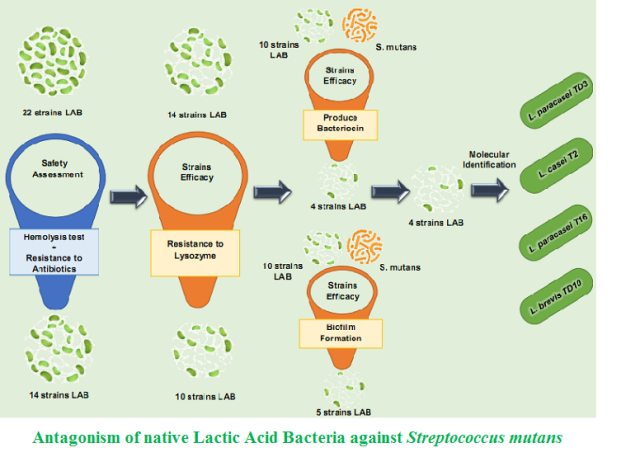
Background and Objective: Probiotics' effects on harmful oral bacteria have been verifed. As antibiotic resistance becomes a major problem, searching for novel potential species is important. The objective of this study was to select novel safe strains of lactic acid bacteria with potentials as oral probiotics. Furthermore, ability of these strains to suppress growth and attachment of Streptococcus mutans as the most important cariogenic bacteria in tooth decay was investigated.
Material and Methods: Initial identification tests, including Gram staining and catalase and oxidase tests, were carried out on 22 strains of lactic acid bacteria isolated from Iranian traditional dairy products. Safety of the strains was assessed using hemolysis test and antibiotic resistance assessment. Strains were then assessed for probiotic characteristics such inhibition of Streptococcus mutans growth, tolerance to lysozyme enzymes and ability of adhesion as well as ability of decreasing Streptococcus mutans adhesion. Selected strains were identified using16S rRNA molecular method.
Results and Conclusion: Of all strains, four strains with the optimal probiotic characteristics were selected. These included one Lactobacillus brevis, one Lactobacillus casei and two Lactobacillus paraceasei. These four strains showed strong antimicrobial characteristics against Streptococcus mutans, were resistant to oral lysozyme enzymes and included high adhesion abilities to polystyrene wells. Furthermore, they decreased Streptococcus mutans attachment; thus, biofilm formation by this bacterium was prevented. These strains were recognized as safe strains since they were approved in assessments of antibiotic susceptibility and hemolytic activity. Therefore, these four strains are suggested as oral probiotics.
Conflict of interest: The authors declare no conflict of interest.
- ▪ lactic acid bacteria ▪ oral probiotics ▪ safety assessment ▪ Streptococcus mutans ▪ tooth decay
How to Cite
References
Yadav K, Prakash S. Dental caries: A review. Asian J Biomed Pharm Sci. 2016;6(53):01.
Amara A, Shibl A. Role of probiotics in health improvement, infection control and disease treatment and management. Saudi pharm J. 2015; 23(2): 107-14.
doi: 10.1016/j.jsps.2013.07.001
Allaker RP, Stephen AS. Use of probiotics and oral Health. curr oral health rep. 2017; 4(4): 309-318.
doi: 10.1007/s40496-017-0159-6
Haukioja A. Probiotics and oral health. Europ J dent. 2010;4(3):348.
doi: 10.1055/s-0039-1697851
Rastogi P, Saini H, Dixit J, Singhal R. Probiotics and oral health. Nati J Maxillofac Surg. 2011; 2(1): 6-9
doi: 10.4103/0975-5950.85845
Bermudez-Brito M, Plaza-Diaz J, Munoz-Quezada S, Gomez-Llorente C, Gil A. Probiotic mechanisms of action. Ann Nutr Metab. 2012;61(2):160-174.
doi: 10.1159/000342079
Tajaabady EM, Bahrami H, Ziyary Z. Tarkhineh source of probiotic lactic acid bacteria. J Anim Physiol Dev . 2011;4:1-8
Ebrahimi MT, Ouweh AC, Hejazi MA, Jafari P. Traditional Iranian dairy products: A source of potential probiotic lactobacilli. Afr J Microbiol Res. 2011; 5(1):20-7.
Garrity GM, Bell JA, Lilburn T. The Revised Road Map to the Manual. Bergey’s Manual® of Systematic Bacteriology: Springer; 2005: 159-187.
Muyanja C, Narvhus JA, Treimo J, Langsrud T. Isolation, characterisation and identification of lactic acid bacteria from bushera: a Ugandan traditional fermented beverage. Int J Food Microbiol. 2003; 80(3): 201-210.
doi: 10.1016/S0168-1605(02)00148-4
Ganguly NK, Bhattacharya SK, Sesikeran B, Nair GB, Ramakrishna BS, Sachdev HPS, Batish VK, Kanagasabapathy AS, Muthuswamy V, Kathuria SC, Katoch VM. ICMR-DBT guidelines for evaluation of probiotics in food. Indian J Med Res. 2011;134(1):22.
Pisano MB, Viale S, Conti S, Fadda ME, Deplano M, Melis MP, Deiana M, Cosentino S. Preliminary evaluation of probiotic properties of Lactobacillus strains isolated from Sardinian dairy products. BioMed Res Int. 2014; 2014:2-9.
doi: 10.1155/2014/286390
Clinical and Laboratory Standards Institute. Performance standards for antimicrobial susceptibility testing. CLSI supplement M100. 2017.
Vlkova E, Rada V, Popelarova P, Trojanova I, Killer J. Antimicrobial susceptibility of bifidobacteria isolated from gastrointestinal tract of calves. Livest Sci. 2006;105(1-3):253-9.
doi: 10.1016/j.livsci.2006.04.011
Kaktcham PM, Zambou NF, Tchouanguep FM, El-Soda M, Choudhary MI. Antimicrobial and safety properties of lactobacilli isolated from two Cameroonian traditional fermented foods. Sci Pharm. 2012;80(1):189-204.
doi: 10.3797/scipharm.1107-12
Angulo FJ, Collignon P, Powers JH, Chiller TM, Aidara-Kane A, Aarestrup FM. World Health Organization ranking of antimicrobials according to their importance in human medicine: A critical step for developing risk management strategies for the use of antimicrobials in food production animals. Clin Infec Dis. 2009;49(1):132-141.
doi: 10.1086/599374
Korhonen JM, van Hoek AHAM, Saarela M, Huys G, Tosi L,
Mayrhofer S, Von Wright A. Antimicrobial susceptibility of
Lactobacillus rhamnosus. Beneficial Microbes. 2010; 1: 75-80
doi: 10.3920/BM2009.0002
Koll P, Mandar R, Marcotte H, Leibur E, Mikelsaar M, Hammarstrom L. Characterization of oral lactobacilli as potential probiotics for oral health. Oral Microbiol Immunol. 2008; 23(2): 139-147.
doi: 10.1111/j.1399-302X.2007.00402.x
Charteris WP, Kelly PM, Morelli L, Collins JK. Antibiotic susceptibility of potentially probiotic Lactobacillus species. J Food Proc. 1998;61(12):1636-1643.
doi: 10.4315/0362-028X-61.12.1636
Sharma C, Gulati S, Thakur N, Singh BP, Gupta S, Kaur S, Mishra SK, Puniya AK, Gill JP, Panwar H. Antibiotic sensitivity pattern of indigenous lactobacilli isolated from curd and human milk samples. 3 Biotech. 2017 ;1:7(1):53.
doi: 10.1007/s13205-017-0682-0
Tahmourespour A, Kermanshahi RK. The effect of a probiotic strain (Lactobacillus acidophilus) on the plaque formation of oral Streptococci. Bosnian J Basic Med Sci. 2011;11(1):37.
doi: 10.17305/bjbms.2011.2621
Rammelsberg M, Radler F. Antibacterial polypeptides of Lactobacillus species. J Appl Bacteriol. 1990; 69(2): 177-184.
doi: 10.1111/j.1365-2672.1990.tb01507.x
Ming L, Zhang Q, Yang L, Huang J-A. Comparison of antibacterial effects between antimicrobial peptide and bacteriocins isolated from Lactobacillus plantarum on three common pathogenic bacteria. Int J Clin Exp Med. 2015; 8(4): 5806-5811.
Batdorj B, Dalgalarrondo M, Choiset Y, Pedroche J, Metro F, Prevost H, Chobert JM, Haertle T. Purification and characterization of two bacteriocins produced by lactic acid bacteria isolated from Mongolian airag. J Appl Microbiol. 2006;101(4):837-848.
doi: 10.1111/j.1365-2672.2006.02966.x
Ben Slama R, Kouidhi B, Zmantar T, Chaieb K, Bakhrouf A. Anti‐listerial and anti‐biofilm activities of potential Probiotic L actobacillus strains isolated from T unisian traditional fermented food. J Food Safe. 2013; 33(1): 8-16.
doi: 10.1111/jfs.12017
Tamura K, Dudley J, Nei M, Kumar S. MEGA4: Molecular evolutionary genetics analysis (MEGA) software version 4.0. Mol Biol Evol. 2007;24(8):1596-1599.
doi: 10.1093/molbev/msm092
Khanafari A, Porgham SH, Ebrahimi MT. Investigation of probiotic chocolate effect on Streptococcus mutans growth inhibition. Jundishapur J Microbiol. 2012; 5(4): 590.
doi: 10.5812/jjm.3861
Shukla G, Sharma G, Goyal N. Probiotic characterization of lactobacilli and yeast strains isolated from whey beverage and therapeutic potential of Lactobacillus yoghurt in murine giardiasis. Am J Biomed Sci. 2010; 2: 248-261.
doi: 10.5099/aj100300248
Zago M, Fornasari ME, Carminati D, Burns P, Suarez V, Vinderola G, Reinheimer J, Giraffa G. Characterization and probiotic potential of Lactobacillus plantarum strains isolated from cheeses. Food Microbiol. 2011; 28(5): 1033-1040.
doi: 10.1016/j.fm.2011.02.009
Neujahr HY, Borstad B, Logardt I-M. Factors affecting the resistance of Lactobacillus fermenti to lysozyme. J Bacteriol. 1973;116(2):694-698.
Teanpaisan R, Piwat S, Dahlen G. Inhibitory effect of oral Lactobacillus against oral pathogens. Letters in Applied Microbiology. 2011 Oct;53(4):452-9.
doi: 10.1111/j.1472-765X.2011.03132.x
Widyarman AS, Bachtiar EW, Bachtiar BM, Seneviratne CJ. Inhibitory effect of probiotic lactobacilli against Streptococcus mutans and Porphyromonas gingivalis biofilms. Sci Dent J. 2019; 3(2): 50-55
doi: 10.4103/SDJ.SDJ_8_19
Cannon ML. A review of probiotic therapy in preventive dental practice. Probiotics Antimicrob. 2011; 3(2): 63-67.
doi: 10.1007/s12602-011-9072-9
Lemos JA, Burne RA. A model of efficiency: stress tolerance by Streptococcus mutans. Microbiol. 2008;154(11):3247-3255.
doi: 10.1099/mic.0.2008/023770-0
Lemos JA, Palmer SR, Zeng L, Wen ZT, Kajfasz JK, Freires IA, Abranches J, Brady LJ. The Biology of Streptococcus mutans. Gram‐Positive Pathogens. 2019: 435-48.
doi: 10.1128/9781683670131.ch27
Pitts NB, Zero DT, Marsh PD, Ekstrand K, Weintraub JA, Ramos-Gomez F, Tagami J, Twetman S, Tsakos G, Ismail A. Dental caries. Nat Rev Dis Primers. 2017 ; 25: 3(1):1-6.
doi: 10.1038/nrdp.2017.30
Twetman S, Keller MK. Probiotics for caries prevention and control. Adv Dent Res. 2012; 24(2): 98-102.
doi: 10.1177/0022034512449465
Vetrovsky T, Baldrian P. The variability of the 16S rRNA gene in bacterial genomes and Its consequences for bacterial community analyses. Plos. 2013.
doi:10.1371/journal.pone.0057923
- Abstract Viewed: 1475 times
- pdf Downloaded: 969 times