A Review of Methods for the Isolation of Vitamins, Pigments, Lipids, Proteins and Other Bioactive Compounds from Yeasts, with Further Directions
Applied Food Biotechnology,
Vol. 13 No. 1 (2026),
7 December 2025
,
Page 1-12 (e5)
https://doi.org/10.22037/afb.v13i1.51580
Abstract
Background and Objective: Yeasts are widely reported as valuable sources of intracellular bioactive compounds with important uses in food, pharmaceutical and biotechnological industries. Efficient recovery of these compounds depends largely on the structural complexity of yeast cells and the diversity of extraction strategies developed to access various molecular targets.
Material and Methods: This review provided a comprehensive overview of the extraction and isolation techniques such as enzymatic, mechanical and green technologies, used in the recovery of bioactive compounds from yeast cells. Wide arrays of biomolecules, including vitamins, pigments, lipids, proteins, peptides and minerals, are discussed in the context of their extraction techniques from yeast cells.
The novelty of this review depends on its integrated assessment of current technologies, mapping the evolution of yeast extraction methods and proposing further directions, involving nanotechnology, hybrid extraction systems and enzyme-assisted green protocols.
Results and Conclusion: This study provided a comprehensive review on bioactive compound recovery methods from yeast cells, highlighting advancements in ultrasonic, enzymatic, microwave-assisted and other extraction methods for improved efficiency. Furthermore, physical techniques [e.g., high-pressure homogenization (HPH) and pulsed electric field (PEF)] and green extraction technologies (e.g., supercritical CO2) offered enhanced yields and decreased ecological footprints. Further directions necessitate optimizing compound specificity, industrial scalability and integrating novel platforms such as nanotechnology and advanced enzymatic systems for efficient, sustainable and commercially viable uses.
Keywords: Bioactive compounds, Encapsulation, Extraction, Functional foods, Yeast cells
- Introduction
Yeast cells have emerged as innovative carriers for the microencapsulation of bioactive compounds, demonstrating significant advantages in the controlled release and protection of sensitive core substances. This encapsulation approach not only enhances the stability of bioactive materials but also minimizes alterations to the sensory characteristics of food products; thereby, maintaining consumer acceptability [1].
The sources demonstrate strong consensus on yeast classification. Approximately 1500 yeast species are described, with Saccharomyces as the most extensively studied genus [2]. Key species include Saccharomyces cerevisiae (S. cerevisiae) (the preeminent industrial ethanologen), S. byayanus, S. pastorianus and nonconventional yeasts such as Brettanomyces, Hanseniaspora and Pichia [3]. Industrial uses span multiple sectors: fermented beverages (beer, wine and sake) [4], bioethanol production [3], pharmaceuticals (insulin and vaccines), food additives and probiotics [5].
From various yeast species, S. cerevisiae has achieved prominence as an effective encapsulating agent due to its unique structural and biochemical characteristics [6]. The S. cerevisiae is a unicellular eukaryote widely used in biotechnology, fermentation and bioactive compound production. Its robust multilayered cell wall (composing of β-glucans, mannoproteins and chitin) provides mechanical stability and limits access to intracellular contents. Close the wall, the plasma membrane regulates molecular transport and homeostasis. Yeast cells contain membrane-bound organelles, including the nucleus, mitochondria, endoplasmic reticulum, Golgi apparatus and vacuole, which compartmentalize metabolism and store bioactive molecules such as proteins, enzymes, lipids, pigments and vitamins [2]. Figure 1 demonstrates the schematic structure of yeast cells.
Research shows diverse uses of yeast-derived bioactive compounds. Tan et al. documented yeast cell-derived delivery systems successfully encapsulating flavors, vitamins, carotenoids and phenolics [7]. Moreover, yeast-derived peptides with antioxidant, ACE-inhibitory and antidiabetic bioactivity were identified [8]. Sarkar et al. highlighted yeast β-glucans with immunomodulatory and metabolic health benefits [9]. The most robust human evidence is from a study, which reviewed oral yeast-derived β-glucans in multiple trials. Particularly, yeast-derived β-glucans significantly decreased upper respiratory tract infection incidence in susceptible individuals, with studies using doses ranging 7.5–1500 mg d-1. Additional benefits included increased salivary IgA and IL-10 levels in various populations [10]. In addition, yeast cells were verified as effective microencapsulation carriers with improved bioavailability and stability, compared to other wall materials. However, the sources highlight that optimal dosing and preparation standardization need further investigations [1].
For more than five decades, S. cerevisiae has been used as a coating material for a diverse range of flavors and essential oils, reflecting its versatility and functional potentials in food technology [6]. Vegetable oils and bioactive compounds such as Zataria multiflora Bois. [11], curcumin [12], berberine [13, 14] and flaxseed oil [15] have widely been used for various industrial and therapeutic uses due to their well-documented pharmacological and nutritional benefits. Yeast cells, specifically S. cerevisiae, are a unique and appealing coating material for encapsulation in food and pharmaceutical industries. This is primarily due to their unique cellular structure and established role in human nutrition, where they are recognized as qualified presumption of safety (QPS) material by regulatory authorities [16]. However, many bioactive substances, including those derived from yeasts, face stability issues when exposed to harsh industrial and environmental conditions. This instability can lead to significant degradation or loss of efficacy, presenting a significant challenge in the use of these bioactive compounds. In response, the technology of microencapsulation has emerged as a promising solution to protect these molecules, enabling their controlled release and stability during storage and processing [17].
Microencapsulation involves a series of critical steps; one of the most critical ones includes extraction of bioactive compounds from the coating materials. Figure 2 summarizes the encapsulation and extraction procedures of bioactive compounds from S. cerevisiae cells.
Recent advancements in extraction technologies have significantly enhanced the efficiency and specificity of recovering bioactive compounds from yeast cells. From these, pulsed electric field (PEF) treatment has shown significant promise for selective extraction of the intracellular proteins and vitamins of yeast cells as rich sources of bioactive compounds by facilitating the release of small molecules while preserving the integrity of macromolecules within the cells [18]. Additionally, high-pressure homogenization (HPH) and PEF have been demonstrated effective in extracting a range of bioactive components of S. cerevisiae cells such as glutathione, proteins and mannoproteins with PEF offering a gradual controlled extraction process [19].
Furthermore, various innovative extraction techniques of bioactive components from yeast cells as a natural source, including ultrasound-assisted extraction, microwave-assisted extraction and supercritical fluid extraction, have been investigated for their potentials to improve extraction yields and decrease environmental effects. These methods offer distinct advantages for enhanced selectivity, efficiency and sustainability, when compared to traditional extraction techniques.
Emerging extraction technologies such as green extraction methods and nanotechnology-based approaches include significant promise for the recovering bioactive compounds from natural sources [20]. To moderate the release of hazardous waste into the environment, researchers have increasingly adopted green chemistry approaches. These methodologies avoid the use of toxic reagents, energy‑intensive processes, costly solvents and high‑temperature reaction conditions; thereby, minimizing environmental effects and resource consumption [21].
This study aimed to provide a comprehensive review of the various extraction methods used to recover bioactive molecules from yeast cells, whether originally from the cells as a natural source or previously inserted. By categorizing the techniques based on the types of substances extracted, the study aimed to highlight the advancements and challenges in the field, as well as the potential uses for these compounds in the food and pharmaceutical industries.
Despite extensive studies on yeast bioactive extractions, comparative analyses that unify conventional and emerging methods within a sustainability framework are still limited. This review addressed this gap by consolidating diverse extraction strategies and assessing them. In particular, it emphasized the convergence of physical and green extraction approaches with innovative technologies such as nanotechnology and enzyme assisted systems.
- Materials and Methods
The following keywords were used to search for this review studies using a number of electronic search engines and databases, including PubMed, Scopus and Google Scholar: extraction, isolation, encapsulation, microencapsulation, bioactive compounds, yeast cell and S. cerevisiae. The authors collected every published original study and review that looked into techniques for extracting bioactive substances from yeast cells. The most relevant articles were included regardless of the time of publication.
- Results and Discussion
The extraction of bioactive compounds from yeast has been investigated using the structural and biochemical characteristics of target molecules. The results under synthesize representative techniques were reported in various yeast species for the recovery of nucleic acids, proteins, peptides, pigments, polysaccharides, vitamins, lipids and mineral elements. Emphasis was on the underlying extraction principles, methodological diversity and primary functional uses, providing an integrated overview of current technological approaches used to achieve yeast-derived bioactive compounds for analytical, nutritional and industrial purposes.
3.1. Nucleic Acids
3.1.1. DNA
Current S. cerevisiae DNA extraction methods are too time-consuming and labor-intensive or produce variable low-quality DNA. Therefore, they are not well appropriate for comprehensive colony screening using polymerase chain reaction (PCR). To address this issue, the glass bead Chelex 100 preparation method, also known as gas chromatography (GC) prep technique, has been introduced. In the presence of a metal chelating resin, glass beads are vortexed with S. cerevisiae cells from liquid cultures or colonies to lyse them. Using this method allows for the extraction of high quantities of genomic DNA from multiple samples in approximately 12 min [22].
In another investigation, EtNa, a rapid inexpensive DNA extraction method that acts well for yeasts and bacteria at a variety of concentrations, is introduced. The EtNa is based on the lysis of hot alkaline ethanol. This technique uses heating in an ethanol alkaline solution to extract single-stranded DNA from yeasts and bacteria with similar effectiveness. A crude DNA pellet is produced by centrifugation; however, purification is possible by direct addition to silica columns. When the bacteria identities as unknown and it is critical to avoid ignoring or favoring any of them, this process can be used [23].
An effective technique has been created for the direct extraction of yeast genomic DNA, which involves silica-adsorption of DNA on microcolumns. In this method, a protracted lysis is carried out using hot detergent after an enzymatic cell-wall destruction phase. For later qPCR assays that assess mixed yeast populations in artisan Mexican mezcal fermentations, the resultant extracts created good templates [24].
In a fully automated protocol, it is demonstrated that the extraction of S. cerevisiae DNA with magnetic beads eliminates the need of hazardous reagents (e.g., chloroform and phenol), incubation of samples at 100 °C (e.g., boiling) and glass beads for mechanical cell disruption. This protocol consists of five basic steps of RNA and cell wall digestion, cell lysis, DNA binding to magnetic beads, washing with ethanol and elution [25].
3.1.2. RNA
Traditional yeast extraction methods have been developed for laboratory strains with modest cell densities that grow relatively quickly. These frequently lack the integrity needed for repeated culture samples. Then, these procedures are typically ineffective for non-laboratory strains or cultures with sluggish growth conditions. Using intense bead beating, a mechanically chemical disruption process has been prepared that can reliably disrupt S. cerevisiae cells (> 95%), regardless of their metabolic condition or cell cycle. Glass beads are used in this technique to break the cells. These are disrupted and then incubated in a temperature-controlled mixing block for optional RNase treatment. After adding phenol, chloroform and isoamyl alcohol in a 25:24:1 ratio, the tubes are inverted and centrifuged and the aqueous phase is transferred to fresh microcentrifuge tubes. A Mini Disk Rotor is used to allow the nucleotides to precipitate after 99.5% ethanol is introduced to the aqueous phase [26].
It is difficult to isolate RNA from S. cerevisiae cells because the thick inflexible cell wall must be broken first. The method described involves heating and freezing cells in a cycle while phenol and the sodium dodecyl sulfate (SDS) detergent are present. Low levels of salt are present during the extraction process, allowing DNA to be extracted from the interface, while RNA presents in the aqueous phase after the phenol and aqueous phases are separated using centrifugation [27].
In an experiment, extraction with solution of formamide and ethylene diamine tetra acetic acid (EDTA) was modified to separate RNA from entire S. cerevisiae cells using a readily scalable method that did not need enzymes, phenol or mechanical cell lysis. Without the need for alcohol precipitation, RNA extracted with formamide-EDTA could be used directly to gels for electrophoretic analysis. Compared to traditional procedures, the formamide-EDTA extraction of S. cerevisiae RNA was quicker, safer and further cost-effective. It was also carried out better overall and significantly boosted throughputs [28].
3.2. Proteins
The use of PEF treatment is suggested as an alternative method for the efficient extraction of proteins and other bioactive intracellular compounds from baker's yeasts, with a focus on decreasing the nucleic acid content in the final product [18]. The effectiveness of three physical extraction methods (HPH, PEFs and heat treatment) for achieving diverse biomolecules such as amino acids, proteins and mannoproteins from S. cerevisiae have been studied as well. The findings suggested that HPH and PEFs were the most effective methods [19].
3.2.1. Enzymes
Two-stage method of buffer autolysis was used to extract glutathione reductase from baker's yeast cells treated with toluene for 1 h at 40 °C. After removing the toluene, the cells were autolyzed in buffer for 72 h at 4 °C. A second autolysis stage was carried out for 96 h. The enzyme was then purified using affinity chromatography, achieving a 786-fold increase in purity with 80% recovery [29].
3.2.2. Peptides
In extraction of DesPro(2)-Val15-Leu17-aprotinin from S. cerevisiae’s culture supernatants, an aqueous two-phase partitioning method was used with chymotrypsin as an affinity ligand. This technique used a polyethylene glycol/salt mixture, where the aprotinin-chymotrypsin complex accumulated in the salt-rich (bottom) phase, driven by hydrophobic interactions. The complex could be dissociated by adjusting the pH to a lower value and chromatographic procedures were then used to separate the recombinant aprotinin and protease, ensuring effective purification [30].
3.3. Pigments
Natural pigments have achieved significant attention in industrial uses due to their numerous health benefits and their ability to enhance the nutritional content of products. Unlike synthetic dyes, which include potential health risks, natural colors are favored for their therapeutic characteristics. Marine yeasts have been identified as potent producers of such pigments. In a study in India, four marine yeast isolates were reported to produce carotenoid pigments, with isolate KSB1 yielding a carotenoid concentration of 856 µg g-1. The pigments were characterized through Fourier transform infrared spectroscopy (FTIR) and high pressure liquid chromatography (HPLC) analyses, revealing promising antioxidant and antibacterial characteristics [31].
Further research into astaxanthin extraction from Xanthophyllomyces dendrorhous demonstrated an efficient three-stage process involving yeast growth, cell wall disruption and pigment extraction using solvents such as ethanol, methanol and acetone. The optimal extraction conditions were reported as 10% ethanol concentration, temperature of 30 °C and yeast cell density of 10 g l-1 extracted for 24 h, resulting in the highest yields [32].
In another study focusing on bioreactor optimization for astaxanthin production, two commercial enzymes, Glucanex and Accelerrase 1500, were used to lyse the yeast cells. Results revealed that Glucanex achieved 100% astaxanthin extractability, far outstripping the conventional dimethyl sulfoxide (DMSO) and acetone methods. Additionally, use of supercritical CO2 as an extraction solvent resulted in a 2.5-fold increase in astaxanthin yield [33]. Moreover, a novel eco-friendly technique, using ultrasonic treatment followed by centrifugation, was developed to extract carotenoids from Rhodotorula glutinis. This method resulted in 82% recovery of carotenoid content, producing an extract rich in carotenoids that could be used in cosmetics, pharmaceuticals and food products [34].
3.4. Saccharides
Yeasts from various industries serve as economical raw materials for mannan extraction. Yeast‑derived mannan is primarily used as a prebiotic in animal feed. Although no standardized extraction protocol is available, methods are selected based on the intended use and cost considerations. From the available approaches, the acid–alkaline method is the most widely adopted and cost‑effective method [35]. Other extraction methods, including chemical, physical and enzymatic techniques, have been investigated as well. From these, an alkaline thermal method produced the highest yield (58.82%), though it resulted in a low mannose concentration. In contrast, autolysis followed by hydrothermal treatment provided an extract with a higher mannose concentration of 59.19%. Particularly, enzymatic hydrolysis led to the highest prebiotic activity, showing the potential for improved functional uses [36].
Mannoproteins and beta-glucans are key components of yeast cell-wall matrix particles. Using alkaline-acid extraction technique, 1→3-β-D-glucan was successfully isolated from the yeast cell wall. Chemical analysis, including IR spectroscopy, verified the absence of proteins or additional carbohydrates in the final product, highlighting alkaline-acid technique as the most effective technique for isolating β-glucan. Furthermore, the dilute alkali Sevage technique was used for extracting mannan oligosaccharides, offering promising results for further uses [37].
3.5. Vitamins
3.5.1. Vitamin A
Vitamin A, essential for vision, immune function and skin health, is traditionally synthesized chemically from petroleum-based substrates. However, a biotechnological approach involving S. cerevisiae has been developed to produce vitamin A from xylose, a non-edible sugar. This bioprocess was further optimized by using a two-phase in situ extraction technique and olive oil or dodecane as extractive agents. The results showed significant two-fold increases in vitamin A production, achieving a final titer of 3350 mg l-1, including retinol (1256 mg l-1) and retinal (2094 mg l-1). This approach offered a promising solution for the limitations of vitamin A production, including intracellular storage capacity and precursor availability [38].
3.5.2. Vitamin B
The liquid chromatography/mass spectrophotometry-time of flight (LC/MS-TOF) technique coupled with stable isotope dilution assays has been used to measure key B vitamins, including thiamine, nicotinic acid, nicotinamide, riboflavin, pantothenic acid, pyridoxine and pyridoxal. Yeast powder served as the model food matrix in this study. Several enzymatic treatments, including acid extraction, were assessed to set the most effective methods for converting complex vitamers into forms that could be quantified using isotope-labeled standards. The enzyme preparations, including α-amylase, β-glucosidase and takadiastase, successfully released thiamine and riboflavin. However, enzymes were unable to release pantothenic acid and nicotinamide from their precursors NAD (+) and CoA. Furthermore, hydrochloric acid extraction at 121 °C for 30 min improved pyridoxal release but was detrimental to pantothenic acid [39].
In another study, a method was developed to extract thiamine from S. cerevisiae biomass, yielding a highly fluorescent thiamine derivative. The technique involved bead-beating S. cerevisiae biomass in 0.1 M HCl with silica spheres, which preserved thiamine pyrophosphate in its biologically active form. Compared to conventional heat treatments, this method was verified further effective in preserving various thiamine vitamers in their natural proportions [40]. Optimal conditions for vitamin B1 extraction from yeast biomass included pH 1.0–1.5 using papain enzyme with optimal conditions for synthetic vitamin B1 conservation at pH 4.0–4.6 [41].
3.5.3. Folic Acid
Folic acid (vitamin B9) is widely incorporated into fortified foods, particularly flour and rice. However, its inherent instability is a major challenge, as degradation decreases its bioactivity. In recent decades, encapsulation of folic acid within yeast cells as protective matrices has successfully emerged as a promising strategy to enhance its chemical stability [42].
In an investigation to produce a concentrated folic acid conjugate from brewer's yeasts, a novel extraction technique combining alcohol and water was developed. The initial extraction used 45–50% alcohol, mildly acidified to remove most extractives. After treating with 60% alcohol to eliminate unwanted compounds, the pH was adjusted to 3 and 70% anhydrous alcohol was added to concentrate the extract further. Then, a relatively inert precipitate was removed, and the pH was adjusted to 6.0, facilitating the precipitation of the active conjugate. This method yielded a 40%, resulting in a 400-fold concentrate containing 22 mg of the conjugate per gram of solid S. cerevisiae cells [43].
3.6. Lipids
Multiple extraction and analysis techniques for the extraction of S. cerevisiae lipids have been developed since none of them provide for the thorough and quantitative identifications of various molecular lipid species, even for an organism such as S. cerevisiae that has a relatively simple lipidome. A number of extraction techniques have been explained as follows.
Ultrasonic aided extraction (43±0.33%, w/w) has produced the maximum lipid content from Trichosporon sp. biomass in a study, compared to the traditional Soxhlet (30±0.28%, w/w) and binary solvent [chloroform: methanol, (2:1, v/v)] (36±0.38%,w/w) techniques, respectively. With frequency of 50 Hz and power of 2800 W, the established process parameters of ultrasonic-assisted extraction combined with a chloroform/methanol solvent system produced a conversion efficiency of 95–97% within 20 min at 30 °C. These findings supported the idea that ultrasonic-assisted extraction is a potentially environmentally friendly extraction method that uses less energy, time and solvent without sacrificing the quality of the lipids. Using this green extraction method, the process of producing biodiesel may become further affordable and environmentally benign [44]. In another investigation, lipids were extracted from the Rhodosporidium toruloides yeast strain using enzyme-assisted method. Straight from the culture without dewatering, nearly 96.6% of the total lipids were extracted from R. toruloides cells at atmospheric pressure and room temperature (RT). This was accomplished using microwave heat pre-treatment, enzymatic treatment with the recombinant β-1,3-glucomannanase, plMAN5C and extraction with ethyl acetate. As a result, this procedure may greatly decrease the energy use and costs associated to extracting lipids from yeast [45].
Lipids may be extracted in as fast as 10 min using a microwave-assisted method. This technique preserves product yields equivalent to traditional approaches while increasing the extraction rate by 27 times. Furthermore, this technique integrates extraction and cell disruption in a single step, which significantly streamlines sample handling, cuts down on analysis time and minimizes sample loss during sample preparation. Using this procedure, 7 ml of chloroform-methanol (2:1, v/v) and internal standard were mixed with freeze-dried cells in an extraction tube. The tube was thoroughly vortexed after being flushed with nitrogen gas. This was transferred in the microwave reaction vessel with 30 ml of Mili-Q water and sealed using screw cover. The microwave digestion method was used to heat the vessel. For 10 min, the microwave extraction temperature was ramped up to 60 °C and set at this temperature. Following RT cooling, 0.73% (w/v) NaCl was added and the mixture was then vigorously vortexed. The organic phase was transferred into a fresh clean extraction tube after the sample was centrifuged for 10 min to allow for phase separation [46]. In a separate experiment, an exceptionally high yield was achieved using the S. cerevisiae total lipid extraction method, appropriate for further LC-MS and thin-layer chromatography (TLC) analyses. This procedure involved breaking S. cerevisiae cells with glass beads using mechanical bead mill and CHCl3/CH3OH (2:1, v/v) as the solvent for lipid extraction. To ensure effective lipid extraction, the procedure was carried out five times [47].
To increase the extraction yield, various methods of extracting lipids from Yarrowia lipolytica yeast were investigated in another study. To increase the effectiveness of lipid recovery, a number of available extraction methods such as bead milling, microwave and ultrasound methods were assessed. The most effective enhanced extraction technique was seemingly bead milling, while the best pre-treatment technique for lipid extraction from yeast was cold drying under pressure, which yielded twice as much as traditional maceration. In contrast to the cold drying pretreatment, which appeared as the most energy-intensive method, bead milling extraction was the best option for lipid recovery, according to research of energy consumption and environmental effects. A kinetic analysis of bead milling extraction revealed that the most critical phase included break down of the yeast cell wall, enabling improved mass transfer of lipids from the yeasts to the solvent [48].
3.7. Minerals
3.7.1. Zinc
Yeast cells are well documented for their capacity to bioaccumulate metal ions from aqueous environments through various physicochemical and biochemical mechanisms, including surface adsorption, intracellular absorption and metabolism-dependent uptake. Incorporation of soluble inorganic salts into the culture media during yeast cultivation facilitates the assimilation of significant quantities of target metals such as zinc. For zinc extraction, cells were centrifuged, washed to remove residual media and dried. Digestion was carried out using concentrated nitric and sulfuric acids under controlled heating to fully oxidize the organic matrix and release intracellular zinc [49].
3.7.2. Chromium
To facilitate the extraction of chromium from yeast cells, the cells were treated with 0.1 N ammonium hydroxide (NH₄OH) for 30 min at pH levels exceeding 8.0; a condition under which, a majority of chromium was recoverable. This procedure resulted in the extraction of approximately 85% of the labeled chromium. In contrast, ethanol treatment yielded a significantly lower extraction efficiency, removing less than 5% of the total chromium content. Furthermore, over 80% of the labeled chromium was released following cell lysis induced by a 12-h treatment with teichozyme-Y. However, the resulting extract showed diminished bioactivity, particularly when sonication was used post-treatment [50].
3.7.3. Iron
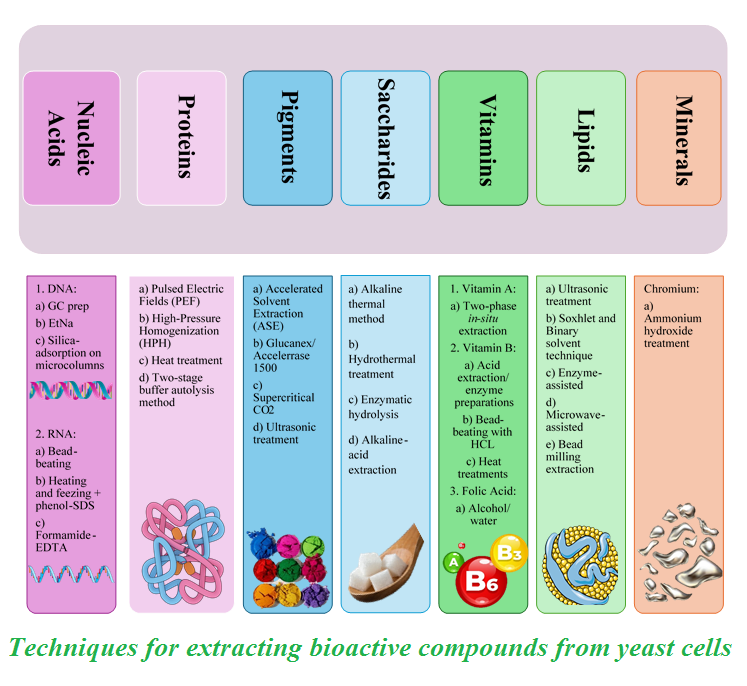
Iron-enriched yeast biomass presents a promising potentially safer alternative for dietary iron supplementation aimed at preventing iron-deficiency anemia. To export intracellular iron content for quantification purposes, the biomass was first harvested by centrifugation; after which, the supernatant was discarded. The resulting cell pellet was washed three times with distilled water (DW) to eliminate loosely bound or surface-associated iron. The purified yeast biomass was dried to a constant mass. Then, the dried sample was subjected to acid digestion with nitric acid, followed by heating at 140°C to ensure complete decomposition of organic matter and release of intracellular iron for further analysis [51]. The summary of yeast bioactive compound extraction strategies is present in Table 1. In addition, all the techniques for extracting bioactive compounds from yeast cells are summarized in Figure 3.
Extraction of a wide range of bioactive molecules—such as proteins, peptides, lipids and vitamins—from yeast cells has led to advancements in the development of functional foods, nutraceuticals and pharmaceutical uses. Techniques such as PEFs for protein extraction, as well as enzymatic methods for glutathione reductase and peptides, have demonstrated promising results for yield and efficiency [19, 29, 30]. The potential for extracting high-value compounds such as folic acid [43] and natural pigments from marine yeasts further extends the versatility of yeast-based systems in various industrial contexts [31–33]. Despite these promising developments, challenges are still in optimizing extraction processes to achieve higher yields and improve efficiency within various types of bioactive molecules. Some bioactive substances, especially those embedded within the yeast cell wall, make difficulties in extraction efficiency and preservation of their bioactivity.
Bioactive compound extraction from yeast cells can broadly be categorized into conventional and emerging techniques. Conventional chemical extraction methods have long been used but often suffer from limitations in yield, selectivity and environmental sustainability [52]. In contrast, emerging techniques, including PEF [18], HPH [19], ultrasound-assisted extraction, supercritical fluid extraction and microwave-assisted extraction [20], offer significant improvements in efficiency, selectivity and eco-friendliness. These advanced methods not only enhance the yield and purity of bioactive compounds but also align with the growing demand for greener further sustainable bioprocesses.
Overall, extraction of yeast-derived bioactive compounds is determined by the physicochemical characteristics, cellular localization and stability of the target molecules. Mechanical disruption methods are commonly used to overcome the rigid yeast cell wall and release intracellular components such as proteins, peptides and lipids. Enzymatic treatments provide selective and mild conditions, making them particularly appropriate for recovering functional cell-wall polymers and structurally susceptible biomolecules. Chemical extraction techniques are typically used for compounds with specific solubility characteristics, including pigments, vitamins and certain polysaccharides, although process conditions must carefully be controlled to prevent degradation. Emerging and green technologies such as ultrasound, microwave and supercritical fluid extraction enhance efficiency while decreasing solvent use and preserving bioactivity. Overall, method selection reflects a balance between effective cell disruption, compound stability and process efficiency.
Further research should focus on the following areas:
- Optimization of extraction processes: Tailoring extraction techniques to maximize the yield and bioactivity of specific compounds, particularly those embedded in the yeast cell wall, is critical. A combination of enzymatic, physical and green extraction methods may offer synergistic effects that improve efficiency and sustainability.
- Scalability and commercial viability: To make yeast-based encapsulation and extraction methods commercially viable, further studies are needed to scale up these processes while maintaining cost-effectiveness and efficiency. This includes optimizing reaction conditions, decreasing energy consumption and improving reproducibility of large-scale extractions.
- Integration of nanotechnology: Use of nanotechnology in extraction and encapsulation can revolutionize the field by enhancing the efficiency of bioactive compound recovery and providing further precise controls over the release of encapsulated molecules [53]. Future research should investigate the potential of nanoparticles, nanocarriers and nanostructured materials in improving yeast-based encapsulation and extraction technologies.
- Essential comparative assessment of extraction techniques: Further research should prioritize a comprehensive comparison of various extraction methods to quantify their respective yields and efficiencies. Essential quantitative data, including extraction yield, recovery percentage and the concentration of bioactive compounds, are critical for assessing the practical and industrial applicability of these techniques.
By addressing these challenges and investigating novel routes of research, further advancements in yeast-based encapsulation and extraction techniques further enhance their applicability and performance in various industries, providing ways for the development of further sustainable, innovative and efficient solutions for bioactive compound preservation and delivery.
- Conclusion
In conclusion, the technologies discussed in this study demonstrate significant advancements in improving the stability, efficiency and sustainability of bioactive compound extraction from yeast cells. Use of physical techniques such as PEFs and HPH with emerging green extraction methods includes significant potential for enhancing extraction yields while minimizing environmental effects.
While the potential of yeast-based microencapsulation and extraction techniques is substantial, further research is needed to address several challenges. These include optimizing extraction protocols for specific bioactive compounds and improving the scalability of the current methods. Additionally, the integration of emerging technologies such as nanotechnology and advanced enzymatic approaches may offer novel pathways for enhancing efficiency and sustainability of the bioactive compound recovery from yeast cells.
The distinctive contribution of this review depends on its comprehensive analysis of extraction mechanisms by categorizing the techniques based on the types of substances extracted while highlighting the advancements and challenges in this field.
- Bioactive compounds
- Encapsulation
- Extraction
- Functional foods
- Yeast cells
How to Cite
References
1. Dadkhodazadeh E, Ghorbani M, Yeganeh M, Jafari SM. Yeast cells for encapsulation of bioactive compounds in food products: A review. Biotechnol Prog. 2021; 37(4): e3138. https://doi.org/10.1002/btpr.3138
2. Parapouli M, Vasileiadis A, Afendra AS, Hatziloukas E. Saccharomyces cerevisiae and its industrial applications. AIMS Microbiol. 2020; 6(1): 1-31. https://www.aimspress.com/article/doi/10.3934/microbiol.2020001
3. Eliodório KP, Ferreira J, Rodrigues L, Rocha L, Rocha M, Moreira M, et al. Advances in yeast alcoholic fermentations for the production of bioethanol, beer and wine. Adv Appl Microbiol. 2019; 109: 61-119. https://doi.org/10.1016/bs.aambs.2019.10.002
4. Steensels, J. and K.J. Verstrepen, Taming wild yeast: Potential of conventional and nonconventional yeasts in industrial fermentations. Annu Rev Microbiol. 2014; 68:61-80. https://doi.org/10.1146/annurev-micro-091213-113025
5. Tullio, V., Yeast genomics and its applications in biotechnological processes: What is our present and near future? J Fungi (Basel). 2022; 8(7): 752. https://doi.org/10.3390/jof8070752
6. Khameneh B, Bazzaz BSF, Moghadam MN. Saccharomyces cerevisiae—a platform for delivery of drugs and food ingredients encapsulation and analysis. In: Biodegradation of Pollutants and Bioremediation Principles. Boca Raton: CRC Press; 2021. p. 102-121. https://doi.org/10.1201/9780429293931-5
7. Tan C, Huang M, McClements DJ, Sun B, Wang J. Yeast cell-derived delivery systems for bioactives. Trends Food Sci Technol. 2021; 118: 362-373. https://doi.org/10.1016/j.tifs.2021.10.020
8. Mirzaei M, Shavandi A, Mirdamadi S, Soleymanzadeh N, Motahari P, Mirdamadi, et al. Bioactive peptides from yeast: A comparative review on production methods, bioactivity, structure-function relationship and stability. Trends Food Sci Technol. 2021; 118: 297-315. https://doi.org/10.1016/j.tifs.2021.10.008
9. Sarkar N, Mahajan AA, Pathak S, Seth P, Chowdhury A, Ghose I, et al. Betaglucans in biotechnology: A holistic review with a special focus on yeast. Bioeng. (Basel). 2025; 12(4): 365. https://doi.org/10.3390/bioengineering12040365
10. Samuelsen AB, Schrezenmeir J, Knutsen SH. Effects of orally administered yeast-derived beta-glucans: A review. Vet. Immunol. Immunopathol. 2014; 158(3-4): p. 165-182. https://doi.org/10.1016/j.vetimm.2014.01.002
11. Nakhaee Moghadam M, Jamshidi A, Fazly Bazzaz BS, Azizzadeh M, Movaffagh J. Saccharomyces cerevisiae as a delivery system of Zataria multiflora Boiss. essential oil as a natural preservative for food applications: Encapsulation of Iranian Zataria multiflora Boiss. essential oil. J. Sci. Food Agric. 2021; 101(5): 2006-2013. https://doi.org/10.1002/jsfa.10818
12. Paramera EI, Konteles SJ, Karathanos VT. Microencapsulation of curcumin in cells of Saccharomyces cerevisiae. Food Chem. 2011; 125(3): 892-902. https://doi.org/10.1016/j.foodchem.2010.09.063
13. Salari R, Fazly Bazzaz BS, Rajabi O, Khashyarmanesh Z. New aspects of Saccharomyces cerevisiae as a novel carrier for berberine. DARU J. Pharm. Sci. 2013; 21(1): 73. https://doi.org/10.1186/2008-2231-21-73
14. Salari R, Rajabi O, Khashyarmanesh Z, Najafi M.F, Fazly Bazzaz BS. Characterization of encapsulated berberine in yeast cells of Saccharomyces cerevisiae. Iran. J. Pharm. Res.: IJPR. 2015; 14(4): 1247-1256. https://pubmed.ncbi.nlm.nih.gov/26664393/
15. Beikzadeh S, Shojaee AS, Dadkhodazade E, Sheidaei Z, Abedi AS, Mirmoghtadaie L, et al. Comparison of properties of breads enriched with omega-3 oil encapsulated in β-Glucan and Saccharomyces cerevisiae yeast cells. Appl. Food Biotechnol. 2019; 7(1):11-20. https://doi.org/10.22037/afb.v1i1.25969
16. Nakhaee Moghadam M, Khameneh B, Fazly Bazzaz BS. Saccharomyces cerevisiae as an efficient carrier for delivery of bioactives: A review. Food Biophys. 2019; 14: 346-353. https://doi.org/10.1007/s11483-019-09584-0
17. Samakar B, Tajani AS, Fazly Bazzaz BS, Soheili V. Fortified bread with encapsulated ingredients: Impacts and potential applications. J. Sci. Food Agric. 2025; 105(11):5601-5610. https://doi.org/10.1002/jsfa.14051
18. Ganeva V, Angelova B, Galutzov B, Goltsev V, Zhiponova M. Extraction of proteins and other intracellular bioactive compounds from Baker's yeasts by pulsed electric field treatment. Front. Bioeng. Biotechnol. 2020; 8:552335. https://doi.org/10.3389/fbioe.2020.552335
19. Marín-Sánchez J, Berzosa A, Álvarez I, Sánchez-Gimeno C, Raso J. Selective extraction of biomolecules from Saccharomyces cerevisiae assisted by high-pressure homogenization, pulsed electric fields and heat treatment: Exploring the effect of endogenous enzymes. LWT. 2024; 207: 116614. https://dx.doi.org/10.2139/ssrn.4845721
20. Bhadange YA, Carpenter J, Saharan VK. A comprehensive review on advanced extraction techniques for retrieving bioactive components from natural sources. ACS Omega. 2024; 9(29): 31274-31297. https://doi.org/10.1021/acsomega.4c02718
21. Rezvani Amin Z, Khashyarmanesh Z, Fazly Bazzaz BS. Different behavior of Staphylococcus epidermidis in intracellular biosynthesis of silver and cadmium sulfide nanoparticles: More stability and lower toxicity of extracted nanoparticles. World J Microbiol Biotechnol. 2016; 32: 140. https://doi.org/10.1007/s11274-016-2110-8
22. Blount BA, Driessen MR, Ellis T. Fast and easy extraction of stable yeast genomic DNA. Sci Rep. 2016; 6: 26863. https://doi.org/10.1038/srep26863
23. Vingataramin L, Frost EH. A single protocol for extraction of gDNA from bacteria and yeast. Biotechniques. 2015; 58(3): 120-125. https://doi.org/10.2144/000114263
24. Kirchmayr MR, Segura-Garcia LE, Flores-Berrios EP, Gschaedler A. Strategy for the extraction of yeast DNA from artisan agave must for quantitative PCR analysis. J Biosci Bioeng. 2011; 112(5): 518-521. https://doi.org/10.1016/j.jbiosc.2011.07.009
25. Alperovich N, Scott BM, Ross D. Automation protocol for high-efficiency and high-quality genomic DNA extraction from Saccharomyces cerevisiae. PLoS One. 2023; 18(10): e0292401. https://doi.org/10.1371/journal.pone.0292401
26. Sasidharan K, Amariei C, Tomita M, Murray DB. Rapid DNA, RNA and protein extraction protocols optimized for slow continuously growing yeast cultures. Yeast. 2012; 29(8): 311-322. https://doi.org/10.1002/yea.2911
27. Green MR, Sambrook J. Total RNA extraction from Saccharomyces cerevisiae using hot acid phenol. Cold Spring Harb Protoc. 2021; 12. https://doi.org/10.1101/pdb.prot101691
28. Shedlovskiy D, Shcherbik N, Pestov DG. One-step hot formamide extraction of RNA from Saccharomyces cerevisiae. RNA Biol. 2017; 14(12): 1722-1726. https://doi.org/10.1080/15476286.2017.1345417
29. Tsai YC, Yang TY, Cheng SW, Li SN, Wang YJ. High-yield extraction and purification of glutathione reductase from Baker's yeast. Prep Biochem. 1991; 21(2-3): 175-185. https://doi.org/10.1080/10826069108018012
30. Barthel T, Kula MR. Studies on the extraction of DesPro(2)-Val15-Leu17-aprotinin from the culture broth of a recombinant Saccharomyces cerevisiae. Bioseparation. 1992; 3(6): 365-372. https://pubmed.ncbi.nlm.nih.gov/1285279/
31. Banerjee S, Sarkar A K. Rao VB. Extraction and characterization of carotenoid pigments with antioxidant and antibacterial potential from marine yeast Rhodotorula sp. KSB1. Int Microbiol. 2024; 28(1): 137-156. https://doi.org/10.1007/s10123-024-00529-3
32. Choi SK, Kim JH, Park YS, Kim YJ, Chang HI. An efficient method for the extraction of astaxanthin from the red yeast Xanthophyllomyces dendrorhous. J. Microbiol. Biotechnol. 2007; 17(5): 847-852. https://pubmed.ncbi.nlm.nih.gov/18051308/
33. Harith ZT, de Andrade Lima M, Charalampopoulos D, Chatzifragkou A. Optimised production and extraction of astaxanthin from the yeast Xanthophyllomyces dendrorhous. Microorganisms. 2020; 8(3):430. https://doi.org/10.3390/microorganisms8030430
34. Martínez, J.M., et al., Organic-solvent-free extraction of carotenoids from yeast Rhodotorula glutinis by application of ultrasound under pressure. Ultrason. Sonochem. 2020; 61: 104833. https://doi.org/10.1016/j.ultsonch.2019.104833
35. Yousefi L. Yeast Mannan: Structure, extraction and bioactivity. Appl Food Biotechnol. 2023; 10(3): 155-164. https://doi.org/10.22037/afb.v10i3.41489
36. Faustino M, Durão J, Pereira CF, Oliveira AS, Pereira JO, Pereira AM, et al. Comparative analysis of mannans extraction processes from spent yeast Saccharomyces cerevisiae. Foods. 2022; 11(23): 3753. https://doi.org/10.3390/foods11233753
37. Huang GL. Extraction of two active polysaccharides from the yeast cell wall. Z Naturforsch C J Biosci. 2008; 63(11-12): 919-921. https://doi.org/10.1515/znc-2008-11-1224
38. Sun L, Kwak S, Jin Y.S. Vitamin A production by engineered Saccharomyces cerevisiae from xylose via two-phase in-situ extraction. ACS Synth Biol. 2019; 8(9): 2131-2140. https://doi.org/10.1021/acssynbio.9b00217
39. Hälvin K, Paalme T, Nisamedtinov I. Comparison of different extraction methods for simultaneous determination of B complex vitamins in nutritional yeast using LC/MS-TOF and stable isotope dilution assay. Anal Bioanal Chem. 2013; 405(4): 1213-1222. https://doi.org/10.1007/s00216-012-6538-x
40. Rocchi R, van Kekem K, Heijnis WH, Smid EJ. A simple, sensitive and specific method for the extraction and determination of thiamine and thiamine phosphate esters in fresh yeast biomass. J. Microbiol. Methods. 2022; 201: 106561. https://doi.org/10.1016/j.mimet.2022.106561
41. Osman J. New Data on the extraction of B1 from natural material (yeast). Science. 1946; 104(2711): 578. https://doi.org/10.1126/science.104.2711.578
42. Maleki A, Nateghi L, Moslemi M, Hashemiravan, M. Characterization of encapsulated folic acid in Saccharomyces cerevisiae cells and assessment of the biochemical stability after baking and during storage of two types of Iranian breads. Appl. Food Biotechnol. 2024; 11(1): e29. https://doi.org/10.22037/afb.v11i1.45691
43. Greene RD. The extraction of folic (pteroylglutamic) acid conjugate from yeast. J Biol Chem. 1949; 179(3): 1075-1078. https://pubmed.ncbi.nlm.nih.gov/18134571/
44. Jeevan Kumar SP, Banerjee R. Enhanced lipid extraction from oleaginous yeast biomass using ultrasound assisted extraction: A greener and scalable process. Ultrason. Sonochem. 2019; 52: 25-32. https://doi.org/10.1016/j.ultsonch.2018.08.003
45. Jin G, Yang F, Hu C, Shen H, Zhao ZK. Enzyme-assisted extraction of lipids directly from the culture of the oleaginous yeast Rhodosporidium toruloides. Bioresour. Technol. 2012; 111: 378-82. https://doi.org/10.1016/j.biortech.2012.01.152
46. Khoomrung S, Chumnanpuen P, Jansa-Ard S, Ståhlman M, Nookaew I, Borén J, et al. Rapid quantification of yeast lipid using microwave-assisted total lipid extraction and HPLC-CAD. Anal. Chem. 2013; 85(10): 4912-9. https://doi.org/10.1021/ac3032405
47. Li D, Zhang ZT, He CW, Xie Z. Yeast lipid extraction and analysis by HPTLC. Bio. Protoc. 2021; 11(13): e4081. https://doi.org/10.21769/BioProtoc.4081
48. Meullemiestre A, Breil C, Abert-Vian M, Chemat F. Microwave, ultrasound, thermal treatments and bead milling as intensification techniques for extraction of lipids from oleaginous Yarrowia lipolytica yeast for a biojetfuel application. Bioresour. Technol. 2016; 211: 190-199. https://doi.org/10.1016/j.biortech.2016.03.040
49. Shet AR, Patil LR, Hombalimath VS, Yaraguppi DA, Udapudi BB. Enrichment of Saccharomyces cerevisiae with zinc and their impact on cell growth. Biotechnol. Bioinf. Bioeng. 2011; 1(4): 523-527.
50. Anderson RA, Polansky MM, Roginski EE, Mertz W. Factors affecting the retention and extraction of yeast chromium. J. Agric. Food Chem. 1978; 26(4): 858-861. https://doi.org/10.1021/jf60218a023
51. Paš, M, Piškur B, Šuštarič M, Raspor P. Iron enriched yeast biomass – A promising mineral feed supplement. Bioresour. Technol. 2007; 98(8): 1622-1628. https://doi.org/10.1016/j.biortech.2006.06.002
52. Zhao F, Wang Z, Huang H. Physical cell disruption technologies for intracellular compound extraction from microorganisms. Processes. 2024; 12(10): 2059. https://www.mdpi.com/2227-9717/12/10/2059
53. Pateiro M, Gómez B, Munekata PE, Barba FJ, Putnik P, Kovačević DB, et al. Nanoencapsulation of promising bioactive compounds to improve their absorption, stability, functionality and the appearance of the final food products. Molecules. 2021; 26(6):1547. https://doi.org/10.3390/molecules26061547
- Abstract Viewed: 267 times
- pdf Downloaded: 184 times