Effects of Soluble Soybean Polysaccharides on Properties of Kefir Produced from Cow and Buffalo Milks
Applied Food Biotechnology,
Vol. 7 No. 1 (2020),
24 December 2019
,
Page 31-40
https://doi.org/10.22037/afb.v7i1.26013
Abstract
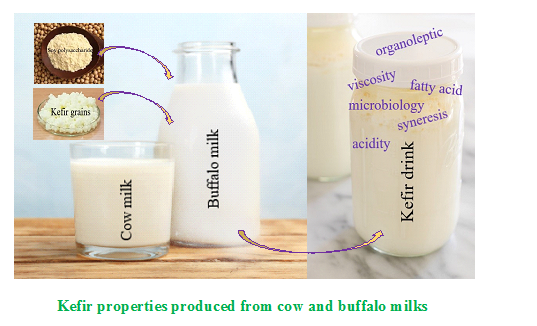
Background and objective: Fermented dairy products are considerably known due to several benefits including high nutritional values, immunity stimulations, antimicrobial and cancer suppressing effects. Kefir is a fermented dairy product with acidic-alcoholic flavors made from various sources of milk with various characteristics. The aim of this study was to investigate impact of soluble soybean polysaccharides on properties of kefir produced from cow and buffalo milk.
Materials and methods: Soluble soybean polysaccharides at concentrations of 0 (control), 0.5, 1 and 1.5% (w v-1) were added to kefir samples produced from cow and buffalo milks and the physicochemical, sensory and microbiological characteristics as well as fatty acid profile analysis of the kefir samples were compared during one month of cold storage.
Results and conclusion: Results showed that soluble soybean polysaccharides (P≤0.05) had significant effects on kefir properties. By increasing concentration of soluble soybean polysaccharides and storage time of the kefir, some properties including acidity, viscosity, sensory score and counts of the lactic acid bacteria and yeasts were increased. The fatty acid analysis revealed that unsaturated fatty acids of cow and buffalo kefirs were more than cow and buffalo milks while these were reverse for saturated fatty acids. The best microbial and sensory properties of kefir were observed by adding 0.5 to 2% (w v-1) soluble soybean polysaccharides on day 30 of storage.
Conflict of interest: The authors declare no conflict of interest.
- ▪ Dairy beverage ▪ Fatty acid ▪ Kefir ▪ Lactic acid bacteria ▪ Soluble soybean polysaccharides ▪ Syneresis
How to Cite
References
. Liu JR, Lin CW. Production of kefir from soymilk with or without added glucose, lactose, or sucrose. Journal of Food Science. 2000 May;65(4):716-9. Doi.org/10.1111/j.1365-2621.2000.tb16078.x
. Gul O, Mortas M, Atalar I, Dervisoglu M, Kahyaoglu T. Manufacture and characterization of kefir made from cow and buffalo milk, using kefir grain and starter culture. Journal of dairy science. 2015 Mar 1;98(3):1517-25.
Doi.org/10.3168/jds.2014-8755
. Wszolek M, Tamime AY, Muir DD, Barclay MN. Properties of kefir made in Scotland and Poland using bovine, caprine and ovine milk with different starter cultures. LWT-Food Science and Technology. 2001 Jun 1;34(4):251-61.
Doi.org/10.1006/fstl.2001.0773
. Otles S, Cagindi O. Kefir: A probiotic dairy-composition, nutritional and therapeutic aspects. Pakistan journal of nutrition. 2003;2(2):54-9.
. Kavas G. Kefirs manufactured from Camel (Camelus Dramedarius) milk and Cow milk: comparison of some Chemical and Microbial properties. Italian Journal of Food Science. 2015 Sep 22;27(3):357-65.
Doi.org/10.14674/1120-1770/ijfs.v279
. Ahmad S, Anjum FM, Huma N, Sameen A, Zahoor T. Composition and physico-chemical characteristics of buffalo milk with particular emphasis on lipids, proteins, minerals, enzymes and vitamins. J Anim Plant Sci. 2013 Jan 1;23:62-74.
. Montanuci FD, Pimentel TC, Garcia S, Prudencio SH. Effect of starter culture and inulin addition on microbial viability, texture, and chemical characteristics of whole or skim milk Kefir. Food Science and Technology. 2012 Dec;32(4):580-865. Doi.org/10.1590/S0101-20612012005000119
. Nagovska VO, Bilyk OY, Gutyj BV, Slyvka NB, Mikhailytska OR. Influence of thistle grist on organoleptic, physico-chemical and microbiological parameters of kefir. Науковий вісник Львівського національного університету ветеринарної медицини та біотехнологій імені СЗ Ґжицького. 2018;20(85). Doi: 10.15421/nvlvet8530
. Sabooni P, Pourahmad R, Adeli HR. Improvement of viability of probiotic bacteria, organoleptic qualities and physical characteristics in kefir using transglutaminase and xanthan. Acta Scientiarum Polonorum Technologia Alimentaria. 2018 Jun 30;17(2):141-8. Doi.org/10.17306/J.AFS.2018.0556
. Hojjati M, Razavi SH, Rezaei K, Gilani K. Spray drying microencapsulation of natural canthaxantin using soluble soybean polysaccharide as a carrier. Food Science and Biotechnology. 2011 Feb 1;20(1):63-9.
Doi.org/10.1007/s10068-011-0009-6
.Fabek H. Understanding the effect of soluble fibres on the hydrolysis of starch and the diffusion of glucose during simulated human digestion (Doctoral dissertation).
. Nakamura A, Furuta H, Kato M, Maeda H, Nagamatsu Y. Effect of soybean soluble polysaccharides on the stability of milk protein under acidic conditions. Food Hydrocolloids. 2003 May 1;17(3):333-43.
Doi.org/10.1016/S0268-005X(02)00095-4
. Chen W, Duizer L, Corredig M, Goff HD. Addition of soluble soybean polysaccharides to dairy products as a source of dietary fiber. Journal of Food science. 2010 Aug;75(6):C478-84.
Doi.org/10.1111/j.1750-3841.2010.01688.x
. Nobuhara T, Matsumiya K, Nambu Y, Nakamura A, Fujii N, Matsumura Y. Stabilization of milk protein dispersion by soybean soluble polysaccharide under acidic pH conditions. Food Hydrocolloids. 2014 Jan 1;34:39-45. Doi.org/10.1016/j.foodhyd.2013.01.022
. Ghani S, Barzegar H, Noshad M, Hojjati M. The preparation, characterization and in vitro application evaluation of soluble soybean polysaccharide films incorporated with cinnamon essential oil nanoemulsions. International journal of biological macromolecules. 2018 Jun 1;112:197-202. Doi: 10.1016/j.ijbiomac.2018.01.145.
. Sayyad R. Effects of deep-fat frying process on the oil quality during French fries preparation. Journal of food science and technology. 2017 Jul 1;54(8):2224-9. Doi.org/10.1007/s13197-017-2657-x
. Pérez-López E, Cela D, Costabile A, Mateos-Aparicio I, Rupérez P. In vitro fermentability and prebiotic potential of soyabean Okara by human faecal microbiota. British Journal of Nutrition. 2016 Sep;116(6):1116-24. Doi.org/10.1017/S0007114516002816
. Panday A, Sahoo MK, Osorio D, Batra S. NADPH oxidases: an overview from structure to innate immunity-associated pathologies. Cellular & molecular immunology. 2015 Jan;12(1):5. Doi.org/10.1038/cmi.2014.89
. Liu J, Nakamura A, Corredig M. Addition of pectin and soy soluble polysaccharide affects the particle size distribution of casein suspensions prepared from acidified skim milk. Journal of agricultural and food chemistry. 2006 Aug 23;54(17):6241-6. Doi.org/10.1021/jf060113n
. AOAC. Official methods of analysis 2003, 17th ed. The association of official analytical chemists, arlington, USA.
. Metcalfe LD, Schmitz AA, Pelka JR. Rapid preparation of fatty acid esters from lipids for gas chromatographic analysis. Analytical chemistry. 1966 Mar 1;38(3):514-5. Doi.org/10.1021/ac60235a044
. Fox, P.F., Guinee, T.P., Cogan, T.M., & McSweeney, P.L.H. (2000). Fundamentals of Cheese Science. Gaithersburg, Maryland: Aspen Publishers, Inc.
. Khan MA, Islam MN, Siddiki MS. Physical and chemical composition of swamp and water buffalo milk: a comparative study. Italian Journal of Animal Science. 2007 Jan 1;6(sup2):1067-70. Doi.org/10.4081/ijas.2007.s2.1067
. Petridis D, Dimitreli G, Vlahvei K, Deligeorgakis C. Effects of Buffalo and Cow Milk Mixtures Enriched With Sodium Caseinates on the Physicochemical, Rheological and Sensory Properties of a Stirred Yogurt Product. Journal of Food Research. 2014 Dec 1;3(6):54.
. Vieira CP, Álvares TS, Gomes LS, Torres AG, Paschoalin VM, Conte-Junior CA. Kefir grains change fatty acid profile of milk during fermentation and storage. PloS one. 2015 Oct 7;10(10):e0139910.
Doi.org/10.1371/journal.pone.0139910
. Ghoneem G, Ismail M, El-Boraey N, Tabekha M, Elashrey H. Optimal combination of soy, buffalo, and cow's milk in bioyogurt for optimal chemical, nutritional, and health benefits. Journal of the American College of Nutrition. 2018 Jan 2;37(1):8-16. Doi.org/10.1371/journal.pone.0139910
. Yadav H, Jain S, Sinha PR. Production of free fatty acids and conjugated linoleic acid in probiotic dahi containing Lactobacillus acidophilus and Lactobacillus casei during fermentation and storage. International Dairy Journal. 2007 Aug 1;17(8):1006-10. Doi.org/10.1016/j.idairyj.2006.12.003
. Guzel‐Seydim ZB, Seydim AC, Greene AK, Taş T. Determination of antimutagenic properties of acetone extracted fermented milks and changes in their total fatty acid profiles including conjugated linoleic acids. International journal of dairy technology. 2006 Aug;59(3):209-15.Doi.org/10.1111/j.1471-0307.2006.00265.x
. McSweeney PL, Sousa MJ. Biochemical pathways for the production of flavour compounds in cheeses during ripening: A review. Le Lait. 2000 May 1;80(3):293-324. Doi: 10.1051/lait:2000127
. Temiz H, Dağyıldız K. Effects of Microbial Transglutaminase on Physicochemical, Microbial and Sensorial Properties of Kefir Produced by Using Mixture Cow’s and Soymilk. Korean journal for food science of animal resources. 2017;37(4):606. Doi: 10.5851/kosfa.2017.37.4.606
. Witthuhn RC, Schoeman T, Cilliers A, Britz TJ. Impact of preservation and different packaging conditions on the microbial community and activity of Kefir grains. Food Microbiology. 2005 Aug 1;22(4):337-44. Doi.org/10.1016/j.fm.2004.09.001
. Kök-Taş T, Seydim AC, Özer B, Guzel-Seydim ZB. Effects of different fermentation parameters on quality characteristics of kefir. Journal of Dairy Science. 2013 Feb 1;96(2):780-9. Doi.org/10.3168/jds.2012-5753
. Kosikowski, F. V. (1982). Cheese and fermented milk foods. 2 eds, Edwards Brothers, Inc., Ann Arbor, MI, USA.
. Ying X, Gong J, Goff HD, Yu H, Wang Q, Cui SW. Effects of pig colonic digesta and dietary fibres on in vitro microbial fermentation profiles. Bioactive Carbohydrates and Dietary Fibre. 2013 Apr 1;1(2):120-30. Doi.org/10.1016/j.bcdf.2013.03.002
. Guzel‐Seydim ZE, Wyffels JT, Seydim AC, Greene AK. Turkish kefir and kefir grains: microbial enumeration and electron microscobic observation. International Journal of Dairy Technology. 2005 Feb;58(1):25-9.
Doi.org/10.1111/j.1471-0307.2005.00177.x
. Joung JY, Lee JY, Ha YS, Shin YK, Kim Y, Kim SH, Oh NS. Enhanced microbial, functional and sensory properties of herbal yogurt fermented with Korean traditional plant extracts. Korean journal for food science of animal resources. 2016;36(1):90. Doi: 10.5851/kosfa.2016.36.1.90
. Dave, R. I., & Shah, N. P. (1997). Viability of yogurt and probiotic bacteria in yogurts made from commercial starter cultures. Int. Dairy J., 7, 31–41. Doi.org/10.1016/ S0958-6946(96)00046-5.
. Guzel-Seydim Z, Seydim AC, Greene AK. Organic acids and volatile flavor components evolved during refrigerated storage of kefir. Journal of Dairy Science. 2000 Feb 1;83(2):275-7.
Doi.org/10.3168/jds.S0022-0302(00)74874-0
. Irigoyen A, Arana I, Castiella M, Torre P, Ibanez FC. Microbiological, physicochemical, and sensory characteristics of kefir during storage. Food Chemistry. 2005 May 1;90(4):613-20.
Doi.org/10.1016/j.foodchem.2004.04.021
. Grønnevik H, Falstad M, Narvhus JA. Microbiological and chemical properties of Norwegian kefir during storage. International Dairy Journal. 2011 Sep 1;21(9):601-6. Doi.org/10.1016/j.idairyj.2011.01.001
. Jooyandeh H, Mortazavi SA, Farhang P, Samavati V. Physicochemical properties of set-style yoghurt as effected by microbial transglutaminase and milk solids contents. Journal of Applied Environmental and Biological Sciences. 2015;4(11S):59-67.
. Baines ZV, Morris ER. Flavour/taste perception in thickened systems: the effect of guar gum above and below c. Food Hydrocolloids. 1987 Apr 1;1(3):197-205. Doi.org/10.1016/S0268-005X(87)80003-6
. Bhat GS, Murthy MR, Rao MB. Carbonyl compounds in cow and buffalo milk fat. Journal of Dairy Science. 1981 Apr 1;64(4):588-93. Doi.org/10.3168/jds.S0022-0302(81)82616-1
- Abstract Viewed: 1033 times
- PDF Downloaded: 836 times