Isolation and Identification of Alicyclobacillus with High Dipicolinic Acid and Heat Resistant Proteins from Mango Juice
Applied Food Biotechnology,
Vol. 3 No. 4 (2016),
1 October 2016
,
Page 270-274
https://doi.org/10.22037/afb.v3i4.13429
Abstract
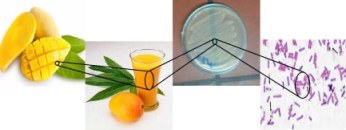
Background and Objectives: Microbial spoilage of juices and industries related with Alicyclobacillus are considerable international issues. This spore-forming bacterium causes changes in juices odor and taste. The isolation and identification of Alicyclobacillus contamination in juice producing and packaging industries has an essential role in the prevention and control of this type of spoilage bacterium in HACCP (Hazard analysis and critical control points ) manner.
Materials and Methods: A thermo-acidophilic, non-pathogenic and sporeforming bacterium was isolated from mango juice. Preliminary identification of the isolates was based on morphological, biochemical and physiological properties. Identification at species level was made by PCR amplification. The influence of temperature in the range of 25-65°C in the growth of bacterium and in the range of 80-120°C in spore-resistant and heat resistant proteins was investigated and compared with other spore producing bacteria.
Results and Conclusion: Phylogenetic analysis of the 16S rRNA gene sequencing indicated that the isolated strain constituted a distinct lineage in the Alicyclobacillus cluster and submitted to NCBI with access number Alicyclobacillus HRM-5 KM983424.1. The spores resisted 110°C for 3 h, and produced 28% dipicolinic acid more comparable to Bacillus licheniformis. Also they could produce 0.69 mg heat resistance protein after 1.5 h treatment in 100°C. The results showed that this strain could have biotechnological applications.
Conflict of interests: The authors declare no conflict of interest.
- Alicyclobacillus
- Spore
- Dipicolinic acid
- Heat resistance
- Mango

How to Cite
References
Chang SS, Kang DH. Alicyclobacillus spp. in the fruit juice industry: History, characteristics, and current isolation/detection procedures. Crit RevMicrobiol. 2004; 30(2):55–74. DOI:10.1080/10408410490435089.
Groenewald W, Gouws P, Witthuhn C. Isolation, identification and typification of Alicyclobacillus acidoterrestris and Alicyclobacillus acidocaldarius strains from orchard soil and the fruit processing environment in South Africa. Food Microbiol. 2009;26(1):71-6. DOI: 10.1016/j.fm.2008.07.008.
Kusube M, Sugihara A, Moriwaki Y, Ueoka T, Shimane Y, Minegishi H. Alicyclobacillus cellulosilyticus sp. nov., a thermophilic, cellulolytic bacterium isolated from steamed Japanese chedar chips from a lumbermill. Int J Syst Evol Microbiol. 2014;64: 2257–2263. DOI: 10.1099/ijs.0.061440-0.
Pontius AJ, Rushing JE, Foegeding PM. Heat resistance of Alicyclobacillus acidoterrestris spores as affected by various pH values and organic acids. J Food Prot. 1998;61(1):41–6.
Eiroa, MNU, Junqueira VCA, Schimdt FL. Alicyclobacillus in orange juice: occurrence and heat resistance of spores. J Food Protection. 1999;62(8)883–6.
Kim MG, Lee JC, Park DJ, Li WJ, Kim CJ. Alicyclobacillus tengchongensis sp. nov., a thermo-acidophilic bacterium isolated from hot spring soil. J Microbiol. 2014;52(10):884–9. DOI: 10.1007/s12275-014-3625-z
Smit Y, Cameron M, Venter P, Witthuhn RC. Alicyclobacyllus spoilage and isolation. Food Microbiol. 2011; 28(3), 331-349. DOI: 10.1016/j.fm.2010.11.008.
Pennacchio A, Mandrich L, Manco, G, Trincone A. Enlarging the substrate portfolio of the thermophilic esterase EST2 from Alicyclobacillus acidocaldarius. Extremophiles. 2015;19(5):1001–11.DOI: 10.1007/s00792-015-0774-x.
Hidaka M, Fushinobu S, Ohtsu N, Motoshima H, Matsuzawa H, Shoun H, Wakagi T. Trimeric crystal structure of the glycoside hydrolase family 42 β-galactosidase from Thermus termophilus A4 and the structure of its complex with galactose. J Mol Biol. 2002;322(1):79-91.
Boyce A, Walsh G. Characterisation of a novel thermostable endoglucanase from Alicyclobacillus vulcanalis of potential application in bioethanol production. Appl Microbiol Biotechnol. 2015;99(18):7515–25. DOI: 10.1007/s00253-015-6474-8.
Tourova TP, Poltoraus AB, Lebedeva IA, Tsaplina IA, Bogdanova TI, Karavaiko GI. 16S ribosomal RNA (rRNA) sequence analysis and phylogenetic position of Sulfobacillus thermosulfidooxidans. Syst Appl Microbiol. 1994;17(5):509–12. DOI: 10.1016/S0723-2020(11)80069-X.
Warth AD. Determination of dipicolinic acid in bacterial spores by derivative spectroscopy. Anal Biochem. 1983;130(2):502-505.
Komitopoulou E, Boziaris IS, Davies EA, Delves-Broughton J, Adams MR. Alicyclobacillus acidoterrestris in fruit juices and its control by nisin. Int J Food Sci Technol. 1999: 34(1): 81–85. DOI: 10. 1046/j.1365-2621.1999.00243.x.
Bevilacqua A, Corbo M. R, Sinigaglia M. Inhibition of Alicyclobacillus acidoterrestris spores by natural compounds. Int J Food Sci Techno. 2008;43(7):1271–75. doi: 10.1016/j.ijfoodmicro.2008.02.030.
Silva FVM, Gibbs P. Target selection in designing pasteurization processes for shelf-stable high-acid fruit products. Crit Rev Food Sci Nutr. 2004;44(5):353–60. DOI: 10.1080/10408690490489251.
Groenewald W, Gouws P, Witthuhn C. Thermal inactivation of Alicyclobacillus acidoterrestris spores isolated from a fruit processing plant and grape juice concentrate in South Africa. African J Microbiol Research. 2013;7(22):2736-40. DOI: 10.5897/AJMR12.1789.
Yingguo B, Huoqing H, Kun M. Identification of an acidic α-amylase from Alicyclobacillus sp. A4 and assessment of its application in the starch industry. Food Chem. 2012; 131: 1473-1478.
Tianli Y, Jiangbo Z, Yahong Y. Spoilage by Alicyclobacillus Bacteria in Juice and Beverage Products: Chemical, Physical, and Combined Control Methods. Compr Rev Food Sci Food Saf. 2014;13(5):77197. DOI: 10.1111/1541-4337.12093.
Setlow B, Atluri S, Kitchel R, Koziol-Dube K, Setlow P. Role of Dipicolinic Acid in Resistance and Stability of Spores of Bacillus subtilis with or without DNA-Protective α/β-Type Small Acid-Soluble Proteins. J Bacteriol. 2006 : 188(11): 3740–3747. doi: 10.1128/JB.00212-06.
Porebska I, Sokolowska B, Skapska S, Wozniak L, Fonberg-Broczek M. DPA Release and Germination of Alicyclobacillus acidoterrestris Spores under High Hydrostatic Pressure. J Nutr Food Sci 2015: 5(6):438- 442. DOI:10.4172/2155-9600.1000438
- Abstract Viewed: 1361 times
- Full article Downloaded: 1371 times