
Potential of a Software Package and Web Tool (SLDAssay) for Estimating Leishmania Parasite Burden in Limiting Dilution Assays
Student Research in Translational Medicine,
Vol. 7 (2025),
1 March 2025
,
Page 1-8
https://doi.org/10.22037/srtm.v7.50150
Abstract
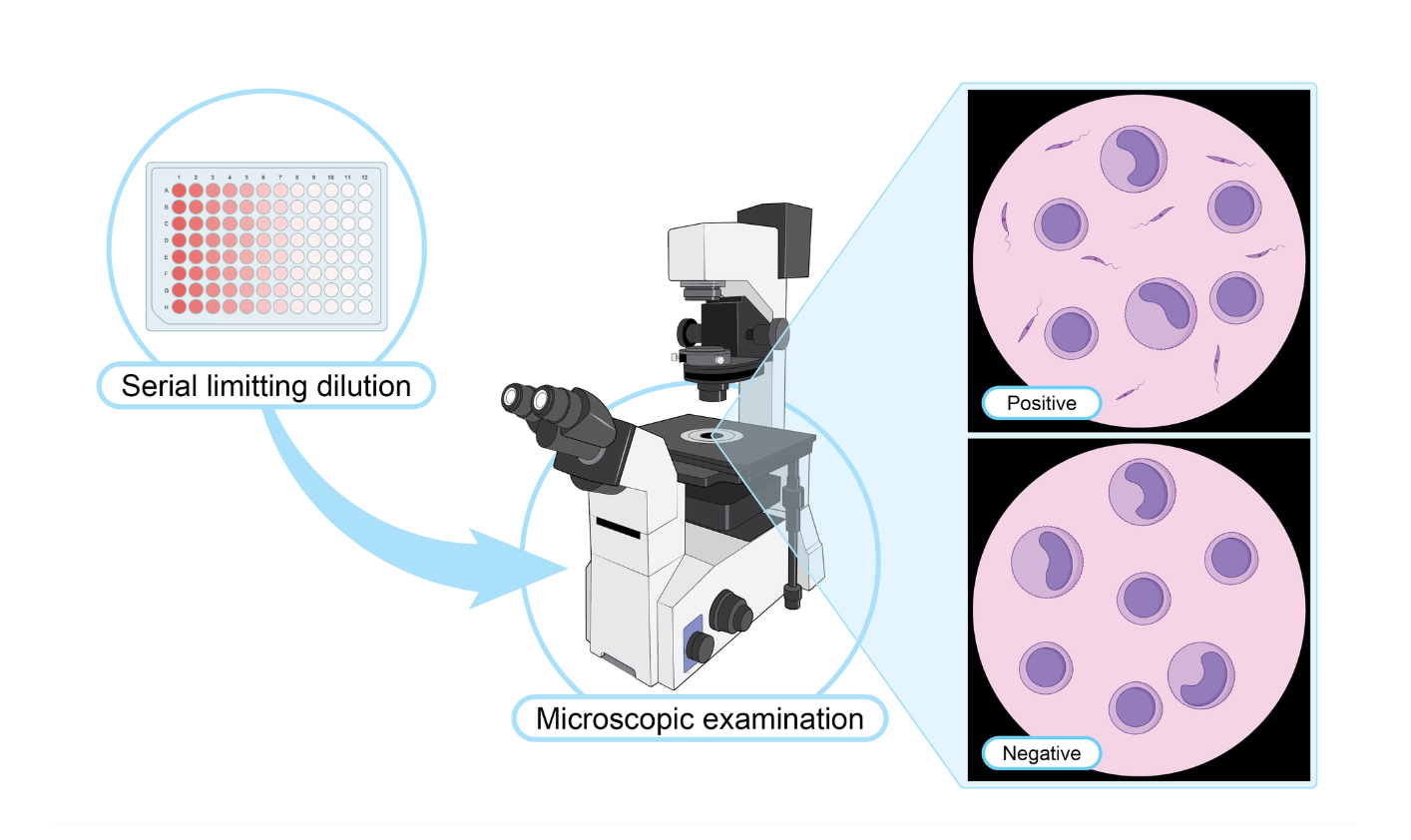
Background and Aim: Several methods exist for assessing parasite load in leishmaniosis. However, limiting dilution assay (LDA) is one of the most reliable tests for quantifying parasite burden in experimental models. Many software programs are available for analyzing LDA results; however, they offer different outputs, which might not be suitable for reporting parasite burden. ELIDA is considered a primary tool for this purpose; nevertheless, this software is inaccessible. Thus, it is essential to identify new software to substitute for this program. Our main objective for this study is to compare the performance of two software platforms, ELIDA and SLDAssay, in assessing parasite burden in the murine leishmaniasis model and determine whether these tools can be used interchangeably. Methods: In this study, we utilized a dataset derived from our previous research to evaluate the performance of the SLDAssay software. Data analysis focused on comparing correlations and trends between the ELIDA and SLDAssay software programs across various treatment groups. Results: A robust positive correlation was found between ELIDA and SLDAssay measurements (R² = 0.9367, P < 0.0001). Both software platforms exhibited comparable patterns of infection load across all treatment groups and individual mice, effectively differentiating between therapeutic and control groups. Conclusion: The results indicate that ELIDA and SLDAssay produce comparable and dependable measurements of Leishmania Major infection burdens in murine models. These methodologies can be utilized interchangeably in research on leishmaniasis, providing flexibility in data analysis while maintaining their reliability.
- Leishmania major
- Limiting Dilution Assay
- SLDAssay
How to Cite
References
1. Saini I, Joshi J, Kaur S. Leishmania vaccine development: A comprehensive review. Cell Immunol. 2024;399-400:104826.
2. Nery RLA, Santos TMS, Gois LL, Barral A, Khouri R, Feitosa CA, et al. Leishmania spp. genetic factors associated with cutaneous leishmaniasis antimony pentavalent drug resistance: a systematic review. Mem Inst Oswaldo Cruz. 2024;119:e230240.
3. Lima HC, Bleyenberg JA, Titus RG. A simple method for quantifying Leishmania in tissues of infected animals. Parasitol Today. 1997;13(2):80-2.
4. Ghotloo S, Haji Mollahoseini M, Najafi A, Yeganeh F. Comparison of Parasite Burden Using Real-Time Polymerase Chain Reaction Assay and Limiting Dilution Assay in Leishmania major Infected Mouse. Iran J Parasitol. 2015;10(4):571-6.
5. Haghdoust S, Azizi M, Haji Molla Hoseini M, Bandehpour M, Mohseni Masooleh M, Yeganeh F. Parasite Burden Measurement in the Leishmania major Infected Mice by Using the Direct Fluorescent Microscopy, Limiting Dilution Assay, and Real-Time PCR Analysis. Iran J Parasitol. 2020;15(4):576-86.
6. Rosenbloom DI, Elliott O, Hill AL, Henrich TJ, Siliciano JM, Siliciano RF. Designing and Interpreting Limiting Dilution Assays: General Principles and Applications to the Latent Reservoir for Human Immunodeficiency Virus-1. Open Forum Infect Dis. 2015;2(4):ofv123.
7. Titus RG, Marchand M, Boon T, Louis JA. A limiting dilution assay for quantifying Leishmania major in tissues of infected mice. Parasite Immunol. 1985;7(5):545-55.
8. Buffet PA, Sulahian A, Garin YJ, Nassar N, Derouin F. Culture microtitration: a sensitive method for quantifying Leishmania infantum in tissues of infected mice. Antimicrob Agents Chemother. 1995;39(9):2167-8.
9. Taswell C. Limiting dilution assays for the determination of immunocompetent cell frequencies. III. Validity tests for the single-hit Poisson model. J Immunol Methods. 1984;72(1):29-40.
10. Greenwood M, Yule GU. On the Statistical Interpretation of some Bacteriological Methods employed in Water Analysis. J Hyg (Lond). 1917;16(1):36-54.
11. Trumble IM, Allmon AG, Archin NM, Rigdon J, Francis O, Baldoni PL, et al. SLDAssay: A software package and web tool for analyzing limiting dilution assays. J Immunol Methods. 2017;450:10-6.
12. Hoseini MH, Moradi M, Alimohammadian MH, Shahgoli VK, Darabi H, Rostami A. Immunotherapeutic effects of chitin in comparison with chitosan against Leishmania major infection. Parasitol Int. 2016;65(2):99-104.
13. Lima HC, Bleyenberg JA, Titus RG. A simple method for quantifying Leishmania in tissues of infected animals. Parasitology Today. 1997;13(2):80-2.
14. Loeuillet C, Bañuls A-L, Hide M. Study of Leishmania pathogenesis in mice: experimental considerations. Parasites & Vectors. 2016;9(1):144.
15. Sacks D, Noben-Trauth N. The immunology of susceptibility and resistance to Leishmania major in mice. Nature Reviews Immunology. 2002;2(11):845-58.
16. Twomey PJ, Kroll MH. How to use linear regression and correlation in quantitative method comparison studies. Int J Clin Pract. 2008;62(4):529-38.
17. Phelps EB. A Method of Calculating the Numbers of B. Coli from the Results of Dilution Tests. Am J Public Hygiene. 1908;18(2):141-5.
18. Sainte-Marie G. Cytokinetics of antibody formation. Journal of Cellular Physiology. 1966;67(S1):109-27.
19. Breivik H. Haematopoietic stem cell content of murine bone marrow, spleen, and blood. Limiting dilution analysis of diffusion chamber cultures. J Cell Physiol. 1971;78(1):73-8.
20. Rosenbloom DIS, Elliott O, Hill AL, Henrich TJ, Siliciano JM, Siliciano RF. Designing and interpreting limiting dilution assays: general principles and applications to the latent reservoir for HIV-1. bioRxiv. 2015:018911.
21. Hu Y, Smyth GK. ELDA: extreme limiting dilution analysis for comparing depleted and enriched populations in stem cell and other assays. J Immunol Methods. 2009;347(1-2):70-8.
- Abstract Viewed: 288 times
- PDF Downloaded: 211 times


