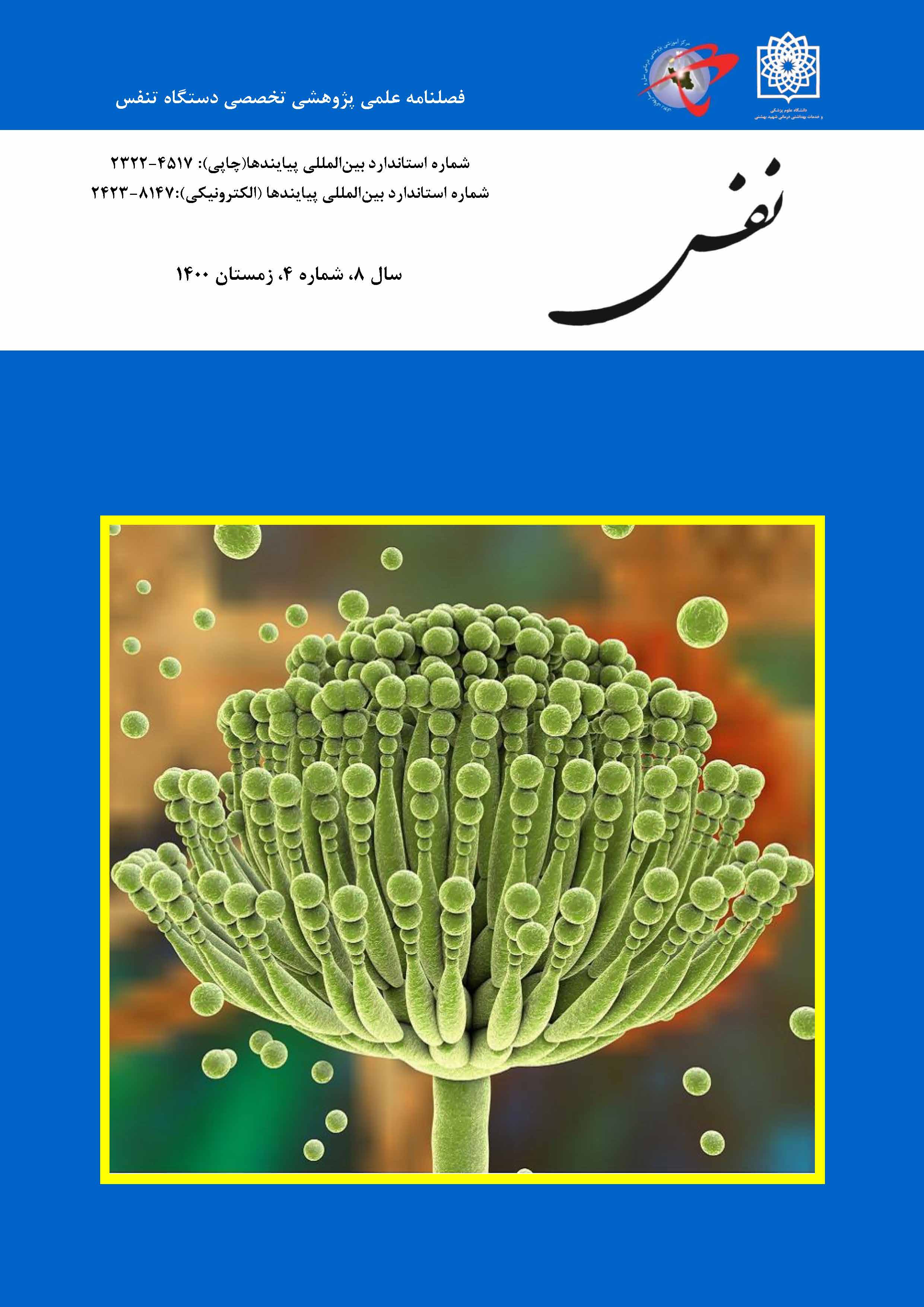
In vitro activities of five antifungal agents against clinical isolates of Aspergillus species In vitro activities of antifungal agents against Aspergillus species
Nafas Journal,
Vol. 8 No. 4 (1400),
6 December 2021
Abstract
Background: Invasive aspergillosis is one of the leading causes of death in patients with weakened immune systems. Since resistance to antifungal agents has been observed in patients, susceptibility testing is helpful in defining the activity spectrum of antifungals and determining the appropriate drug for treatment. Despite an increasing number of infections of Aspergillus in Iran, the antifungal susceptibility patterns and molecular epidemiology of clinical strains has not been well studied. In the current study, we evaluated the in vitro antifungal susceptibilities of five antifungal agents against clinical Aspergillus isolates from Iran.
Methods: Clinical Aspergillus isolates were preliminarily identified to the species level based on microscopic and macroscopic characteristics; subsequently, their identity was confirmed by DNA sequencing of the partial β-tubulin (BTU) gene. Antifungal susceptibilities of AMB, ITC, VRC, POS, and CAS against clinical Aspergillus isolates were determined in accordance with the CLSI M38-A2 document.
Results: One hundred and sixty-three clinical (n = 163) Aspergillus isolates were evaluated for their antifungal susceptibilities patterns. Aspergillus flavus 42 (64.4%), Aspergillus fumigatus 12 (18.4%), Aspergillus niger 8 (12.3%) and Aspergillus terreus 3 (4.6%) species were identified. Caspofangin (MIC90=0.063 µg/mL) had the highest antifungal activity against Aspergillus isolates and 100% of the isolates had MIC90 equal to 0.063 µg/mL. Among azole drugs, posaconazole had the highest antifungal activity and the MIC of this drug for all isolates was ≤1 µg/mL. Also, 0.5% and 1% of Aspergillus fumigatus isolates were resistant to itraconazole and vriconazole, respectively.
Conclusion: Our results suggest that clinical Aspergillus isolates are the most susceptible to posaconazole and caspofungin. These results should be further investigation, especially in in vivo study with different manifestations of aspergillosis.
- حساسیت دارویی
- آسپرژیلوس فلاووس
- آسپرژیلوس فومیگاتوس
How to Cite
References
2. Zmeili O, Soubani A. Pulmonary aspergillosis: a clinical update. Qjm. 2007;100(6):317-34.
3. Chandrasekhar P, Alangaden G, Manavathu E. Aspergillus: an increasing problem in tertiary care hospitals? Clinical Infectious Diseases. 2000;30(6):984-5.
4. Patterson TF, Kirkpatrick WR, White M, et al. Invasive Aspergillosis Disease Spectrum, Treatment Practices, and Outcomes. Medicine. 2000;79[4]:250-60.
5. Trof R, Beishuizen A, Debets-Ossenkopp Y, Girbes A, Groeneveld A. Management of invasive pulmonary aspergillosis in non-neutropenic critically ill patients. Intensive care medicine. 2007;33[10]:1694-703.
6. Lin S-J, Schranz J, Teutsch SM. Aspergillosis case-fatality rate: systematic review of the literature. Clinical Infectious Diseases. 2001;32(3):358-66.
7. Kaya AD, Kiraz N. In vitro susceptibilities of Aspergillus spp. causing otomycosis to amphotericin B, voriconazole and itraconazole. Mycoses. 2007;50(6):447-50.
8. Von Eiff M, Roos N, Schulten R, Hesse M, Zühlsdorf M, Van de Loo J. Pulmonary aspergillosis: early diagnosis improves survival. Respiration. 1995;62(6):341-7.
9. Khodavaisy S, Badali H, Hashemi S, et al. In vitro activities of five antifungal agents against 199 clinical and environmental isolates of Aspergillus flavus, an opportunistic fungal pathogen. Journal de mycologie medicale. 2016;26[2]:116-21.
10. Verweij PE, Howard SJ, Melchers WJ, Denning DW. Azole-resistance in Aspergillus: proposed nomenclature and breakpoints. Drug Resistance Updates. 2009;12(6):141-7.
11. Badali H, Vaezi A, Haghani I, et al. Environmental study of azole‐resistant Aspergillus fumigatus with TR34/L98H mutations in the cyp51A gene in Iran. Mycoses. 2013;56(6):659-63.
12. Dannaoui E, Meletiadis J, Tortorano A-M, et al. Susceptibility testing of sequential isolates of Aspergillus fumigatus recovered from treated patients. Journal of medical microbiology. 2004;53[2]:129-34.
13. Espinel-Ingroff A, Cuenca-Estrella M, Fothergill A, et al. Wild-type MIC distributions and epidemiological cutoff values for amphotericin B and Aspergillus spp. for the CLSI broth microdilution method (M38-A2 document). Antimicrobial agents and chemotherapy. 2011;55[11]:5150-4.
14. Hedayati MT, Khodavaisy S, Alialy M, Omran SM, Habibi MR. Invasive aspergillosis in intensive care unit patients in Iran. Acta Medica (Hradec Kralove). 2013;56[2]:52-6.
15. Hsueh P-R, Lau Y-J, Chuang Y-C, et al. Antifungal susceptibilities of clinical isolates of Candida species, Cryptococcus neoformans, and Aspergillus species from Taiwan: surveillance of multicenter antimicrobial resistance in Taiwan program data from 2003. Antimicrobial agents and chemotherapy. 2005;49[2]:512-7.
16. Rath P. Susceptibility of Aspergillus strains from culture collections to amphotericin B and itraconazole. Journal of Antimicrobial Chemotherapy. 1998;41[5]:567-70.
17. Burgel P-R, Baixench M-T, Amsellem M, et al. High prevalence of azole-resistant Aspergillus fumigatus in adults with cystic fibrosis exposed to itraconazole. Antimicrobial agents and chemotherapy. 2012;56[2]:869-74.
18. Denning DW, Lee JY, Hostetler JS, et al. NIAID Mycoses Study Group multicenter trial of oral itraconazole therapy for invasive aspergillosis. The American journal of medicine. 1994;97[2]:135-44.
19. Caillot D, Bassaris H, McGeer A, et al. Intravenous itraconazole followed by oral itraconazole in the treatment of invasive pulmonary aspergillosis in patients with hematologic malignancies, chronic granulomatous disease, or AIDS. Clinical Infectious Diseases. 2001;33[8]:e83-e90.
20. Abdolvahab Alborzi M, Mahsa Moeini M, Pedram Haddadi M. Antifungal susceptibility of the Aspergillus species by Etest and CLSI Reference Methods. Archives of Iranian medicine. 2012;15(7):429.
21. Saravolatz LD, Johnson LB, Kauffman CA. Voriconazole: a new triazole antifungal agent. Clinical Infectious Diseases. 2003;36[5]:630-7.
22. Shi J-y, Xu Y-c, Shi Y, et al. In vitro susceptibility testing of Aspergillus spp. against voriconazole, itraconazole, posaconazole, amphotericin B and caspofungin. Chinese Medical Journal (English Edition). 2010;123[19]:2706.
23. Van Der Linden JW, Warris A, Verweij PE. Aspergillus species intrinsically resistant to antifungal agents. Medical mycology. 2011;49(sup1):S82-S9.
24. Alexander BD, Perfect JR, Daly JS, et al. Posaconazole as salvage therapy in patients with invasive fungal infections after solid organ transplant. Transplantation. 2008;86(6):791-6.
25. Canuto MM, Rodero FG. Antifungal drug resistance to azoles and polyenes. The Lancet infectious diseases. 2002;2[9]:550-63.
26. Pfaller MA, Castanheira M, Diekema DJ, Messer SA, Jones RN. Triazole and echinocandin MIC distributions with epidemiological cutoff values for differentiation of wild-type strains from non-wild-type strains of six uncommon species of Candida. Journal of clinical microbiology. 2011;49[11]:3800-4.
27. Al-Wathiqi F, Ahmad S, Khan Z. Molecular identification and antifungal susceptibility profile of Aspergillus flavus isolates recovered from clinical specimens in Kuwait. BMC infectious diseases. 2013;13[1]:126.
28. Ullmann AJ, Lipton JH, Vesole DH, et al. Posaconazole or fluconazole for prophylaxis in severe graft-versus-host disease. New England Journal of Medicine. 2007;356[4]:335-47.
29. Candoni A, Mestroni R, Damiani D, et al. Caspofungin as first line therapy of pulmonary invasive fungal infections in 32 immunocompromised patients with hematologic malignancies. European journal of haematology. 2005;75(3):227-33.
30. Maertens J, Raad I, Petrikkos G, et al. Efficacy and safety of caspofungin for treatment of invasive aspergillosis in patients refractory to or intolerant of conventional antifungal therapy. Clinical Infectious Diseases. 2004;39[11]:1563-71.
31. Singh N, Limaye AP, Forrest G, et al. Combination of voriconazole and caspofungin as primary therapy for invasive aspergillosis in solid organ transplant recipients: a prospective, multicenter, observational study. Transplantation. 2006;81(3):320-6.
32. Maertens JA, Madero L, Reilly AF, et al. A randomized, double-blind, multicenter study of caspofungin versus liposomal amphotericin B for empiric antifungal therapy in pediatric patients with persistent fever and neutropenia. The Pediatric infectious disease journal. 2010;29[5]:415-20.
- Abstract Viewed: 654 times
- pdf (فارسی) Downloaded: 159 times