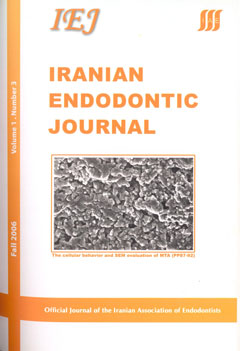
Bacterial Leakage of Mineral Trioxide Aggregates and Portland Cement
Iranian Endodontic Journal,
Vol. 1 No. 3 (2006),
1 October 2006
,
Page 93-96
https://doi.org/10.22037/iej.v1i3.441
Abstract
INTRODUCTION: The purpose of this study was to compare the ability of ProRoot mineral trioxide aggregate (PMTA) and Root mineral trioxide aggregate (RMTA) as root-end filling materials, and Portland cement (PC) to prevent bacterial leakage through filled root end cavities. MATERIALS AND METHODS: Fifty-one extracted human single rooted teeth were cleaned and shaped using a step back technique. The root-ends were resected and a 4 mm deep root-end preparation was made with fissure bur. The teeth were randomly divided into three experimental groups (n=15) and a further six teeth served as controls. Three root-end cavities were filled with gutta-percha without a root canal sealer (positive control) and three remaining were filled with sticky wax, covered with two layers of nail polish (negative control). Root-end cavities in each experimental group were filled with PMTA, RMTA or PC. After attaching the teeth to plastic caps of 9 ml vials, the teeth and the caps were sterilized using Gamma ray. Then the caps with teeth were placed on the vials containing Phenol Red Lactose broth. A tenth of microliter of Tripticase Soy broth containing Staphylococcus Epidermidis (SE) was placed into the root canals of the teeth. Every 48 hours inoculation of 0.1 ml of the SE broth culture into each root canal was performed. RESULTS: All positive controls leaked within 3 days, none of the negative controls leaked. Bacterial leakage occurred in 33% of samples in the PMTA group and in 40% of samples in RMTA and PC groups. The results indicated no statistical difference between three test materials after 35 days. CONCLUSION: It was concluded that PMTA, RMTA and PC demonstrated a similar ability to seal root end cavities.
- Bacterial Leakage
- MTA
- Portland Cement
- Root End Filling
How to Cite
- Abstract Viewed: 324 times
- PDF Downloaded: 261 times
Download Statastics
Make a Submission
Information
Developed By
Indexing/Abstracting
This journal is indexed in:
- PubMed
- Europe PMC
- Scopus
- SCImago
- MIAR
- CINAHL
- CAS (Chemical Abstracts)
- Dimensions
- DOAJ
- EBSCO
- FATCAT
- Google Scholar
- IMEMR (Index Medicus for the WHO Eastern Mediterranean Region)
- Index Copernicus
- ISC (Islamic World Science Citation Center)
- Magiran
- ROAD
- SID (Scientific Information Database)
- SUDOC
- UC Santa Barbara University
- WIKIDATA
- ZDB


