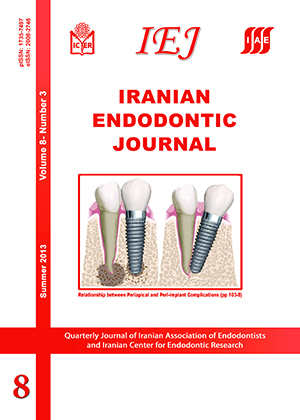
A New Classification for the Relationship between Periodontal, Periapical, and Peri-implant Complications
Iranian Endodontic Journal,
Vol. 8 No. 3 (2013),
28 July 2013
,
Page 103-108
https://doi.org/10.22037/iej.v8i3.4040
Abstract
Introduction: There are numerous studies supporting the high success rate of dental implants used for reconstruction of missing teeth. However, complications like mucositis and peri-implantitis are increasingly reported. Placement of dental implants in partially edentulous patients is associated with the risk of peri-implant diseases, especially when an old or a new inflammatory lesion is present adjacent to the implant site. Although no consensus has been reached on the difference in prevalence of peri-implant mucositis and peri-implantitis between fully and partially edentulous patients, available data clearly show that the combination of periodontal lesion and peri-implantitis is a possible risk factor for further complications. Several classification systems have been suggested for determination of the severity of disease around dental implants. However, no classification has been proposed for combined biological complications around teeth and implants. This study reviews the possible pathologic communication routes between natural dentition and the implants installed adjacent to them. Furthermore, we introduce a new classification system for the peri-implant disease in association with natural teeth called “PIST”. This system was designed based on the origin of the defects in order to clarify the different pathological situations which can be detected around dental implant. Using this classification system can help improve diagnosis, comparison and subsequent selection of the best treatment option.
Keywords:
- Classification
- Peri-implantitis
- Periodontal disease
- Periapical Diseases
How to Cite
1.
Kadkhodazadeh M, Amid R. A New Classification for the Relationship between Periodontal, Periapical, and Peri-implant Complications. Iran Endod J [Internet]. 2013 Jul. 15 [cited 2026 Oct. 19];8(3):103-8. Available from: https://journals.sbmu.ac.ir/iej/article/view/4040
- Abstract Viewed: 461 times
- PDF Downloaded: 493 times
Download Statastics
Make a Submission
Information
Developed By
Indexing/Abstracting
This journal is indexed in:
- PubMed
- Europe PMC
- Scopus
- SCImago
- MIAR
- CINAHL
- CAS (Chemical Abstracts)
- Dimensions
- DOAJ
- EBSCO
- FATCAT
- Google Scholar
- IMEMR (Index Medicus for the WHO Eastern Mediterranean Region)
- Index Copernicus
- ISC (Islamic World Science Citation Center)
- Magiran
- ROAD
- SID (Scientific Information Database)
- SUDOC
- UC Santa Barbara University
- WIKIDATA
- ZDB


