Publisher: Research Institute for Gastroenterology and Liver Diseases (RIGLD)
  • Register
  • Login

Gastroenterology and Hepatology from Bed to Bench

  • Home
  • Issues
    • Current
    • Archives
  • About
    • About the Journal
    • Aims and Scope
    • Editorial Team
    • Privacy Statement
    • Contact
  • For Authors
    • Submissions
    • Author Guidelines
    • Article Processing Charge
    • Peer Review Process
  • Indexing & Abstracting
  • Announcements
Advanced Search
  1. Home
  2. Archives
  3. Vol. 2 No. 1 (2009): Special Issue May 2009
  4. New Section Title Here
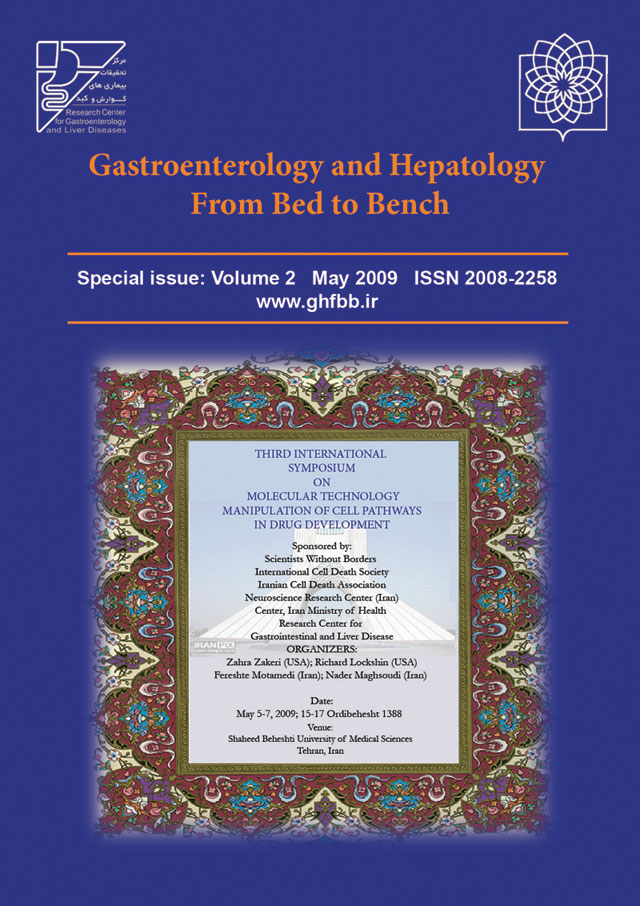
Special Issue May 2009

Vol. 2 No. 1 (2009)

July 2009

Cell death in drug design

  • Richard A. Lockshin

Gastroenterology and Hepatology from Bed to Bench, Vol. 2 No. 1 (2009), 27 July 2009
https://doi.org/10.22037/ghfbb.v0i0.6 Published: 2009-07-27

  • View Article
  • Download
  • Cite
  • Statastics
  • Share

Abstract

Cell death is a major factor separating healthy physiology from pathology and is rightly the target of considerable attention in the development of new therapies. Most of the effort has been directed at the activation of key effectors of apoptosis and the molecules that regulate this activation. This approach may be valid to address cancer, but otherwise, while efforts are making progress, they miss an important point that addresses cells that die too soon or inappropriately. In these situations, the stress on the cell often derives from an external source, and ultimately this stress must be relieved. If it is not, the cell is still likely to die, though perhaps not by apoptosis. Controlled autophagy, in which specific organelles are removed, begins to give us clues by which we may learn to understand how organelles are targeted.

Keywords:
  • Cell Death
  • Apoptosis
  • Drug Design
  • Autophagy
  • Lysosome.
  • PDF

How to Cite

Lockshin, R. A. (2009). Cell death in drug design. Gastroenterology and Hepatology from Bed to Bench, 2(1). https://doi.org/10.22037/ghfbb.v0i0.6
  • ACM
  • ACS
  • APA
  • ABNT
  • Chicago
  • Harvard
  • IEEE
  • MLA
  • Turabian
  • Vancouver
  • Endnote/Zotero/Mendeley (RIS)
  • BibTeX
  • Abstract Viewed: 265 times
  • PDF Downloaded: 173 times

Download Statastics

  • Linkedin
  • Twitter
  • Facebook
  • Google Plus
  • Telegram

Developed By

Open Journal Systems
  • Home
  • Archives
  • Submissions
  • About the Journal
  • Editorial Team
  • Contact

GHFBB journal is distributed under the terms of the Creative Commons Attribution-NonCommercial 4.0 International License (CC BY-NC 4.0).

Print ISSN: 2008-2258
Online ISSN: 2008-4234

Support Contact: ghfbb.journal@gmail.com

Powered by OJSPlus