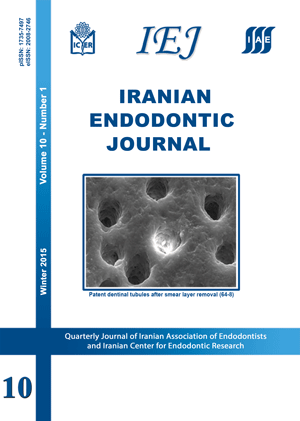
Antimicrobial Activity of Nanoparticle Calcium Hydroxide against Enterococcus Faecalis: An In Vitro Study
Iranian Endodontic Journal,
Vol. 10 No. 1 (2015),
3 January 2015
,
Page 39-43
https://doi.org/10.22037/iej.v10i1.6379
Abstract
Introduction: Enterococcus faecalis (E. faecalis) has the ability to invade the dentinal tubules and resist high pH levels. As a result, calcium hydroxide (CH) is not much effective on this bacterium. In theory, nanoparticle calcium hydroxide (NCH) has smaller size and high surface area that enables it to penetrate into the deeper layers of dentin and be more effective on E. faecalis. This in vitro study was designed to compare the antimicrobial activity of NCH and CH against E. faecalis. Methods and Materials: The antimicrobial activity of NCH against E. faecalis was evaluated by two independent tests: the minimum inhibitory concentration (MIC) of intracanal medicament and agar diffusion test (ADT). The efficiency of the medicament in dentinal tubules was evaluated on 23 human tooth blocks that were inoculated with E. faecalis. The tooth blocks were assigned to one control group (saline irrigation) and two experimental groups receiving CH and NCH as intracanal medication. The optical density in each group was assessed with spectrophotometer after collecting samples from dentin depths of 0, 200 and 400 µm. Data were analyzed by SPSS software ANOVA, Kruskal-Wallis and Dunnett’s test. Results: The MIC for NCH was 1/4 of the MIC for CH. NCH with distilled water (DW) produced the greatest inhibition zone in agar diffusion test. NCH had greater antimicrobial activity in dentin samples from depths of 200 and 400 µm compared to CH. Conclusion: The antimicrobial activity of NCH was superior to CH in culture medium. In dentinal tubules the efficacy of NCH was again better than CH on the 200- and 400-µm samples.
Keywords:
- Calcium Hydroxide
- Enterococcus Faecalis
- Intracanal Medicament
- Nanoparticle
How to Cite
1.
Dianat O, Saedi S, Kazem M, Alam M. Antimicrobial Activity of Nanoparticle Calcium Hydroxide against Enterococcus Faecalis: An In Vitro Study. Iran Endod J [Internet]. 2014 Dec. 31 [cited 2026 Oct. 19];10(1):39-43. Available from: https://journals.sbmu.ac.ir/iej/article/view/6379
- Abstract Viewed: 595 times
- PDF Downloaded: 481 times
Download Statastics
Make a Submission
Information
Developed By
Indexing/Abstracting
This journal is indexed in:
- PubMed
- Europe PMC
- Scopus
- SCImago
- MIAR
- CINAHL
- CAS (Chemical Abstracts)
- Dimensions
- DOAJ
- EBSCO
- FATCAT
- Google Scholar
- IMEMR (Index Medicus for the WHO Eastern Mediterranean Region)
- Index Copernicus
- ISC (Islamic World Science Citation Center)
- Magiran
- ROAD
- SID (Scientific Information Database)
- SUDOC
- UC Santa Barbara University
- WIKIDATA
- ZDB


