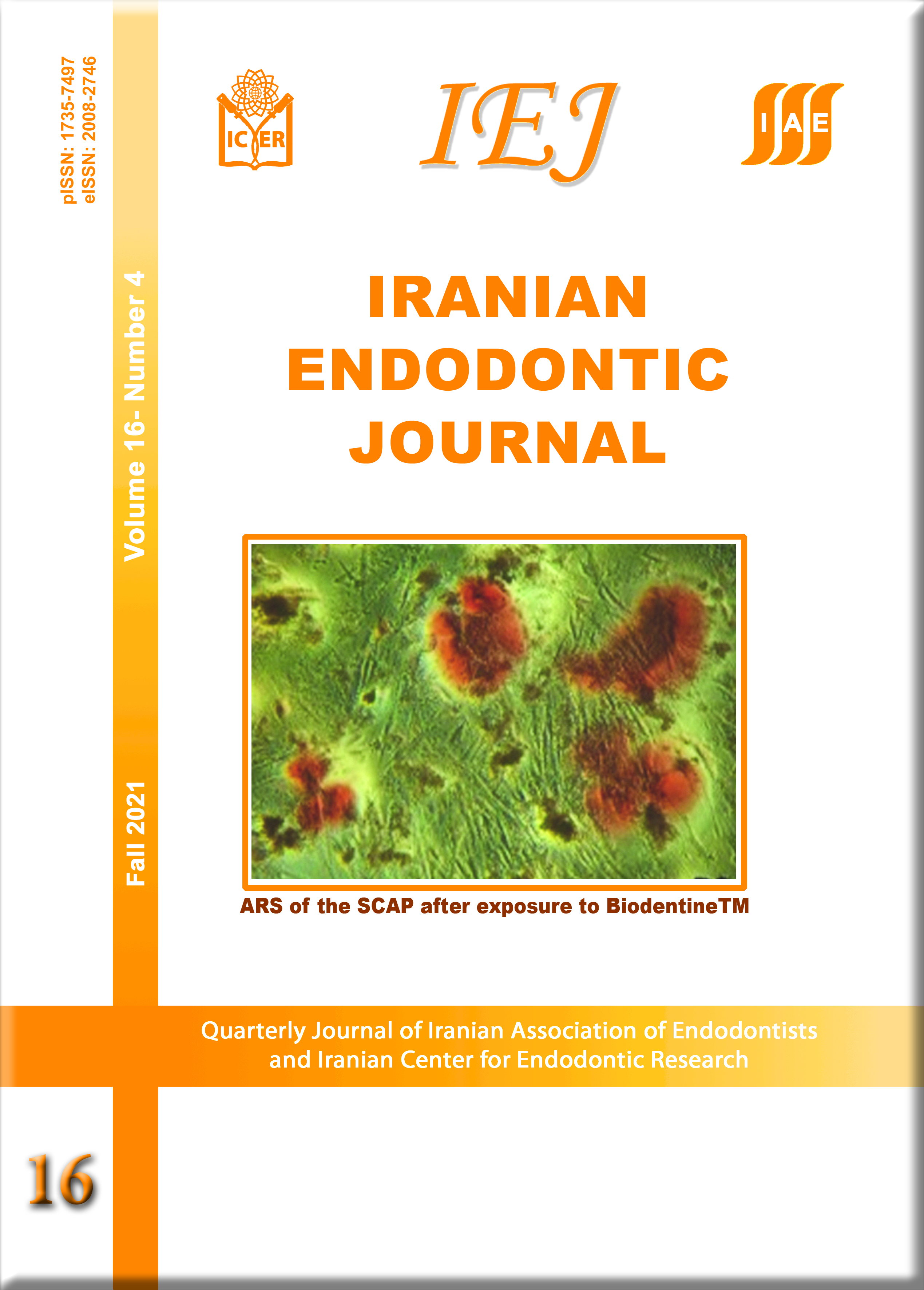
Smear Layer Removal from the Apical Third Using the Er,Cr:YSGG Photon-induced Photoacoustic Streaming
Iranian Endodontic Journal,
Vol. 16 No. 4 (2021),
13 October 2021
,
Page 238-243
https://doi.org/10.22037/iej.v16i4.34544
Abstract
Introduction: The purpose was to study the influence of Erbium,Chromium:Yttrium Scandium Gallium Garnet (Er,Cr:YSGG) laser at short pulse duration on smear layer removal from apical root third. Materials and Methods: Twenty-four single-rooted mandibular premolars were used. The roots length was cut to 14 mm and instrumented using the Protaper Gold system to size 40/0.06. The samples were divided into four groups (n=6) as follows: (A) conventional irrigation with 5 mL of 17% Ethylenediaminetetraacetic acid ( EDTA), (B) passive ultrasonic irrigation with 5mL of 17% EDTA, (C) Er,Cr:YSGG induced photoacoustic streaming (PIPS) with 5 mL of 17% EDTA and (D)Er,Cr: YSGG induced PIPS with 5 mL of 5.25% sodium hypochlorite (NaOCl). After final irrigation with normal saline and drying, the roots were painted with nail varnish externally, and 2%methylene blue dye was injected into the canal. The tooth split horizontally at the fourth millimetres. The picture was taken by a professional Digital SLR camera. The dye penetration was measured using analytical software (measure picture CAD-KAS Kessler Germany). Dunnett's test was used to compare control group against experimental groups. Results: After the statistical test, the highest mean percentage was presented in the laser group with 17% EDTA (Group C=85.9804) followed by the laser group with 5.25% NaOCl (Group D=69.7817) and ultrasonic group (Group B=34.5453) respectively and the lowest mean percentage was in the control group (Group A=20.7969). Conclusion: Based on this in vitro study, PIPS technique using Er,Cr:YSGG pulse laser (0.5 W,5 Hz, air and water off) at short pulse duration and 17% EDTA proved effectively in smear layer removal, while the PIPS proved an acceptable result when the laser is used alone assisted by NaOCl.
- Endodontics; Er,Cr:YSGG Laser; Irrigation; Photoacoustic Effect; Smear Layer; Sodium Hypochlorite
How to Cite
References
(2)Mittal A, Dadu S, Yendrembam B, Abraham A, Singh NS, Garg P. Comparison of new irrigating solutions on smear layer removal and calcium ions chelation from the root canal: an in vitro study. Endodontology. 2018; 30:55–61.
(3)Plotino G, Özyürek T, Grande N.M, Gündoğar M. Influence of size and taper of basic root canal preparation on root canal cleanliness: a scanning electron microscopy study. Int Endo J. 2019; 25(3): 343351.
(4)Dioguardi M, Gioia GD, Illuzzi G, Laneve E, Cocco A, Troiano G. Endodontic irrigants: Different methods to improve efficacy and related problems. Eur J Dent. 2018; 12(3):459–466.
(5)Kamble AB, Abraham S, Kakde DD, Shashidhar C, Mehta DL. Scanning electron microscopic evaluation of efficacy of 17% Ethylenediaminetetraacetic acid and chitosan for smear layer removal with ultrasonic: an in vitro study. Contemp Clin Dent. 2017; 8:621–6.
(6)Topbas C and Adiguzel O. Endodontic Irrigation Solutions: A Review. Int Dent Res 2017; 7:54-61.
(7)Dasilva Beraldo Â, Silva RV, da Gama Antunes AN, Silveira FF, Nunes E. Scanning Electron Microscopic Evaluation of Smear Layer Removal Using Isolated or Interweaving EDTA with Sodium Hypochlorite. Iran Endod J. 2017; 12(1):55-9.
(8)Mazen Doumani ,Adnan Habib, Ahmad Doumani, Mohammad Kinan, Seirawan, Mohamad Alaa Sadeka, Salman Raheem Alnofiai. A Review: The Applications of EDTA in Endodontics (Part I). JDMS. 2017; PP 83-85.
(9)Martin, H., et al., Ultrasonic versus hand filing of dentin: aquantitative study. Oral Surgery, Oral Medicine, Oral Pathology, 1980. 49(1): p. 79-81.
(10)Brugnera, A., et al., Effects of Er: YAG and Nd: YAG laser irradiation on radicular dentine permeability using differentirrigating solutions. Lasers in surgery and medicine, 2003. 33(4): p.256-259.
(11)Paloma Montero-Miralles, Daniel Torres-Lagares, Juan-Jose Segura-Egea, Maria-Ángeles Serrera-Figallo, Jose-Luis Gutierrez-Perez, Gabriel Castillo-Dali, Comparative Study of Debris and Smear Layer Removal With EDTA and Er,Cr:YSGG Laser, J Clin Exp Dent. 2018 Jun 1;10(6):e598-e602. doi: 10.4317/jced.54936.
(12)Grinkevičiūtė, P., Povilaitytė, G. & Siudikienė, J. The Effect Of Laser Irradiation In Smear Layer Removal –A Review Of The Literature. European International Journal of Science and Technology, 2019. 8(3), 72-84.72.
(13)Ayca Yilmaz , Turgut Y. Yalcin , and Dilek Helvacioglu-Yigit, Effectiveness of Various Final Irrigation Techniques on Sealer Penetration in Curved Roots: A Confocal Laser Scanning Microscopy Study, Volume 2020, Article ID 8060489. https://doi.org/10.1155/2020/8060489.
(14) Esteves-Oliveira, M., et al., Comparison of dentin root canal permeability and morphology after irradiation with Nd: YAG, Er:YAG, and diode lasers. Lasers in medical science, 2010. 25(5): p.755-760.
(15) Zmener, O., et al., Significance of moist root canal dentin with the use of methacrylate-based endodontic sealers: an in vitro coronaldye leakage study. Journal of endodontics, 2008. 34(1): p. 76-79.
(16)Cheung, G. and C. Stock, In vitro cleaning ability of root canal irrigants with and without endosonics. International Endodontic Journal, 1993. 26(6): p. 334-343.
(17)Blanken J, De Moor RJ, Meire M, Verdaasdonk R. Laserinduced explosive vapor and cavitation resulting in effective irrigation of the root canal. Part 1: a visualization study. Lasers Surg Med, 2009. 41(7):514–519.
(18)de Groot SD, Verhaagen B, Versluis M, Wu MK, Wesselink PR,van der Sluis LW .Laser activated irrigation within root canals: cleaning efficacy and flow visualization. Int Endod J, 2009.42 (12):1077–1083.
19)Schoop U, Goharkhay K, Klimscha J, Zagler M, Wernisch J,Georgopoulos A, Sperr W, Moritz A. The use of the erbium,chromium:yttrium-scandium-gallium-garnet laser in endodontic treatment: the results of an in vitro study. J Am Dent Assoc, 2007. 138:949–955.
(20)Schoop U, Barylyak A, Goharkhay K, Beer F, Wernisch J,Georgopoulos A, Sperr W, Moritz A . The impact of an erbium,chromium:yttrium-scandium-gallium-garnet laser with radial-firing tips on endodontic treatment. Lasers Med Sci, 2009. 24:59–65.
(21)Gordon W, Atabakhsh VA, Meza F, Doms A, Nissan R, Rizoiu I,Stevens RH .The antimicrobial efficacy of the erbium, chromium:yttrium-scandium-gallium-garnet laser with radial emitting tips on root canal dentin walls infected with Enterococcus faecalis. J Am Dent Assoc, 2007. 138:992–1002.
(22)Hülsmann, M., M. Heckendorff, and A. Lennon, Chelating agents in root canal treatment: mode of action and indications for their use. International Endodontic Journal, 2003. 36(12): p. 810-830.
- Abstract Viewed: 608 times
- PDF Downloaded: 423 times
Download Statastics
Make a Submission
Information
Developed By
Indexing/Abstracting
This journal is indexed in:
- PubMed
- Europe PMC
- Scopus
- SCImago
- MIAR
- CINAHL
- CAS (Chemical Abstracts)
- Dimensions
- DOAJ
- EBSCO
- FATCAT
- Google Scholar
- IMEMR (Index Medicus for the WHO Eastern Mediterranean Region)
- Index Copernicus
- ISC (Islamic World Science Citation Center)
- Magiran
- ROAD
- SID (Scientific Information Database)
- SUDOC
- UC Santa Barbara University
- WIKIDATA
- ZDB


