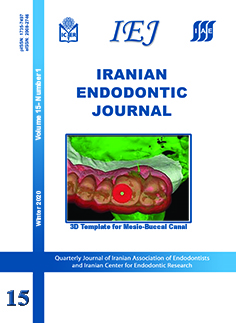
Optimization of Results for Cracked Teeth Using CAD-CAM System: A Case Series
Iranian Endodontic Journal,
Vol. 15 No. 1 (2020),
12 January 2020
,
Page 57-63
https://doi.org/10.22037/iej.v15i1.26731
Abstract
Different restorative techniques have been proposed for the treatment of posterior teeth affected by cracked tooth syndrome (CTS). However, the literature is scarce in protocols of how to solve CTS using ceramic restorations made by computer aided design–computer aided manufacturing (CAD-CAM) system. CAD-CAM provides a fast and efficient restorative treatment usually in a single visit, reducing the risk of contamination and micro-infiltration of the cracked line. The objective of this work was to describe 3 clinical cases of cracked teeth, which presented vertical fracture lines in different directions and extension through the pulp, restored by CAD-CAM system, with 5-year follow-up. Patients with short-term spontaneous masticatory pain, cold sensibility and restored teeth without cuspal coverage were selected. Digital radiographs (DR) were taken to confirm the pulp and periapical status. Periodontal probing depth, sensitivity, percussion, and occlusion tests were performed. The fracture lines with their direction and extension were identified under dental optical microscope (DOM). The treatment plan was performed in two stages: immediate treatment to stabilize the tooth and minimize pain, and final restorative treatment by CAD-CAM system to stabilize the crack. Patients were between the ages of 37 and 45 years. Most of the studied teeth presented extensive restorations without cuspal coverage. The presence of occlusal interference, in lateral movement, was a constant finding. Endodontic treatment was performed in cases of irreversible pulpitis or pulpal necrosis. In all three cases, cavity preparation was performed for full coverage restorations, as the fracture lines extended in several directions, requiring a re-enforcement of the cervical region of the teeth in question. The survival rate of the reported cases was 100% with 5-year clinical and radiographic follow-up, suggesting that CAD-CAM system may be a promising alternative treatment in the management of CTS, improving tooth longevity.
Keywords: CAD-CAM; Cracked Teeth; Cracked Tooth Syndrome; Incomplete Fracture; Prognosis
How to Cite
- Abstract Viewed: 859 times
- PDF Downloaded: 639 times
Download Statastics
Make a Submission
Information
Developed By
Indexing/Abstracting
This journal is indexed in:
- PubMed
- Europe PMC
- Scopus
- SCImago
- MIAR
- CINAHL
- CAS (Chemical Abstracts)
- Dimensions
- DOAJ
- EBSCO
- FATCAT
- Google Scholar
- IMEMR (Index Medicus for the WHO Eastern Mediterranean Region)
- Index Copernicus
- ISC (Islamic World Science Citation Center)
- Magiran
- ROAD
- SID (Scientific Information Database)
- SUDOC
- UC Santa Barbara University
- WIKIDATA
- ZDB


