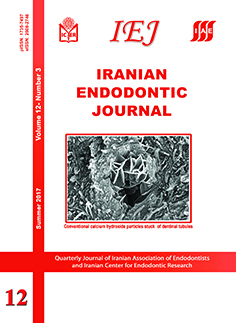
Comparison of the Penetration Depth of Conventional and Nano-Particle Calcium Hydroxide into Dentinal Tubules
Iranian Endodontic Journal,
Vol. 12 No. 3 (2017),
2 July 2017
,
Page 366-370
https://doi.org/10.22037/iej.v12i3.16421
Abstract
Introduction: The aim of this in vitro study was to evaluate and compare the penetration depth of conventional (CH) and nano-particle calcium hydroxide (NCH) into dentinal tubules. Methods and Materials: Ninety human single-rooted teeth were instrumented by RaCe rotary system and after chemomechanical preparation were randomly divided in two equal groups (n=45). In the first group conventional CH and in the other NCH was used as intracanal medicament. After 2 weeks of incubation all roots were intentionally split at longitudinal axis and prepared for scanning electron microscope (SEM) observation. Three zones of each root, coronal, middle and apical were examined under SEM and the maximum penetration depth of the dressing material into dentinal tubules was recorded for each zone. Data were analyzed using the independent sample t test and the level of significance was set at 0.05. Results: In all of the three zones, NCH group had greater penetration depth than CH (P<0.001). In both groups the penetration depth increased from the apical section to the coronal. Conclusion: The depth of penetration of nano-particle calcium hydroxide into the dentinal tubules was significantly higher than that of conventional calcium hydroxide. The lowest penetration depth was observed in apical zone in both groups.
Keywords: Calcium Hydroxide; Dentinal Tubules; Nano Particle; Penetration Depth; Tubular Penetration
How to Cite
- Abstract Viewed: 1366 times
- PDF Downloaded: 1174 times
Download Statastics
Make a Submission
Information
Developed By
Indexing/Abstracting
This journal is indexed in:
- PubMed
- Europe PMC
- Scopus
- SCImago
- MIAR
- CINAHL
- CAS (Chemical Abstracts)
- Dimensions
- DOAJ
- EBSCO
- FATCAT
- Google Scholar
- IMEMR (Index Medicus for the WHO Eastern Mediterranean Region)
- Index Copernicus
- ISC (Islamic World Science Citation Center)
- Magiran
- ROAD
- SID (Scientific Information Database)
- SUDOC
- UC Santa Barbara University
- WIKIDATA
- ZDB


