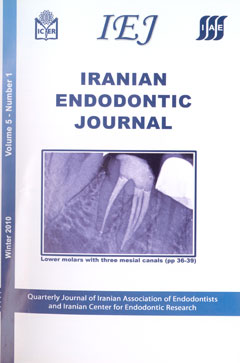
In Vitro Evaluation of the Antibacterial Activity of Three Root Canal Sealers
Iranian Endodontic Journal,
Vol. 5 No. 1 (2010),
1 January 2010
,
Page 1-5
https://doi.org/10.22037/iej.v5i1.1598
Abstract
INTRODUCTION: Antibacterial activity is one of the desirable properties of an ideal sealer. This study aimed to compare the antimicrobial effect of three different sealers, i.e. resin (AH26), calcium hydroxide (Apexit) and zinc oxide eugenol (ZOE) based sealers. MATERIALS AND METHODS: Direct contact test with agar diffusion was used in this in vitro study. The freshly mixed sealers were AH26, Apexit and pure ZOE. They were prepared according to manufacturer’s instruction and placed in prepared wells of 30 agar plates inoculated with Streptococcus (S) mutans and Prevotella (P) melaninogenicus (15 samples for each microorganism). All plates were incubated for 7 days (196 hours) at 37˚C under anaerobic conditions, and zones of inhibition were measured after 3 days, 5 days and 7 days. The data were analyzed using Kruskal-Wallis and Friedman tests. RESULTS: In all determined intervals, the antibacterial activity of AH26 was significantly greater than other test materials (P<0.001). ZOE sealer had moderate effect on test microorganisms, whilst Apexit showed the lowest antibacterial activity on S. Mutans and no antibacterial activity on P. melaninogenicus. CONCLUSION: The ascending sequence of bacterial growth inhibition zones was as AH26>Pure ZOE>Apexit.
- AH26
- Antibacterial Activity
- Apexit
- Endodontic Sealers
- ZOE Sealer
How to Cite
- Abstract Viewed: 339 times
- PDF Downloaded: 338 times
Download Statastics
Make a Submission
Information
Developed By
Indexing/Abstracting
This journal is indexed in:
- PubMed
- Europe PMC
- Scopus
- SCImago
- MIAR
- CINAHL
- CAS (Chemical Abstracts)
- Dimensions
- DOAJ
- EBSCO
- FATCAT
- Google Scholar
- IMEMR (Index Medicus for the WHO Eastern Mediterranean Region)
- Index Copernicus
- ISC (Islamic World Science Citation Center)
- Magiran
- ROAD
- SID (Scientific Information Database)
- SUDOC
- UC Santa Barbara University
- WIKIDATA
- ZDB


