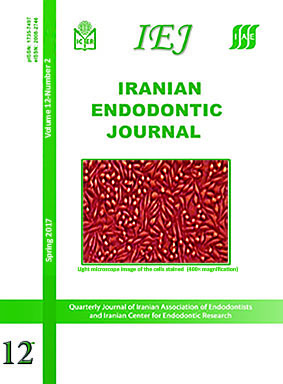
Comparative Antimicrobial Efficacy of Eucalyptus Galbie and Myrtus Communis L. Extracts, Chlorhexidine and Sodium Hypochlorite against Enterococcus Faecalis
Iranian Endodontic Journal,
Vol. 12 No. 2 (2017),
28 March 2017
,
Page 205-210
https://doi.org/10.22037/iej.v12i2.15291
Abstract
Introduction: The aim of this study was to evaluate the antimicrobial effect of Eucalyptus galbie and Myrtus communis L. methanolic extracts, chlorhexidine (CHX) and sodium hypochlorite (NaOCl) on Enterococcus faecalis (E. faecalis) as the predominant species isolated from infected root canals. Methods and Materials: One hundred twenty mandibular premolars were randomly divided into 8 groups: Eucalyptus galbie (E. galbie) 12.5 mg/mL, Myrtus communis L. (M. communis L.) 6.25 mg/mL, 0.2% CHX, %2 CHX, 2.5% NaOCl, 5.25% NaOCl, positive and negative control group. Sampling was performed using paper points (from the root canal space lumen) and Gates-Glidden drills (from the dentinal tubules); then colony forming units (CFU) were counted and analyzed using the Kruskal-Wallis test, followed by Mann Whitney U test. The level of significance was set at 0.05. Results: All irrigants reduced more than 99% of bacteria in root canal. In the presence of M. communis L. and E. galbie, the bacterial count in dentin were significantly more than CHX and NaOCl groups (P<0.05) except 0.2% CHX in 200 µm and 400 µm depths (P>0.05). Conclusion: Although 5.25% NaOCl was the most effective irrigant, all agents exerted acceptable antimicrobial activity against E. faecalis.
Keywords: Antibacterial Agent; Eucalyptus; Myrtus; Root Canal Therapy
How to Cite
- Abstract Viewed: 356 times
- PDF Downloaded: 300 times
Download Statastics
Make a Submission
Information
Developed By
Indexing/Abstracting
This journal is indexed in:
- PubMed
- Europe PMC
- Scopus
- SCImago
- MIAR
- CINAHL
- CAS (Chemical Abstracts)
- Dimensions
- DOAJ
- EBSCO
- FATCAT
- Google Scholar
- IMEMR (Index Medicus for the WHO Eastern Mediterranean Region)
- Index Copernicus
- ISC (Islamic World Science Citation Center)
- Magiran
- ROAD
- SID (Scientific Information Database)
- SUDOC
- UC Santa Barbara University
- WIKIDATA
- ZDB


