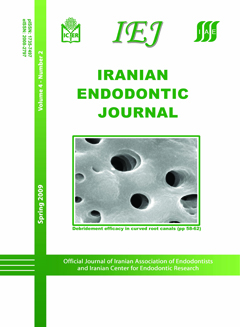
Efficacy of MTAD, Glyde and EDTA in debridement of curved root canals
Iranian Endodontic Journal,
Vol. 4 No. 2 (2009),
17 April 2009
,
Page 58-62
https://doi.org/10.22037/iej.v4i2.1350
Abstract
INTRODUCTION: This study aimed to compare the efficacy of MTAD, Glyde and EDTA in removing the post-preparation smear layer and debris produced in apical third of curved molar root canals. MATERIALS AND METHODS: Forty extracted human maxillary first molars with curved mesiobuccal canals (30˚-35˚), similar root lengths and morphologies were divided into 3 experimental groups (n=12) and one control group (n=4). Canals were prepared by RaCe rotary files and were treated with the following materials between each two files: Group A (control group); 5 mL of distilled water, Group B; 1 mL of 17% ethylenediamine tetra-acetic acid (EDTA) for 1 min, Group C; BioPureä MTAD (according to the manufacturer’s instruction; 5mL for 5 min), and Group D; Glyde File Prep alternated with sodium hypochlorite (NaOCl) between each two files. Debridement of the apical third was evaluated using scanning electron microscope (SEM) (×5000). The data were statistically analyzed using the Kruskal-Wallis and Mann-Whitney U tests (P<0.05). RESULTS: Statistical analysis of the data showed that MTAD and 17% EDTA were effective in removing smear layer and debris from the apical thirds. MTAD was more effective than EDTA in smear layer removal. Glyde did not adequately debride curved root canals of molar teeth. CONCLUSION: MTAD and 17% EDTA were effective in debriding the apical third of curved molar root canals during endodontic treatment, whereas Glyde File Prep does not provide adequate debridement.
- Debris
- EDTA
- Glyde
- MTAD
- Smear layer.
How to Cite
- Abstract Viewed: 368 times
- PDF Downloaded: 331 times
Download Statastics
Make a Submission
Information
Developed By
Indexing/Abstracting
This journal is indexed in:
- PubMed
- Europe PMC
- Scopus
- SCImago
- MIAR
- CINAHL
- CAS (Chemical Abstracts)
- Dimensions
- DOAJ
- EBSCO
- FATCAT
- Google Scholar
- IMEMR (Index Medicus for the WHO Eastern Mediterranean Region)
- Index Copernicus
- ISC (Islamic World Science Citation Center)
- Magiran
- ROAD
- SID (Scientific Information Database)
- SUDOC
- UC Santa Barbara University
- WIKIDATA
- ZDB


